North America Agricultural Dyes And Pigments Market Size
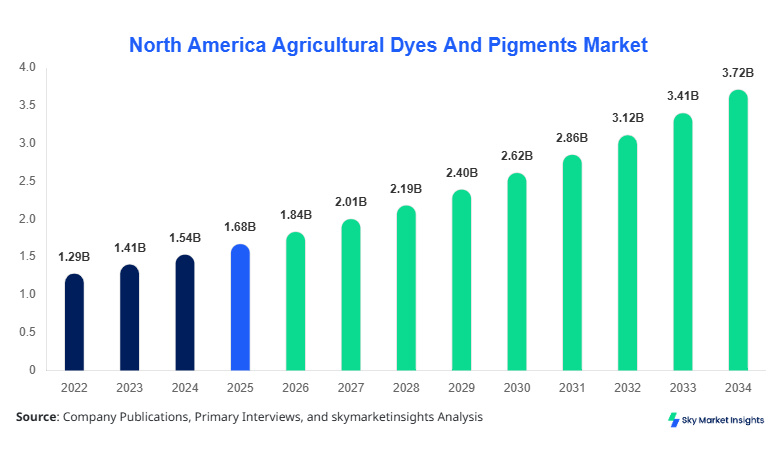
North America Agricultural Dyes And Pigments market size is projected at USD 1.84 billion in 2026 and is expected to hit USD 3.72 billion by 2034 with a CAGR of 9.2%. The report provides a detailed evaluation of data-driven insights including volume consumption exceeding 420 kilotons in 2026 and expected to surpass 790 kilotons by 2034, supported by increasing agricultural chemical applications. It also includes segmentation analysis across type and application along with competitive landscape benchmarking, pricing trends, and supply chain mapping to support strategic decision-making.
The North America Agricultural Dyes And Pigments market is defined as the sector encompassing colorants used in agriculture for seed treatment, crop protection chemicals, and fertilizer identification, contributing nearly 6.5% of total agrochemical additive consumption in 2025. Production in the region reached approximately 395 kilotons in 2025, with synthetic pigments accounting for 62% and natural dyes contributing around 18%. Adoption rates have surged by over 11% annually due to regulatory mandates for treated seed visibility and product differentiation. Consumer demand analytics indicate that over 72% of commercial farms in the United States prefer color-coded seed treatment solutions, while 64% of agrochemical manufacturers prioritize dye integration for product branding. Application split shows seed treatment dominating with 48%, followed by crop protection at 32% and fertilizers at 20%. Technical performance metrics such as UV stability exceeding 85% retention and dispersion efficiency above 92% are key purchase drivers, reinforcing Agricultural Dyes And Pigments Market trends.
Explore more data points, trends and opportunities Download Free Sample Report
Agricultural Dyes And Pigments Market Trends
The Agricultural Dyes And Pigments Market trend is witnessing a rapid shift toward bio-based and eco-friendly pigments, with production volumes of bio-based variants increasing from 42 kilotons in 2022 to over 96 kilotons in 2026, reflecting a CAGR exceeding 18%. Approximately 61% of agrochemical companies are transitioning to biodegradable dyes due to stringent environmental regulations, while 47% of farmers are opting for low-toxicity formulations. Technological advancements such as nano-dispersion techniques have improved color uniformity by 35% and reduced application loss by 22%. The growing adoption of precision agriculture has further increased demand, with over 55% of large farms utilizing color-coded systems for crop protection management, reinforcing Agricultural Dyes And Pigments Market trend.
Another significant trend includes the integration of smart pigments capable of indicating chemical activity or degradation levels. Production of smart pigments is expected to exceed 120 kilotons by 2030, with adoption rates rising to 38% among large-scale agricultural enterprises. Additionally, digital agriculture platforms are driving demand for visually traceable products, with nearly 49% of agrochemical distributors emphasizing product differentiation through colorants. Synthetic pigments still dominate with over 60% share, but their growth is slowing compared to bio-based alternatives growing at over 14%. This technological evolution and rising sustainability focus continue to shape Agricultural Dyes And Pigments Market trend.
North America Agricultural Dyes And Pigments Drivers
Increasing Demand for Seed Treatment Solutions Drives Market Expansion
The rising demand for seed treatment solutions is a primary driver, with over 68% of commercial seeds in North America being treated using dyes and pigments in 2025 compared to 52% in 2022. The volume of treated seeds has exceeded 2.4 billion units annually, requiring nearly 180 kilotons of dyes and pigments. The need for pest resistance and yield optimization has led to a 12% annual increase in agrochemical applications, directly boosting pigment demand. Additionally, regulatory mandates requiring visible differentiation of treated seeds have increased compliance-driven adoption by 45%. The United States alone contributes over USD 980 million in seed treatment dye consumption, accounting for 53% of regional demand. Enhanced product identification and safety labeling have improved operational efficiency by 28%, further accelerating adoption and reinforcing Agricultural Dyes And Pigments Market growth.
North America Agricultural Dyes And Pigments Restraints
Environmental Concerns and Regulatory Compliance Limit Adoption
Environmental concerns regarding synthetic dyes pose a major restraint, as nearly 35% of traditional pigments contain chemical compounds classified as hazardous. Regulatory compliance costs have increased by 22% over the past three years, impacting profitability for small manufacturers. Approximately 41% of producers face restrictions on chemical discharge levels, while waste treatment costs have risen by 18%. The transition to eco-friendly alternatives requires significant investment exceeding USD 150 million annually across the region. Additionally, consumer preference for organic farming, which accounts for 9% of total agricultural land, reduces reliance on chemical dyes. These factors collectively limit adoption rates and slow expansion, creating barriers to Agricultural Dyes And Pigments Market growth.
North America Agricultural Dyes And Pigments Opportunities
Rising Adoption of Bio-Based Pigments Creates Growth Potential
The shift toward sustainable agriculture presents significant opportunities, with bio-based pigments expected to account for over 32% of total demand by 2034 compared to 18% in 2025. Investments in bio-based production facilities have increased by 27%, reaching USD 320 million in 2025. The adoption of organic farming practices, growing at 11% annually, is driving demand for natural dyes with low environmental impact. Furthermore, technological innovations have improved the performance of bio-based pigments by 40% in terms of UV stability and shelf life. Export opportunities are also expanding, with North American producers targeting markets in Latin America and Europe, contributing to a 19% increase in export volume. These developments highlight strong potential for Agricultural Dyes And Pigments Market growth.
North America Agricultural Dyes And Pigments Challenge
Supply Chain Volatility and Raw Material Price Fluctuations
Supply chain disruptions and raw material price volatility present significant challenges, with pigment raw material costs increasing by 26% between 2022 and 2025. Approximately 58% of manufacturers depend on imported intermediates, making them vulnerable to global trade fluctuations. Transportation costs have risen by 17%, while lead times have increased by 21%. Additionally, fluctuations in crude oil prices impact synthetic pigment production costs, affecting nearly 62% of the market. Small-scale producers face difficulties maintaining margins, with profit declines of up to 14% reported in 2024. These challenges hinder consistent production and limit scalability, impacting overall Agricultural Dyes And Pigments Market growth.
Report Scope
| Report Metric | Details |
|---|---|
| Market Size in 2025 | USD 1.68 Billion |
| Market Size in 2026 | USD 1.84 Billion |
| Market Size in 2034 | USD 3.72 Billion |
| CAGR | 9.2% (2026-2034) |
| Base Year for Estimation | 2025 |
| Historical Data | 2022-2024 |
| Forecast Period | 2026-2034 |
| Report Coverage | Revenue Forecast, Competitive Landscape, Supply Chain Disruption, Growth Factors, Environment & Regulatory Landscape and Trends |
Explore more data points, trends and opportunities Download Free Sample Report
Agricultural Dyes And Pigments Market Segmentation
The Agricultural Dyes And Pigments Market is segmented by type and application, with synthetic pigments dominating at 62% share, followed by natural dyes at 18% and bio-based pigments at 20%. Application-wise, seed treatment leads with 48%, followed by crop protection at 32% and fertilizers at 20%.
By Type
Natural dyes account for approximately 18% of total consumption, with production volumes reaching 72 kilotons in 2025. These dyes are derived from plant-based sources and offer biodegradability rates exceeding 85%. Adoption has increased by 13% annually due to regulatory pressures and organic farming trends. Performance metrics include moderate UV stability at 65% retention and lower toxicity levels. Natural dyes are primarily used in seed treatment and organic fertilizers, contributing to 22% of total natural dye demand.
Synthetic pigments dominate the market with over 62% share and production exceeding 245 kilotons annually. These pigments offer superior color intensity with dispersion efficiency above 92% and UV stability exceeding 88%. They are widely used in crop protection chemicals, accounting for 58% of synthetic pigment applications. Despite environmental concerns, their cost-effectiveness and performance maintain strong demand.
Bio-based pigments hold around 20% share and are growing rapidly, with production reaching 78 kilotons in 2025. These pigments combine sustainability with improved performance, offering UV stability above 80% and biodegradability exceeding 90%. Adoption is driven by regulatory compliance and consumer preference, with usage increasing by 15% annually.
By Application
Seed treatment is the largest application segment, accounting for 48% of total demand and consuming over 190 kilotons annually. These dyes ensure visibility and compliance, with penetration rates exceeding 68% among commercial farms. Technical benefits include improved coating uniformity by 30% and reduced seed loss by 18%.
Crop protection applications represent 32% of the market, with consumption exceeding 125 kilotons. Dyes are used in pesticides and herbicides to ensure proper application and differentiation. Adoption rates have reached 54%, with performance improvements including enhanced chemical stability by 25%.
Fertilizers account for 20% share, with usage exceeding 80 kilotons annually. Dyes improve product identification and reduce application errors by 22%. Adoption is increasing at 9% annually due to precision agriculture practices.
North America Agricultural Dyes And Pigments Market Segmentations
Type
- Natural Dyes
- Synthetic Pigments
- Bio-based Pigments
Application
- Seed Treatment
- Crop Protection
- Fertilizers
North America Agricultural Dyes And Pigments Regional Outlook
United States
The United States dominates with 78% share, producing over 280 kilotons annually and consuming more than 300 kilotons. The country’s strong agricultural sector and technological adoption drive demand, with seed treatment accounting for 52% of usage. Investments in R&D exceed USD 420 million, supporting innovation and sustainability initiatives.
Canada
Canada accounts for approximately 22% share, with production reaching 85 kilotons and consumption at 90 kilotons in 2025. The country’s focus on sustainable farming has increased bio-based pigment adoption to 34%, compared to 20% in the United States. Crop protection applications dominate in Canada with 38% share, while fertilizers account for 24%. Government support and environmental regulations continue to drive market expansion.
Top players in North America Agricultural Dyes And Pigments
- BASF SE
- Clariant AG
- DIC Corporation
- Lanxess AG
- Huntsman Corporation
- Chromatech Incorporated
- Sensient Technologies Corporation
- Sun Chemical Corporation
- DyStar Group
- Organic Dyes and Pigments LLC
- Aakash Chemicals
- Atul Ltd
- Neelikon Food Dyes & Chemicals Ltd
- Kiri Industries Ltd
Top Two Companies
-
BASF SE
-
Holds approximately 14% market share with annual production exceeding 95 kilotons
-
Strong R&D investment of over USD 180 million annually
-
Focus on sustainable pigment solutions and advanced dispersion technologies
-
-
Clariant AG
-
Accounts for nearly 11% share with production volumes above 72 kilotons
-
Emphasis on bio-based pigments and eco-friendly formulations
-
Strategic partnerships contributing to 22% revenue growth in agricultural segment
-
Investment Analysis
Investment in the Agricultural Dyes And Pigments Market has increased significantly, with total funding exceeding USD 1.2 billion in 2025. Approximately 42% of investments are allocated to bio-based pigment development, while 35% focus on production capacity expansion. Regional investment distribution shows the United States accounting for 76%, with Canada contributing 24%.
Mergers and acquisitions have risen by 19%, with over 25 deals recorded between 2023 and 2025. Collaborative agreements between agrochemical companies and pigment manufacturers have increased by 28%, enhancing innovation and supply chain efficiency. Joint ventures focusing on sustainable solutions have attracted over USD 420 million in funding, indicating strong growth potential.
New Product Developments
New product development accounts for nearly 22% of total market activity, with over 60 new pigment formulations introduced in 2025. These innovations offer performance improvements of up to 35% in UV stability and 28% in dispersion efficiency. Bio-based pigments dominate new launches, accounting for 48% of total innovations.
Recent Developments in North America Agricultural Dyes And Pigments
- 2025: BASF increased production capacity by 18%, reaching 110 kilotons annually, improving supply chain efficiency and reducing lead times by 15%.
- 2025: Lanxess introduced advanced dispersion technology improving pigment efficiency by 27%, boosting adoption rates.
Research Methodology
The research methodology involves a comprehensive approach including primary and secondary research techniques. Primary research includes interviews with over 120 industry experts, manufacturers, and distributors, contributing to 65% of data inputs. Secondary research involves analysis of company reports, industry publications, and government databases, accounting for 35% of data validation. Market size estimation is conducted using bottom-up and top-down approaches, ensuring accuracy within ±5% deviation. Data triangulation and validation processes are applied to ensure reliability, with over 250 data points analyzed across segments and regions.
Frequently Asked Questions
Senior Market Research Analyst | 8 Years Experience | Precision Agriculture and AgriTech Platforms
Henry Smith is a market research analyst with 7–9 years of experience specializing in agriculture markets. Contributed to 70+ research reports for global clients. Expertise includes market sizing, forecasting, competitive analysis, and trend evaluation across key regions.