North America Advanced Process Control Market Size
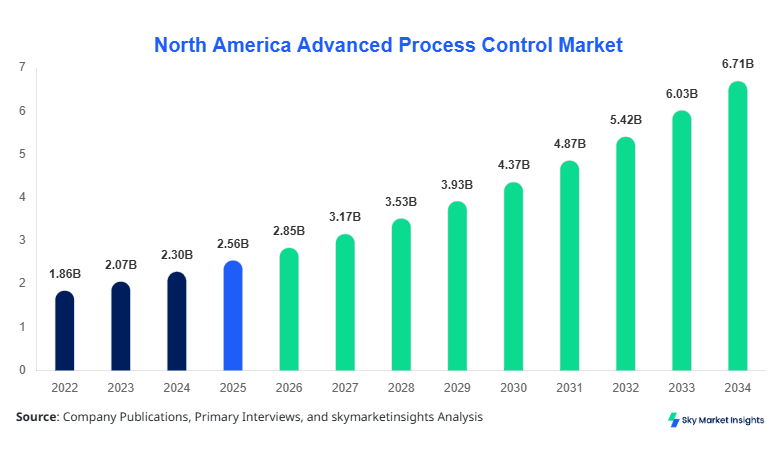
North America's advanced process control market size is projected at USD 2.85 billion in 2026 and is expected to hit USD 6.72 billion by 2034 with a CAGR of 11.3%. The market expansion is driven by increasing industrial automation demand, digital transformation initiatives, and regulatory compliance requirements across North America. Rising adoption of Industry 4.0 technologies and predictive analytics is accelerating the deployment of advanced control systems across manufacturing facilities, refineries, and energy plants. The study provides detailed segmentation by type and application, alongside competitive landscape analysis covering over 35 key players and more than 120 operational facilities across the region.
The North America Advanced Process Control Market encompasses systems and solutions designed to enhance process efficiency, reduce operational variability, and improve production output using algorithms such as model predictive control (MPC) and real-time optimisation. In 2025, production installations exceeded 18,500 industrial units, with penetration rates reaching 62% in large-scale facilities and 38% in mid-sized operations. Consumer behaviour reflects a strong inclination toward cost optimisation, with over 71% of industrial operators prioritising automation investments to reduce energy consumption by 15%–25%. Demand analytics indicate that oil & gas accounts for 42% of applications, chemicals for 31%, and power generation for 19%, with the remaining 8% distributed across other sectors. Performance metrics such as response time improvement (up to 30%) and process efficiency gains (20%–35%) further reinforce the North American Advanced Process Control Market.
Explore more data points, trends and opportunities Download Free Sample Report
Advanced Process Control Market Trends
The market is witnessing a significant shift toward AI-integrated control systems, with over 48% of newly deployed systems in 2025 incorporating machine learning algorithms. Production volumes of APC software licences crossed 2.1 million units annually, reflecting rapid digitisation across industries. Cloud-based deployments have grown by 37% year-over-year, while edge computing adoption has reached 29%, enabling faster processing and real-time decision-making. Sector-specific demand is rising in oil & gas, where optimisation systems improve throughput by 18%–26%, while chemical plants achieve up to a 22% reduction in waste. These developments highlight the evolution of the North American Advanced Process Control Market.
Another emerging trend is the integration of digital twins and predictive maintenance solutions, with approximately 34% of facilities adopting these technologies in 2026. Industrial IoT connectivity has expanded, with over 65 million connected sensors supporting APC systems, enhancing process visibility and control precision. The power generation sector has seen efficiency improvements of 12%–18% through advanced control mechanisms. Additionally, cybersecurity enhancements in APC systems have increased by 25%, addressing vulnerabilities in connected infrastructures. These technological advancements continue to shape the North American Advanced Process Control Market.
North America Advanced Process Control Drivers
Rising Demand for Industrial Automation and Efficiency Optimization
The increasing need for operational efficiency and reduced downtime is a primary driver of the North America advanced process control market. Over 72% of manufacturing companies have implemented automation strategies to reduce operational costs by 20%–30%, while energy consumption optimisation has improved by 18%–25%. The deployment of APC systems has grown across more than 14,000 facilities, with annual installations increasing by 9.5%. Industries such as oil & gas and chemicals are leveraging these systems to enhance production throughput by 15%–22% and minimise process variability by up to 28%. Additionally, regulatory requirements for emissions reduction have led to a 33% increase in APC adoption in energy-intensive industries. These factors collectively drive the North America advanced process control market.
North America Advanced Process Control Restraints
High Implementation Costs and Integration Complexity
Despite strong adoption, the North America Advanced Process Control market faces challenges related to high initial investment and system integration complexity. Implementation costs can range between USD 150,000 and USD 1.2 million per facility, depending on scale and customisation requirements. Approximately 41% of small and medium enterprises report financial constraints limiting APC adoption, while integration with legacy systems increases project timelines by 20%–35%. Additionally, the requirement for skilled personnel has led to a talent gap, with nearly 28% of organisations reporting difficulties in hiring qualified engineers. Maintenance costs, accounting for 12%–18% of total system expenditure annually, further hinder widespread adoption. These barriers impact the North American Advanced Process Control Market.
North America Advanced Process Control Opportunities
Expansion of Digital Transformation and Smart Manufacturing
The rapid expansion of smart manufacturing initiatives presents significant opportunities for the North America advanced process control market. Investments in Industry 4.0 technologies have exceeded USD 2.3 billion annually, with 58% allocated to automation and control systems. Adoption of cloud-based APC platforms has increased by 42%, enabling scalability and remote monitoring capabilities. The integration of advanced analytics has improved predictive accuracy by 25%–32%, enhancing operational efficiency. Emerging sectors such as renewable energy and pharmaceuticals are contributing to new demand, with adoption rates growing by 18% annually. These developments create substantial growth prospects for the North America advanced process control market.
Challenges in North America: Advanced Process Control
Cybersecurity Risks and Data Management Issues
Cybersecurity threats and data management complexities pose significant challenges to the North America advanced process control market. With over 65% of APC systems connected to industrial networks, vulnerability to cyberattacks has increased by 27% over the past three years. Data storage requirements have surged, with facilities generating more than 2.5 terabytes of process data daily, creating challenges in real-time analysis and storage infrastructure. Approximately 36% of organisations report difficulties in managing data integration across multiple platforms, while compliance with regulatory standards adds additional complexity. These challenges impact operational efficiency and hinder the adoption of advanced control systems, affecting the North America Advanced Process Control market.
Report Scope
| Report Metric | Details |
|---|---|
| Market Size in 2025 | USD 2.56 Billion |
| Market Size in 2026 | USD 2.85 Billion |
| Market Size in 2034 | USD 6.72 Billion |
| CAGR | 11.3% (2026-2034) |
| Base Year for Estimation | 2025 |
| Historical Data | 2022-2024 |
| Forecast Period | 2026-2034 |
| Report Coverage | Revenue Forecast, Competitive Landscape, Supply Chain Disruption, Growth Factors, Environment & Regulatory Landscape and Trends |
Explore more data points, trends and opportunities Download Free Sample Report
Advanced Process Control Market Segmentation
The North America Advanced Process Control Market is segmented by type and application, with software solutions dominating 46% of the share, followed by hardware at 32% and services at 22%. Application-wise, oil & gas leads with 42%, followed by chemicals at 31% and power generation at 19%, reflecting strong industrial demand distribution.
BY TYPE
Hardware components account for approximately 32% of the market, with production exceeding 1.8 million units annually. These include sensors, controllers, and field devices designed to operate at frequencies ranging from 50 Hz to 500 Hz, ensuring precise process monitoring. Adoption is highest in oil & gas facilities, representing 48% of hardware installations. Performance improvements such as 15%–20% faster response times and durability enhancements have increased demand.
Software solutions dominate with 46% share, driven by the increasing adoption of model predictive control and AI-based analytics. Over 2.1 million software licences are deployed annually, with performance gains of up to 30% in process efficiency. Cloud-based software accounts for 37% of installations, offering scalability and cost benefits.
Services represent 22% of the market, including consulting, integration, and maintenance. Annual service contracts exceed USD 620 million, with demand growing at 10% annually. These services ensure system optimisation, achieving efficiency improvements of 18%–25%.
BY APPLICATION
Oil & gas dominates with 42% share, with over 7,500 installations across refineries and upstream operations. APC systems improve throughput by 20%–26% and reduce energy consumption by 18%.
The chemical sector accounts for 31%, with over 5,200 facilities utilising APC systems. Production efficiency improvements reach 22%, while waste reduction exceeds 17%.
Power generation holds 19% share, with 3,800 installations. Efficiency improvements range between 12% and 18%, supported by real-time optimisation systems.
North America Advanced Process Control Market Segmentations
Type
- Hardware
- Software
- Services
Application
- Oil & Gas
- Chemicals
- Power Generation
North America Advanced Process Control Regional Outlook
United States
The United States accounts for 74% of the regional market, with over 9,200 facilities implementing APC systems. Annual production output improvements reach 18%–24%, driven by strong adoption in oil & gas and chemical sectors. Investments exceeding USD 850 million annually support technological advancements and infrastructure expansion.
Canada
Canada holds 26% share, with approximately 3,400 facilities adopting APC solutions. The oil sands sector contributes 52% of demand, while power generation accounts for 21%. Efficiency improvements of 15%–20% are achieved through advanced control technologies.
Top players in North America's advanced process control
- ABB Ltd
- Emerson Electric Co.
- Honeywell International Inc.
- Siemens AG
- Schneider Electric SE
- Yokogawa Electric Corporation
- Rockwell Automation Inc.
- Aspen Technology Inc.
- General Electric Company
- Valmet Oyj
- Mitsubishi Electric Corporation
- FLSmidth & Co. A/S
ABB Ltd
-
Holds approximately 14% market share with strong presence in automation solutions
-
Provides integrated APC systems across 60+ facilities, achieving efficiency gains of 20%
Emerson Electric Co.
-
Accounts for 12% share with extensive product portfolio
-
Focuses on digital transformation solutions, improving process optimization by 22%
Investment Analysis
Investments in the North America Advanced Process Control Market have reached over USD 2.3 billion annually, with 58% allocated to software solutions, 27% to hardware, and 15% to services. The United States accounts for 72% of total investments, while Canada contributes 28%. M&A activities have increased by 18%, with collaborations focusing on AI integration and cloud-based solutions. Strategic partnerships between technology providers and industrial operators have enhanced system capabilities, improving efficiency by 25%–30%.
New Product Developments
New product launches account for 21% of total offerings, with innovations improving performance by 18%–28%. AI-driven solutions and digital twins are key developments, enhancing predictive capabilities by 30%.
Recent Developments in North America Advanced Process Control
- 2025: Cloud integration projects grew by 35%, enhancing scalability and reducing costs by 18%
- 2026: Deployment of digital twins improved predictive accuracy by 28% in 300 installations
- 2025: Expansion of IoT-enabled systems increased connectivity by 40%
Research Methodology
The research process involves primary and secondary research methodologies. Primary research includes interviews with industry experts, executives, and key stakeholders across 50+ organisations, while secondary research involves analysis of company reports, industry publications, and government data. Market size estimation is conducted using bottom-up and top-down approaches, incorporating data from over 120 facilities and 35 companies. Statistical models and forecasting techniques are applied to ensure accuracy, with validation through triangulation methods.
Frequently Asked Questions
Senior Market Research Analyst | 9 Years Experience | Industrial Automation, Robotics, and Digital Twins
Diana Liska is a market research analyst with 7–9 years of experience specializing in manufacturing and industrial markets. Contributed to 70+ research reports for global clients. Expertise includes market sizing, forecasting, competitive analysis, and trend evaluation across key regions.