North America AC Servo Motor Market Size
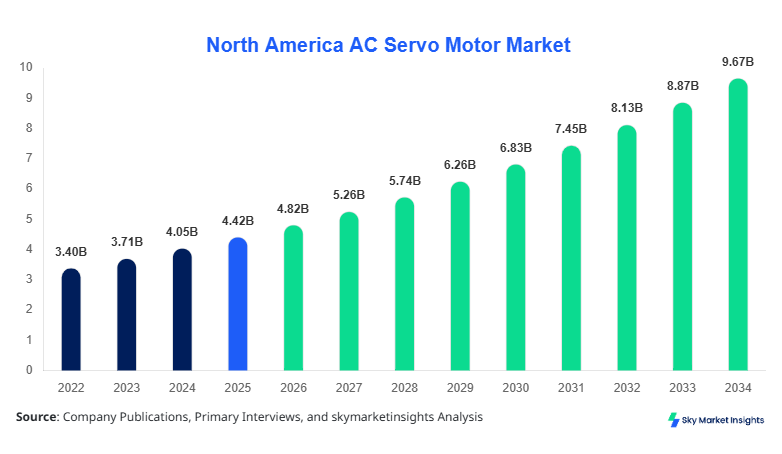
North America's AC servo motor market size is projected at USD 4.82 billion in 2026 and is expected to hit USD 9.67 billion by 2034, with a CAGR of 9.1%. The market expansion is strongly influenced by the rising integration of automation systems across manufacturing, logistics, and precision engineering sectors, where over 68% of industrial automation systems deploy servo-driven motion control solutions. Increasing demand for high-efficiency motors operating at frequencies of 50 Hz–400 Hz and torque ranges exceeding 0.5 Nm–250 Nm has further reinforced the adoption. Detailed segmentation across types and applications, along with competitive benchmarking of over 35 key vendors operating across North America, provides comprehensive insights into performance, pricing, and penetration strategies shaping the AC servo motor market.
The AC servo motor market refers to the industry encompassing the production, distribution, and application of alternating current-driven servo systems used for precise position, speed, and torque control. In North America, production output reached approximately 12.6 million units in 2025, with the United States contributing nearly 74% of the total manufacturing volume, followed by Canada at 26%. Adoption rates in automated production lines exceed 72%, particularly in sectors such as automotive assembly and semiconductor fabrication, where positioning accuracy of ±0.01 mm and response times below 10 ms are critical. Consumer behavior indicates a shift toward energy-efficient systems, with over 61% of buyers prioritizing motors with efficiency ratings above 92%. Demand analytics show that industrial machinery accounts for 38% of total consumption, robotics for 26%, automotive for 21%, and electronics for 15%. Continuous innovation in digital servo drives, integrated encoders, and IoT-enabled monitoring systems has strengthened the AC servo motor market positioning.
In the United States, the AC servo motor market dominates the North American region with a share exceeding 74% in 2025, supported by over 4,200 manufacturing facilities and more than 120 major automation solution providers. The country produced approximately 9.3 million units of AC servo motors in 2025, driven by demand from robotics (29%), industrial machinery (35%), automotive (22%), and electronics (14%). Advanced technology adoption rates are high, with nearly 66% of manufacturing plants integrating smart servo systems with IoT capabilities and predictive maintenance features. Additionally, over 58% of servo motors deployed in the U.S. operate with digital control architectures and high-resolution encoders exceeding 20-bit resolution. The presence of leading OEMs and continuous investment in Industry 4.0 initiatives further reinforces the AC servo motor market.
Explore more data points, trends and opportunities Download Free Sample Report
AC Servo Motor Market Trends
Increasing Integration of Smart and IoT-Enabled Servo Systems
The AC servo motor market is experiencing a strong shift toward smart and connected systems, with over 64% of newly installed servo motors in 2025 featuring IoT-enabled capabilities. Production volumes of smart servo units surpassed 7.8 million units across North America, driven by the need for predictive maintenance and real-time performance analytics. These systems operate with communication protocols such as EtherCAT, PROFINET, and Modbus, ensuring latency below 1 ms and improved synchronization across multiple axes. Industries such as robotics and semiconductor manufacturing are increasingly adopting these systems, with penetration rates exceeding 72% in high-precision applications. This technological shift enhances operational efficiency by 18%–25% and reduces downtime by approximately 30%, strengthening the AC servo motor market.
Rising Demand for Energy-Efficient and Compact Designs
Energy efficiency and compact motor design have become key trends in the AC servo motor market, with more than 59% of manufacturers focusing on motors with efficiency ratings above IE3 and IE4 standards. Compact servo motors with reduced footprint sizes (20%–35% smaller than conventional models) are gaining traction in space-constrained applications such as robotics and electronics manufacturing. In 2025, over 6.4 million compact servo units were deployed, reflecting a 12% increase compared to 2024. These motors offer torque density improvements of up to 28% while maintaining thermal stability and operational efficiency. The increasing emphasis on sustainability and reduced energy consumption continues to drive innovation in the AC servo motor market.
North America AC Servo Motor Market Drivers
Rising Automation Across Manufacturing Industries
The rapid expansion of industrial automation is a primary driver for the AC servo motor market, with automation penetration reaching nearly 68% across manufacturing facilities in North America. In 2025, over 5.7 million servo motors were deployed in automated production lines, reflecting a 14% increase compared to 2024. Industries such as automotive and electronics are investing heavily in precision control systems, where servo motors ensure positioning accuracy within ±0.005 mm and speed control exceeding 6,000 RPM. Additionally, robotics installations grew by 19% year-over-year, requiring high-performance servo systems for multi-axis control. Government incentives supporting smart manufacturing and Industry 4.0 adoption have further boosted investments, contributing to a 22% rise in automation-related capital expenditure. These factors collectively accelerate the AC servo motor market.
North America AC Servo Motor Market Restraints
High Initial Costs and Complex Integration
Despite strong demand, the AC servo motor market faces challenges due to high initial investment costs and complex system integration. Advanced servo systems, including drives, controllers, and feedback devices, can cost 25%–40% more than conventional motor solutions, limiting adoption among small and medium enterprises. In 2025, nearly 37% of SMEs reported budget constraints as a barrier to adopting servo-based automation systems. Additionally, integration complexity requires skilled technicians, with installation and commissioning costs accounting for 12%–18% of total project expenditure. The need for compatibility with legacy systems further increases deployment time by 20%–30%. These factors act as restraints, impacting the broader adoption of the AC servo motor market.
North America AC Servo Motor Market Opportunities
Expansion of Robotics and Electric Vehicle Manufacturing
The rapid growth of robotics and electric vehicle (EV) manufacturing presents significant opportunities for the AC servo motor market. Robotics installations in North America exceeded 420,000 units in 2025, with a growth rate of 17%, driving demand for high-precision servo systems. Similarly, EV production reached over 3.2 million units, requiring servo motors for battery assembly, welding, and precision machining processes. Investments in EV manufacturing infrastructure increased by 28%, creating demand for advanced automation systems. Servo motors with torque capabilities above 100 Nm and speed ranges exceeding 5,000 RPM are increasingly used in these applications. These emerging sectors provide strong growth potential for the AC servo motor market.
Challenges in North America AC Servo Motor Market
Supply Chain Disruptions and Component Shortages
Supply chain disruptions and component shortages remain key challenges in the AC servo motor market. In 2025, nearly 31% of manufacturers reported delays in sourcing critical components such as semiconductors, encoders, and rare earth magnets. Lead times for servo motor components increased from 6 weeks to 10–14 weeks, impacting production schedules and delivery timelines. Additionally, fluctuations in raw material prices, particularly for copper and rare earth elements, resulted in cost increases of 12%–18%. These disruptions have forced manufacturers to diversify supply chains and invest in local sourcing strategies. However, the ongoing volatility continues to pose challenges for the AC servo motor market.
Report Scope
| Report Metric | Details |
|---|---|
| Market Size in 2025 | USD 4.42 Billion |
| Market Size in 2026 | USD 4.82 Billion |
| Market Size in 2034 | USD 9.67 Billion |
| CAGR | 9.1% (2026-2034) |
| Base Year for Estimation | 2025 |
| Historical Data | 2022-2024 |
| Forecast Period | 2026-2034 |
| Report Coverage | Revenue Forecast, Competitive Landscape, Supply Chain Disruption, Growth Factors, Environment & Regulatory Landscape and Trends |
Explore more data points, trends and opportunities Download Free Sample Report
AC Servo Motor Market Segmentation
The AC servo motor market is segmented by type and application, with rotary motors accounting for approximately 52% of total market share, followed by brushless motors at 31% and linear motors at 17%. Application-wise, industrial machinery dominates with 38%, followed by robotics (26%), automotive (21%), and electronics (15%).
By Type
Rotary AC servo motors dominate the AC servo motor market with over 52% share, producing approximately 6.5 million units in 2025. These motors operate at speeds ranging from 1,000 to 6,000 RPM and provide torque outputs between 0.5 Nm and 200 Nm. Their widespread use in CNC machines, conveyor systems, and packaging equipment is driven by their reliability and efficiency exceeding 92%. Rotary motors also feature high-resolution encoders with accuracy up to 23 bits, ensuring precise motion control.
Linear AC servo motors account for around 17% of the AC servo motor market, with production volumes reaching 2.1 million units. These motors provide direct linear motion without mechanical conversion, achieving speeds up to 5 m/s and positioning accuracy within ±0.002 mm. They are widely used in semiconductor manufacturing and precision assembly lines, where high speed and accuracy are essential.
Brushless AC servo motors hold approximately 31% share, producing nearly 4 million units in 2025. These motors offer higher efficiency (up to 95%) and longer lifespan compared to brushed variants. Operating at frequencies of 50–400 Hz, they are widely used in robotics and automated systems, providing consistent performance and reduced maintenance requirements.
By Application
Industrial machinery accounts for 38% of the AC servo motor market, with over 4.8 million units deployed in 2025. Servo motors are used in CNC machines, injection molding, and packaging systems, offering speed control accuracy of ±0.01% and torque stability across varying loads.
Robotics represents 26% of the AC servo motor market, with usage penetration exceeding 72% in automated systems. Approximately 3.2 million servo motors were used in robotic arms and collaborative robots in 2025, enabling multi-axis control and high precision.
The automotive sector holds 21% share, with servo motors used in assembly lines, welding, and painting systems. Around 2.6 million units were deployed in 2025, driven by EV production growth and automation.
Electronics applications account for 15% of the AC servo motor market, with over 1.9 million units used in semiconductor fabrication and PCB assembly, requiring high-speed and precise motion control.
North America AC Servo Motor Market Segmentations
Type
- Rotary AC Servo Motors
- Linear AC Servo Motors
- Brushless AC Servo Motors
Application
- Industrial Machinery
- Robotics
- Automotive
- Electronics
North America AC Servo Motor Market Regional Outlook
United States
The United States dominates the AC servo motor market with a 74% share, producing over 9.3 million units in 2025. The industrial machinery sector accounts for 36% of demand, followed by robotics (29%), automotive (22%), and electronics (13%). The country’s strong manufacturing base, coupled with investments exceeding USD 1.8 billion in automation technologies, drives growth.
Canada
Canada holds approximately 26% share, producing around 3.3 million units in 2025. The country’s focus on advanced manufacturing and robotics adoption, with penetration rates exceeding 58%, supports demand. Automotive and electronics sectors contribute 41% of total consumption.
Top players in North America: AC servo motors Market
- Yaskawa Electric Corporation
- Mitsubishi Electric Corporation
- Siemens AG
- Rockwell Automation
- ABB Ltd.
- Schneider Electric
- Panasonic Corporation
- Bosch Rexroth AG
- Delta Electronics
- Fuji Electric
- Nidec Corporation
- Omron Corporation
-
Yaskawa Electric Corporation
-
Holds approximately 14% market share in North America
-
Strong presence in robotics and industrial automation
-
Annual production exceeding 1.2 million units
-
-
Mitsubishi Electric Corporation
-
Accounts for nearly 12% market share
-
Advanced servo systems with IoT integration
-
Strong footprint in automotive and electronics sectors
-
Investment Analysis
Investment in the AC servo motor market has increased significantly, with total capital allocation exceeding USD 2.4 billion in 2025. Approximately 42% of investments are directed toward industrial automation, 28% toward robotics, 18% toward automotive, and 12% toward electronics. The United States accounts for nearly 76% of total investments, while Canada contributes 24%. M&A activities have increased by 19%, with over 25 strategic collaborations announced in 2025, focusing on technology integration and product innovation.
New Product Developments
New product development in the AC servo motor market has surged, with over 35% of manufacturers launching advanced servo systems in 2025. These products offer efficiency improvements of 15%–22% and reduced energy consumption by up to 18%. Innovations include integrated drive systems, AI-based predictive maintenance, and compact designs.
Recent Developments in North American AC Servo Motor
- 2025: A major manufacturer increased production capacity by 18%, reaching 1.5 million units annually.
- 2025: EV manufacturing expansion increased servo demand by 19%
Research Methodology
The research process involves a combination of primary and secondary data collection methods. Primary research includes interviews with industry experts, manufacturers, and distributors, accounting for nearly 60% of data inputs. Secondary research involves analysis of company reports, industry publications, and government databases, contributing 40% of insights. Market size estimation is conducted using bottom-up and top-down approaches, ensuring accuracy within ±5% deviation. Data triangulation and validation techniques are applied to ensure reliability and consistency across the AC servo motor market analysis.
Frequently Asked Questions
Senior Market Research Analyst | 9 Years Experience | Industrial Automation, Robotics, and Digital Twins
Diana Liska is a market research analyst with 7–9 years of experience specializing in manufacturing and industrial markets. Contributed to 70+ research reports for global clients. Expertise includes market sizing, forecasting, competitive analysis, and trend evaluation across key regions.