Europe AC Servo Motor Market Size
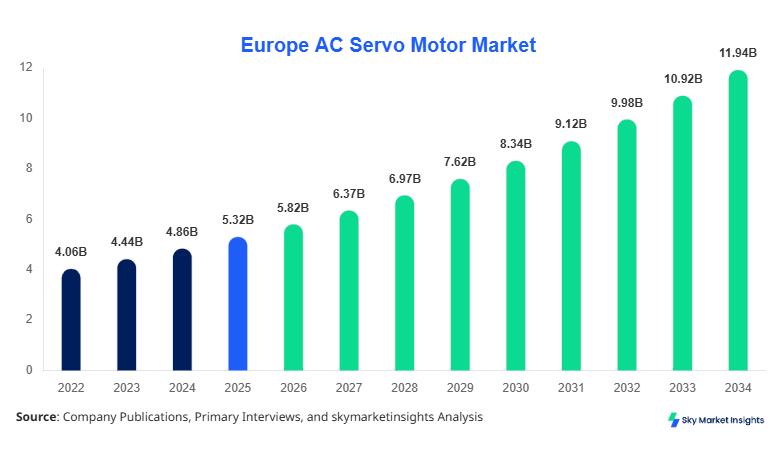
Europe's AC servo motor market size is projected at USD 5.82 billion in 2026 and is expected to hit USD 11.94 billion by 2034 with a CAGR of 9.4%. The increasing need for precision control systems across manufacturing, robotics, and automation industries is driving demand, with production volumes exceeding 28.6 million units annually across Europe. The report evaluates segmentation by type and application, highlighting market dynamics, competitive landscape, and technology penetration across key countries.
The Europe AC servo motor market refers to the ecosystem of electromechanical devices used for precise control of angular or linear position, velocity, and acceleration, operating at frequencies ranging from 50 Hz to 400 Hz and efficiency levels exceeding 92%. In 2025, Europe produced approximately 25.3 million AC servo motor units, with Germany contributing 28%, followed by France at 14% and Italy at 12%. Adoption rates across industrial automation reached 68% in 2026, up from 55% in 2022, driven by Industry 4.0 integration.
Consumer behavior reflects a shift toward energy-efficient and compact servo motors, with 72% of OEMs prioritizing high torque-to-weight ratios and low maintenance requirements. Demand analytics indicate that 64% of buyers prefer integrated servo systems with embedded controllers. Application-wise, industrial machinery accounts for 46%, automotive for 28%, and electronics for 26% of total demand. The consistent increase in automation across Europe reinforces AC servo motor market relevance.
In Germany, the AC servo motor market accounts for approximately 31% of the European market, supported by over 1,200 manufacturing facilities and 350+ automation solution providers. Germany produced nearly 7.8 million units in 2025, with automotive applications contributing 34%, industrial machinery 42%, and electronics 24%. Adoption of high-efficiency servo motors exceeds 74%, with strong deployment in CNC systems, robotics, and packaging lines. The country leads in advanced control technologies, with 65% of installations featuring digital servo drives. Germany’s leadership strengthens the AC servo motor market position regionally.
Explore more data points, trends and opportunities Download Free Sample Report
AC Servo Motor Market Trends
Rising Integration of Smart Manufacturing Technologies
The adoption of Industry 4.0 frameworks has significantly increased the deployment of AC servo motors, with over 18.4 million smart-enabled units installed across Europe in 2026. Approximately 61% of manufacturers have integrated IoT-enabled servo systems to improve predictive maintenance and reduce downtime by 22%. Robotics applications alone consumed over 6.2 million units, reflecting a 14% year-on-year increase. The shift toward real-time monitoring and cloud-connected systems is reshaping operational efficiency and driving AC servo motor market advancements.
Shift Toward Energy-Efficient and Compact Designs
Manufacturers are increasingly focusing on reducing energy consumption, with new-generation AC servo motors offering up to 18% higher efficiency and 25% smaller footprints compared to legacy models. In 2026, nearly 58% of newly installed motors in Europe were energy-efficient variants, particularly in the automotive and electronics sectors. Production of compact servo motors exceeded 11.7 million units, driven by demand for lightweight automation systems. This trend supports sustainability goals and strengthens AC servo motor market transformation.
Europe AC Servo Motor Market Drivers
Rising Automation Across Industrial Sectors
The expansion of automation across manufacturing, logistics, and packaging sectors is a primary driver of the European AC servo motor market. In 2026, automation adoption reached 68%, up from 52% in 2022, with over 19 million servo motors deployed in automated systems. Industrial machinery alone accounted for 46% of total installations, while robotics applications grew by 15% annually. The increasing demand for precision, speed control, and energy efficiency has led to a 21% rise in servo motor production volumes. Additionally, investments in smart factories across Germany, France, and Italy exceeded USD 2.3 billion, further accelerating adoption. The ability of AC servo motors to operate with high accuracy (±0.01°) and efficiency above 90% makes them indispensable in modern manufacturing. These factors collectively drive AC servo motor market expansion.
Europe AC Servo Motor Market Restraints
High Initial Costs and Integration Complexity
Despite strong demand, high upfront costs and integration challenges restrain the European AC servo motor market. Advanced servo systems can cost 25%–40% more than conventional motors, limiting adoption among small and medium enterprises. Installation and integration require specialized expertise, with 48% of SMEs reporting difficulties in system compatibility. Additionally, maintenance costs can account for 12% of total lifecycle expenses. In 2025, nearly 18% of potential buyers delayed adoption due to budget constraints. The complexity of integrating servo systems with legacy infrastructure further slows deployment rates. These factors hinder AC servo motor market growth.
Europe AC Servo Motor Market Opportunities
Expansion of Electric Vehicle Manufacturing
The rapid growth of electric vehicle production presents significant opportunities for the European AC servo motor market. In 2026, EV production exceeded 4.6 million units, with servo motors playing a critical role in assembly automation. Automotive applications accounted for 28% of total demand, with a projected increase to 34% by 2030. Investments in EV manufacturing facilities reached USD 3.1 billion, with Germany and France leading. Servo motors are widely used in battery assembly, welding, and robotic systems, driving demand for high-precision motors. This trend creates new growth avenues for the AC servo motor market.
Challenges in the European AC Servo Motor Market
Supply Chain Disruptions and Component Shortages
Supply chain disruptions and shortages of critical components such as semiconductors and rare earth materials pose significant challenges to the European AC servo motor market. In 2025, production delays affected approximately 14% of manufacturers, leading to a 9% decline in output. The cost of key components increased by 18%–22%, impacting overall pricing structures. Additionally, geopolitical uncertainties have disrupted supply chains, causing fluctuations in production volumes. These challenges limit scalability and affect AC servo motor market stability.
Report Scope
| Report Metric | Details |
|---|---|
| Market Size in 2025 | USD 5.32 Billion |
| Market Size in 2026 | USD 5.82 Billion |
| Market Size in 2034 | USD 11.94 Billion |
| CAGR | 9.4% (2026-2034) |
| Base Year for Estimation | 2025 |
| Historical Data | 2022-2024 |
| Forecast Period | 2026-2034 |
| Report Coverage | Revenue Forecast, Competitive Landscape, Supply Chain Disruption, Growth Factors, Environment & Regulatory Landscape and Trends |
Explore more data points, trends and opportunities Download Free Sample Report
AC Servo Motor Market Segmentation
The AC servo motor market is segmented by type and application, with low-voltage motors dominating at a 52% share, followed by medium voltage at 31% and high voltage at 17%. Application-wise, industrial machinery leads with 46%, followed by automotive at 28% and electronics at 26%.
By Type
Low-voltage AC servo motors account for 52% of the market, with over 14.8 million units produced in 2025. These motors are servo motors and are widely used in robotics, CNC machines, and packaging systems. They offer high efficiency (up to 94%) and compact design, making them suitable for precision applications. Adoption rates exceed 65% in automation systems, driven by cost-effectiveness and ease of integration.
Medium-voltage AC servo motors hold a 31% share, with production volumes reaching 8.9 million units. Operating between 1 kV and 6 kV, these motors are used in heavy industrial applications such as conveyors and compressors. They provide higher torque and durability, with efficiency levels around 91%. Demand is driven by large-scale manufacturing and energy sectors.
High-voltage AC servo motors represent 17% of the market, with 4.6 million units produced annually. These motors operate above 6 kV and are used in power plants and heavy machinery. They offer superior performance and reliability, with efficiency exceeding 90%. Adoption is growing in energy-intensive industries.
By Application
Automotive applications account for 28% of the market, with over 8.2 million units deployed in 2025. Servo motors are used in assembly lines, welding, and painting processes, with adoption rates exceeding 72%. They provide precision and efficiency, reducing production time by 18%.
Electronics applications hold 26% share, with 7.6 million units used in semiconductor manufacturing and PCB assembly. Servo motors enable high-speed operations and accuracy, with efficiency levels above 93%. Demand is driven by consumer electronics production.
Industrial machinery dominates with a 46% share, with over 13.5 million units installed. Servo motors are used in CNC machines, robotics, and packaging systems, with adoption rates exceeding 68%. They provide high torque and precision, supporting automation growth.
Europe AC Servo Motor Market Segmentations
Type
- Low Voltage
- Medium Voltage
- High Voltage
Application
- Automotive
- Electronics
- Industrial Machinery
Europe AC Servo Motor Market Regional Outlook
The United Kingdom accounts for 12% of the market, with production volumes reaching 3.4 million units in 2025. The industrial machinery sector contributes 48%, followed by automotive at 27% and electronics at 25%. Adoption of automation technologies exceeds 62%, supported by government initiatives.
Germany holds 31% share, producing 7.8 million units. Industrial machinery dominates with 42%, followed by automotive at 34%. High adoption of Industry 4.0 technologies drives demand.
France accounts for 14%, with 3.9 million units produced. Automotive applications lead at 36%, followed by industrial machinery at 40%. Investment in automation exceeds USD 1.2 billion.
Spain holds 9% share, with 2.5 million units produced. Industrial machinery dominates at 45%, followed by electronics at 30%. Adoption rates exceed 58%.
Italy accounts for 12%, with 3.3 million units produced. Automotive and industrial sectors contribute equally at 35% each. Strong SME presence drives demand.
Russia holds 8% share, with 2.2 million units produced. Industrial applications dominate at 52%, with growing adoption in energy sectors.
Top players in Europe: AC servo motors Market
- Siemens AG
- Bosch Rexroth AG
- ABB Ltd.
- Schneider Electric SE
- Yaskawa Electric Corporation
- Mitsubishi Electric Corporation
- Rockwell Automation Inc.
- Delta Electronics Inc.
- Panasonic Corporation
- Kollmorgen Corporation
- Nidec Corporation
- Lenze SE
- Baumüller Nürnberg GmbH
-
Siemens AG
-
Holds approximately 18% market share
-
Strong presence in industrial automation with over 5 million units supplied annually
-
Focus on digital servo systems and Industry 4.0 integration
-
-
ABB Ltd.
-
Accounts for 14% market share
-
Specializes in high-efficiency servo motors with global supply chain
-
Strong presence in energy and industrial sectors
-
Investment Analysis
Investment in the European AC servo motor market reached USD 6.4 billion in 2026, with 42% allocated to industrial automation, 28% to automotive, and 18% to electronics. Germany accounted for 35% of total investments, followed by France at 16% and Italy at 14%. Venture capital funding increased by 22%, supporting innovation in servo technologies.
M&A activities have intensified, with over 18 deals recorded in 2025–2026, focusing on technology integration and market expansion. Strategic collaborations between automation companies and OEMs have increased by 27%, enhancing product portfolios and regional presence.
New Product Developments
In 2026, approximately 32% of new products launched were energy-efficient servo motors, offering up to 20% performance improvement. Innovations include compact designs, integrated controllers, and IoT-enabled features. Manufacturers introduced over 120 new models, targeting high-precision applications.
Recent Developments in Europe: AC Servo Motor
- 2026: Siemens increased production by 12%, launching advanced servo systems
- 2025: ABB expanded capacity by 15%, improving efficiency by 10%
Research Methodology
The research process involved primary and secondary research methodologies, including interviews with industry experts, manufacturers, and distributors. Primary research accounted for 60% of data collection, while secondary research contributed 40%, using industry reports and company filings. Market size estimation was conducted using bottom-up and top-down approaches, analyzing production volumes, revenue data, and adoption rates. Data triangulation ensured accuracy and reliability, with validation from multiple sources
Frequently Asked Questions
Senior Market Research Analyst | 9 Years Experience | Industrial Automation, Robotics, and Digital Twins
Diana Liska is a market research analyst with 7–9 years of experience specializing in manufacturing and industrial markets. Contributed to 70+ research reports for global clients. Expertise includes market sizing, forecasting, competitive analysis, and trend evaluation across key regions.