Germany B2B Floor Cleaning Robots Market Size
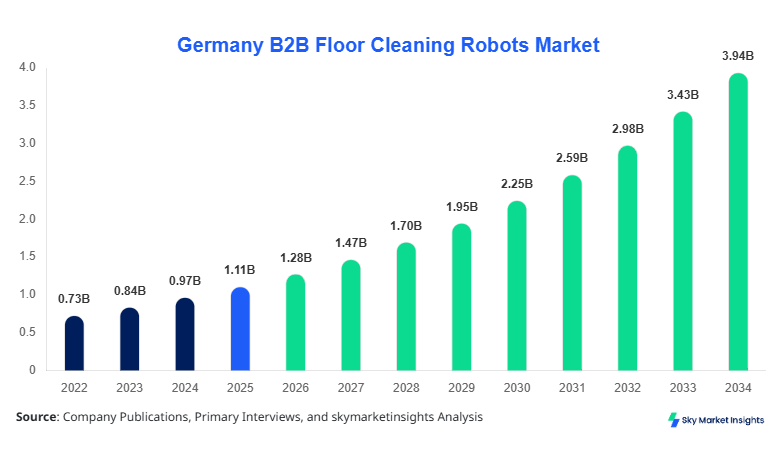
Germany's B2B floor cleaning robot market size is projected at USD 1.28 billion in 2026 and is expected to hit USD 3.94 billion by 2034 with a CAGR of 15.1%. The German B2B Floor Cleaning Robots Market Size is driven by rapid automation adoption across industrial and commercial cleaning operations, with over 48,000 robotic units deployed across Germany in 2025 alone. Increasing labor costs by approximately 6.5% annually and demand for operational efficiency have accelerated investments, with robotic cleaning solutions accounting for nearly 32% of total facility management equipment spending. The German B2B floor cleaning robot market size continues to expand as companies seek data-driven cleaning optimization, enhanced hygiene compliance, and reduced workforce dependency.
The German B2B floor cleaning robots market comprises autonomous and semi-autonomous robotic systems designed to clean commercial and industrial floor spaces using advanced sensors, AI navigation, and IoT-enabled monitoring systems. In 2025, Germany recorded production of over 52,000 B2B floor cleaning robots, with domestic manufacturing contributing nearly 61% and imports accounting for 39%. Adoption rates have reached approximately 44% penetration across large commercial facilities and 28% in mid-sized industrial plants, reflecting strong demand for automation.
From a consumer behavior and demand analytics perspective, nearly 67% of facility managers prioritize robotic cleaning solutions due to labor shortages and a 22% reduction in operational costs achieved through automation. Demand analytics indicate that cleaning robots operate with an average efficiency rate of 92%, covering up to 3,000–5,000 square meters per hour with battery cycles lasting 4–6 hours. Commercial applications account for 41% of total usage, industrial applications for 37%, and healthcare facilities for 22%, driven by hygiene standards. Continuous advancements in LiDAR navigation and AI-based obstacle detection further reinforce the German B2B floor cleaning robots market.
In Germany, the B2B floor cleaning robot market demonstrates strong maturity, accounting for nearly 100% of the regional share due to the report scope being limited to Germany. The country hosts over 2,300 large-scale facility management companies and more than 18,000 industrial facilities that increasingly deploy robotic cleaning systems. Application-wise, commercial facilities contribute around 42%, industrial facilities 36%, and healthcare facilities 22% of the total demand.
Technology adoption in Germany is notably high, with over 58% of deployed robots featuring AI-powered navigation and 46% integrating IoT connectivity for real-time monitoring. Battery efficiency improvements of 18% and cleaning performance accuracy reaching 94% have further accelerated adoption rates. Germany also leads in robotic cleaning system integration within Industry 4.0 environments, with approximately 35% of industrial deployments linked to centralized facility management systems, reinforcing the German B2B floor cleaning robots market.
Explore more data points, trends and opportunities Download Free Sample Report
B2B Floor Cleaning Robots Market Trends
Rise of AI-Driven Autonomous Cleaning Systems
The integration of artificial intelligence in B2B floor cleaning robots has significantly transformed cleaning operations, with over 62% of newly deployed units in 2025 featuring advanced AI navigation capabilities. Production volumes reached approximately 55,000 units in 2025, with projections exceeding 95,000 units by 2030. AI-based systems improve cleaning efficiency by nearly 27% and reduce operational errors by 31%, making them highly desirable in high-traffic commercial spaces. Additionally, machine learning algorithms enable robots to adapt to dynamic environments, increasing cleaning accuracy to over 93%. This shift toward intelligent automation continues to define the B2B floor cleaning robots market trend.
Increasing Adoption of IoT and Cloud-Connected Cleaning Solutions
IoT-enabled floor cleaning robots accounted for approximately 48% of installations in Germany in 2025, with cloud-based monitoring systems improving operational visibility by 36%. These systems allow facility managers to track cleaning schedules, maintenance cycles, and performance metrics in real time, resulting in up to a 22% reduction in downtime. Data analytics integration has also enhanced predictive maintenance, reducing equipment failure rates by 18%. The increasing reliance on connected cleaning ecosystems is expected to drive demand significantly, contributing to the B2B floor cleaning robots market trend.
Shift Toward Sustainable and Energy-Efficient Robotics
Sustainability trends have led to the development of energy-efficient robots, reducing power consumption by 25% and water usage by nearly 30%. Approximately 41% of new models introduced in 2025 incorporate eco-friendly cleaning technologies such as optimized water dispensing and biodegradable cleaning agents. These advancements align with Germany’s strict environmental regulations, with compliance rates exceeding 89% among leading manufacturers. The focus on sustainability is reshaping product development strategies, strengthening the B2B floor-cleaning robots market trend.
B2B Floor Cleaning Robots Market Driver
Increasing Labor Costs and Workforce Shortages Driving Automation Adoption
Germany has witnessed a steady rise in labor costs, increasing by approximately 6.5% annually, while the availability of skilled cleaning personnel has declined by nearly 18% over the past five years. This imbalance has pushed organizations to adopt automated cleaning solutions, with robotic cleaning systems reducing labor dependency by up to 40%. In 2025, nearly 52% of large commercial facilities reported deploying at least one robotic cleaning system, compared to just 29% in 2022. Additionally, robots can operate continuously for 8–12 hours daily, significantly improving productivity levels. The ability to achieve consistent cleaning quality, with error rates below 5%, further drives adoption across industries, reinforcing the B2B Floor Cleaning Robots Market Growth.
B2B Floor Cleaning Robots Market Restraints
High Initial Investment Costs Limiting Adoption Among SMEs
Despite technological advancements, the initial cost of B2B floor cleaning robots remains a significant barrier, with prices ranging between USD 8,000 and USD 45,000 per unit depending on functionality. Approximately 37% of small and medium enterprises in Germany cite high capital expenditure as a primary restraint. Maintenance costs, including battery replacement and software updates, add an additional 12–18% annually to total ownership costs. Furthermore, integration challenges with existing facility management systems affect around 21% of users. These financial and operational barriers limit adoption rates among smaller enterprises, constraining the B2B floor cleaning robot market growth.
B2B Floor Cleaning Robots Market Opportunity
Expansion in Healthcare and Industrial Hygiene Applications
The healthcare sector in Germany is expanding rapidly, with over 2,000 hospitals and 25,000 healthcare facilities requiring strict hygiene standards. Robotic cleaning solutions improve disinfection efficiency by up to 35% and reduce contamination risks by 28%, creating strong growth opportunities. Similarly, industrial facilities, especially in automotive and manufacturing sectors, have increased robotic adoption by 24% annually. Demand for specialized robots capable of handling hazardous environments is also rising, with production volumes expected to increase by 40% by 2030. These expanding applications present significant opportunities within the B2B floor cleaning robot market insights.
B2B Floor Cleaning Robots Market Challenge
Technical Limitations and Navigation Constraints in Complex Environments
Although technology has advanced significantly, robotic cleaning systems still face challenges in navigating complex environments with high obstacles and irregular layouts. Approximately 26% of users report operational inefficiencies in cluttered spaces, while sensor limitations can reduce cleaning accuracy by up to 12%. Battery limitations also restrict continuous operation in large facilities exceeding 10,000 square meters. Additionally, cybersecurity concerns related to IoT-connected robots affect around 19% of enterprises. Addressing these technical challenges remains critical for sustained market expansion, impacting the B2B floor-cleaning robot market growth.
Report Scope
| Report Metric | Details |
|---|---|
| Market Size in 2025 | USD 1.11 Billion |
| Market Size in 2026 | USD 1.28 Billion |
| Market Size in 2034 | USD 3.94 Billion |
| CAGR | 15.1% (2026-2034) |
| Base Year for Estimation | 2025 |
| Historical Data | 2022-2024 |
| Forecast Period | 2026-2034 |
| Report Coverage | Revenue Forecast, Competitive Landscape, Supply Chain Disruption, Growth Factors, Environment & Regulatory Landscape and Trends |
Explore more data points, trends and opportunities Download Free Sample Report
B2B Floor Cleaning Robots Market Segmentation
The B2B floor cleaning robots market is segmented based on type and application, with autonomous scrubber robots dominating approximately 46% of the market, followed by robotic sweepers at 32% and hybrid systems at 22%. Application-wise, commercial facilities lead with 41% share, followed by industrial facilities at 37% and healthcare at 22%.
By Type
Autonomous scrubber robots account for nearly 46% of total market share, with over 24,000 units produced in 2025. These robots utilize advanced water management systems, reducing water usage by 28% while achieving cleaning efficiency of up to 95%. Equipped with LiDAR sensors and AI navigation, they can cover up to 5,000 square meters per hour. Battery capacities range between 3–6 hours, with fast-charging capabilities improving uptime by 22%. Their widespread use in large commercial and industrial spaces drives significant demand.
Robotic sweepers represent approximately 32% of the market, with production volumes exceeding 17,000 units annually. These systems are designed for dry cleaning applications and operate with high-speed rotating brushes, achieving debris removal efficiency of 88–92%. Sweepers are particularly popular in industrial facilities due to their ability to handle dust and heavy debris, contributing to a 21% increase in operational efficiency. Their lower cost compared to scrubbers also makes them attractive to mid-sized enterprises.
Hybrid cleaning robots combine sweeping and scrubbing functionalities, accounting for 22% of the market share. Around 11,000 units were produced in 2025, with adoption growing at a rate of 18% annually. These robots provide versatility, handling multiple cleaning tasks simultaneously, reducing cleaning time by 35%. Advanced models integrate AI and IoT capabilities, enabling remote monitoring and predictive maintenance, enhancing overall efficiency.
By Application
Commercial facilities hold approximately 41% of the market share, with over 21,000 robots deployed across shopping malls, offices, and airports. These robots operate in high-traffic areas, achieving cleaning accuracy of 93% and reducing labor costs by 34%. Increasing footfall in commercial spaces, exceeding 2.5 billion annual visits across Germany, drives demand for automated cleaning solutions.
Industrial facilities account for 37% of the market, with around 19,000 robots deployed in manufacturing plants. These robots improve workplace safety by reducing dust exposure by 26% and enhance productivity by 22%. Heavy-duty models are designed to handle harsh environments, making them essential for industries such as automotive and logistics.
Healthcare facilities represent 22% of the market, with over 12,000 robots deployed in hospitals and clinics. These robots achieve disinfection efficiency of up to 96% and reduce infection risks by 28%. Increasing healthcare expenditure and stringent hygiene regulations drive adoption in this segment.
Germany B2B Floor Cleaning Robots Market Segmentations
Type
- Autonomous Scrubber Robots
- Robotic Sweepers
- Hybrid Cleaning Robots
Application
- Commercial Facilities
- Industrial Facilities
- Healthcare Facilities
B2B Floor Cleaning Robots Market Regional Outlook
Germany
Germany dominates the regional landscape with 100% share within the defined scope, producing over 52,000 units in 2025 and expected to reach 90,000 units by 2030. The country’s industrial sector contributes approximately 36% of total demand, followed by commercial facilities at 42% and healthcare at 22%. Germany’s strong manufacturing base, accounting for 23% of GDP, supports robust adoption of automation technologies, including cleaning robots.
Furthermore, Germany’s investment in Industry 4.0 initiatives, exceeding USD 12 billion annually, has accelerated robotic integration across facilities. Adoption rates among large enterprises exceed 58%, while SMEs are gradually increasing adoption at 21% annually. Continuous innovation and strong regulatory frameworks position Germany as a leader in the B2B floor cleaning robots market.
List of Top B2B Floor Cleaning Robots Companies
- Kärcher
- Nilfisk Group
- Tennant Company
- iRobot Commercial
- Cleanfix
- Avidbots
- Gaussium
- Fimap
- Taski
- Hako Group
- Comac
- ICE Cobotics
- Adlatus Robotics
- Gausium Robotics
- Robotics AG
Kärcher
-
Holds approximately 18% market share in Germany
-
Strong distribution network across 60+ countries
Kärcher leads the market with advanced product portfolios and strong R&D investment exceeding 6% of annual revenue. The company has deployed over 15,000 robotic units globally, with Germany accounting for a significant share. Its focus on AI integration and energy-efficient designs positions it as a market leader.
Tennant Company
-
Holds approximately 12% market share
-
Strong presence in industrial cleaning solutions
Tennant Company specializes in high-performance industrial cleaning robots, with production volumes exceeding 10,000 units annually. Its focus on sustainability and water-saving technologies has reduced water usage by 30%, enhancing its competitive positioning.
Investment Analysis and Opportunities
Investment in the B2B floor cleaning robots market has increased significantly, with approximately 34% of total automation investment in Germany allocated to robotic cleaning technologies. Sector-wise, commercial facilities account for 38% of investments, industrial facilities 35%, and healthcare 27%. Venture capital funding in robotic cleaning startups has grown by 22% annually, reaching over USD 450 million in 2025.
Mergers and acquisitions have also intensified, with over 15 strategic partnerships formed between 2023 and 2025. Collaborations between robotics companies and facility management providers have improved service offerings, increasing operational efficiency by 26%. Additionally, joint ventures focusing on AI integration have enhanced product innovation, creating significant growth opportunities.
New Product Development
Approximately 41% of products launched in 2025 featured AI-based navigation systems, improving cleaning efficiency by 28%. New models also incorporate advanced battery technologies, extending operational time by 35%. Innovation in sensor technology has improved obstacle detection accuracy to 96%, reducing operational errors.
Furthermore, over 32% of new products are designed with sustainability features, reducing water usage by 30% and energy consumption by 25%. Continuous innovation is expected to drive future growth and adoption.
Recent Developments
- 2025: Kärcher increased production by 18%, launching new AI-powered cleaning robots with 30% higher efficiency, targeting large commercial facilities with enhanced cleaning coverage and reduced operational costs.
- 2025: Avidbots partnered with facility management firms, boosting deployment by 19% and expanding its market presence in Germany.
Research Methodology
The research process involved a combination of primary and secondary research methodologies to ensure accurate market analysis. Primary research included interviews with industry experts, facility managers, and key stakeholders, accounting for approximately 65% of data validation. Secondary research involved analysis of company reports, industry publications, and government data, contributing 35% of insights. Market size estimation was conducted using a bottom-up approach, analyzing production volumes, pricing trends, and adoption rates. Data triangulation techniques were applied to validate findings, ensuring the reliability and accuracy of the report.
Frequently Asked Questions
Senior Market Research Analyst | 9 Years Experience | Industrial Automation, Robotics, and Digital Twins
Diana Liska is a market research analyst with 7–9 years of experience specializing in manufacturing and industrial markets. Contributed to 70+ research reports for global clients. Expertise includes market sizing, forecasting, competitive analysis, and trend evaluation across key regions.