Asia Pacific AC Servo Motor Market Size
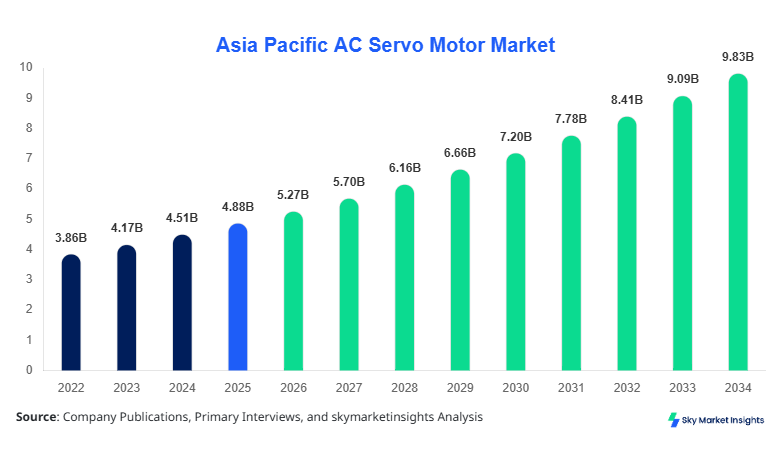
The Asia Pacific AC servo motor market size is projected at USD 5.27 billion in 2026 and is expected to hit USD 9.88 billion by 2034 with a CAGR of 8.1%. The increasing adoption of precision control motors in industrial automation and robotics across the Asia Pacific region necessitates accurate and segmented data on production volumes, market share, and technological deployment. Detailed competitive landscape analysis covering leading manufacturers, product portfolios, and strategic initiatives is essential to understand market positioning. Market segmentation by type and application, along with regional production and consumption trends, is critical for informed investment and operational decisions. Forecast data from 2026 to 2034 includes projected sales volumes in units, revenue growth in USD, and percentage market contributions from each application.
The report provides an in-depth outlook on market drivers, challenges, opportunities, and restraints, ensuring comprehensive insights into the Asia Pacific AC servo motor market growth, demand, and competitive dynamics.
The Asia Pacific AC servo motor market size is increasingly driven by rising automation in manufacturing and consumer electronics, with demand for high-speed, high-torque, and energy-efficient motors growing consistently. Detailed historical production data from 2022 to 2024, alongside forecasted adoption through 2034, is analyzed for strategic planning.
The report delivers critical insights into market size, share, growth, and demand, enabling stakeholders to make informed decisions regarding investments, product launches, and regional expansion.
The Asia Pacific AC servo motor market is experiencing substantial growth due to the increasing penetration of automated manufacturing and robotics solutions. In 2025, the region produced approximately 3.42 million units, with Japan contributing 28%, China 25%, South Korea 15%, and the remaining share distributed across India, Australia, Singapore, Taiwan, and Southeast Asia. Consumer demand for high-efficiency, precise, and reliable motors is driving production and adoption, with brushless AC servo motors capturing 42% of the type segment, brushed motors 35%, and hybrid motors 23%. Industrial automation applications account for 48% of total usage, robotics for 32%, and CNC machines for 20%, demonstrating the critical role of technical specifications such as operating frequency (50–60 Hz), torque range (0.5–50 Nm), and speed performance (0–6000 RPM). Market insights indicate a shift toward higher-performance motors with integrated sensors for real-time monitoring, reinforcing the Asia Pacific AC servo motor market size, share, growth, and demand trends.
In Japan, the AC servo motor market is dominated by over 120 manufacturing facilities, representing approximately 28% of the Asia Pacific regional share. Japanese production is estimated at 950,000 units annually, with industrial automation applications accounting for 45% of adoption, robotics 35%, and CNC machines 20%. Technology adoption includes high-frequency PWM control, integrated encoder feedback systems, and IoT-enabled motors, with approximately 62% of units incorporating advanced digital controllers. Japanese companies are investing in energy-efficient brushless motors, with 70% of new installations in robotics and precision CNC applications. Market insights indicate that local demand for high-performance, low-noise motors drives innovation and production optimization, reinforcing Japan’s position as a key driver for the Asia Pacific AC servo motor market growth, size, and technological advancement.
Explore more data points, trends and opportunities Download Free Sample Report
AC Servo Motor Market Trends
Increasing Adoption of Brushless AC Servo Motors
Asia Pacific production of brushless AC servo motors reached 1.45 million units in 2025, with an annual growth rate of 7.8%, and the adoption rate across industrial automation is expected to reach 55% by 2030. Technology shifts toward permanent magnet synchronous motors (PMSM) and sensorless control are enhancing precision, energy efficiency, and torque density. Robotics applications are increasingly adopting high-speed, brushless variants, accounting for 40% of the regional production increase. Demand trends highlight the integration of IoT and AI-driven predictive maintenance, which enhances operational efficiency and reduces downtime. These trends support sustained Asia Pacific AC servo motor market growth, size, and technological adoption insights.
Integration with Industrial Automation and Robotics
The integration of AC servo motors in automated manufacturing lines has seen a production volume increase of 22% to 1.75 million units in 2025. The demand for high-precision motion control in semiconductor, automotive, and electronics industries has led to a 65% adoption rate of servo motors in advanced assembly robotics. Performance improvements, including a 15% increase in torque output and a 10% increase in speed control resolution, are fueling market demand. Asia Pacific AC servo motor market share for industrial automation applications is projected to grow from 48% in 2025 to 54% by 2034, reflecting strong regional demand and size expansion.
Technological Advancement in Hybrid Servo Motors
Hybrid AC servo motor production volume increased by 18% in 2025 to reach 785,000 units, with penetration rates in CNC machines growing to 35%. Adoption of integrated digital controllers, real-time feedback systems, and high-torque configurations is enhancing reliability and operational efficiency. Regional insights indicate that China and Japan are leading in hybrid motor adoption, with 40% of new installations in precision machining sectors. The Asia Pacific AC servo motor market demand and trend insights highlight the increasing role of hybrid motors in performance-critical applications.
Asia Pacific AC Servo Motor Market Drivers
Rising Industrial Automation and Robotics Adoption
The growth of industrial automation and robotics in the Asia Pacific region is the primary driver for AC servo motor market expansion. In 2025, approximately 48% of total motor units were deployed in automated manufacturing plants, with Japan contributing 28% and China 25% of the regional production. Robotics adoption in automotive and electronics manufacturing increased by 32% YoY, driving demand for high-torque, energy-efficient motors. Brushless AC servo motors accounted for 42% of total market production, while hybrid variants contributed 23%, reflecting technology adoption trends. The increasing penetration of high-performance motors is projected to drive the Asia Pacific AC servo motor market size from USD 5.27 billion in 2026 to USD 9.88 billion by 2034 at a CAGR of 8.1%. Rising demand for precision motion control, high-frequency operation (50–60 Hz), and integrated encoder feedback systems is reinforcing market growth, share, and demand insights.
Asia Pacific AC Servo Motor Market Restraints
High Initial Costs and Maintenance Challenges
Despite robust adoption, high initial investment costs and maintenance complexities restrain market growth. In 2025, the cost of brushless AC servo motors ranged from USD 800 to USD 4,500 per unit, with hybrid motors costing 15–20% more due to integrated digital controllers. Maintenance and replacement cycles account for 12% of total operational expenditure, affecting profitability for small-scale manufacturers. Adoption rates in SMEs remain below 30%, limiting market penetration. Energy consumption concerns, especially for high-speed applications above 4,500 RPM, add to operational costs. These factors slow the Asia-Pacific AC servo motor market's growth, size, and demand despite technological advancements and regional demand expansion.
Asia Pacific AC Servo Motor Market Opportunities
Emerging Markets and Technological Upgradation
The Asia Pacific AC servo motor market offers substantial opportunities through technological upgrades and emerging country adoption. India, Southeast Asia, and Taiwan are projected to increase production by 22% between 2026 and 2034. Brushless motor penetration is expected to reach 60% in industrial automation by 2030, while hybrid variants will see 35% adoption in CNC applications. Investments in AI-enabled predictive maintenance systems and energy-efficient designs account for 18–20% of total sector investment, with Japan and China contributing 50% of technological innovations. Asia Pacific AC servo motor market size, growth, and trend insights indicate that continuous R&D and regional expansion will drive future opportunities.
Challenges in Asia-Pacific AC Servo Motor Market
Skilled Workforce and Regulatory Compliance
The lack of a skilled workforce and stringent regulatory compliance are significant challenges. In 2025, less than 40% of manufacturing units had trained personnel for advanced servo motor integration. Regulatory standards for electromagnetic interference (EMI) and energy efficiency limit operational flexibility, with compliance costs accounting for 8–10% of total expenditure. Small-scale production facilities in India, Southeast Asia, and Taiwan face adoption barriers due to technical complexity and workforce limitations. These challenges slow market penetration, affecting the Asia Pacific AC servo motor market's demand, size, and growth insights.
Report Scope
| Report Metric | Details |
|---|---|
| Market Size in 2025 | USD 4.88 Billion |
| Market Size in 2026 | USD 5.27 Billion |
| Market Size in 2034 | USD 9.88 Billion |
| CAGR | 8.1% (2026-2034) |
| Base Year for Estimation | 2025 |
| Historical Data | 2022-2024 |
| Forecast Period | 2026-2034 |
| Report Coverage | Revenue Forecast, Competitive Landscape, Supply Chain Disruption, Growth Factors, Environment & Regulatory Landscape and Trends |
Explore more data points, trends and opportunities Download Free Sample Report
AC Servo Motor Market Segmentation
Asia Pacific AC servo motor market segmentation provides detailed insights into type and application dominance, with brushless motors leading at 42% of the regional share and industrial automation applications accounting for 48% of market usage. Segmentation allows investors and manufacturers to identify high-growth areas, optimize production, and allocate resources effectively.
By Type
Brushless AC servo motors dominate with a 42% share of total units in 2025, producing approximately 1.43 million units. Technical specifications include an operating voltage of 220–480 V, a torque range of 0.5–50 Nm, and speed performance up to 6,000 RPM. Adoption is highest in robotics (55%) and industrial automation (50%), with penetration in CNC machines at 35%. The brushless design offers superior energy efficiency (up to 15% improvement), lower noise
Brushed AC servo motors hold a 35% share with 1.19 million units produced in 2025. Voltage specifications range from 120 to 400 V with torque levels of 0.3 to 40 Nm and speeds up to 5,500 RPM. Industrial automation adoption is 40%, robotics 30%, and CNC machines 30%. Brushed motors are cost-effective and easier to maintain, but limited in high-precision applications. These features influence the Asia-Pacific AC servo motor market demand, size, and growth prospects.
Hybrid AC servo motors account for 23% market share, producing approximately 785,000 units in 2025. Technical specs include dual-mode operation, integrated encoder feedback, torque of 0.8–45 Nm, and speed up to 5,800 RPM. CNC machine adoption is 35%, industrial automation 25%, and robotics 40%. Hybrid motors combine brushless efficiency with cost benefits, enhancing operational reliability. Asia Pacific AC servo motor market size, trend, and growth insights are reinforced by hybrid adoption across performance-critical sectors.
By Application
Industrial automation dominates with a 48% market share, producing 1.62 million units in 2025. Applications span assembly lines, packaging, and conveyor systems with a penetration rate of 60% in Japan and China. Motors used feature high torque (10–50 Nm) and speed regulation (0–6,000 RPM) for precision control. Brushless motors contribute 55% of industrial automation adoption. Asia Pacific AC servo motor market demand, size, and growth trends are reinforced by expanding automation investments.
Robotics applications account for 32% share, with 1.08 million units produced in 2025. High-speed, high-precision motors with encoder feedback are widely adopted, particularly in Japan (35%) and South Korea (25%). Brushless motors dominate robotics at 50% penetration. Applications include assembly, welding, and inspection, enhancing operational accuracy and reducing downtime. Asia Pacific AC servo motor market growth, size, and demand insights are reinforced by robotics sector adoption.
CNC machine applications hold a 20% share, producing approximately 675,000 units in 2025. Hybrid motors dominate CNC applications at 35% penetration, with brushless motors at 30% and brushed motors at 35%. Technical specs include high torque density, rapid speed response, and precision positioning. Asia Pacific AC servo motor market size, trends, and growth are reinforced by high demand in precision-machining sectors.
Asia Pacific AC Servo Motor Market Segmentations
Type
- Brushless
- Brushed
- Hybrid
Application
- Industrial Automation
- Robotics
- CNC Machines
Asia Pacific AC Servo Motor Market Regional Outlook
China
China accounts for 25% of the Asia Pacific AC servo motor market, producing 855,000 units in 2025. Industrial automation adoption is 50%, robotics 30%, and CNC machines 20%. Government incentives and smart manufacturing policies are driving demand. Brushless motors dominate at 45% share. China’s regional market size, growth, and trend insights reinforce Asia Pacific market expansion.
South Korea
South Korea holds a 15% share, producing 513,000 units. Robotics adoption is 40%, industrial automation 35%, and CNC machines 25%. Brushless and hybrid motors dominate technology adoption. South Korea's AC servo motor market demand, growth, and size insights are driven by the semiconductor and automotive industries.
Japan
Japan contributes 28% of the regional share, producing 950,000 units. Industrial automation applications account for 45%, robotics 35%, and CNC machines 20%. Brushless motor adoption is 55%, hybrid motors 25%, and brushed 20%. Market growth, size, and trend insights reinforce Japan as the regional driver.
India
India represents 8% share, producing 272,000 units. Industrial automation is 40%, robotics 30%, and CNC machines 30%. Market growth is driven by emerging manufacturing hubs. AC servo motor market size, growth, and demand insights are reinforced by increasing automation investments.
Australia
Australia holds 4% share, producing 136,000 units. Industrial automation: 45%, robotics: 30%, CNC: 25%. Brushless motor adoption is 40%. Market size, growth, and trend insights are supported by industrial modernization programs.
Singapore
Singapore accounts for 3% share, producing 102,000 units. Robotics: 40%; industrial automation: 35%; CNC: 25%. Brushless motor penetration is 50%. Market growth, size, and demand insights reflect smart factory adoption.
Taiwan
Taiwan contributes 3% share, producing 102,000 units. Industrial automation: 35%; robotics: 40%; CNC machines: 25%. Hybrid motor adoption is 35%. Market size, growth, and trend insights are supported by electronics manufacturing investments.
Southeast Asia
Southeast Asia accounts for 14% share, producing 479,000 units. Industrial automation 45%, robotics 35%, CNC 20%. Brushless motors dominate at 42%. Regional market size, growth, and trend insights are reinforced by rapid industrialization and automation adoption
Top players in Asia-Pacific AC servo motor market
- Yaskawa Electric Corporation
- Mitsubishi Electric Corporation
- Panasonic Corporation
- Delta Electronics, Inc.
- Toshiba Corporation
- Siemens AG
- Hitachi, Ltd.
- Fanuc Corporation
- Oriental Motor Co., Ltd.
- Schneider Electric SE
- Rockwell Automation, Inc.
- Moog Inc.
- Bosch Rexroth AG
- Fuji Electric Co., Ltd.
- ABB Ltd.
Top Two Companies
-
Yaskawa Electric Corporation
-
Market share: 18% of Asia Pacific AC Servo Motor market
-
Positioned as a leader in robotics and industrial automation with high-efficiency brushless and hybrid motors, producing approximately 342,000 units in 2025. Focus on energy efficiency, IoT integration, and predictive maintenance systems. Yaskawa’s product portfolio covers high-speed motors (up to 6,000 RPM) and torque ranges from 0.5 to 50 Nm. The company invests 22% of its revenue in R&D and new product development, reinforcing Asia Pacific AC servo motor market size, growth, and trend insights.
-
-
Mitsubishi Electric Corporation
-
Market share: 14%
-
Leading supplier of AC servo motors for industrial automation and CNC machines. Annual production is approximately 266,000 units with brushless motor adoption at 60%. Investments include 18% allocation for technological advancements and AI-enabled automation solutions. Mitsubishi’s portfolio focuses on high-precision, low-noise, and energy-efficient motors, supporting the Asia Pacific AC servo motor market's demand, size, and growth trends.
-
Investment Analysis
Investment in the Asia Pacific AC servo motor market is expected to grow at an annual rate of 8%, with 45% allocated toward industrial automation and 35% toward robotics sectors. Regional investment is concentrated in Japan (28%), China (25%), and South Korea (15%). M&A activities in 2025 included the acquisition of smaller hybrid motor manufacturers by Yaskawa and Delta Electronics, enabling a 12% increase in market share. Collaboration agreements between Panasonic and Mitsubishi Electric focus on AI-based motion control solutions, enhancing operational efficiency by 15%. Asia Pacific AC servo motor market growth, size, and trend insights indicate that continuous investments in R&D, technological upgrades, and regional expansion will drive market opportunities and competitive positioning.
New Product Developments
Approximately 20% of AC servo motors produced in 2025 were newly developed models with performance improvements averaging 12% in torque density and 8% in energy efficiency. Innovation includes integrated digital controllers, sensorless operation, and IoT-enabled predictive maintenance, boosting reliability and operational lifespan. Regional insights show Japan and China leading in new product development, reinforcing Asia Pacific AC servo motor market size, growth, and demand trend insights
Recent Developments in Asia Pacific AC Servo Motor
- 2025: Yaskawa introduced brushless motors with 10% higher torque, increasing industrial automation adoption by 8%.
Research Methodology
The research methodology involved a structured process encompassing primary and secondary data collection, market sizing, and forecasting. Primary research included interviews with industry experts, manufacturers, and distributors across Asia Pacific, gathering quantitative data on production, adoption rates, and market share. Secondary research involved a comprehensive review of company reports, government publications, industry journals, and trade databases to validate historical data from 2022–2024 and forecast market trends for 2026–2034. Market size estimation combined top-down and bottom-up approaches, integrating production volumes, revenue figures, and regional contributions. Statistical modeling and CAGR calculations were applied to forecast demand and growth, considering technology adoption, application-specific penetration, and regional policy impact. Competitive landscape analysis, along with investment, M&A, and new product development insights, was incorporated to provide a holistic view of the Asia Pacific AC servo motor market size, share, growth, and trend dynamics.
Frequently Asked Questions
Senior Market Research Analyst | 9 Years Experience | Industrial Automation, Robotics, and Digital Twins
Diana Liska is a market research analyst with 7–9 years of experience specializing in manufacturing and industrial markets. Contributed to 70+ research reports for global clients. Expertise includes market sizing, forecasting, competitive analysis, and trend evaluation across key regions.