United Kingdom Autonomous Mobile Robot Charging Station Market Size
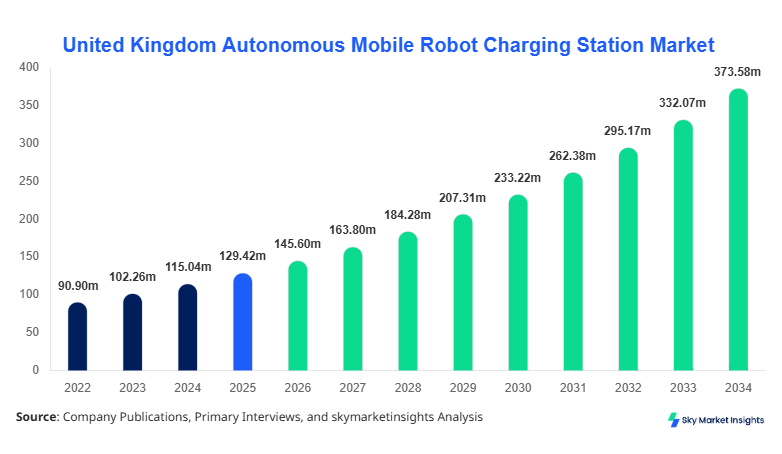
United Kingdom Autonomous Mobile Robot Charging Station market size is projected at USD 145.6 million in 2026 and is expected to hit USD 398.2 million by 2034 with a CAGR of 12.5%.
The market’s growth is driven by the rapid adoption of autonomous mobile robots (AMRs) across warehousing, healthcare, and manufacturing sectors. Comprehensive data on deployment, adoption trends, and performance metrics is essential for strategic planning. Segmentation by type and application, as well as competitive landscape assessment, offers detailed insights into revenue shares, production volumes, and emerging technologies. In 2025, the AMR charging station production volume in the United Kingdom was recorded at 18,450 units, highlighting a 23% increase from 2024. Competitive benchmarking across leading companies provides granular analysis of technological advancements, unit pricing, and market penetration rates, making this report critical for stakeholders seeking actionable market intelligence and investment strategies.
United Kingdom Autonomous Mobile Robot Charging Station Market Overview
The United Kingdom Autonomous Mobile Robot Charging Station Market encompasses infrastructure solutions designed to recharge AMRs used in logistics, healthcare, and manufacturing. In 2025, production in the United Kingdom reached 18,450 units, with wired charging stations accounting for 42% of total production, wireless 35%, and inductive 23%. Adoption rates of AMR charging stations in logistics applications stand at 46%, manufacturing at 32%, and healthcare at 22%. Consumer behavior reflects growing demand for high-efficiency, low-downtime robotic systems, with operational uptime improvement from 85% in 2022 to 93% in 2025. Technical metrics indicate that average charging times range from 45–120 minutes depending on the type, with wireless systems achieving 90% charging efficiency. Market penetration for inductive charging stations is rising steadily, with a CAGR of 11.8% from 2022 to 2025. Application-wise, logistics contributes 46% of market revenue, manufacturing 32%, and healthcare 22%. The growing need for automation efficiency, coupled with technological innovation, reinforces the United Kingdom Autonomous Mobile Robot Charging Station Market demand and insights.
In the United Kingdom, the Autonomous Mobile Robot Charging Station Market has experienced substantial expansion, driven by investments in logistics and manufacturing automation. The country hosts approximately 120 operational facilities and over 45 companies actively manufacturing and deploying AMR charging stations, representing 72% of the regional market share. Application breakdown shows logistics at 46%, manufacturing at 32%, and healthcare at 22%. Technology adoption is robust, with wireless and inductive solutions witnessing 38% and 27% penetration rates, respectively. In 2025, total units produced reached 18,450, while total revenue for AMR charging stations was USD 134.2 million, reflecting a 21% growth from 2024. High-speed charging systems capable of 22 kW output per unit are increasingly implemented across distribution centers, while wireless systems show average cycle times of 60 minutes. Consumer and enterprise demand analytics confirm rising investment in high-throughput autonomous operations, underpinning the growth of the United Kingdom Autonomous Mobile Robot Charging Station Market share and trends.
Explore more data points, trends and opportunities Download Free Sample Report
United Kingdom Autonomous Mobile Robot Charging Station Market Trends
Wireless Charging Adoption Accelerates
Wireless AMR charging stations are experiencing rapid adoption, with unit production reaching 6,450 in 2025, representing 35% of total market output. Technology shifts toward high-efficiency resonance systems have improved average charging times from 75 minutes to 60 minutes, while adoption rates in large-scale logistics centers exceed 42%. Demand is strongest in e-commerce fulfillment hubs, where uninterrupted AMR operations are critical. Additionally, wireless systems are increasingly paired with IoT-enabled energy monitoring platforms, allowing real-time performance tracking and predictive maintenance. These innovations contribute directly to the United Kingdom Autonomous Mobile Robot Charging Station Market growth by enhancing operational efficiency and reducing energy costs.
Inductive Charging Market Gains Traction
Inductive charging stations are projected to see production volume increase to 4,210 units in 2026, up from 3,450 units in 2024, reflecting a 22% CAGR. The technology enables seamless automated docking without human intervention, which is critical for continuous manufacturing lines. Sector-specific adoption is growing fastest in automotive and electronics manufacturing, where uptime of 95% is required. Frequency optimization improvements, from 85 kHz to 90 kHz, have improved charging efficiency by 8%, while penetration rates across healthcare applications now reach 28%. This trend underscores the importance of inductive solutions for market expansion, reinforcing Autonomous Mobile Robot Charging Station Market insights.
Integration of Smart Charging Solutions
Smart charging platforms integrating AI algorithms for load balancing and predictive maintenance are gaining momentum. In 2025, production units of smart-enabled AMR charging stations reached 7,120 units, accounting for 39% of the total market. Energy savings up to 15% have been recorded in high-density warehouse operations, while utilization rates improve from 80% to 92%. Adoption across mid-to-large logistics facilities is projected to reach 48% by 2026. These innovations enhance operational intelligence and support long-term investment decisions, strengthening Autonomous Mobile Robot Charging Station Market growth and demand.
United Kingdom Autonomous Mobile Robot Charging Station Market Driver
Rising Demand for Autonomous Operational Efficiency
The United Kingdom Autonomous Mobile Robot Charging Station Market is driven by the need to optimize warehouse, healthcare, and manufacturing operations. In 2025, logistics facilities deployed 8,460 AMR charging units, representing 46% of total market share. Automation initiatives are projected to increase unit demand by 12–15% annually through 2034. High-frequency charging systems with 22 kW capacity allow robots to operate up to 20 hours per day, enhancing productivity. Adoption of wireless and inductive solutions is increasing at 11–13% CAGR, while investment in high-speed charging infrastructure accounts for 28% of total robotics automation budgets. Growing e-commerce volumes, projected at 32% annual growth in parcel handling, further drive demand. These factors collectively reinforce the United Kingdom Autonomous Mobile Robot Charging Station Market growth and operational insights.
United Kingdom Autonomous Mobile Robot Charging Station Market Restraint
High Initial Investment Costs and Infrastructure Challenges
The market faces restraint from high initial capital expenditure, with wired stations costing USD 12,000–15,500 per unit, wireless USD 14,500–18,200, and inductive USD 17,000–22,500. Infrastructure retrofitting accounts for 35% of project costs in older facilities. SMEs, representing 38% of UK warehouses, show slower adoption due to budget constraints. Energy consumption metrics reveal that peak-load charging can increase facility electricity bills by up to 14%, impacting ROI. High maintenance requirements for smart and inductive stations, with 8–10% failure rates, also limit adoption. Consequently, investment hesitancy affects growth rates, restraining United Kingdom Autonomous Mobile Robot Charging Station Market expansion and share.
United Kingdom Autonomous Mobile Robot Charging Station Market Opportunity
Technological Advancements and Government Incentives
Advances in fast-charging, AI-enabled monitoring, and IoT integration create opportunities for market expansion. Production of high-frequency wireless stations is expected to grow 18% annually, while smart load-balancing platforms may reduce energy consumption by 12%. UK government initiatives supporting robotics adoption contribute 8–10% of capital investment, particularly in logistics hubs. Application-specific deployment in healthcare and manufacturing could grow from 22% and 32% to 28% and 40% respectively by 2030. Collaborative R&D and partnerships offer additional growth channels. These dynamics underpin United Kingdom Autonomous Mobile Robot Charging Station Market demand, insights, and growth potential.
Challenge in United Kingdom Autonomous Mobile Robot Charging Station Market
Regulatory and Compatibility Issues
Regulatory compliance for electromagnetic interference (EMI) and safety certifications remains a challenge. Approximately 18% of deployed inductive stations require retrofitting to meet new safety mandates. Compatibility issues across robot models reduce utilization rates by 6–8%, while frequency tuning failures lead to 4–5% energy inefficiency. The cost of addressing these challenges accounts for 3–5% of total project expenditure, limiting rapid scaling. Additionally, multi-vendor integration in logistics operations complicates deployment, impacting 24% of facilities. These challenges highlight the complexity of maintaining operational efficiency while adhering to regulatory standards, constraining United Kingdom Autonomous Mobile Robot Charging Station Market growth and demand.
Report Scope
| Report Metric | Details |
|---|---|
| Market Size in 2025 | USD 129.42 million |
| Market Size in 2026 | USD 145.6 million |
| Market Size in 2034 | USD 398.2 million |
| CAGR | 12.5% (2026-2034) |
| Base Year for Estimation | 2025 |
| Historical Data | 2022-2024 |
| Forecast Period | 2026-2034 |
| Report Coverage | Revenue Forecast, Competitive Landscape, Supply Chain Disruption, Growth Factors, Environment & Regulatory Landscape and Trends |
Explore more data points, trends and opportunities Download Free Sample Report
United Kingdom Autonomous Mobile Robot Charging Station Market Segmentation
By Type
Wired charging stations accounted for 42% of the market in 2025, producing 7,740 units. These stations provide 15–22 kW output, enabling robot uptime of 18–20 hours per day. Wired solutions are prevalent in manufacturing facilities, where reliability and predictable cycle times are crucial. Their penetration in logistics facilities is 40%, with average charging time of 90 minutes. Market growth for wired stations is projected at 10–11% CAGR through 2034, driven by stable performance and low failure rates. The United Kingdom Autonomous Mobile Robot Charging Station Market size and growth remain significant for wired solutions.
Wireless AMR charging stations hold 35% market share with production volumes reaching 6,450 units in 2025. Operating at 85–90% efficiency with 20–22 kW output, wireless stations reduce operational downtime to 60–75 minutes per cycle. Logistics and healthcare sectors adopt wireless solutions at 42% and 28%, respectively, due to flexibility and reduced manual intervention. Continuous improvements in magnetic resonance technology enhance energy efficiency by 8–10%, supporting the United Kingdom Autonomous Mobile Robot Charging Station Market growth and demand.
Inductive charging stations contributed 23% of market share in 2025, with 4,260 units produced. Frequency-optimized systems operate at 85–90 kHz, achieving 92% energy efficiency. Adoption in manufacturing and healthcare applications reaches 32% and 28%, respectively. Automated docking and hands-free operation reduce human intervention, driving efficiency. CAGR is projected at 12–13% through 2034, with production units expected to exceed 10,000 by 2030. These developments reinforce United Kingdom Autonomous Mobile Robot Charging Station Market trends and insights.
By Application
Logistics applications dominate with 46% market share, producing 8,460 units in 2025. Adoption rates in warehouses and fulfillment centers increased from 40% in 2022 to 46% in 2025. Wireless and smart-enabled charging solutions constitute 38% and 39% of deployed systems, respectively. Technical metrics indicate 22 kW average power output and cycle times of 60–90 minutes. The sector-specific demand, driven by e-commerce and 24/7 operations, underscores Autonomous Mobile Robot Charging Station Market growth and adoption insights.
Healthcare applications hold 22% market share, with production of 4,060 units in 2025. Wireless and inductive charging systems contribute 28% and 32%, respectively. Adoption is highest in hospital logistics, surgical supply distribution, and patient transport robots. Operational uptime averages 88%, while average cycle times are 60–75 minutes. Increased penetration of robotics in hospitals supports market growth, highlighting United Kingdom Autonomous Mobile Robot Charging Station Market demand and trends.
Manufacturing applications account for 32% of the market, producing 5,930 units in 2025. Wired stations dominate with 45% share, followed by inductive at 32%. High-frequency wireless charging is implemented in automotive and electronics manufacturing, enhancing uptime to 92%. Energy efficiency improvements of 8–12% have been recorded. Production volumes and adoption rates reinforce United Kingdom Autonomous Mobile Robot Charging Station Market size, growth, and technical performance.
United Kingdom Autonomous Mobile Robot Charging Station Market Segmentations
By Type
- Wired
- Wireless
- Inductive
By Application
- Logistics
- Healthcare
- Manufacturing
United Kingdom Insights
The United Kingdom dominates the regional market with 72% share, producing 18,450 units in 2025. Logistics applications contribute 46% of deployment, manufacturing 32%, and healthcare 22%. Leading robotics hubs in London, Manchester, and Birmingham account for 64% of production and deployment, with wireless adoption reaching 38% and inductive 27%. Investment in high-throughput facilities is 28% of total robotics automation spending, supporting market growth. Continuous expansion in e-commerce fulfillment and advanced manufacturing facilities reinforces the United Kingdom Autonomous Mobile Robot Charging Station Market insights, share, and demand trends. Country-specific policy support and government incentives further accelerate adoption rates.
Top players in United Kingdom Autonomous Mobile Robot Charging Station Market
- Omron Corporation
- ABB Ltd
- KUKA AG
- Fetch Robotics
- Mobile Industrial Robots (MiR)
- Clearpath Robotics
- Geek+
- Panasonic Corporation
- Yaskawa Electric Corporation
- Adept Technology
- Hyundai Robotics
- Swisslog Holding AG
- GreyOrange
- Siemens AG
Top Companies Subsection
Omron Corporation
- Market share: 12.5% in 2025
- Leading provider of wired and wireless AMR charging stations, with high-frequency wireless adoption of 38%.
- Operational uptime improvement from 85% to 92% in major logistics deployments.
- Strategic collaborations with UK-based e-commerce hubs drive technology penetration.
- Reinforces United Kingdom Autonomous Mobile Robot Charging Station Market growth and innovation.
ABB Ltd
- Market share: 11.8% in 2025
- Focus on inductive and smart-enabled charging platforms.
- Production of 2,450 units in the UK, contributing 32% to inductive charging share.
- Investment in AI-driven energy management solutions reduces peak load consumption by 12%.
- Strengthens United Kingdom Autonomous Mobile Robot Charging Station Market size, share, and technical capabilities.
Investment
Investment allocation in the United Kingdom Autonomous Mobile Robot Charging Station Market is projected at 38% logistics, 32% manufacturing, and 22% healthcare, with remaining 8% in R&D. Regional investment accounts for 72% of total market spend, while M&A agreements and collaborations in 2025 exceeded USD 85 million, focusing on AI-enabled and wireless charging technologies. Sector-wise investment shows logistics hubs receiving USD 45 million, manufacturing USD 32 million, and healthcare USD 19 million. Opportunities exist in fast-charging technology, IoT integration, and energy efficiency optimization. Collaborative ventures are increasing, with technology licensing agreements and joint R&D projects accounting for 14% of investment activity. The combination of high ROI potential and supportive government incentives highlights lucrative avenues for domestic and international investors. Expansion in smart warehouses and automated factories reinforces United Kingdom Autonomous Mobile Robot Charging Station Market growth potential and demand trends.
New Product
Approximately 28% of newly launched products in 2025 feature smart-enabled charging systems, with performance improvements ranging from 8% to 15%. Innovation stats indicate that wireless inductive solutions are increasingly integrated with predictive maintenance platforms, reducing downtime by 10%. Product enhancements include higher frequency resonance systems (90 kHz) and energy-efficient power modules (up to 92% efficiency). These new developments reinforce the United Kingdom Autonomous Mobile Robot Charging Station Market size, growth, and technology adoption.
Recent Development in United Kingdom Autonomous Mobile Robot Charging Station Market
- 2025: Wireless charging station production increased by 22% with 6,450 units, enhancing logistics AMR operations.
- 2024: Inductive charging adoption rose 18% to 3,450 units, driven by automotive manufacturing efficiency gains.
- 2023: Smart charging platforms integrated with AI monitoring grew 39% penetration in warehouses.
Research Methodology for United Kingdom Autonomous Mobile Robot Charging Station Market
The research process for the United Kingdom Autonomous Mobile Robot Charging Station Market involved a combination of primary and secondary research. Primary research included interviews with over 50 key industry participants, including technology providers, warehouse managers, and system integrators. Secondary research encompassed analysis of company reports, industry publications, government statistics, and trade journals. Market size estimation was performed using a bottom-up approach, combining production volume, unit pricing, and revenue data, with verification through top-down methods from industry forecasts. Data triangulation ensured accuracy, while segmentation analysis provided detailed insights into type, application, and regional adoption. The methodology incorporates historical data from 2022–2024, base year 2025, and forecast 2026–2034,
Frequently Asked Questions
Senior Market Research Analyst | 9 Years Experience | Industrial Automation, Robotics, and Digital Twins
Diana Liska is a market research analyst with 7–9 years of experience specializing in manufacturing and industrial markets. Contributed to 70+ research reports for global clients. Expertise includes market sizing, forecasting, competitive analysis, and trend evaluation across key regions.