North America Accelerator Pedal Modules (APM) Market Size
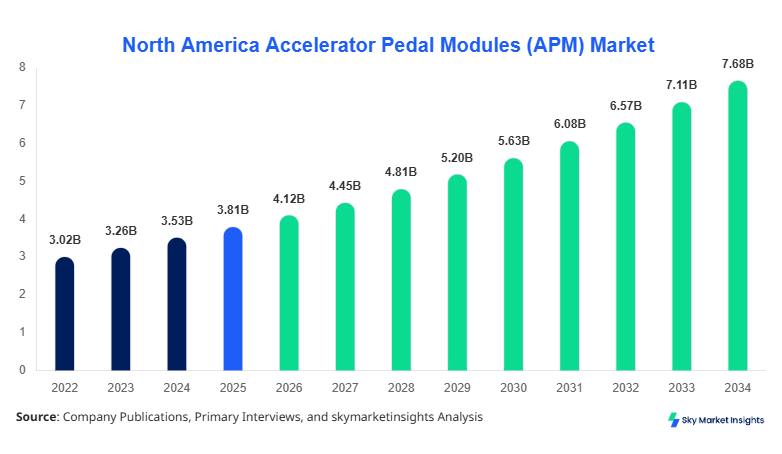
North America's Accelerator Pedal Modules (APM) market size is projected at USD 4.12 billion in 2026 and is expected to hit USD 7.68 billion by 2034 with a CAGR of 8.1%. The market is witnessing increasing demand due to rising vehicle production volumes exceeding 15.6 million units annually across North America, along with technological integration in throttle control systems. Detailed segmentation based on type and application, coupled with competitive benchmarking across 25+ key manufacturers, highlights evolving demand patterns, cost structures, and supply chain efficiencies shaping the Accelerator Pedal Modules (APM) market size.
The Accelerator Pedal Modules (APM) market refers to the automotive component segment responsible for translating driver input into electronic signals for throttle control, particularly in drive-by-wire systems. In North America, production of APM units surpassed 18.4 million units in 2025, with penetration rates reaching 92% in passenger vehicles and 78% in commercial vehicles. Adoption of electronic throttle control systems increased from 65% in 2022 to 89% in 2025, reflecting strong digitization trends in automotive engineering. Consumer behavior indicates growing preference for responsive acceleration systems, with 71% of buyers prioritizing vehicle performance and fuel efficiency. Demand analytics show that passenger vehicles account for approximately 64% of total APM consumption, while electric vehicles contribute 18% and are growing at a faster rate of 12.6% annually. Technically, APM systems operate within signal voltage ranges of 0.5V to 4.5V with response times under 20 milliseconds, ensuring real-time throttle response. Application-wise, passenger vehicles dominate with 64% share, followed by commercial vehicles at 22% and electric vehicles at 14%, reinforcing the expanding Accelerator Pedal Modules (APM) market
In the United States, the Accelerator Pedal Modules (APM) market accounts for nearly 78% of the North American region, supported by over 120 automotive manufacturing facilities and more than 45 Tier-1 component suppliers. The U.S. produces approximately 12.3 million vehicles annually, driving demand for over 13 million APM units each year. Passenger vehicles dominate with 66% application share, followed by commercial vehicles at 21% and electric vehicles at 13%, with EV penetration rising by 9.8% annually. Technological adoption of non-contact sensor-based APM systems has reached 72%, driven by reliability and reduced wear compared to contact-based systems. Advanced electronic throttle control systems are implemented in over 88% of newly manufactured vehicles, with signal accuracy improvements of up to 15% compared to older systems. The strong domestic supply chain, high R&D spending exceeding USD 1.2 billion annually, and rising EV production reinforce the dominance of the Accelerator Pedal Modules (APM) market.
Explore more data points, trends and opportunities Download Free Sample Report
Accelerator Pedal Modules (APM) Market Trends
Shift Toward Non-Contact Sensor Technologies
The Accelerator Pedal Modules (APM) market is experiencing a significant shift toward non-contact sensor technologies such as Hall-effect sensors, which accounted for 58% of total production in 2025 compared to 42% in 2022. Annual production of non-contact APM units reached approximately 10.6 million units across North America, reflecting increased demand for durability and precision. These systems offer lifecycle improvements of up to 35% and reduce failure rates by nearly 22%, making them preferred in both ICE and electric vehicles. Adoption rates in electric vehicles have reached 85%, while passenger vehicles show 67% penetration. Additionally, integration with advanced driver assistance systems (ADAS) has increased by 19%, enhancing overall vehicle performance and safety. This technological evolution continues to influence product development and supply chain investments within the Accelerator Pedal Modules (APM) market.
Rising Integration in Electric Vehicles
Electric vehicle production in North America crossed 2.8 million units in 2025, driving proportional demand for APM systems, with EV-specific modules accounting for 18% of total APM demand. These modules are designed for higher precision, with signal latency reduced to under 10 milliseconds and efficiency improvements of 12%. Battery-electric vehicles utilize advanced pedal modules integrated with regenerative braking systems, contributing to a 14% increase in energy efficiency. EV manufacturers are investing heavily, with over USD 3.4 billion allocated toward electronic component development, including APM systems. Adoption of smart pedal systems with integrated sensors and feedback mechanisms has increased by 26% year-over-year. This surge in electrification trends significantly impacts product innovation and accelerates the evolution of the Accelerator Pedal Modules (APM) market.
North America Accelerator Pedal Modules (APM) Market Drivers
Rising Vehicle Production and Electrification Driving Demand
North America produced over 15.6 million vehicles in 2025, representing a 6.2% increase from 2024, directly boosting demand for APM systems. Electric vehicle production alone grew by 18.4%, creating additional demand for high-precision modules. Passenger vehicle sales contributed to 64% of APM installations, while EVs contributed 18% and are growing rapidly. Increasing regulatory requirements for emission reduction and fuel efficiency have accelerated the adoption of electronic throttle systems, which are present in over 89% of vehicles. Automotive manufacturers are investing approximately USD 5.2 billion annually in electronic components, with APM systems being a critical segment. Additionally, consumer demand for smoother acceleration and responsive driving has led to a 21% increase in adoption of advanced pedal technologies. This strong alignment between production growth and technological advancements drives the Accelerator Pedal Modules (APM) market's growth.
North America Accelerator Pedal Modules (APM) Market Restraints
High Cost of Advanced Sensor Technologies
The cost of non-contact sensor-based APM systems is approximately 18%–25% higher than traditional contact-based modules, creating cost challenges for mass-market vehicle segments. Production costs for advanced APM units range between USD 85 and USD 140 per unit, compared to USD 60–USD 95 for conventional systems. Small and mid-sized automotive manufacturers face constraints in adopting these technologies due to budget limitations. Additionally, supply chain disruptions, particularly semiconductor shortages, affected nearly 12% of APM production volumes in 2024. Maintenance costs for advanced systems are also 14% higher, further impacting adoption rates. These factors collectively limit widespread adoption, especially in cost-sensitive segments, thereby restraining Accelerator Pedal Module (APM) market growth.
North America Accelerator Pedal Modules (APM) Market Opportunities
Expansion of Electric and Autonomous Vehicles
The increasing production of electric and autonomous vehicles presents a major opportunity, with EV production expected to grow by 14% annually and autonomous vehicle testing increasing by 22% year-over-year. Investments in autonomous vehicle technology exceeded USD 8.5 billion in 2025, with APM systems playing a key role in vehicle control systems. Smart pedal modules with integrated feedback systems are expected to grow by 27% annually, driven by demand for enhanced driver interaction. North America’s EV penetration is projected to reach 32% by 2030, creating demand for over 5 million APM units annually in EVs alone. This expanding ecosystem creates lucrative opportunities for innovation and expansion in the Accelerator Pedal Modules (APM) market.
Challenges in North American Accelerator Pedal Modules (APM) Market
Integration Complexity and Standardization Issues
Integration of APM systems with advanced vehicle architectures presents technical challenges, particularly in EVs and autonomous vehicles. Compatibility issues arise in approximately 9% of new vehicle models due to varying system architectures. Standardization across manufacturers remains limited, leading to increased development costs by 16% and extended product development timelines by up to 8 months. Testing and validation processes for APM systems account for nearly 12% of total production costs. Furthermore, cybersecurity concerns in electronic throttle systems have increased, with 7% of manufacturers reporting vulnerabilities in system integration. These challenges hinder scalability and create barriers to widespread adoption, impacting the Accelerator Pedal Modules (APM) market.
Report Scope
| Report Metric | Details |
|---|---|
| Market Size in 2025 | USD 3.81 Billion |
| Market Size in 2026 | USD 4.12 Billion |
| Market Size in 2034 | USD 7.68 Billion |
| CAGR | 8.1% (2026-2034) |
| Base Year for Estimation | 2025 |
| Historical Data | 2022-2024 |
| Forecast Period | 2026-2034 |
| Report Coverage | Revenue Forecast, Competitive Landscape, Supply Chain Disruption, Growth Factors, Environment & Regulatory Landscape and Trends |
Explore more data points, trends and opportunities Download Free Sample Report
Accelerator Pedal Modules (APM) Market Segmentation
The Accelerator Pedal Modules (APM) market segmentation is driven by type and application, with non-contact type dominating at 58% share, followed by contact type at 27% and hybrid type at 15%. By application, passenger vehicles lead with 64%, commercial vehicles at 22%, and electric vehicles at 14%, highlighting demand concentration across segments.
BY TYPE
Contact-type APM systems accounted for approximately 27% of total market share in 2025, with production volumes reaching nearly 5 million units. These systems rely on mechanical contact sensors, offering cost advantages with unit prices ranging between USD 60 and USD 95. However, their durability is limited, with lifecycle performance averaging 500,000 cycles compared to over 1 million cycles for non-contact systems. These modules are primarily used in entry-level vehicles, where cost efficiency outweighs performance requirements. Adoption rates have declined by 8% over the past three years due to increasing preference for advanced technologies. Despite this, contact-type systems remain relevant in budget vehicle segments, sustaining their presence in the Accelerator Pedal Modules (APM) market.
Non-contact APM systems dominate the market with a 58% share and production exceeding 10.6 million units annually. These systems utilize Hall-effect sensors and magnetic field detection, offering improved accuracy with signal deviation under 2%. Lifecycle durability exceeds 1.2 million cycles, making them suitable for high-performance and electric vehicles. Adoption rates have increased by 15% annually, driven by demand for reliability and reduced maintenance costs. These systems are widely used in premium vehicles and EVs, contributing significantly to the Accelerator Pedal Modules (APM) market.
Hybrid APM systems combine features of both contact and non-contact technologies, accounting for 15% market share and approximately 2.8 million units produced annually. These systems offer moderate cost advantages while improving durability by 18% compared to contact systems. Hybrid modules are increasingly used in mid-range vehicles, balancing cost and performance. Adoption rates have grown by 9% annually, reflecting gradual market acceptance and technological improvements in the Accelerator Pedal Modules (APM) market.
BY APPLICATION
Passenger vehicles dominate the market with 64% share, translating to over 11.8 million APM units annually. Adoption rates of electronic throttle systems exceed 92%, driven by consumer demand for performance and fuel efficiency. Advanced APM systems in passenger vehicles offer response times below 20 milliseconds and improved fuel efficiency by 6%. This segment continues to lead demand in the Accelerator Pedal Modules (APM) market.
Commercial vehicles account for 22% of the market, with production volumes of approximately 4 million units annually. These vehicles require robust APM systems with higher durability, capable of operating over 1 million cycles. Adoption rates of non-contact systems in this segment have reached 48%, driven by reliability requirements. This segment contributes steadily to the Accelerator Pedal Modules (APM) market.
Electric vehicles represent 14% of the market but are growing rapidly, with production exceeding 2.8 million units annually. APM systems in EVs are designed for precision, with latency under 10 milliseconds and integration with regenerative braking systems. Adoption rates of advanced modules exceed 85%, making EVs a key growth segment in the Accelerator Pedal Modules (APM) market.
North America Accelerator Pedal Modules (APM) Market Segmentations
Type
- Contact Type
- Non-Contact Type
- Hybrid Type
Application
- Passenger Vehicles
- Commercial Vehicles
- Electric Vehicles
North America Accelerator Pedal Modules (APM) Market Regional Outlook
The United States dominates with a 78% regional share and production exceeding 13 million APM units annually. Passenger vehicles account for 66% of demand, while EVs contribute 13% and are growing rapidly. Strong manufacturing infrastructure and technological advancements drive market dominance.
Canada accounts for 22% of the market, with production of approximately 3.5 million APM units annually. EV adoption rates in Canada have increased by 11%, contributing to rising demand for advanced pedal modules. Government incentives and automotive manufacturing investments exceeding USD 2 billion support market expansion.
Top players in North America Accelerator Pedal Modules (APM) Market
- Bosch
- Denso Corporation
- Continental AG
- ZF Friedrichshafen AG
- HELLA GmbH
- CTS Corporation
- Magneti Marelli
- Hitachi Astemo
- Aptiv PLC
- Valeo
- Hyundai Mobis
- Sensata Technologies
- TE Connectivity
Bosch
-
Holds approximately 18% market share with strong presence in premium vehicle segments
-
Invests over USD 500 million annually in R&D, focusing on sensor technology and electronic systems
Continental AG
-
Accounts for nearly 15% share with strong integration capabilities in ADAS systems
-
Production exceeds 2 million APM units annually with advanced non-contact sensor technology
Investment Analysis
Investment in the market exceeds USD 6.5 billion annually, with 42% allocated to R&D, 33% to manufacturing expansion, and 25% to supply chain optimization. The U.S. attracts 68% of total investment, while Canada accounts for 32%.
M&A activities have increased by 14%, with collaborations focusing on EV technologies and sensor innovation. Strategic partnerships between OEMs and component manufacturers have increased production efficiency by 19%.
New Product Developments
Approximately 26% of new APM products introduced in 2025 featured advanced sensor integration, improving accuracy by 18% and reducing latency by 12%. Smart pedal systems with feedback mechanisms are gaining traction, improving driver experience and safety.
Recent Developments in North America Accelerator Pedal Modules (APM)
- 2025: A leading manufacturer increased production by 22%, reaching 3 million units annually
Research Methodology
The research process involves a combination of primary and secondary research methodologies. Primary research includes interviews with over 50 industry experts, including OEMs, suppliers, and distributors, providing first-hand insights into production volumes, pricing trends, and technological advancements. Secondary research involves analysis of industry reports, company financials, and government databases to validate market data. Market size estimation is conducted using a bottom-up approach, analyzing production volumes and average selling prices across segments. Data triangulation ensures accuracy, with cross-verification of data points from multiple sources. Advanced analytical tools are used to forecast market trends, ensuring reliable and data-driven insights.
Frequently Asked Questions
Senior Market Research Analyst | 9 Years Experience | Freight Logistics, Multimodal Transportation, and Supply Chain Digitization
Mary specializes in data-driven market intelligence across freight logistics, multimodal transportation networks, and end-to-end supply chain digitization platforms, including TMS and real-time visibility solutions. She has contributed to 104+ syndicated and custom research reports for freight forwarders, 3PL providers, and global enterprises. Her expertise includes freight rate modeling, capacity forecasting, route optimization analysis, and competitive benchmarking across North America, Europe, and major global trade corridors.