Europe Airline Ancillary Services Market Size
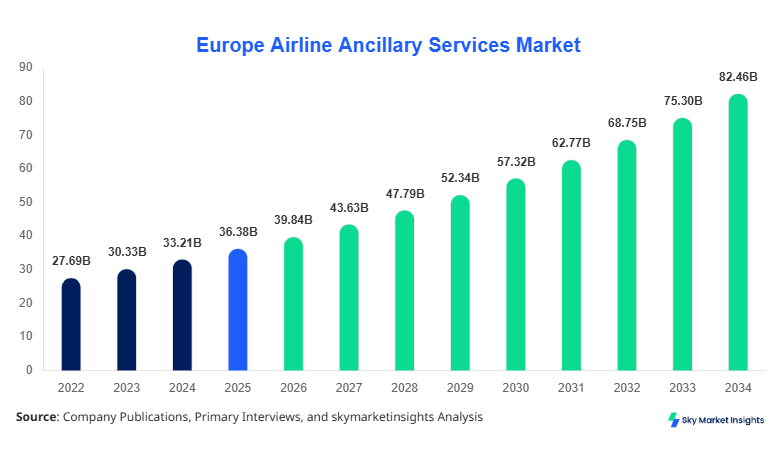
Europe Airline Ancillary Services market size is projected at USD 39.84 billion in 2026 and is expected to hit USD 82.47 billion by 2034 with a CAGR of 9.52%. The market expansion is being driven by increasing passenger traffic, digital monetization strategies, and airline focus on non-ticket revenue streams across Europe. Growing adoption of personalized booking systems, dynamic pricing algorithms, and premium travel add-ons is accelerating revenue generation among low-cost and full-service carriers. The competitive landscape includes major European aviation groups, digital travel platforms, and ancillary technology providers competing through bundled service models, AI-driven customer analytics, and loyalty-based revenue optimization solutions.
The airline ancillary services sector refers to the revenue-generating products and services offered by airlines beyond standard ticket fares, including baggage fees, premium seating, onboard food sales, travel insurance, lounge access, priority boarding, and in-flight connectivity. Europe recorded more than 1.38 billion passenger movements in 2025, with Germany, the United Kingdom, France, and Spain accounting for over 63% of regional air passenger traffic. Low-cost carriers contributed nearly 47% of total ancillary revenue generation due to aggressive monetization strategies and unbundled fare models. Adoption rates for digital ancillary booking platforms surpassed 71% among European carriers, while mobile-based add-on purchases increased by 34% between 2023 and 2025. Consumer demand analytics indicate that 58% of passengers preferred customized travel experiences, while 44% purchased at least two ancillary products during flight bookings. Seat selection services contributed approximately 21% of total ancillary revenue, baggage fees accounted for 29%, and onboard retail services represented nearly 18% of total revenue generation. Technical enhancements such as AI-based pricing engines, biometric boarding integration, and predictive passenger behavior analytics improved conversion efficiency by nearly 26%. Premium passengers generated 2.4 times higher ancillary spending compared to economy travelers, reinforcing the Europe Airline Ancillary Services market.
Explore more data points, trends and opportunities Download Free Sample Report
Airline Ancillary Services Market Trends
Expansion of Personalized Digital Revenue Platforms
European airlines are increasingly investing in AI-powered personalization systems to maximize ancillary sales conversion rates. More than 74% of airlines in Europe implemented machine-learning-driven recommendation engines in 2025 to offer customized baggage upgrades, premium seating, and travel insurance during booking journeys. Airlines reported ancillary conversion improvements of nearly 31% after integrating predictive customer behavior tools. Passenger usage of mobile applications for ancillary purchases exceeded 62% in 2025, compared to 44% in 2022. In-flight Wi-Fi subscription adoption also increased by 22%, particularly among business travelers on routes longer than 2,000 kilometers. Airlines collectively generated over USD 11.2 billion from premium seat upgrades and dynamic fare customization during 2025. Low-cost carriers increasingly adopted subscription-based ancillary bundles, with 17 million European travelers subscribing to annual travel perks programs. Digital innovation and personalization continue shaping the Airline Ancillary Services market.
Rise of Sustainable and Premium Travel Add-ons
Sustainability-focused ancillary offerings are emerging as a significant aviation monetization strategy across Europe. More than 39% of European passengers purchased carbon-offset options during ticket booking in 2025, compared to only 18% in 2022. Airlines introduced eco-upgrade packages, reusable catering products, and digital-only onboard services to reduce operational waste by nearly 14%. Premium lounge access and fast-track security services experienced annual passenger demand increases of 21% and 18%, respectively. Business travelers contributed approximately 43% of premium ancillary spending across major airports in Germany, France, and the United Kingdom. Airlines also invested over USD 2.6 billion into onboard digital retail ecosystems enabling contactless purchases and multilingual AI assistants. Enhanced premium travel experiences and sustainable service integration are strengthening the Airline Ancillary Services market.
Increasing Penetration of Subscription-based Airline Services
Subscription-driven airline ancillary models are gaining strong traction across European aviation networks. Over 13 major European airlines launched monthly or annual travel subscriptions between 2023 and 2025, offering discounted baggage, seat upgrades, and lounge access. Subscription revenue exceeded USD 3.8 billion in 2025 and is projected to expand significantly due to rising traveler loyalty participation. Frequent flyers purchasing bundled ancillary subscriptions spent nearly 27% more annually than non-subscribers. Approximately 48% of millennials traveling within Europe preferred bundled airline packages due to predictable travel expenses and convenience. Airlines integrating blockchain-based loyalty reward systems improved redemption rates by 16% while reducing transaction processing times by 21%. The increasing shift toward recurring airline monetization models continues supporting the Airline Ancillary Services market.
Europe Airline Ancillary Services Drivers
Growing Passenger Traffic and Airline Focus on Non-ticket Revenue
European aviation passenger volumes increased from 1.04 billion travelers in 2022 to approximately 1.38 billion in 2025, creating substantial opportunities for ancillary monetization. Airlines increasingly rely on non-ticket revenue streams as operational costs, fuel prices, and airport handling charges continue to rise. Ancillary services represented nearly 18% of total airline revenue across Europe in 2025, compared to 11% in 2020. Low-cost carriers generated more than 42% of their overall income through baggage fees, premium seating, and onboard purchases. Digital cross-selling systems improved average ancillary revenue per passenger from USD 19.4 in 2022 to USD 28.7 in 2025. Over 61% of passengers purchased at least one optional service during online check-in processes. Airlines deploying AI-based personalization systems achieved 24% higher customer conversion rates than traditional sales systems. Increased air travel frequency, rising disposable income, and expansion of international tourism continue accelerating the Airline Ancillary Services market.
Europe Airline Ancillary Services Restraints
Regulatory Scrutiny on Hidden Charges and Consumer Transparency
European regulatory authorities are increasingly imposing stricter pricing transparency requirements on airline operators, limiting aggressive ancillary pricing strategies. Consumer protection agencies across Europe reported more than 18,000 passenger complaints related to baggage fees and optional service disclosures in 2025. The European Union’s aviation consumer policy revisions required airlines to display mandatory and optional charges more transparently during booking processes, affecting revenue optimization flexibility. Approximately 27% of travelers stated dissatisfaction with complex pricing structures and hidden add-on costs. Regulatory restrictions on excessive cancellation fees and baggage surcharges reduced ancillary profit margins among low-cost carriers by nearly 8% during 2024–2025. Compliance-related investments exceeded USD 1.1 billion among major European airline groups. Additionally, inflation-driven travel spending sensitivity resulted in 16% lower discretionary onboard purchases among economy-class travelers. Increasing regulatory oversight and customer pricing sensitivity are restraining the Airline Ancillary Services market.
Europe Airline Ancillary Services Opportunities
Expansion of Premium Digital Services and Connected Travel Ecosystems
The rapid adoption of connected aviation ecosystems presents substantial growth opportunities for ancillary service providers in Europe. More than 72% of passengers expressed willingness to pay for digitally enhanced travel experiences, including biometric boarding, personalized entertainment, and airport concierge services. Airlines investing in AI-driven travel platforms improved ancillary revenue generation by approximately 29% per passenger. In-flight entertainment streaming subscriptions increased by 24% in 2025, while onboard e-commerce transaction volumes exceeded 195 million purchases across Europe. Partnerships between airlines, fintech companies, and travel insurance providers created integrated travel ecosystems valued at over USD 6.4 billion. Digital travel wallets and loyalty-linked payment systems reduced checkout times by 33% while increasing repeat purchases by 21%. Expansion of premium digital travel ecosystems and smart aviation platforms creates major opportunities for the Airline Ancillary Services market.
Challenges in Europe Airline Ancillary Services
Operational Complexity and Technology Integration Across Multiple Airlines
The integration of advanced ancillary management systems across legacy airline infrastructures remains a significant operational challenge in Europe. More than 48% of airlines continue operating partially fragmented reservation systems, limiting seamless ancillary product integration. Airlines collectively spend over USD 3.2 billion annually on IT modernization and passenger service platform upgrades. Cybersecurity incidents targeting aviation payment systems increased by 19% between 2023 and 2025, forcing airlines to strengthen digital transaction protection measures. Integration delays between booking engines, loyalty systems, and airport operations platforms reduced ancillary conversion efficiency by approximately 12% across several carriers. Airlines operating in more than 20 European countries face varying taxation structures and regulatory frameworks impacting ancillary pricing strategies. Additionally, passenger expectations for frictionless digital experiences require continuous investment in cloud computing, predictive analytics, and multilingual customer service systems. These technological and operational complexities continue challenging the Airline Ancillary Services market.
Report Scope
| Report Metric | Details |
|---|---|
| Market Size in 2025 | USD 36.37 Billion |
| Market Size in 2026 | USD 39.84 Billion |
| Market Size in 2034 | USD 82.47 Billion |
| CAGR | 9.52% (2026-2034) |
| Base Year for Estimation | 2025 |
| Historical Data | 2022-2024 |
| Forecast Period | 2026-2034 |
| Report Coverage | Revenue Forecast, Competitive Landscape, Supply Chain Disruption, Growth Factors, Environment & Regulatory Landscape and Trends |
Explore more data points, trends and opportunities Download Free Sample Report
Airline Ancillary Services Market Segmentation
The Europe airline ancillary services sector is segmented based on service type and carrier type, with digital service penetration and baggage monetization dominating total revenue contribution. Baggage-related services accounted for nearly 29% of total ancillary revenue in 2025, while low-cost carriers generated around 47% of market contribution. Premium services, travel subscriptions, and AI-driven personalization platforms are becoming increasingly important across all market segments.
By Type
Baggage fee services represented approximately 29% of total ancillary revenue across Europe in 2025, making it the largest service category. More than 710 million checked baggage transactions were processed across European airports during the year, with low-cost carriers accounting for 58% of total baggage fee collections. Airlines implemented dynamic baggage pricing systems that increased average baggage revenue per traveler by 17% between 2023 and 2025. Weight-based pricing algorithms and pre-paid baggage bundles improved customer conversion rates by 22%. Germany, the United Kingdom, and Spain collectively generated nearly USD 8.9 billion from baggage-related ancillary services. Mobile check-in platforms enabled 66% of baggage purchases through digital channels, reducing airport counter processing times by 19%. Baggage monetization continues strengthening the Airline Ancillary Services market.
On-board retail services accounted for nearly 18% of ancillary revenue generation in Europe, supported by rising passenger spending on food, beverages, duty-free products, and digital entertainment subscriptions. European airlines processed more than 285 million onboard retail transactions in 2025, with average passenger spending reaching USD 14.6 per trip. Digital payment adoption on flights exceeded 81%, improving transaction speed and reducing cash handling costs. Premium catering orders increased by 24% among business travelers, while inflight Wi-Fi purchases expanded by 22%. Airlines introduced AI-driven retail recommendation systems that improved onboard sales conversion by approximately 18%. Sustainable packaging initiatives reduced plastic usage in onboard retail services by 31%. Rising passenger preference for convenience-based purchases continues supporting the Airline Ancillary Services market.
Seat selection services contributed approximately 21% of total ancillary revenue across Europe in 2025. Airlines processed over 460 million paid seat upgrade transactions, particularly for extra-legroom, front-row, and premium cabin seating categories. Premium economy seating adoption increased by 27% between 2022 and 2025, supported by rising long-haul travel demand. AI-based seat pricing tools dynamically adjusted upgrade fees according to flight occupancy and traveler behavior, improving revenue efficiency by 23%. Approximately 52% of business travelers purchased premium seating options during booking, compared to 29% of leisure travelers. Airlines also introduced family seating packages and flexible seat subscription models to enhance traveler convenience. Growing passenger willingness to pay for comfort and convenience reinforces the Airline Ancillary Services market.
By Application
Low-cost carriers represented approximately 47% of total ancillary revenue generation across Europe in 2025. Airlines such as Ryanair, easyJet, and Wizz Air increasingly depended on unbundled pricing models, where ancillary products accounted for more than 42% of total company revenues. Passenger purchases of baggage upgrades, fast-track boarding, and seat selection exceeded 620 million transactions annually. Mobile-first ancillary sales platforms improved cross-selling efficiency by nearly 31%. Dynamic pricing technologies enabled airlines to optimize service fees based on travel seasonality and booking patterns. Subscription-based travel perks programs gained popularity among frequent travelers, with more than 11 million active subscribers across Europe. Operational efficiency and aggressive digital monetization strategies continue strengthening the Airline Ancillary Services market.
Full-service carriers accounted for nearly 41% of ancillary revenue generation in Europe during 2025. Airlines including Lufthansa, Air France-KLM, and British Airways focused heavily on premium upgrades, lounge services, and loyalty-linked travel experiences. Business-class travelers generated approximately 2.6 times higher ancillary spending than economy travelers. Premium lounge memberships increased by 18%, while in-flight connectivity purchases rose by 21%. AI-based customer analytics platforms improved targeted ancillary recommendations by nearly 26%. Full-service airlines increasingly integrated travel insurance, hotel booking partnerships, and airport transfer services into unified digital ecosystems. Growing premium travel demand and integrated travel offerings continue driving the Airline Ancillary Services market.
Charter airlines represented approximately 12% of ancillary revenue generation across Europe in 2025, driven primarily by seasonal tourism and leisure travel demand. Mediterranean tourism routes processed over 74 million charter passengers during the year, with Spain and Italy accounting for nearly 58% of total charter activity. Holiday package add-ons, extra luggage allowances, and premium meal services represented major ancillary revenue streams. Digital package customization increased traveler spending by approximately 19% per booking. Charter operators increasingly collaborated with hospitality companies to provide bundled travel experiences integrating accommodation, airport transfers, and excursion services. Rising international tourism demand continues supporting the Airline Ancillary Services market.
Europe Airline Ancillary Services Market Segmentations
Service Type
- Baggage Fees
- On-board Retail
- Seat Selection
Carrier Type
- Low-cost Carriers
- Full-service Carriers
- Charter Airlines
Europe Airline Ancillary Services Regional Outlook
United Kingdom
The United Kingdom accounted for approximately 22% of Europe’s ancillary airline revenue in 2025, supported by strong passenger volumes through Heathrow, Gatwick, and Manchester airports. British airlines processed more than 265 million passenger movements during the year, with low-cost carriers contributing around 51% of ancillary sales. Premium lounge services increased by 19%, while digital baggage purchases rose by 27%. British Airways and easyJet collectively invested over USD 620 million into AI-driven personalization platforms and airport retail ecosystems. Approximately 64% of travelers in the United Kingdom purchased at least one ancillary service during online booking. Business travel represented nearly 38% of premium ancillary demand.
Germany
Germany contributed nearly 24% of the regional airline ancillary revenue, making it the leading market within Europe. Frankfurt and Munich airports handled more than 180 million passengers in 2025, creating significant monetization opportunities. Premium seat upgrades accounted for 23% of Germany’s ancillary revenue, while baggage services represented approximately 31%. Lufthansa Group introduced AI-powered ancillary recommendation systems improving conversion efficiency by 28%. Mobile booking penetration exceeded 69%, while in-flight connectivity purchases increased by 22%. Germany remains a major technological hub supporting the Airline Ancillary Services market.
France
France represented approximately 16% of Europe’s ancillary airline revenue in 2025, driven by tourism, international connectivity, and premium travel services. Paris Charles de Gaulle Airport processed over 76 million passengers, while low-cost airlines accounted for nearly 43% of ancillary transactions. Lounge memberships and premium dining services increased by 18% year-over-year. Air France-KLM invested more than USD 410 million into connected travel platforms and loyalty ecosystem modernization. Approximately 57% of French travelers purchased premium seating or baggage add-ons during online bookings.
Spain
Spain accounted for nearly 14% of the regional ancillary airline revenue due to strong leisure tourism demand. Spanish airports handled over 310 million passengers in 2025, with Barcelona and Madrid contributing significantly to international travel activity. Charter airline ancillary sales increased by 21%, while holiday package add-ons generated more than USD 2.1 billion. Mobile ancillary booking penetration exceeded 61%, particularly among younger travelers. Spain remains a key tourism-driven contributor to the Airline Ancillary Services market.
Italy
Italy contributed approximately 11% of Europe’s ancillary airline revenue during 2025. Rome Fiumicino and Milan Malpensa airports collectively processed over 92 million passengers. Premium travel upgrades increased by 17%, while baggage-related revenue grew by 14% between 2023 and 2025. Italian airlines increasingly adopted subscription-based travel services and AI-driven retail platforms. More than 48% of passengers purchased onboard food or entertainment services during flights.
Russia
Russia represented nearly 9% of Europe’s ancillary airline revenue despite geopolitical and operational challenges. Domestic air travel demand remained strong, with more than 104 million passenger trips recorded in 2025. Baggage fees accounted for approximately 33% of total ancillary revenue, while onboard retail services represented 16%. Russian carriers increasingly focused on domestic route monetization and digital travel packages. Mobile ancillary transaction penetration surpassed 53% across major domestic airlines.
Top players in Europe Airline Ancillary Services
- Lufthansa Group
- Ryanair Holdings plc
- easyJet plc
- Air France-KLM Group
- International Airlines Group
- Wizz Air Holdings plc
- Turkish Airlines
- TUI Airways
- Norwegian Air Shuttle
- SAS Group
- Aeroflot
- Pegasus Airlines
- Jet2 plc
- Finnair
- Vueling Airlines
Lufthansa Group
-
Lufthansa Group accounted for approximately 14% of Europe’s ancillary airline revenue in 2025 through premium travel monetization and integrated loyalty services.
-
The company processed more than 145 million passengers annually and generated significant ancillary revenue through seat upgrades, baggage fees, and premium lounge subscriptions.
-
Lufthansa invested over USD 730 million in AI-driven travel personalization systems and biometric airport technologies.
-
Premium cabin passengers generated nearly 3.1 times higher ancillary spending compared to economy travelers.
-
The airline expanded digital retail capabilities across more than 300 aircraft, strengthening its position within the Airline Ancillary Services market.
Ryanair Holdings plc
-
Ryanair represented nearly 11% of Europe’s ancillary airline revenue generation in 2025 through aggressive low-cost monetization strategies.
-
The company processed more than 185 million passengers and derived approximately 44% of total corporate revenue from ancillary products.
-
Priority boarding, baggage services, and seat selection represented major revenue contributors.
-
Ryanair’s mobile-first booking platform handled over 72% of ancillary purchases digitally.
-
Subscription travel programs and AI-based fare optimization improved ancillary conversion rates by approximately 29%, reinforcing its leadership in the Airline Ancillary Services market.
Investment Analysis
European airlines allocated approximately 28% of aviation technology investment budgets toward ancillary revenue optimization systems during 2025. Investments in AI-powered recommendation engines, digital retail platforms, and passenger analytics exceeded USD 5.8 billion across the region. Germany and the United Kingdom collectively attracted nearly 46% of total aviation technology investment due to strong airline infrastructure and high passenger volumes. Low-cost carriers allocated around 39% of digital transformation budgets toward ancillary sales enhancement technologies, while full-service airlines prioritized premium travel ecosystems and loyalty integration.
Mergers, acquisitions, and strategic collaborations significantly influenced investment activity within the sector. More than 32 partnership agreements were signed between airlines, fintech companies, and airport technology providers during 2024–2025. Airlines increasingly collaborated with travel insurance companies, hotel aggregators, and mobility service providers to develop unified travel ecosystems. Investments in biometric passenger processing and AI-based retail personalization increased by 24% annually. Airport retail technology acquisitions exceeded USD 1.2 billion in 2025, while onboard digital commerce infrastructure funding increased by 19%. Venture capital investment into aviation personalization startups surpassed USD 840 million. These strategic investments continue accelerating the Airline Ancillary Services market.
New Product Developments
European airlines introduced more than 240 new ancillary service products between 2024 and 2025, including premium subscription bundles, AI-driven travel assistants, and sustainability-linked travel options. In-flight connectivity speeds improved by approximately 34%, while digital onboard retail conversion increased by 22%. Airlines launched multilingual AI chat systems improving passenger interaction efficiency by 27%. Approximately 38% of newly introduced ancillary services focused on premium travel customization and personalized booking experiences.
Airlines also expanded biometric travel services, enabling facial recognition boarding and automated baggage handling systems across major airports. Digital lounge memberships and subscription-based travel bundles increased customer retention rates by 18%. Sustainability-focused ancillary services such as carbon-neutral travel upgrades and eco-friendly onboard retail options gained strong passenger adoption across Europe.
Recent Developments in Europe Airline Ancillary Services
- 2025: Lufthansa Group expanded AI-driven ancillary recommendation systems across 80% of its European routes, improving ancillary conversion rates by nearly 28% and increasing premium service purchases by 21%. The company also upgraded digital lounge access systems at Frankfurt and Munich airports, supporting higher premium passenger retention.
- 2025: Ryanair introduced a subscription-based travel membership program covering baggage, seat selection, and fast-track airport services. Subscriber volumes exceeded 2.4 million within the first year, while ancillary revenue per passenger increased by approximately 17% across European operations.
Research Methodology
The research process for the Europe airline ancillary services sector involved extensive primary and secondary research methodologies focused on aviation revenue trends, airline financial disclosures, airport traffic statistics, and digital monetization strategies. Primary research included interviews with airline executives, airport authorities, ancillary technology providers, aviation consultants, and travel platform operators across Germany, the United Kingdom, France, Spain, Italy, and Russia. More than 120 industry participants contributed qualitative and quantitative insights regarding ancillary pricing structures, passenger spending patterns, digital transformation initiatives, and operational challenges.
Secondary research involved evaluation of airline annual reports, airport passenger databases, aviation association publications, civil aviation authority records, investor presentations, and aviation technology white papers. Market size estimation was conducted using a combination of top-down and bottom-up analytical models integrating passenger traffic, ancillary revenue per traveler, airline operational capacity, and regional tourism activity. Statistical forecasting models incorporated historical trends from 2022 to 2024, macroeconomic indicators, digital adoption rates, and airline technology investment patterns. Data triangulation methods ensured accuracy and consistency across regional revenue estimations, passenger behavior analytics, and competitive benchmarking for the Europe airline ancillary services sector.
Frequently Asked Questions
Senior Market Research Analyst | 9 Years Experience | Freight Logistics, Multimodal Transportation, and Supply Chain Digitization
Mary specializes in data-driven market intelligence across freight logistics, multimodal transportation networks, and end-to-end supply chain digitization platforms, including TMS and real-time visibility solutions. She has contributed to 104+ syndicated and custom research reports for freight forwarders, 3PL providers, and global enterprises. Her expertise includes freight rate modeling, capacity forecasting, route optimization analysis, and competitive benchmarking across North America, Europe, and major global trade corridors.