Europe Anti Pollution Vessels Market Size
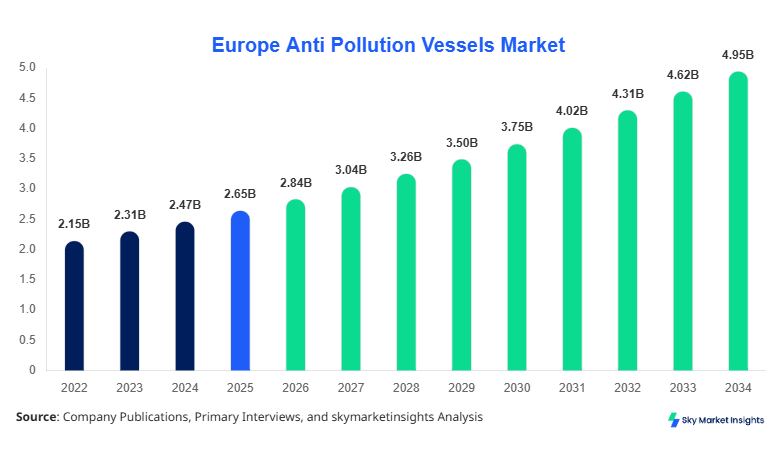
Europe Anti Pollution Vessels market size is projected at USD 2.84 billion in 2026 and is expected to hit USD 4.97 billion by 2034 with a CAGR of 7.2%. The market expansion is being supported by increasing maritime environmental regulations, rising investments in harbor waste management systems, and the modernization of marine pollution control fleets across European coastal economies. More than 1,240 anti-pollution vessels were operational across Europe in 2025, while over 185 additional units are expected to be commissioned between 2026 and 2030 to meet stricter International Maritime Organization compliance standards. Market participants are emphasizing data-driven fleet optimization, vessel automation, and hybrid propulsion integration to improve operational efficiency and strengthen the competitive landscape of the Europe Anti Pollution Vessels market size.
The anti pollution vessels industry consists of specialized marine vessels designed for oil spill containment, wastewater collection, chemical pollutant recovery, harbor waste removal, and environmental monitoring operations. Europe accounted for nearly 31% of global anti-pollution marine infrastructure spending in 2025, with France, Germany, and the United Kingdom representing more than 58% of regional procurement expenditure. European shipyards produced approximately 146 environmental protection vessels during 2024, compared with 121 vessels in 2022, reflecting a production increase of 20.6%. Adoption and penetration rates continue to rise as port authorities integrate AI-assisted navigation, sonar pollution mapping, and remote-control recovery systems. Nearly 62% of newly procured vessels in 2025 included hybrid-electric propulsion systems, while 44% integrated IoT-based contamination sensors operating at frequencies exceeding 5 GHz for real-time monitoring applications.
Consumer behavior and demand analytics indicate that marine logistics operators, offshore energy companies, and port management authorities are prioritizing environmental compliance to avoid penalties exceeding EUR 3 million per incident under European maritime environmental legislation. Marine oil spill response applications contributed nearly 46% of total vessel deployment in 2025, while wastewater management accounted for 34% and harbor pollution control represented 20%. Operational endurance improved significantly, with modern anti-pollution vessels achieving collection capacities between 600 cubic meters and 2,500 cubic meters per deployment cycle. Increasing offshore shipping activity exceeding 3.9 billion tons annually across European trade corridors continues to strengthen the Europe Anti Pollution Vessels market share.
Explore more data points, trends and opportunities Download Free Sample Report
Anti Pollution Vessels Market Trends
Hybrid and Autonomous Vessel Integration
The European maritime industry is rapidly integrating hybrid propulsion and autonomous operational systems into anti-pollution vessels to improve fuel efficiency and environmental compliance. More than 62% of new vessels delivered during 2025 included hybrid-electric propulsion, reducing operational emissions by approximately 38% compared with conventional diesel-powered systems. Shipbuilders across Germany, France, and Italy manufactured over 88 hybrid anti-pollution vessels in 2025 alone, compared with 41 units in 2022. Automated oil skimming systems capable of recovering up to 95% of surface hydrocarbons within 8 hours are becoming standard in large-capacity vessels. Demand from offshore wind energy projects increased by 29%, contributing significantly to the Europe Anti Pollution Vessels market trend.
Digital monitoring technologies are also reshaping operational performance. Nearly 57% of fleet operators adopted AI-enabled contamination analytics and satellite-based spill tracking systems capable of monitoring marine pollutants across 450 square kilometers per deployment cycle. IoT-integrated sensors operating with data transmission speeds exceeding 1.5 Gbps enabled real-time contamination detection and faster deployment response times. Advanced radar systems with scanning ranges exceeding 120 nautical miles improved incident response efficiency by 26%. Rising environmental compliance requirements continue driving the Europe Anti Pollution Vessels market trend.
Expansion of Harbor Pollution Management Programs
European ports are increasingly investing in harbor pollution management programs due to stricter maritime environmental regulations and rising shipping traffic volumes. More than 430 commercial ports across Europe initiated harbor waste reduction programs during 2024 and 2025, collectively allocating over EUR 2.1 billion toward environmental infrastructure development. Waste collection vessels capable of handling 1,200 tons of solid and liquid waste annually witnessed adoption growth exceeding 34% between 2023 and 2025. Spain, Italy, and the United Kingdom accounted for nearly 49% of harbor-focused vessel procurement expenditure.
The expansion of offshore shipping and cruise tourism also accelerated demand for advanced wastewater collection systems. Approximately 71% of large European ports implemented mandatory wastewater recovery procedures for commercial shipping vessels by 2025. Modern harbor pollution vessels now include automated filtration systems with 99.2% contaminant separation efficiency and processing capacities exceeding 3,500 cubic meters daily. Digital fleet management platforms improved operational scheduling efficiency by nearly 31%, reducing idle vessel time and lowering operational costs. Increasing investments in smart port infrastructure continue supporting Europe Anti Pollution Vessels market trend.
Europe Anti Pollution Vessels Drivers
Stringent Maritime Environmental Regulations Accelerating Fleet Modernization
European environmental authorities continue introducing stricter maritime pollution regulations, significantly driving demand for anti-pollution vessels across coastal economies. More than 82% of European ports implemented mandatory pollution mitigation compliance frameworks during 2025, compared with 61% in 2021. Regulatory penalties for oil spill incidents exceeded EUR 3.8 billion collectively across Europe between 2022 and 2025, encouraging port operators and marine logistics companies to invest heavily in pollution control fleets. France, Germany, and the United Kingdom together allocated over EUR 1.6 billion toward environmental vessel modernization programs in 2025 alone. Advanced environmental vessels equipped with AI-assisted navigation and hybrid propulsion systems reduced contamination response time by approximately 42%, increasing adoption among port management authorities and offshore energy companies. Furthermore, offshore shipping traffic surpassed 3.9 billion tons annually across European maritime trade routes, increasing environmental monitoring requirements. Governments are also expanding subsidies covering up to 28% of vessel procurement costs for low-emission anti-pollution fleets. These combined factors continue strengthening Europe Anti Pollution Vessels market growth.
Europe Anti Pollution Vessels Restraints
High Procurement and Maintenance Costs Limiting Small Operator Adoption
The high capital investment required for advanced anti-pollution vessels remains a significant restraint for regional market expansion. Modern multi-purpose environmental protection vessels cost between USD 18 million and USD 65 million depending on operational capacity, propulsion technology, and onboard treatment systems. Maintenance expenditure for hybrid-powered vessels increased by approximately 22% between 2023 and 2025 due to rising battery replacement and digital system servicing costs. Smaller port authorities handling less than 12 million tons of annual cargo often struggle to justify fleet modernization expenditure, particularly in Eastern and Southern Europe. Additionally, specialized crew training costs increased by 17% in 2025 because operators increasingly require expertise in automated navigation systems, IoT-based contamination analytics, and remote-control deployment technologies. The shortage of certified environmental vessel operators across Europe exceeded 8,500 personnel in 2025, limiting fleet utilization rates. Supply chain disruptions affecting marine electronics and advanced filtration components also increased vessel construction lead times from 14 months in 2022 to nearly 22 months in 2025. These cost-related challenges continue affecting Europe Anti Pollution Vessels market growth.
Europe Anti Pollution Vessels Opportunities
Expansion of Offshore Renewable Energy Infrastructure Creating New Demand
Rapid expansion of offshore renewable energy infrastructure across Europe presents substantial opportunities for anti-pollution vessel manufacturers and service providers. Europe commissioned more than 19 GW of offshore wind capacity between 2023 and 2025, while offshore maintenance zones expanded by approximately 27%. Environmental protection vessels are increasingly deployed around offshore wind farms to manage oil leakage risks, turbine maintenance waste, and wastewater discharge. Germany, the United Kingdom, and France collectively invested over EUR 4.2 billion in offshore environmental safety programs during 2025. Specialized vessels supporting renewable energy infrastructure operations witnessed demand growth exceeding 31% between 2023 and 2025. Hybrid-electric vessels with dynamic positioning systems capable of maintaining operational accuracy within 0.5 meters are increasingly preferred by offshore energy operators. Moreover, automated underwater drones integrated with pollution recovery vessels improved seabed contamination monitoring efficiency by 36%. Expansion of cross-border green shipping corridors connecting France, Spain, Italy, and Germany is also expected to create long-term procurement opportunities for environmental vessel manufacturers. These factors collectively support Europe Anti Pollution Vessels market demand.
Challenges in Europe Anti Pollution Vessels
Technological Integration Complexity and Regulatory Standardization Issues
The integration of advanced digital systems and the lack of standardized environmental vessel regulations across European countries remain major challenges for industry participants. More than 41% of vessel operators reported interoperability issues between onboard pollution analytics systems and regional maritime monitoring networks during 2025. Different environmental compliance standards across the United Kingdom, Russia, France, and Southern European countries increased certification complexity and delayed vessel deployment timelines by an average of 5.4 months. Furthermore, integrating AI-assisted operational platforms, satellite communication systems, and automated recovery equipment increased software calibration expenditure by nearly 24% between 2023 and 2025. Shipbuilders also face rising cybersecurity concerns as approximately 58% of modern environmental vessels now rely on cloud-connected operational platforms for real-time data exchange. Cybersecurity breaches targeting maritime infrastructure increased by 19% during 2025, encouraging operators to allocate larger budgets toward digital protection systems. The complexity of integrating hybrid propulsion, autonomous navigation, and environmental analytics technologies into a single operational framework continues creating engineering and operational challenges across the Europe Anti Pollution Vessels market.
Report Scope
| Report Metric | Details |
|---|---|
| Market Size in 2025 | USD 2.65 Billion |
| Market Size in 2026 | USD 2.84 Billion |
| Market Size in 2034 | USD 4.97 Billion |
| CAGR | 7.2% (2026-2034) |
| Base Year for Estimation | 2025 |
| Historical Data | 2022-2024 |
| Forecast Period | 2026-2034 |
| Report Coverage | Revenue Forecast, Competitive Landscape, Supply Chain Disruption, Growth Factors, Environment & Regulatory Landscape and Trends |
Explore more data points, trends and opportunities Download Free Sample Report
Anti Pollution Vessels Market Segmentation
The Europe anti pollution vessels industry is segmented based on type and application, with oil spill recovery vessels accounting for nearly 43% of total fleet deployment in 2025. Waste collection vessels contributed approximately 34%, while multi-purpose environmental protection vessels represented 23%. Marine oil spill response remained the dominant application with 46% market penetration, followed by wastewater management at 34% and harbor pollution control at 20%. Technological integration, operational capacity, and environmental efficiency remain primary segmentation differentiators.
BY TYPE
Oil spill recovery vessels represented approximately 43% of total vessel deployments across Europe during 2025 due to increasing offshore oil transportation activities and stringent environmental safety regulations. More than 520 active oil spill recovery vessels operated across European waters, with collection capacities ranging from 800 cubic meters to 3,200 cubic meters per mission cycle. These vessels utilize advanced skimming technologies capable of recovering 92% to 97% of surface hydrocarbons within contaminated marine zones. France, Germany, and the United Kingdom collectively accounted for 61% of regional procurement expenditure in this segment. Hybrid-electric propulsion adoption exceeded 58% within newly commissioned oil spill recovery fleets, reducing fuel consumption by approximately 33%. Additionally, AI-based contamination mapping systems integrated into these vessels improved spill response efficiency by nearly 28%. Increasing offshore energy projects and maritime cargo movement continue supporting demand for oil spill recovery systems.
Waste collection vessels accounted for nearly 34% of Europe’s environmental vessel fleet in 2025, supported by expanding harbor waste management programs and stricter port sanitation requirements. More than 410 waste collection vessels operated across major commercial ports, processing approximately 18.6 million cubic meters of marine waste annually. These vessels are equipped with automated filtration systems capable of separating 99% of floating contaminants and handling over 120 tons of solid waste per operational cycle. Spain and Italy together represented approximately 38% of waste collection vessel demand due to high tourism and cruise ship activity. Vessel operators increasingly integrated digital route optimization software, reducing operational fuel usage by 21% and improving waste collection efficiency by 26%. The deployment of solar-assisted auxiliary power systems also increased by 17% during 2025.
Multi-purpose environmental protection vessels contributed around 23% of the regional fleet and are increasingly preferred because of their ability to handle oil spill response, wastewater treatment, and debris collection simultaneously. Approximately 280 multi-purpose vessels operated across Europe in 2025, with onboard treatment capacities exceeding 2,000 cubic meters daily. Germany and France together accounted for 46% of procurement spending within this category. These vessels integrate dynamic positioning systems with operational precision within 0.4 meters and advanced radar systems capable of monitoring marine contamination across 150 nautical miles. Hybrid propulsion adoption exceeded 64%, while autonomous operational assistance technologies improved crew efficiency by nearly 31%. Growing demand for operational flexibility continues driving adoption across European ports and offshore infrastructure operators.
BY APPLICATION
Marine oil spill response remained the leading application segment, accounting for approximately 46% of total anti-pollution vessel deployment during 2025. Europe handled more than 3.9 billion tons of maritime cargo annually, significantly increasing the need for emergency spill response infrastructure. More than 610 vessels were actively deployed for oil spill response operations across offshore drilling zones, shipping corridors, and industrial harbor regions. These vessels integrated high-capacity skimmers capable of recovering 95% of surface oil contaminants within 10 hours of incident deployment. France, the United Kingdom, and Norway collectively contributed over 57% of regional emergency response operations. Satellite-assisted contamination mapping improved deployment accuracy by 34%, while automated oil-water separation systems processed up to 2,800 cubic meters of contaminated material daily. Increasing offshore renewable energy activities and stricter environmental penalties continue supporting application demand.
Wastewater management represented approximately 34% of application demand due to increasing environmental restrictions on industrial and shipping wastewater discharge. European ports collectively processed more than 27 million cubic meters of maritime wastewater during 2025. Over 430 wastewater-focused environmental vessels operated across the region, integrating biological treatment systems with contaminant removal efficiency exceeding 98%. Italy, Spain, and Germany represented approximately 51% of wastewater vessel deployments because of high commercial shipping activity and industrial coastal operations. Advanced onboard treatment systems reduced hazardous discharge volumes by nearly 29% compared with traditional mechanical processing systems. Automated monitoring technologies operating with sensor refresh rates below 0.8 seconds improved contamination detection speed significantly. Growing environmental awareness among port authorities and shipping operators continues accelerating wastewater management investments.
Harbor pollution control accounted for nearly 20% of total market deployment in 2025 and remains essential for maintaining environmental compliance across busy commercial ports. More than 300 specialized harbor pollution vessels operated in Europe, focusing on floating debris removal, wastewater recovery, and chemical containment. The United Kingdom, France, and Spain together represented 49% of harbor pollution management expenditure. These vessels processed approximately 9.4 million cubic meters of contaminated harbor water annually and removed over 2.1 million tons of floating debris and solid waste materials. Smart port integration technologies improved fleet coordination efficiency by 32%, while automated navigation systems reduced harbor response times by 24%. Increasing cruise tourism and urban coastal industrialization continue driving harbor pollution control operations throughout Europe.
Europe Anti Pollution Vessels Market Segmentations
Type
- Oil Spill Recovery Vessels
- Waste Collection Vessels
- Multi-purpose Environmental Protection Vessels
Application
- Marine Oil Spill Response
- Wastewater Management
- Harbor Pollution Control
Europe Anti Pollution Vessels Regional Outlook
United Kingdom
The United Kingdom accounted for approximately 19% of Europe’s anti-pollution vessel deployment during 2025 due to strong offshore energy operations and expanding green shipping initiatives. More than 185 specialized environmental vessels operated across British coastal waters and industrial ports, processing approximately 7.2 million cubic meters of contaminated marine waste annually. Offshore oil spill response represented 51% of vessel activity, while wastewater treatment contributed 29% and harbor contamination management accounted for 20%. The UK government invested nearly EUR 620 million in maritime environmental infrastructure modernization between 2023 and 2025. More than 58% of new vessels integrated hybrid-electric propulsion systems, reducing fuel consumption by 36%. Smart port initiatives across Liverpool, Southampton, and London improved pollution response coordination efficiency by 27%.
Germany
Germany represented nearly 17% of regional market activity in 2025 and maintained a strong presence in advanced vessel manufacturing and environmental engineering technologies. German shipyards produced more than 28 anti-pollution vessels during 2025, while operational fleets exceeded 160 active units. Wastewater management applications accounted for 39% of deployment demand because of industrial shipping and manufacturing activity across Hamburg and Bremen ports. Germany invested over EUR 540 million in AI-assisted maritime pollution control technologies between 2024 and 2025. Approximately 67% of newly delivered German vessels integrated autonomous navigation systems and advanced contamination analytics platforms capable of monitoring pollutants across 500 square kilometers. Offshore renewable energy infrastructure expansion also increased environmental vessel deployment by 24%.
France
France held approximately 24% of Europe’s anti-pollution vessel infrastructure in 2025, supported by extensive Atlantic and Mediterranean maritime operations. More than 210 environmental vessels operated across French waters, including 92 oil spill recovery units and 68 wastewater management vessels. French shipyards manufactured approximately 34 specialized anti-pollution vessels during 2025, reflecting a 19% increase compared with 2023. Offshore shipping activity exceeding 325 million metric tons annually increased demand for advanced environmental response systems. France allocated over EUR 780 million toward maritime environmental modernization programs, including AI-assisted spill recovery systems and low-emission propulsion technologies. Nearly 68% of the French fleet integrated hybrid-electric propulsion systems, while automated oil recovery technologies improved operational efficiency by 33%.
Spain
Spain accounted for nearly 13% of regional demand during 2025 due to increasing tourism, cruise shipping, and Mediterranean harbor modernization programs. More than 140 anti-pollution vessels operated across Spanish ports, processing over 4.8 million cubic meters of wastewater and marine contaminants annually. Waste collection applications represented 42% of total vessel deployment because of extensive cruise ship activity in Barcelona and Valencia. Spain invested approximately EUR 410 million in smart harbor pollution management systems between 2023 and 2025. Nearly 49% of Spanish environmental vessels integrated digital route optimization systems capable of reducing operational fuel consumption by 22%. Growing Mediterranean maritime trade activity continues supporting fleet expansion.
Italy
Italy represented around 12% of Europe’s environmental vessel demand in 2025, supported by increasing industrial shipping and coastal tourism activity. More than 132 anti-pollution vessels operated across Italian ports, with wastewater management applications contributing nearly 38% of deployment activity. Italy processed approximately 5.1 million cubic meters of maritime wastewater annually through specialized environmental fleets. Hybrid propulsion integration exceeded 53% within newly commissioned vessels, while automated filtration systems achieved contaminant removal efficiency exceeding 98%. Italy allocated over EUR 350 million toward marine environmental infrastructure modernization during 2025, including smart monitoring systems and advanced harbor waste management equipment. Rising cruise tourism and industrial exports continue driving fleet modernization initiatives.
Russia
Russia accounted for approximately 9% of regional anti-pollution vessel deployment, primarily concentrated around Baltic and Arctic maritime routes. More than 95 environmental vessels operated within Russian-controlled European waters during 2025, focusing mainly on oil spill response operations linked to offshore energy infrastructure. Oil spill recovery applications represented 61% of deployment activity due to extensive crude oil transportation and Arctic drilling operations. Russia invested nearly EUR 280 million in environmental fleet upgrades between 2023 and 2025. Approximately 41% of vessels integrated automated ice-resistant navigation systems and advanced oil containment technologies capable of operating under sub-zero conditions. Increasing Arctic shipping activity and offshore energy projects continue strengthening environmental protection infrastructure requirements.
Top players in Europe Anti Pollution Vessels
- Mitsubishi Heavy Industries
- Damen Shipyards Group
- Fincantieri S.p.A.
- Naval Group
- Babcock International Group
- Bollinger Shipyards
- Hitzler Werft
- Abeking & Rasmussen
- Sembcorp Marine
- Keppel Offshore & Marine
- HYUNDAI Heavy Industries
- Sanmar Shipyards
- VARD Group
- Eastern Shipbuilding Group
- Meyer Werft
Damen Shipyards Group
-
Estimated regional positioning share of approximately 11%
-
Strong presence across hybrid environmental vessel manufacturing
-
Extensive partnerships with European port authorities
-
Specialized in multi-purpose environmental protection vessels
Damen Shipyards Group maintained a dominant position within Europe’s anti-pollution vessel manufacturing landscape during 2025. The company delivered more than 22 environmental protection vessels across Europe between 2024 and 2025, including hybrid-powered oil spill recovery systems and harbor waste collection platforms. Approximately 63% of Damen’s environmental fleet included autonomous operational support technologies and AI-assisted navigation systems. The company strengthened its position through partnerships with French and German port operators, focusing on low-emission vessel technologies and integrated waste recovery systems. Damen’s extensive product portfolio and operational flexibility continue supporting strong competitive positioning.
Fincantieri S.p.A.
-
Estimated regional positioning share of approximately 9%
-
Strong expertise in wastewater management vessel construction
-
Major supplier for Mediterranean environmental operations
-
Focus on advanced hybrid propulsion integration
Fincantieri S.p.A. remained one of the leading European environmental vessel manufacturers during 2025 due to extensive engineering expertise and strong Mediterranean market presence. The company produced over 16 specialized anti-pollution vessels in 2025, including high-capacity wastewater treatment vessels and multi-purpose environmental response ships. Approximately 58% of Fincantieri’s environmental vessel portfolio incorporated hybrid-electric propulsion technologies capable of reducing operational emissions by nearly 37%. The company also invested heavily in smart monitoring systems, automated oil recovery technologies, and advanced digital fleet analytics. Strategic collaborations with Italian and Spanish port authorities further strengthened the company’s regional market positioning.
Investment Analysis
European investments in anti-pollution vessel infrastructure increased significantly between 2023 and 2025, surpassing EUR 5.8 billion collectively across environmental fleet modernization, smart harbor systems, and offshore contamination management projects. France, Germany, and the United Kingdom together accounted for approximately 61% of total regional investment allocation. Offshore energy infrastructure projects represented nearly 34% of investment activity, while harbor pollution control contributed 29%, wastewater management accounted for 23%, and oil spill response systems represented 14%. Hybrid propulsion technology adoption attracted more than EUR 1.7 billion in direct investment during 2025 due to rising low-emission compliance requirements.
Mergers, acquisitions, and collaboration agreements also increased considerably across the European environmental marine sector. More than 26 strategic collaborations were announced between shipbuilders, AI software providers, and maritime environmental agencies during 2024 and 2025. Germany-based engineering firms partnered with French shipyards to develop autonomous oil spill recovery systems capable of reducing deployment time by 31%. Italy and Spain initiated cross-border harbor pollution management agreements covering over 48 Mediterranean ports. Additionally, private equity investment in maritime environmental technology startups increased by approximately 22% during 2025, with a strong focus on digital monitoring systems and automated waste processing equipment.
Public-private partnerships continue accelerating environmental infrastructure deployment across Europe. Nearly 46% of new environmental vessel procurement programs launched during 2025 were financed through combined government and private sector investment structures. Offshore renewable energy operators allocated approximately EUR 920 million toward environmental monitoring and spill containment systems. Increased demand for AI-enabled environmental analytics, hybrid propulsion systems, and automated waste management technologies continues generating strong investment opportunities across the regional industry.
New Product Developments
Environmental vessel manufacturers across Europe accelerated new product development activities during 2025, focusing on hybrid propulsion integration, autonomous navigation systems, and advanced waste recovery technologies. More than 37% of newly launched anti-pollution vessels included AI-assisted contamination analytics capable of improving operational response accuracy by 33%. Advanced oil spill recovery systems introduced during 2025 achieved hydrocarbon collection efficiency exceeding 96%, while reducing fuel consumption by approximately 29% compared with earlier vessel generations.
Manufacturers also introduced compact multi-purpose environmental vessels specifically designed for urban harbor applications and offshore renewable energy zones. Nearly 41% of newly developed vessel models integrated modular onboard wastewater treatment systems capable of processing over 2,500 cubic meters daily. Digital fleet management software upgrades improved route optimization efficiency by 26%, while automated filtration technologies enhanced contaminant separation rates beyond 99%. Increasing focus on sustainable marine infrastructure and environmental compliance continues driving innovation throughout the industry.
Recent Developments in Europe Anti Pollution Vessels
- 2025: European shipbuilders accelerated the development of hybrid-electric and autonomous anti-pollution vessels, with 62% of newly delivered vessels incorporating hybrid propulsion systems to reduce emissions and improve operational efficiency.
- 2025: France expanded maritime environmental modernization initiatives, investing in advanced pollution response vessels, automated waste recovery systems, and low-emission propulsion technologies.
Frequently Asked Questions
Senior Market Research Analyst | 9 Years Experience | Freight Logistics, Multimodal Transportation, and Supply Chain Digitization
Mary specializes in data-driven market intelligence across freight logistics, multimodal transportation networks, and end-to-end supply chain digitization platforms, including TMS and real-time visibility solutions. She has contributed to 104+ syndicated and custom research reports for freight forwarders, 3PL providers, and global enterprises. Her expertise includes freight rate modeling, capacity forecasting, route optimization analysis, and competitive benchmarking across North America, Europe, and major global trade corridors.