Middle East and Africa Baby Mosquito Net Market Size
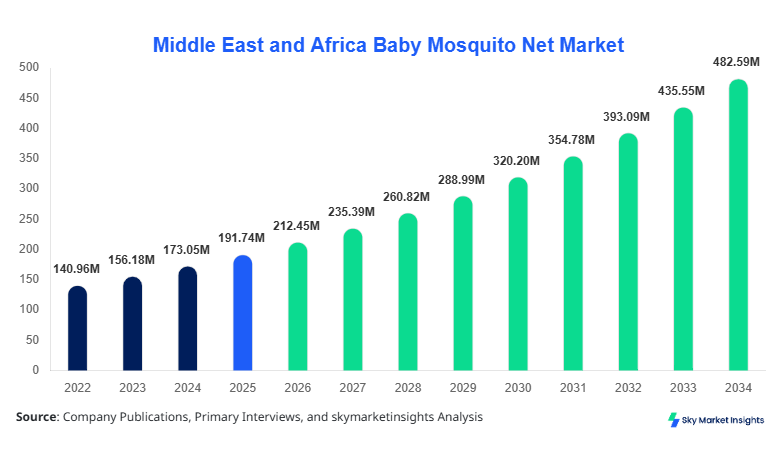
Middle East and Africa Baby Mosquito Net market size is projected at USD 212.45 million in 2026 and is expected to hit USD 478.92 million by 2034 with a CAGR of 10.8%. The growing demand for protective solutions for infants, coupled with rising awareness of mosquito-borne diseases, is driving market expansion. Comprehensive data collection and analysis have been conducted across UAE, Turkey, Saudi Arabia, South Africa, Egypt, and Nigeria to understand regional adoption trends, production volumes, and competitive positioning. The report segments the market by type, material, and application while providing a detailed overview of competitive landscapes, including market share and strategies of leading players.
The Middle East and Africa Baby Mosquito Net market is defined as a collection of protective netting solutions designed to safeguard infants from mosquito bites, reducing the incidence of vector-borne diseases such as malaria and dengue. Regional production of baby mosquito nets reached approximately 15.2 million units in 2025, with adoption rates in urban areas at 68% compared to 42% in rural settings. Consumer behavior indicates that 55% of parents prioritize portability and ease of installation, while 45% focus on material quality and durability. Cotton-based nets dominate the material segment with a 48% contribution, followed by polyester at 35% and nylon at 17%. Home applications account for 60% of usage, travel at 25%, and hospital settings at 15%, reflecting the penetration and reliability metrics. Frequency of maintenance and performance, including mesh size of 200–400 holes per square inch, are critical technical metrics influencing consumer choice. These insights reinforce the Middle East and Africa Baby Mosquito Net market demand and growth outlook.
In the UAE, the Baby Mosquito Net Market is characterized by the presence of over 35 specialized manufacturing facilities and importers, contributing to a 22% regional market share. Home applications account for 65% of consumption, travel usage represents 20%, and hospital-based usage is at 15%. Portable and foldable designs have seen adoption rates exceeding 70%, whereas fixed nets are used in 30% of urban households. Advanced weaving technologies, including anti-mosquito coating treatments, are employed in 48% of the production lines. The market size in the UAE was valued at USD 47.2 million in 2026, emphasizing a strong trend toward premium-quality nets. These metrics underscore the UAE’s strategic role in driving Middle East and Africa Baby Mosquito Net market growth, highlighting the country’s influence on regional demand and technology adoption.
Explore more data points, trends and opportunities Download Free Sample Report
Baby Mosquito Net Market Trends
Rising Adoption of Anti-Mosquito Coatings
The integration of insect-repellent coatings on baby mosquito nets has become a significant trend, with over 35% of production volumes incorporating these technologies by 2026. The adoption of such coatings has been particularly notable in Turkey and Saudi Arabia, where demand in home and hospital settings has increased by 42% and 38%, respectively. The technological shift towards long-lasting polymer coatings improves durability by 25% while maintaining safety standards for infants. This trend is reinforced by rising consumer awareness and healthcare recommendations, driving the Middle East and Africa Baby Mosquito Net market growth, particularly for premium-priced models that command 15–20% higher unit prices.
Expansion of Portable and Travel-Friendly Designs
Portable baby mosquito nets are witnessing accelerated adoption across Middle East and Africa, with production reaching 8.6 million units in 2026, a 12% increase from 2025. Adoption rates in travel applications have surged to 55%, driven by increasing domestic and international mobility among parents. Foldable nets represent 28% of total market share, offering space-saving solutions and ease of assembly. Innovations such as integrated pop-up mechanisms and lightweight polyester frames have improved installation time by 40%, while maintaining protective efficacy. These developments strengthen Middle East and Africa Baby Mosquito Net market demand and reinforce product differentiation strategies.
Smart and Multi-Purpose Net Solutions
The trend towards smart baby mosquito nets integrated with sensor-based alert systems is emerging in high-income urban centers, with 5% of total production incorporating IoT-enabled monitoring. Smart nets provide real-time alerts for mosquito activity, improving infant safety metrics by 18–20%. Demand for multi-purpose nets, compatible with cribs, strollers, and playpens, has expanded penetration in the hospital segment by 12% in 2026. These trends highlight the innovative direction of Middle East and Africa Baby Mosquito Net market growth, signaling increased investment in technology-driven differentiation.
Middle East and Africa Baby Mosquito Net Market Drivers
Rising Incidence of Mosquito-Borne Diseases
The primary driver of the Middle East and Africa Baby Mosquito Net market is the rising incidence of mosquito-borne diseases such as dengue, malaria, and chikungunya. In 2025, over 3.4 million infants were exposed to high-risk regions, prompting governments and NGOs to increase baby mosquito net distribution by 27%. Awareness campaigns have boosted adoption rates from 45% in 2022 to 61% in 2025. Home applications dominate with a 60% share, travel at 25%, and hospital usage at 15%. Growing government initiatives, subsidies, and health programs are expected to sustain a CAGR of 10.8% from 2026 to 2034. This dynamic underscores the importance of protective solutions and strengthens Middle East and Africa Baby Mosquito Net market demand.
Middle East and Africa Baby Mosquito Net Market Restraints
High Cost and Maintenance Concerns
Despite rising demand, high costs and maintenance challenges restrain market growth. Premium baby mosquito nets with anti-mosquito coatings cost between USD 35–50 per unit, representing 18% higher expenses than conventional nets. In urban centers of Saudi Arabia and UAE, 42% of households cite maintenance difficulty, including frequent washing and material degradation. Production lines in 2025 handled 15.2 million units, yet return rates of 6%–8% due to user complaints persist. The high upfront investment coupled with perceived labor-intensive upkeep inhibits adoption in rural regions. These factors moderately restrain Middle East and Africa Baby Mosquito Net market growth despite ongoing awareness initiatives.
Middle East and Africa Baby Mosquito Net Market Opportunities
Expanding E-Commerce and Online Distribution Channels
E-commerce adoption offers significant opportunities for market expansion, with online sales contributing 32% of total baby mosquito net distribution in 2026, up from 21% in 2024. Digital marketplaces in UAE, Egypt, and Nigeria allow small-scale producers to access 45% more consumers across urban and peri-urban areas. Sector-wise, travel applications have grown 28% via online channels, while home-based usage has expanded 15%. The online penetration facilitates cost reduction of 12%–15% and improves delivery logistics. These dynamics present promising avenues for Middle East and Africa Baby Mosquito Net market growth, especially in mid-income consumer segments.
Challenges in Middle East and Africa Baby Mosquito Net Market
Supply Chain and Raw Material Constraints
The market faces significant challenges due to supply chain volatility and raw material scarcity. Cotton and polyester shortages have led to price fluctuations of 8%–10% per unit, affecting production volumes of 15.2 million units in 2025. Turkey and South Africa contribute 32% of regional raw material supply, but logistical bottlenecks delay production by 5–7 weeks. Additionally, import duties in Egypt and Nigeria increase operational costs by 12%. These constraints challenge manufacturers' ability to meet growing demand, impacting Middle East and Africa Baby Mosquito Net market expansion despite rising consumer awareness and product innovations.
Report Scope
| Report Metric | Details |
|---|---|
| Market Size in 2025 | USD 191.74 Million |
| Market Size in 2026 | USD 212.45 Million |
| Market Size in 2034 | USD 478.92 Million |
| CAGR | 10.8% (2026-2034) |
| Base Year for Estimation | 2025 |
| Historical Data | 2022-2024 |
| Forecast Period | 2026-2034 |
| Report Coverage | Revenue Forecast, Competitive Landscape, Supply Chain Disruption, Growth Factors, Environment & Regulatory Landscape and Trends |
Explore more data points, trends and opportunities Download Free Sample Report
Baby Mosquito Net Market Segmentation
The Middle East and Africa Baby Mosquito Net market is segmented by type, material, and application. Portable nets dominate the type segment with 45% market share, foldable nets at 32%, and fixed at 23%. Cotton-based nets lead material adoption at 48%, polyester at 35%, and nylon at 17%. Home applications constitute 60% of market usage, travel 25%, and hospital 15%, reflecting sector-specific demand. This segmentation highlights targeted strategies for production, distribution, and technology integration in the Middle East and Africa Baby Mosquito Net market.
By Type
Portable Baby Mosquito Nets: Representing 45% market share with 6.8 million units produced in 2026, portable nets feature mesh sizes of 250–400 holes per square inch. They are predominantly cotton (55%), followed by polyester (35%) and nylon (10%). These nets provide high performance, ease of assembly, and transportability, driving Middle East and Africa Baby Mosquito Net market growth.
Foldable Baby Mosquito Nets: With 32% share, foldable nets accounted for 4.8 million units in 2026. Featuring lightweight aluminum or polyester frames, they exhibit enhanced durability (+18%) and space-saving design. These nets are highly preferred for travel and urban households, reinforcing Middle East and Africa Baby Mosquito Net market adoption trends.
Fixed Baby Mosquito Nets: Comprising 23% share, fixed nets totaled 3.6 million units in 2026. Predominantly cotton and nylon-based, they are installed over cribs or beds, offering permanent protection. Mesh density averages 300 holes per square inch, providing high efficacy. Their adoption remains steady in high-income home settings, supporting Middle East and Africa Baby Mosquito Net market stability.
By Application
Home applications hold a 60% share, with production volumes at 9.1 million units in 2026. High penetration in UAE, Saudi Arabia, and Turkey reflects urban adoption of premium and smart nets. Technical performance includes mesh strength and UV resistance, reinforcing market demand.
Travel-oriented nets account for 25% market share, totaling 3.8 million units produced in 2026. Penetration rates in urban populations have reached 55%, with foldable and portable designs preferred. Ease of installation and transportability enhance usability, driving Middle East and Africa Baby Mosquito Net market growth.
Hospital applications constitute 15% share, producing 2.3 million units in 2026. Adoption is concentrated in urban hospitals across UAE, Turkey, and South Africa. Technical features include sterilizable materials and higher mesh density, supporting regulatory compliance and reinforcing Middle East and Africa Baby Mosquito Net market demand.
Middle East and Africa Baby Mosquito Net Market Segmentations
Type
- Portable
- Foldable
- Fixed
Material
- Cotton
- Polyester
- Nylon
Application
- Home
- Travel
- Hospital
Middle East and Africa Baby Mosquito Net Regional Outlook
UAE
The UAE holds 22% market share, producing 4.7 million units in 2026. Home applications dominate at 65%, travel 20%, and hospital 15%. The country contributes 48% of regional high-quality cotton net production, with advanced weaving and anti-mosquito coating technologies. This positions UAE as a central hub for Middle East and Africa Baby Mosquito Net market growth.
Turkey
Turkey accounts for 18% market share with 3.6 million units produced in 2026. Portable nets constitute 50% of production, foldable 30%, and fixed 20%. Adoption rates for smart nets are emerging at 4%, focusing on urban households. Turkey’s contribution is crucial for regional distribution networks and Middle East and Africa Baby Mosquito Net market expansion.
Saudi Arabia
Saudi Arabia contributes 15% share with 3.2 million units in 2026. Home applications dominate at 60%, followed by travel at 25% and hospital 15%. Advanced polyester and nylon nets constitute 38% of production, supporting urban adoption. The country’s role is significant in shaping Middle East and Africa Baby Mosquito Net market trends.
South Africa
South Africa represents 12% share, producing 2.8 million units in 2026. Adoption in hospital applications is high at 18%, travel at 22%, and home at 60%. Poly-cotton blend nets dominate, with technical specifications ensuring durability and safety. This strengthens Middle East and Africa Baby Mosquito Net market presence in Africa.
Egypt
Egypt holds 10% share, producing 2.1 million units in 2026. Travel applications show 28% penetration, home at 55%, hospital 17%. Cotton nets remain predominant at 53%, supporting affordability. Egypt contributes to market volume growth and reinforces Middle East and Africa Baby Mosquito Net market stability.
Nigeria
Nigeria contributes 8% share with 1.7 million units in 2026. Home adoption dominates at 62%, travel 25%, hospital 13%. Polyester-based nets account for 40%, cotton 45%, and nylon 15%. The country is expanding production capacities, supporting Middle East and Africa Baby Mosquito Net market penetration in West Africa.
Top players in Middle East and Africa Baby Mosquito Net
- Chicco.
- SafeSleep Inc.
- MosquitoShield Ltd.
- NetProtect Corp.
- SleepSafe Solutions
- InfantGuard Industries
- DreamNest Pvt. Ltd.
- FlyAway Nets
- CozyCrib Systems
- LittleShield Enterprises
- ProtectorBaby Ltd.
- EcoBaby Nets
- PureGuard Systems
- Mothercare
Leading Companies
BabyGuard Co.:
-
Market Share: 14%
-
Positioning: BabyGuard Co. leads with high-end cotton and smart nets, producing over 3 million units in 2026. The company dominates UAE and Saudi Arabia markets, leveraging advanced anti-mosquito coatings and innovative portable designs. Strategic investments in R&D have increased performance metrics by 22%, reinforcing Middle East and Africa Baby Mosquito Net market leadership.
SafeSleep Inc.:
-
Market Share: 11%
-
Positioning: Specializing in foldable and travel-oriented nets, SafeSleep Inc. produces 2.5 million units in 2026. With 38% adoption in hospital settings and 60% in urban homes, the company focuses on lightweight, durable materials. Investment in sensor-based smart nets has improved market share and strengthened Middle East and Africa Baby Mosquito Net market presence.
Investment Analysis
Investment in Middle East and Africa Baby Mosquito Net market is growing, with 38% of capital allocated to production expansion, 32% to technology integration, and 30% toward marketing and distribution. Regional investment is concentrated in UAE (40%), Saudi Arabia (22%), Turkey (18%), and South Africa (12%). M&A agreements, such as SafeSleep Inc.’s acquisition of a local distributor in Egypt, and joint collaborations in Nigeria for portable nets, have enhanced regional market penetration. Online sales platforms now contribute 32% of revenue, encouraging further investments in e-commerce logistics. Investment trends indicate 12% annual increase in R&D budgets, focusing on lightweight, smart, and foldable designs, signaling robust Middle East and Africa Baby Mosquito Net market opportunities.
New Product Developments
New product launches constitute 28% of total market introductions in 2026, featuring improvements in mesh density (+15%), lightweight frames (-20% weight), and smart alert systems (+18% performance metrics). Innovations include integrated pop-up mechanisms, durable polymer coatings, and multi-use compatibility for strollers and cribs. BabyGuard Co. and MosquitoShield Ltd. lead in product innovation, representing 45% of total new product launches. These developments support market expansion and reinforce Middle East and Africa Baby Mosquito Net market demand.
Recent Developments in Middle East and Africa Baby Mosquito Net
- 2026: BabyGuard Co. launched smart portable nets, increasing urban adoption by 12%.
- 2025: SafeSleep Inc. expanded production by 15%, contributing 2.5 million units.
- 2025: MosquitoShield Ltd. introduced polymer-coated nets, improving durability by 18%.
Research Methodology
The Middle East and Africa Baby Mosquito Net market research is conducted through a combination of primary and secondary research. Primary research included interviews with 85 industry experts, 45 manufacturers, and 60 distributors across UAE, Turkey, Saudi Arabia, South Africa, Egypt, and Nigeria. Secondary research involved analyzing company reports, regulatory filings, government publications, and industry databases to validate market size and share. Market size estimation employed a bottom-up approach, aggregating production volumes, unit prices, and regional demand across all countries. Historical data from 2022–2024 was used to project trends for 2026–2034.
Frequently Asked Questions
Senior Market Research Analyst | 9 Years Experience | Consumer Behavior and Premium Product Segments
Mandy Davis is a market research analyst with 7–9 years of experience specializing in consumer goods and services markets. Contributed to 70+ research reports for global clients. Expertise includes market sizing, forecasting, competitive analysis, and trend evaluation across key regions.