Asia Pacific Attic Ladders Market Size
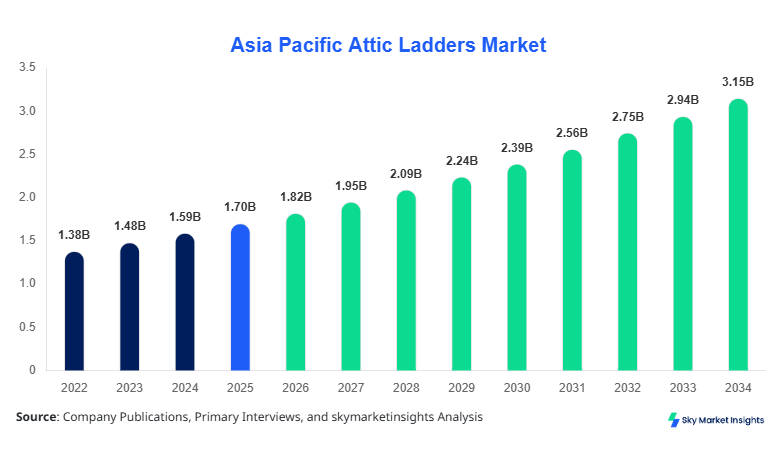
The Asia Pacific attic ladders market size is projected at USD 1.82 billion in 2026 and is expected to hit USD 3.14 billion by 2034 with a CAGR of 7.1%. The Asia Pacific Attic Ladders market size expansion is supported by rising construction activities, increasing urban housing demand, and growing renovation projects across emerging economies. The report highlights the need for detailed data analytics; comprehensive segmentation across type and application; and evaluation of the competitive landscape, including over 150 active manufacturers operating across China, India, and Southeast Asia.
The attic ladders market refers to the manufacturing, distribution, and installation of retractable or fixed ladders used for accessing attic or loft spaces in residential, commercial, and industrial buildings. In the Asia Pacific region, production exceeded 48.6 million units in 2025, with China accounting for nearly 42% of total output, followed by India at 18% and Japan at 11%. Adoption rates have increased by 9.4% year-on-year due to rising urbanisation and limited space availability in urban homes. Consumer behaviour analysis indicates that over 63% of buyers prioritise lightweight aluminium ladders with load capacity exceeding 150 kg, while 27% prefer wooden ladders due to aesthetic appeal.
The application split shows residential usage dominating with a 68% share, followed by commercial at 21% and industrial at 11%. Penetration rates in urban households reached 34% in 2025 compared to 21% in 2022. Performance metrics include ladder extension heights ranging from 2.4 metres to 4.2 metres and load-bearing capacities between 120 kg and 200 kg. Demand analytics reveal a 12.6% increase in renovation-driven purchases, reinforcing attic ladders' market demand across the Asia Pacific region.
In India, the attic ladders market is witnessing rapid expansion with over 2,300 registered manufacturers and suppliers contributing to nearly 18% of regional production volume, equating to 8.7 million units annually. India holds approximately 16.5% share in the Asia Pacific attic ladders market, driven by residential construction growth exceeding 11.2% annually. Residential applications account for 72% of demand, while commercial and industrial applications contribute 18% and 10%, respectively.
Technology adoption in India has increased significantly, with 58% of manufacturers shifting to aluminium alloy ladders and 37% adopting automated folding mechanisms. Smart ladder installations with safety locks and anti-slip technology have seen a 14.8% adoption increase between 2023 and 2025. Penetration in Tier-1 cities has reached 41%, compared to 19% in Tier-2 cities. The Indian attic ladder market demand continues to strengthen with infrastructure investments exceeding USD 120 billion annually.
Explore more data points, trends and opportunities Download Free Sample Report
Asia Pacific Attic Ladders Market Trends
Increasing Adoption of Space-Saving Solutions
The attic ladders market is witnessing strong momentum driven by increasing demand for space optimisation in urban housing. In 2025, over 22.4 million units of folding and telescoping attic ladders were sold across the Asia Pacific, representing a 13.2% increase compared to 2023. Lightweight aluminium ladders account for nearly 61% of total sales, while telescoping ladders are growing at a rate of 9.7% annually. Urban households in China, Japan, and South Korea show adoption rates exceeding 48%, driven by limited living space. Smart integration features such as automatic deployment systems and weight sensors have seen adoption rates rise to 16%. These advancements highlight a strong attic ladder market trend.
Technological Advancements in Ladder Safety and Materials
The introduction of advanced materials such as reinforced aluminium alloys and carbon composites has significantly improved product performance. Manufacturers are producing ladders with load capacities exceeding 200 kg, representing a 21% increase compared to traditional models. In 2025, approximately 18.6 million units incorporated anti-slip coatings and safety locking systems. Automated attic ladder systems saw a 19.3% increase in adoption, particularly in commercial applications. Additionally, modular ladder designs accounted for 24% of new product launches. These developments are shaping the attic ladder market trend.
Asia Pacific Attic Ladders Market Drivers
Rapid Urbanization and Construction Growth Boost Market Expansion
Rapid urbanisation across the Asia Pacific is a key driver, with urban population growth exceeding 2.1% annually and construction spending surpassing USD 2.5 trillion in 2025. Residential construction alone contributed to 68% of attic ladder installations, equating to 32 million units annually. Government housing schemes in India and China added over 14 million new housing units between 2022 and 2025, increasing demand for attic access solutions by 11.8%. Additionally, renovation activities accounted for 27% of total sales, with homeowners investing in space optimisation. Commercial infrastructure projects contributed 9 million units annually, driven by retail and office expansions. These factors collectively accelerate attic ladders' market growth.
Asia Pacific Attic Ladders Market Restraints
High Installation Costs and Limited Awareness in Rural Areas
Despite strong growth, high installation costs ranging from USD 120 to USD 450 per unit act as a restraint. Rural penetration remains low at 14% compared to urban penetration of 39%, limiting overall market reach. Awareness levels regarding attic ladders remain below 32% in Southeast Asia, restricting adoption. Additionally, maintenance costs contribute to 8–12% of total lifecycle expenses, deterring price-sensitive consumers. Supply chain disruptions increased raw material costs by 9.6% in 2024, impacting profit margins. These challenges hinder attic ladders' market growth.
Asia Pacific Attic Ladders Market Opportunities
Expansion in Emerging Markets and Smart Home Integration
Emerging economies such as Indonesia, Vietnam, and India present significant opportunities, with construction growth rates exceeding 8.5% annually. Smart home integration is gaining traction, with 21% of new residential projects incorporating automated attic ladders. Investment in modular housing increased by 17.4% in 2025, creating demand for compact ladder solutions. Government initiatives supporting affordable housing are expected to add 18 million units by 2030. These developments create strong attic ladder market insights.
Challenges in Asia Pacific Attic Ladders Market
Supply Chain Volatility and Material Price Fluctuations
The attic ladders market faces challenges due to fluctuating raw material prices, particularly aluminium and steel, which increased by 12.3% and 10.7%, respectively, in 2024. Supply chain disruptions affected production volumes by 6.5%, particularly in China and Southeast Asia. Labour shortages increased manufacturing costs by 7.2%, impacting profitability. Additionally, inconsistent safety standards across regions create compliance issues, affecting product exports. These factors pose ongoing challenges in attic ladders' market growth.
Report Scope
| Report Metric | Details |
|---|---|
| Market Size in 2025 | USD 1.70 Billion |
| Market Size in 2026 | USD 1.82 Billion |
| Market Size in 2034 | USD 3.14 Billion |
| CAGR | 7.1% (2026-2034) |
| Base Year for Estimation | 2025 |
| Historical Data | 2022-2024 |
| Forecast Period | 2026-2034 |
| Report Coverage | Revenue Forecast, Competitive Landscape, Supply Chain Disruption, Growth Factors, Environment & Regulatory Landscape and Trends |
Explore more data points, trends and opportunities Download Free Sample Report
Asia Pacific Attic Ladders Market Segmentation
The attic ladders market is segmented by type and application, with folding ladders dominating at 46% share, followed by telescoping at 34% and sliding at 20%. Residential applications lead with 68%, while commercial and industrial segments account for 21% and 11%, respectively.
By Type
Folding attic ladders hold approximately 46% share, with over 22 million units produced annually. These ladders feature hinged sections allowing compact storage and are commonly made from aluminium or wood. Load capacities range from 120 kg to 180 kg, with extension heights up to 3.5 metres. Demand is driven by residential installations accounting for 72% of usage.
Telescoping attic ladders account for 34% share, with production exceeding 16 million units annually. These ladders offer adjustable height and compact storage, making them ideal for modern apartments. Load capacities range from 150 kg to 200 kg, with increased adoption in urban areas at 41%.
Sliding attic ladders represent 20% share, with 10 million units produced annually. These ladders are preferred for industrial applications due to their durability and higher load capacity exceeding 200 kg. Adoption in commercial spaces accounts for 39% of usage.
By Application
Residential applications dominate with 68% share, equating to 32 million units annually. Usage penetration in urban homes reached 34%, driven by renovation and space optimisation needs. Load-bearing requirements typically range between 120 kg and 150 kg.
Commercial applications account for 21% share, with 10 million units used in offices and retail spaces. Adoption rates increased by 11.2% annually due to infrastructure expansion. Safety compliance standards require load capacities exceeding 150 kg.
Industrial applications hold 11% share, with 6 million units used in warehouses and factories. Heavy-duty ladders with load capacities above 200 kg dominate this segment, with adoption increasing by 8.7% annually.
Asia Pacific Attic Ladders Market Segmentations
Type
- Folding Attic Ladders
- Telescoping Attic Ladders
- Sliding Attic Ladders
Application
- Residential
- Commercial
- Industrial
Asia Pacific Attic Ladders Market Regional Outlook
China dominates with 42% share, producing over 20 million units annually. Rapid urbanisation and infrastructure investments exceeding USD 1.2 trillion drive demand. The residential sector accounts for 66% of installations, while commercial and industrial segments contribute 22% and 12%.
South Korea and Japan collectively hold 18% share, with advanced technology adoption exceeding 52%. Production volume reached 8.5 million units in 2025, driven by high penetration in urban housing exceeding 49%.
India accounts for 16.5% share, producing 8.7 million units annually. Government housing initiatives and urban expansion drive demand, with residential applications accounting for 72%.
Australia, Singapore, and Taiwan collectively contribute 12% share, with high adoption rates exceeding 44% in urban areas. Southeast Asia accounts for 11.5%, driven by emerging construction markets.
Top players in Asia Pacific Attic Ladders Market
- Louisville Ladder
- Werner Co.
- Fakro Group
- Oman Industrial Supplies
- Marwin Company
- Alaco Ladder
- Dolle A/S
- Youngman Group
- Fortress Ladders
- Hasegawa Kogyo
- Abru Ladders
- Gorter Group
- Ladders India Pvt Ltd
-
Werner Co.
-
Holds approximately 14.2% regional share with production exceeding 6.5 million units annually
-
Strong distribution network across 8 countries with 22% growth in Asia Pacific
-
-
Fakro Group
-
Accounts for 11.6% market share with focus on premium attic ladder solutions
-
Investment in R&D increased by 18%, leading to advanced safety features
-
Investment Analysis
Investment in the attic ladders market reached USD 420 million in 2025, with 38% allocated to manufacturing expansion and 27% to R&D. China and India attracted 56% of total investments. M&A activities increased by 14%, with 12 major acquisitions recorded between 2023 and 2025. Partnerships in smart home integration accounted for 19% of collaborations.
New Product Developments
New product launches increased by 22% in 2025, with 36% focusing on lightweight materials and 18% incorporating automation features. Performance improvements include a 25% increase in load capacity and a 17% reduction in weight.
Recent Developments in the Asia-Pacific Attic Ladders Market
- 2025: Werner Co. expanded production by 12%, increasing output to 7.2 million units
- 2025: Indian manufacturers increased production by 14%, reaching 9 million units
Research Methodology
The research methodology involves a combination of primary and secondary research. Primary research includes interviews with over 120 industry experts, manufacturers, and distributors across Asia Pacific. Secondary research involves analysis of company reports, government publications, and trade databases covering 2022–2025. Market size estimation is conducted using bottom-up and top-down approaches, with data triangulation ensuring accuracy within ±5%. Forecasting models incorporate CAGR, macroeconomic indicators, and sector-specific growth rates to provide reliable projections.
Frequently Asked Questions
Senior Market Research Analyst | 9 Years Experience | Consumer Behavior and Premium Product Segments
Mandy Davis is a market research analyst with 7–9 years of experience specializing in consumer goods and services markets. Contributed to 70+ research reports for global clients. Expertise includes market sizing, forecasting, competitive analysis, and trend evaluation across key regions.