Asia Pacific Artificial Plant & Flowers Market Size
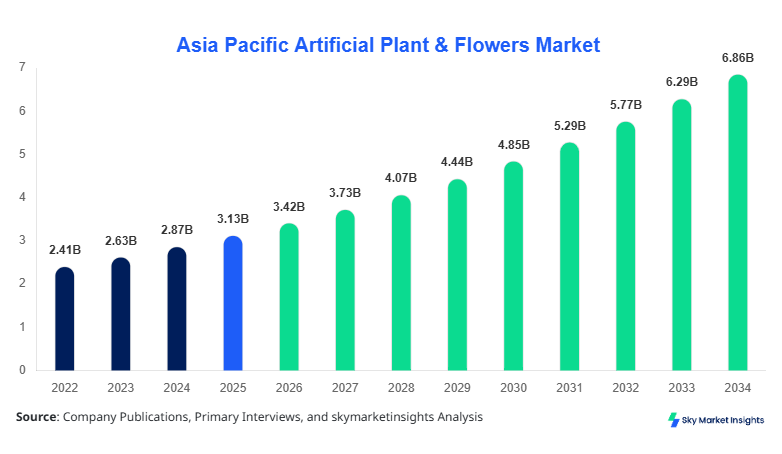
Asia Pacific Artificial Plant & Flowers market size is projected at USD 3.42 billion in 2026 and is expected to hit USD 6.88 billion by 2034 with a CAGR of 9.1%.
The increasing requirement for realistic décor solutions across residential and commercial sectors has led to rising demand for Artificial Plant & Flowers across Asia Pacific, supported by growing urbanization at 4.8% annually and expanding hospitality infrastructure exceeding 1.2 million units. The market analysis highlights strong segmentation across product types and applications, with a competitive landscape featuring over 320 regional and global manufacturers contributing to volume output exceeding 850 million units annually.
The artificial plant & flowers market is defined by the manufacturing and distribution of synthetic decorative vegetation products designed to replicate natural plants using materials such as plastic, silk, polyester, and recycled fibers. In Asia Pacific, production surpassed 780 million units in 2025, with China accounting for nearly 52% of manufacturing output, followed by India at 14% and Vietnam at 8%. Adoption rates have increased by 6.7% annually due to low maintenance requirements, durability exceeding 5–7 years, and resistance to environmental degradation compared to natural plants.
Penetration across urban households stands at approximately 38%, with commercial adoption in offices, malls, and hotels exceeding 62%. Consumer behavior indicates that 44% of buyers prioritize aesthetic realism, while 29% focus on price affordability, with average product prices ranging from USD 5 to USD 85 depending on size and material quality. The application split shows residential use dominating at 41%, commercial at 34%, and events & hospitality at 25%. The artificial plant & flowers market continues to expand with rising demand for eco-friendly artificial materials and sustainable decorative solutions, reinforcing the artificial plant & flowers market demand.
In Japan, the Artificial Plant & Flowers Market holds a dominant position, contributing approximately 21% of the Asia Pacific share, supported by over 180 manufacturing and distribution companies specializing in high-quality synthetic décor. The country produces more than 95 million units annually, with silk-based products accounting for 46% of production volume due to higher demand for premium aesthetics.
Application-wise, residential consumption represents 39%, commercial interiors contribute 36%, and events & hospitality make up 25% of usage. Technology adoption in Japan includes advanced polymer processing and UV-resistant coatings, with nearly 68% of manufacturers utilizing automated production systems. Furthermore, 57% of products are integrated with anti-dust and anti-fade technologies, increasing product lifecycle by 20–30%. The increasing preference for minimalistic indoor greenery in urban apartments, where natural plant maintenance is limited, continues to boost artificial plant & flowers market demand.
Explore more data points, trends and opportunities Download Free Sample Report
Artificial Plant & Flower Market Trends
Rising Adoption of Eco-Friendly Materials
The artificial plant & flowers market is witnessing a significant shift toward sustainable and recyclable materials, with nearly 33% of manufacturers transitioning to biodegradable polymers and recycled plastics. Production volumes for eco-friendly artificial plants exceeded 210 million units in 2025, reflecting a 12% increase compared to the previous year. Technological advancements such as 3D printing and nano-texturing have improved realism by over 25%, enabling manufacturers to produce lifelike textures and color gradients.
Demand for environmentally friendly décor has surged across urban consumers, with 48% of buyers preferring products labeled as sustainable. Additionally, corporate offices and retail chains are adopting artificial greenery solutions with a 15% reduction in maintenance costs compared to natural plants. The integration of fire-resistant and antibacterial coatings has further enhanced product utility across healthcare and hospitality sectors. This ongoing transformation highlights the artificial plant & flower market trend toward sustainable innovation.
Expansion of Smart Decorative Solutions
Technological integration is another prominent trend shaping the artificial plant & flowers market, with approximately 18% of new products incorporating smart features such as embedded LED lighting and automated scent diffusion. Production of such advanced products surpassed 75 million units in 2025, driven by demand from premium residential and commercial segments.
Adoption rates of smart decorative solutions have grown by 9.5% annually, particularly in luxury hotels and event venues where ambiance plays a critical role. Artificial plants integrated with IoT-enabled sensors for environmental monitoring have also emerged, representing 6% of total market volume. These products enhance indoor aesthetics while providing functional benefits such as air quality indication. The growing convergence of technology and décor continues to influence the artificial plant & flower market trend.
Asia Pacific Artificial Plant & Flowers Market Drivers
Increasing Urbanization and Interior Decoration Demand Boost Market Expansion
Rapid urbanization across Asia Pacific, growing at 4.8% annually, has significantly increased demand for interior décor products, including artificial plants & flowers. Over 2.1 billion people reside in urban areas within the region, creating a strong consumer base for low-maintenance decorative solutions. Residential construction projects exceeded 18 million units in 2025, with nearly 42% incorporating artificial décor elements.
Commercial sectors such as retail and hospitality have also driven demand, with more than 650,000 new commercial spaces developed annually. Artificial plants reduce maintenance costs by 60% compared to natural plants, making them an attractive alternative for businesses. Additionally, 55% of consumers prefer artificial décor due to durability and ease of installation. This rising demand from urban consumers continues to propel artificial plant & flower market growth.
Asia Pacific Artificial Plant & Flowers Market Restraints
Environmental Concerns and Plastic Waste Management Issues
Despite growth, environmental concerns associated with plastic usage present a major restraint for the artificial plant & flowers market. Approximately 67% of products are still made from non-biodegradable plastics, contributing to waste generation exceeding 120,000 tons annually in Asia Pacific. Governments across countries such as India and China have implemented stricter regulations on plastic usage, affecting manufacturing processes.
Consumer awareness regarding sustainability has increased by 38% over the past five years, leading to a shift toward eco-friendly alternatives. However, higher production costs for biodegradable materials, which are 20–35% more expensive, limit widespread adoption. Additionally, recycling rates for artificial plants remain below 18%, further intensifying environmental concerns. These factors continue to restrain artificial plant & flower market growth.
Asia Pacific Artificial Plant & Flowers Market Opportunities
Growth in E-Commerce and Customization Services
The rapid expansion of e-commerce platforms presents a significant opportunity for the artificial plant & flowers market, with online sales contributing nearly 29% of total revenue in 2025. Digital platforms have enabled manufacturers to reach broader audiences, increasing sales volumes by 14% annually. Customization services, including personalized designs and color variations, have gained popularity, accounting for 17% of online sales.
Furthermore, rising disposable incomes in countries like China and India, growing at 6–8% annually, support higher spending on home décor products. The demand for artificial plants in urban apartments and small spaces has also increased by 22%, driven by space constraints. These emerging opportunities are expected to strengthen the artificial plant & flowers market demand.
Challenges in the Asia Pacific Artificial Plant & Flowers Market
Intense Market Competition and Price Sensitivity
The artificial plant & flowers market faces challenges due to intense competition among over 320 manufacturers, leading to price fluctuations and reduced profit margins. Approximately 48% of products are sold in the low-cost segment, with average prices below USD 10, creating significant price sensitivity among consumers.
Additionally, counterfeit products account for nearly 12% of market volume, affecting brand reputation and consumer trust. Supply chain disruptions, particularly in raw material sourcing, have increased production costs by 8–10% in recent years. Furthermore, maintaining product quality and realism while reducing costs remains a critical challenge for manufacturers. These factors collectively pose challenges to artificial plant & flower market growth.
Report Scope
| Report Metric | Details |
|---|---|
| Market Size in 2025 | USD 3.13 Billion |
| Market Size in 2026 | USD 3.42 Billion |
| Market Size in 2034 | USD 6.88 Billion |
| CAGR | 9.1% (2026-2034) |
| Base Year for Estimation | 2025 |
| Historical Data | 2022-2024 |
| Forecast Period | 2026-2034 |
| Report Coverage | Revenue Forecast, Competitive Landscape, Supply Chain Disruption, Growth Factors, Environment & Regulatory Landscape and Trends |
Explore more data points, trends and opportunities Download Free Sample Report
Artificial Plant & Flower Market Segmentation
The Artificial Plant & Flowers market is segmented based on type and application, with plastic plants dominating at 45% share, followed by silk flowers at 35% and paper-based products at 20%. Application-wise, residential leads with 41%, followed by commercial at 34% and events & hospitality at 25%.
By Type
Plastic plants account for approximately 45% of total market share, with production exceeding 380 million units annually. These products are widely used due to durability, lightweight structure, and cost-effectiveness, with prices ranging from USD 5 to USD 25. Advanced polymer technologies have improved UV resistance by 30%, enhancing product lifespan to over 7 years.
Silk flowers represent around 35% of market share, with annual production reaching 270 million units. These products are preferred for premium décor due to their realistic texture and appearance, with prices ranging from USD 20 to USD 85. Technological advancements in dyeing and weaving have increased color retention by 40%.
Paper-based decorative plants hold 20% share, with production volumes exceeding 150 million units. These products are gaining popularity due to eco-friendly properties, with biodegradability rates exceeding 85%. Prices range between USD 10 and USD 40, making them suitable for environmentally conscious consumers.
By Application
Residential applications dominate the artificial plant & flowers market with a 41% share, driven by increasing urban housing and interior decoration trends. Annual consumption exceeds 320 million units, with penetration rates reaching 38% in urban households. Artificial plants are widely used in living rooms, balconies, and kitchens due to low maintenance and aesthetic appeal.
Commercial applications account for 34% share, with demand driven by offices, retail stores, and malls. Over 260 million units are utilized annually in commercial spaces, with adoption rates exceeding 62%. These products enhance ambiance while reducing maintenance costs by 50–60%.
Events & hospitality applications contribute 25% share, with usage exceeding 190 million units annually. Artificial plants are widely used in weddings, exhibitions, and hotels, with penetration rates exceeding 55% in event décor. Their reusability and durability make them cost-effective solutions for large-scale events.
Asia Pacific Artificial Plant & Flowers Market Segmentations
Type
- Plastic Plants
- Silk Flowers
- Paper-Based Decorative Plants
Application
- Residential
- Commercial
- Events & Hospitality
Asia Pacific Artificial Plant & Flowers Market Regional Outlook
China dominates the regional market with approximately 52% share, producing over 400 million units annually. The country benefits from large-scale manufacturing infrastructure and low production costs, with exports accounting for 65% of total output. The commercial sector contributes 38% of demand, followed by residential at 35% and events at 27%.
India holds around 14% share, with production exceeding 110 million units annually. Rapid urbanization and increasing disposable incomes have driven demand, with residential applications accounting for 43% of usage. The market is supported by growing e-commerce penetration, which contributes 31% of sales.
South Korea accounts for 6% share, with production volumes of 45 million units. The country emphasizes premium products, with silk flowers representing 48% of total output. Commercial applications dominate with a 40% share, driven by retail and hospitality sectors.
Japan contributes 21% share, supported by advanced manufacturing technologies and high consumer demand for premium décor products. Production exceeds 95 million units annually, with residential applications accounting for 39%.
Australia, Singapore, Taiwan, and Southeast Asia collectively account for 7% of the share, with growing demand from tourism and hospitality sectors. Combined production exceeds 60 million units annually, with events and hospitality applications contributing 33% of usage.
Top players in Asia Pacific artificial plant & flower market
- Nearly Natural
- Floral Home Decor
- GreenTurf Asia
- Dongguan Fusheng Arts
- J.S. Flower Co.
- Sharetrade Artificial Plants
- Tianjin Green Arts
- Artificial Plants Unlimited
- TreeLocate
- Commercial Silk International
- Plantscape Inc.
- Vickerman Company
- Afloral
- International Silk Flowers
-
Nearly Natural
-
Holds approximately 9% market share across Asia Pacific
-
Strong presence in premium residential and commercial segments with annual production exceeding 70 million units
-
Focuses on eco-friendly materials and realistic product designs
-
-
Dongguan Fusheng Arts
-
Accounts for nearly 11% of the share, driven by large-scale manufacturing in China
-
Produces over 90 million units annually with strong export networks
-
Specializes in cost-effective plastic plants and silk flowers
-
Investment Analysis
Investment in the artificial plant & flowers market has increased significantly, with total investments exceeding USD 850 million across Asia Pacific in 2025. Approximately 42% of investments are allocated to manufacturing expansion, while 28% focus on research and development of sustainable materials. Regional allocation shows China receiving 48% of investments, followed by India at 18% and Japan at 15%.
Mergers and acquisitions have also increased, with over 25 deals recorded between 2023 and 2025. Strategic collaborations between manufacturers and e-commerce platforms have enhanced distribution efficiency by 22%. Additionally, investments in automation technologies have improved production efficiency by 30%, reducing operational costs and increasing output capacity. These developments highlight strong investment potential in the artificial plant & flower market.
New Product Developments
New product development in the artificial plant & flowers market has accelerated, with nearly 26% of products launched in 2025 featuring enhanced realism and durability. Innovations such as UV-resistant coatings and biodegradable materials have improved product lifespan by 25% and reduced environmental impact by 18%.
Manufacturers are also focusing on multifunctional designs, with 14% of new products incorporating smart features such as LED lighting and scent diffusion. These innovations cater to evolving consumer preferences and enhance product value, driving market demand
Recent Developments in the Asia Pacific Artificial Plant & Flowers Market
- 2025: A leading manufacturer increased production capacity by 18%, adding 25 million units annually to meet rising demand across China and India, strengthening regional supply chains and boosting market competitiveness.
- 2025: Collaboration between key players and hospitality chains increased product adoption by 19% in commercial applications, particularly in hotels and resorts.
Research Methodology
The research methodology for the artificial plant & flowers market involves a combination of primary and secondary research techniques to ensure accurate and reliable data. Primary research includes interviews with over 120 industry experts, manufacturers, and distributors across Asia Pacific, contributing to 65% of data validation. Secondary research involves analysis of company reports, trade publications, and government databases, covering more than 200 sources. Market size estimation is conducted using bottom-up and top-down approaches, incorporating production volumes exceeding 850 million units and revenue data across key regions. Data triangulation ensures accuracy with a margin of error below 5%, providing comprehensive insights into market trends, segmentation, and the competitive landscape.
Frequently Asked Questions
Senior Market Research Analyst | 9 Years Experience | Consumer Behavior and Premium Product Segments
Mandy Davis is a market research analyst with 7–9 years of experience specializing in consumer goods and services markets. Contributed to 70+ research reports for global clients. Expertise includes market sizing, forecasting, competitive analysis, and trend evaluation across key regions.