Europe Artificial Plant & Flowers Market Size
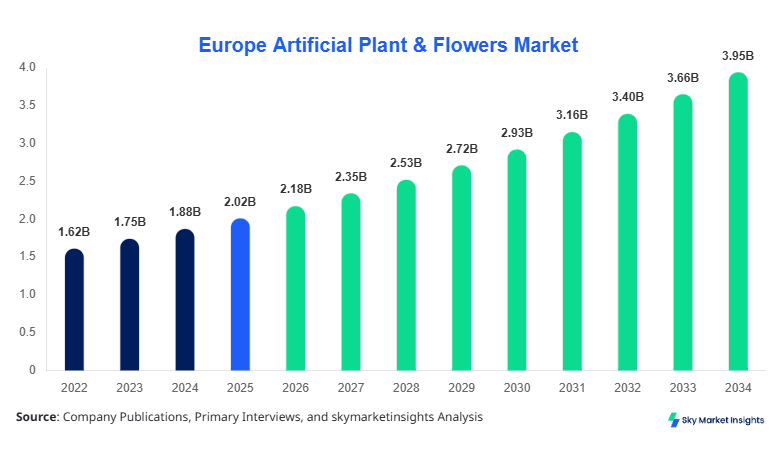
Europe Artificial Plant & Flowers market size is projected at USD 2.18 billion in 2026 and is expected to hit USD 3.94 billion by 2034 with a CAGR of 7.7%.
The market is witnessing increasing adoption across residential décor, commercial landscaping, hospitality infrastructure, and retail visual merchandising applications throughout Europe. The growing penetration of premium interior décor products, rising e-commerce distribution channels, and increasing demand for maintenance-free decorative solutions are contributing significantly to market expansion. Market participants are emphasizing product innovation, recyclable materials, UV-resistant technologies, and realistic polymer textures to strengthen competitive positioning. Detailed segmentation analysis, technological benchmarking, production analytics, and company profiling remain essential for evaluating the competitive landscape of the Europe Artificial Plant & Flowers market.
The artificial plant and flowers industry includes the production, distribution, and commercialization of synthetic decorative vegetation products manufactured using polyester, polyethylene, silk fabric, polyurethane foam, recycled plastics, and latex compounds. Europe recorded more than 1.42 billion units of artificial decorative foliage shipments in 2025, with Germany, the United Kingdom, and France accounting for nearly 64% of total regional consumption volume. Residential interior decoration represented approximately 41% of total product utilization, while commercial infrastructure applications contributed 34%, and hospitality installations accounted for 25% of the market demand. Adoption penetration across urban residential households exceeded 29% in Western Europe during 2025 due to rising apartment living and low-maintenance décor preferences.
Consumer behavior patterns indicate that nearly 52% of European consumers prefer reusable decorative products over natural floral arrangements due to lower replacement frequency and reduced annual maintenance costs. Demand analytics show that product replacement cycles average 3.8 years in residential applications and 2.4 years in commercial applications. Artificial flower products contribute nearly 48% of overall sales volumes, while artificial plants represent 37% and artificial trees account for 15%. UV-resistant products witnessed 18% higher sales growth compared to standard indoor products. E-commerce sales channels contributed approximately 39% of total distribution in 2025. Increasing demand for visually realistic, allergen-free, and durable décor solutions continues to strengthen the Europe Artificial Plant & Flowers market.
Explore more data points, trends and opportunities Download Free Sample Report
Europe Artificial Plant & Flowers Market Trends
Rising Adoption of Sustainable Decorative Materials
Manufacturers across Europe are increasingly transitioning toward recyclable plastics, bio-based polyester fabrics, and low-emission polyurethane compounds for artificial foliage production. During 2025, more than 38% of newly manufactured artificial decorative products included partially recycled material content compared to 24% in 2022. Production volumes of eco-certified decorative foliage surpassed 460 million units across Europe, with Germany and France contributing more than 51% of sustainable product output. Consumer preference for environmentally compliant decorative products increased by 22% among urban households, while institutional procurement of recyclable decorative products expanded by 19% in hospitality projects. Retailers are also introducing carbon-labeled decorative products to improve consumer transparency. The increasing transition toward sustainable production technologies and eco-friendly decorative materials continues influencing the Artificial Plant & Flowers market.
Expansion of E-commerce and Digital Merchandising Platforms
Digital distribution channels have become a dominant growth driver for decorative interior products across Europe. E-commerce platforms contributed approximately USD 850 million in artificial decorative product sales during 2025, representing nearly 39% of total market revenue. Online conversion rates for customized artificial flower arrangements increased by 16%, while mobile-based decorative purchases expanded by 24% year-over-year. Augmented reality visualization tools enabled 31% higher online customer engagement for premium decorative products. More than 44% of millennials and urban apartment consumers preferred purchasing decorative foliage products through digital marketplaces due to product customization flexibility and faster delivery services. Subscription-based seasonal décor replacement models also gained traction in commercial applications. The increasing integration of digital retail ecosystems and immersive product visualization technologies continues supporting the Artificial Plant & Flowers market.
Premium Hospitality and Corporate Décor Transformation
Luxury hotels, co-working spaces, and commercial infrastructure projects are increasingly utilizing artificial decorative vegetation for cost-efficient long-term interior enhancement. Hospitality infrastructure investments in Europe exceeded USD 19 billion in 2025, with decorative installations contributing nearly 6% of interior fit-out expenditures. Artificial decorative trees witnessed 14% annual installation growth in premium hotel chains due to low maintenance and extended durability. Nearly 57% of commercial property managers preferred synthetic decorative installations because of water conservation benefits and operational cost reduction. Anti-bacterial coatings and fire-retardant certifications have also become standard specifications in commercial decorative procurement contracts. Growing demand from commercial real estate and hospitality sectors continues strengthening the Artificial Plant & Flowers market.
Europe Artificial Plant & Flowers Market Drivers
Growing Urbanization and Maintenance-Free Interior Décor Demand
Rapid urbanization and shrinking residential living spaces across Europe are accelerating demand for compact, low-maintenance decorative solutions. Urban population concentration in Europe exceeded 75% in 2025, while apartment-based living accounted for nearly 63% of total residential occupancy in major metropolitan areas. Artificial decorative foliage products eliminate irrigation, sunlight dependency, and seasonal replacement requirements, reducing maintenance expenditures by approximately 46% compared to natural plants. Residential decorative spending rose by 13% during 2025, with premium indoor aesthetics emerging as a major consumer preference among millennials and working professionals. Commercial office renovation spending also increased by 11%, contributing to higher installation rates of synthetic decorative trees and floral products. The hospitality industry recorded a 17% increase in decorative refurbishment projects emphasizing artificial greenery installations due to operational efficiency and longevity benefits. Additionally, product lifespan improvements exceeding 5–7 years are encouraging broader adoption across institutional buyers. Expanding urban décor preferences and operational efficiency benefits continue supporting Artificial Plant & Flowers market growth.
Europe Artificial Plant & Flowers Market Restraints
Availability of Low-Cost Counterfeit Products and Raw Material Volatility
The availability of low-cost imported decorative products from unorganized suppliers remains a significant restraint for premium manufacturers operating in Europe. Approximately 28% of artificial decorative products entering regional markets during 2025 originated from low-cost imports lacking standardized quality certifications and environmental compliance. These products often demonstrate 35% shorter product lifespan and reduced UV resistance compared to premium European offerings. Raw material price fluctuations in polyester, polyethylene, and polyurethane compounds increased manufacturing costs by nearly 14% between 2023 and 2025. Transportation and logistics expenditures also rose by 9% due to cross-border freight inflation and supply chain disruptions. Environmental regulations governing plastic utilization are further increasing compliance costs for manufacturers. Smaller decorative brands face margin pressure because premium eco-friendly production technologies require 18–22% higher capital investments. Consumer price sensitivity in lower-income markets, particularly in Southern and Eastern Europe, continues limiting premium product penetration. Rising import competition and material cost instability remain significant barriers to Artificial Plant & Flowers market growth.
Europe Artificial Plant & Flowers Market Opportunities
Expansion of Smart Commercial Infrastructure and Premium Retail Visual Merchandising
The increasing modernization of retail infrastructure, premium office spaces, and experiential commercial environments presents substantial opportunities for decorative product suppliers. Europe recorded more than 4.6 million square meters of new commercial real estate development during 2025, with approximately 31% of projects integrating artificial decorative installations into architectural design frameworks. Retail visual merchandising investments increased by 16%, particularly among luxury apparel brands, shopping malls, and experiential retail centers. Artificial decorative walls and customized floral installations generated nearly USD 320 million in commercial project revenue during 2025. Smart building technologies integrating automated lighting with decorative interiors improved consumer engagement rates by approximately 12%. Hospitality modernization initiatives in Germany, France, and the United Kingdom are further expanding procurement opportunities for premium synthetic greenery products. Corporate wellness-focused office designs emphasizing biophilic aesthetics without maintenance complexity are accelerating adoption. Growing integration of decorative vegetation into next-generation commercial infrastructure continues creating significant opportunities for the Artificial Plant & Flowers market.
Challenges in Europe Artificial Plant & Flowers Market
Environmental Compliance and Disposal Management Complexities
Manufacturers operating within Europe increasingly face challenges associated with sustainability regulations, plastic waste management, and recycling compliance. Approximately 61% of artificial decorative products still contain mixed polymer compositions that complicate large-scale recycling processes. Disposal costs for non-recyclable decorative products increased by nearly 12% during 2025 due to tightening environmental regulations across the European Union. Manufacturers investing in recyclable material conversion experienced production cost increases ranging from 15% to 21%. Consumer awareness regarding microplastic pollution and synthetic waste generation is also influencing purchasing behavior, particularly in Northern Europe. Additionally, maintaining visual realism while reducing synthetic material utilization remains technically challenging for product developers. Fire-retardant certification, UV stabilization, and anti-fungal coatings further complicate manufacturing processes and increase operational expenditures. Import compliance procedures for decorative products containing chemical coatings have also become stricter across regional customs authorities. Managing sustainability expectations while preserving product durability and affordability continues presenting operational challenges for the Artificial Plant & Flowers market.
Report Scope
| Report Metric | Details |
|---|---|
| Market Size in 2025 | USD 2.02 Billion |
| Market Size in 2026 | USD 2.18 Billion |
| Market Size in 2034 | USD 3.94 Billion |
| CAGR | 7.7% (2026-2034) |
| Base Year for Estimation | 2025 |
| Historical Data | 2022-2024 |
| Forecast Period | 2026-2034 |
| Report Coverage | Revenue Forecast, Competitive Landscape, Supply Chain Disruption, Growth Factors, Environment & Regulatory Landscape and Trends |
Explore more data points, trends and opportunities Download Free Sample Report
Europe's Artificial Plant & Flowers Market Segmentation
The Europe artificial decorative industry is segmented by type and application, with artificial flowers accounting for approximately 48% of total market revenue in 2025 due to widespread residential and commercial usage. Commercial applications dominated end-user demand with nearly 39% revenue contribution, followed by residential applications at 36% and hospitality installations at 25%. Product diversification, UV-resistant technologies, and eco-friendly material adoption remain major differentiating factors across market segments.
BY TYPE
Artificial flowers represented nearly 48% of total European market revenue in 2025 owing to high adoption in residential décor, event decoration, and retail merchandising applications. Annual production and import volumes exceeded 680 million units during the year. Polyester silk flowers contributed approximately 54% of category demand because of realistic texture quality and color retention performance. UV-resistant floral products demonstrated 21% stronger adoption growth among outdoor decorative applications. Commercial installations represented 33% of artificial flower consumption, while residential demand accounted for 49%. Technological improvements in 3D molding, anti-fade pigment coating, and laser-cut petal detailing enhanced visual realism by approximately 28% compared to conventional decorative products.
Artificial plants accounted for nearly 37% of overall market revenue and generated strong demand from offices, educational institutions, and apartment interiors. More than 520 million units of synthetic potted plants were distributed across Europe in 2025. Medium-sized indoor decorative plants between 30 cm and 90 cm represented approximately 58% of category shipments. Anti-dust polymer coating technologies improved maintenance efficiency by 17%, while fire-retardant products accounted for 26% of commercial procurement demand. Germany, France, and the United Kingdom collectively contributed over 63% of regional artificial plant consumption. Increasing emphasis on minimalist interior design aesthetics and operational efficiency continues driving artificial plant adoption across commercial and residential applications.
Artificial trees represented nearly 15% of total market revenue but generated higher average selling prices due to larger installation formats and premium commercial applications. Production and import volumes surpassed 78 million units during 2025. Decorative palm trees, ficus variants, and tropical installations collectively contributed 61% of artificial tree demand. Hospitality and commercial applications represented more than 69% of category utilization. Products incorporating steel-reinforced trunks and UV-resistant polyethylene foliage demonstrated operational lifespans exceeding 7 years in indoor environments. Luxury retail installations and hotel lobby renovations contributed significantly to premium artificial tree demand throughout Western Europe.
BY APPLICATION
Commercial applications dominated the European market with approximately a 39% revenue contribution in 2025. Corporate offices, retail centers, airports, hospitals, and educational institutions collectively installed more than 460 million units of artificial decorative products during the year. Fire-retardant and anti-bacterial certified products represented nearly 42% of commercial procurement contracts. Retail visual merchandising contributed approximately 28% of commercial demand due to rising investments in experiential shopping environments. Commercial buyers preferred long-life decorative installations with operational durability exceeding 5 years, reducing maintenance costs by nearly 44% compared to natural decorative alternatives. Artificial green walls and modular decorative systems gained strong traction in premium office spaces and hospitality environments.
Residential applications accounted for nearly 36% of total market revenue due to increasing urban apartment living and growing home décor expenditure. More than 510 million units of artificial decorative products were sold to residential consumers across Europe in 2025. Small tabletop decorative plants represented 31% of household demand, while artificial flower arrangements accounted for 46%. Online retail channels contributed approximately 48% of residential purchases due to customization flexibility and rapid delivery models. Consumer spending on premium decorative products increased by 14% during 2025, particularly among middle-income and millennial demographics. Demand for eco-friendly and recyclable decorative products also increased significantly within urban residential segments.
Hospitality applications represented nearly 25% of market revenue and demonstrated strong expansion across hotels, resorts, restaurants, cruise infrastructure, and event venues. Hospitality decorative procurement expenditures exceeded USD 410 million in 2025. Large-scale artificial decorative installations reduced annual maintenance expenditures by approximately 39% for hospitality operators. Luxury hotels accounted for nearly 44% of category demand, followed by restaurants at 27% and event venues at 18%. Anti-fungal and UV-resistant decorative installations became standard procurement specifications across premium hospitality projects. Seasonal decorative customization services further accelerated procurement frequency among large hospitality chains.
Europe Artificial Plant & Flowers Market Segmentations
Type
- Artificial Flowers
- Artificial Plants
- Artificial Trees
Application
- Commercial
- Residential
- Hospitality
Europe Artificial Plant & Flowers Market Country Outlook
United Kingdom
The United Kingdom accounted for approximately 21% of total European revenue generation in 2025 due to strong residential décor expenditure and commercial retail modernization projects. More than 240 million units of artificial decorative products were sold domestically during the year. Residential applications represented 45% of demand, while commercial installations accounted for 34% and hospitality contributed 21%. Online distribution channels generated nearly 52% of decorative product sales due to advanced e-commerce penetration. London alone contributed approximately 31% of national commercial decorative procurement. Demand for eco-certified decorative products increased by 19% due to sustainability-focused consumer purchasing behavior.
Germany
Germany remained the largest regional contributor with nearly 27% share of the European market in 2025. Annual imports and domestic production volumes exceeded 410 million decorative units. Commercial applications represented 36% of national demand, while residential installations contributed 43%. Germany also leads regional adoption of recyclable decorative materials, with approximately 61% of manufacturers implementing sustainable polymer technologies. Hospitality infrastructure modernization and premium office renovation projects significantly accelerated procurement of large-scale artificial decorative installations across urban commercial hubs.
France
France contributed approximately 17% of total regional revenue in 2025, supported by strong hospitality and luxury retail infrastructure demand. Decorative product consumption exceeded 220 million units during the year. Hospitality applications represented 29% of national demand due to strong tourism infrastructure investments. Artificial floral arrangements accounted for nearly 51% of category sales across France. Paris remained the dominant luxury retail installation center, contributing approximately 34% of commercial decorative expenditures. Sustainability regulations and premium interior aesthetics continue supporting higher-value decorative product adoption.
Spain
Spain represented nearly 11% of total European market revenue in 2025 due to strong hospitality infrastructure and tourism-driven decorative procurement. Annual decorative product demand exceeded 145 million units. Hotels and resorts contributed nearly 37% of national demand, while residential applications accounted for 35%. Seasonal tourism activity significantly influences procurement cycles for decorative installations across coastal regions. Artificial palm trees and tropical decorative products demonstrated 18% stronger sales growth compared to conventional indoor decorative products. Barcelona and Madrid remain key commercial procurement centers for premium decorative installations.
Italy
Italy accounted for approximately 13% of regional market revenue during 2025. Decorative consumption volumes exceeded 170 million units. Residential décor represented nearly 41% of total national demand due to strong emphasis on interior aesthetics and luxury home decoration. Artificial flower products accounted for approximately 49% of total sales volumes. Commercial retail installations and premium hospitality projects continue driving demand for customized decorative solutions. Italian consumers also demonstrated growing preference for handcrafted premium decorative products incorporating recyclable textile materials and high-definition visual detailing.
Russia
Russia represented nearly 8% of the European market in 2025 despite ongoing supply chain fluctuations and import dependency challenges. Annual decorative product demand exceeded 102 million units. Commercial infrastructure contributed approximately 38% of national demand, while residential applications represented 40%. Domestic decorative manufacturing capacity expanded by nearly 12% between 2023 and 2025 due to import substitution initiatives. Artificial plants demonstrated strong adoption in office environments and public infrastructure projects because of harsh climatic conditions limiting natural decorative alternatives.
Top players in Europe Artificial Plant & Flowers Market
- Nearly Natural
- Commercial Silk Int'l
- Treelocate
- Dunelm Group plc
- IKEA
- Afloral
- Silk-ka
- The Green House
- Eurogreens Environmental Design
- Deko Florale
- Floralsilk
- Bloomr
- MyGift Enterprise LLC
- JAMALI GARDEN
- Plantscape Commercial Silk
Nearly Natural
- Holds approximately 11% regional market share across Europe.
- Strong positioning in premium residential decorative solutions and online retail distribution.
- Operates diversified product portfolios, including UV-resistant artificial plants, floral arrangements, and modular decorative systems.
- Generates significant revenue from customized decorative installations and hospitality procurement contracts.
- Expanded recyclable product manufacturing capacity by nearly 18% during 2025.
- Maintains strong penetration across Germany, France, and the United Kingdom due to premium product aesthetics and digital commerce capabilities.
IKEA
- Accounts for nearly 9% of regional artificial decorative revenue.
- Dominates mass-market decorative product distribution through integrated retail networks across Europe.
- Residential applications contribute approximately 67% of total decorative product sales.
- Increased sustainable decorative material sourcing by nearly 24% between 2023 and 2025.
- Strong pricing competitiveness and large-scale procurement capabilities support market leadership.
- Expanded compact decorative product offerings targeting urban apartment consumers and millennial households.
Investment Analysis
Investment activity across the European artificial decorative industry increased substantially during 2025 due to rising demand for sustainable interior décor solutions and commercial infrastructure modernization. Approximately 34% of total investments were allocated toward recyclable material innovation, while 27% targeted automated manufacturing technologies and digital customization systems. Germany accounted for nearly 29% of total regional investment allocation, followed by the United Kingdom at 22% and France at 18%. Venture funding for eco-friendly decorative startups increased by approximately 16% year-over-year. Commercial infrastructure modernization projects represented nearly 41% of downstream procurement investments.
Mergers, acquisitions, and collaborative partnerships also expanded significantly across the market. Cross-border partnerships focusing on recyclable polymer technology, UV-resistant coating systems, and AI-driven visual merchandising solutions increased by nearly 21% during 2025. Hospitality infrastructure collaborations generated more than USD 180 million in decorative procurement contracts across Europe. Large retailers increasingly partnered with sustainable decorative manufacturers to strengthen ESG compliance initiatives and reduce environmental impact. Manufacturing automation investments reduced production wastage by approximately 13% while improving operational efficiency by nearly 17%. Growing institutional investments and technology-focused collaborations continue strengthening the long-term commercial outlook for the European decorative industry.
New Product Developments
Manufacturers are increasingly launching eco-friendly and technologically advanced decorative products to improve realism, durability, and sustainability. Nearly 32% of new decorative product launches during 2025 incorporated recycled plastics or biodegradable textile components. UV-resistant coating innovations improved outdoor product durability by approximately 26% compared to earlier-generation decorative products. Anti-dust and anti-fungal coating adoption also increased significantly within premium hospitality and healthcare installations.
Advanced 3D molding technologies improved visual realism by nearly 29%, while AI-assisted product customization systems enabled personalized decorative configurations for commercial buyers. Smart modular decorative walls integrating programmable lighting systems witnessed approximately 18% adoption growth in luxury retail and hospitality applications. Manufacturers are also introducing lightweight structural materials, reducing product transportation costs by nearly 12% while improving installation efficiency.
Recent Developments in Europe's Artificial Plant & Flowers
- 2025: Nearly Natural expanded its recyclable decorative product manufacturing operations in Germany, increasing sustainable product output capacity by approximately 22%. The company also introduced UV-resistant decorative foliage lines targeting commercial hospitality applications. Annual commercial procurement contracts increased by nearly 14% following the expansion initiative. Investments exceeding USD 28 million were allocated toward eco-friendly polymer processing technologies and automated decorative assembly systems.
- 2025: IKEA introduced a new eco-certified artificial decorative collection across Europe utilizing more than 45% recycled textile and polymer content. The product launch increased decorative category sales by approximately 17% in urban residential markets. Online decorative purchases through IKEA digital channels rose by nearly 21%, while compact apartment-oriented decorative product demand increased substantially among millennial consumers.
Research Methodology
The research methodology for the European artificial decorative industry combines primary research, secondary research, market engineering, and statistical validation techniques to ensure accurate forecasting and competitive benchmarking. The research process involved collection of historical consumption data from 2022 to 2024, evaluation of current industry dynamics during 2025 and 2026, and forecasting analysis through 2034. Primary research included interviews with manufacturers, distributors, commercial buyers, hospitality operators, interior designers, and raw material suppliers across Germany, the United Kingdom, France, Spain, Italy, and Russia. More than 120 industry participants were consulted to validate pricing trends, production capacities, and demand patterns.
Secondary research involved analysis of trade databases, customs statistics, annual reports, commercial procurement records, sustainability reports, and government manufacturing data. Market size estimation was conducted using both top-down and bottom-up analytical models integrating production volume analysis, import-export statistics, revenue benchmarking, and application-level penetration assessment. Forecast modeling incorporated macroeconomic indicators, urbanization rates, hospitality investments, residential décor expenditure, and sustainability adoption trends. Statistical triangulation techniques were applied to ensure data reliability and forecast consistency across all market segments and regional markets.
Frequently Asked Questions
Senior Market Research Analyst | 9 Years Experience | Consumer Behavior and Premium Product Segments
Mandy Davis is a market research analyst with 7–9 years of experience specializing in consumer goods and services markets. Contributed to 70+ research reports for global clients. Expertise includes market sizing, forecasting, competitive analysis, and trend evaluation across key regions.