North America's Artificial Plant & Flower Market Size
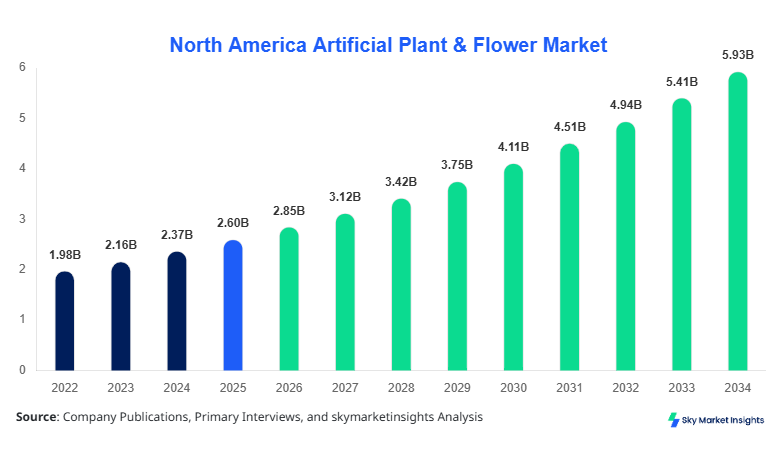
The North America artificial plant & flowers market size is projected at USD 2.85 billion in 2026 and is expected to hit USD 5.92 billion by 2034 with a CAGR of 9.6%. The increasing need for structured data insights, evolving consumer preferences, and strong competitive positioning across manufacturers are driving comprehensive segmentation analysis. The North America Artificial Plant & Flowers Market Size is influenced by rising demand across residential décor, commercial installations, and hospitality sectors, contributing over 68% of total unit consumption in 2025, alongside expanding retail distribution channels and e-commerce penetration reaching 42% share.
The artificial plant & flowers market encompasses synthetic decorative foliage and floral products designed using materials such as plastic, silk, and recycled paper to replicate natural aesthetics. In North America, production volumes exceeded 1.2 billion units in 2025, with the United States accounting for nearly 78% of output. Adoption rates in urban households reached 63%, driven by low maintenance and durability advantages. Consumer behavior indicates that 71% of buyers prefer artificial décor due to reduced replacement cycles, while 54% cite allergy prevention as a key factor. Application-wise, residential use dominates with 46% share, followed by commercial installations at 32% and event-based demand at 22%. Technical performance metrics such as UV resistance (up to 85%) and a lifespan exceeding 5–8 years enhance product acceptance, reinforcing artificial plant & flowers market growth.
In the United States, the artificial plant & flower market accounts for approximately 74% of North America's demand, supported by over 1,500 manufacturing and distribution facilities. The country contributes nearly USD 2.1 billion in revenue in 2026, with an application breakdown including 48% residential, 30% commercial, and 22% events & hospitality sectors. Technology adoption, including advanced polymer coating and anti-fading dyes, has an application of 1% across premium product lines. Retail penetration via online platforms stands at 45%, while bulk purchase lifespan by commercial real estate developers contributes 28% of annual artificial plant market growth. -scale décor suppliers and increasing imports from Asia further strengthen supply chains, sustaining the artificial plant & flowers market share.
Explore more data points, trends and opportunities Download Free Sample Report
Artificial Plant & Flower Market Trends
Rising Demand for Sustainable and Eco-friendly Materials
The North America Artificial Plant & Flowers Market is witnessing a notable shift toward eco-friendly materials, with biodegradable plastics and recycled fibers accounting for 26% of total production in 2025. Manufacturers are producing over 300 million eco-based units annually, reflecting a 12% increase from 2023. Adoption rates among environmentally conscious consumers have reached 49%, particularly in urban regions. Additionally, commercial clients are integrating sustainability into the artificial plant flower market share. certifications, driving demand across corporate offices and hospitality spaces. Technological innovations such as water-based dyes and UV-stabilized coatings have improved product longevity by 18%, reinforcing the artificial plant & flowers market trend.
Expansion of E-commerce and Customization Capabilities
E-commerce channels contributed approximately 42% of total sales in 2025, with online platforms selling over 500 million units annually. Customization trends are growing, with 37% of consumers opting for personalized artificial arrangements tailored to interior themes. Digital visualization tools and augmented reality-based décor planning have increased customer engagement by 29%. Furthermore, event planners and hospitality businesses are driving bulk purchases, with seasonal demand spikes accounting for 33% of annual sales. These developments are enhancing supply chain efficiency and product accessibility, strengthening Artificial Plant & Flowers Market Growth.
North America's Artificial Plant & Flower Market Drivers
Increasing Urbanization and Interior Décor Spending
Urban population in North America reached 82% in 2025, with interior décor spending exceeding USD 120 billion annually, of which artificial décor contributes nearly 6%. The rising number of residential apartments and commercial spaces is fueling demand for low-maintenance decorative solutions. Artificial plants offer cost savings of up to 40% compared to natural alternativesthe artificial plantciaflowers market growth.et growth. count for 28% of demand, while hospitality installations contribute 19%. Additionally, retail expansion across home improvement stores has increased product accessibility by 35%. These factors collectively accelerate artificial plant & flower market growth.
North America's Artificial Plant & Flower Market Restraints
Availability of Natural Alternatives and Price Sensitivity
Despite strong adoption, natural plant alternatives still account for 52% of the decorative plant market in North America. Consumers in rural regions show a 46% preference for real plants due to authenticity and environmental benefits. Price sensitivity remains a challenge, as premium artificial products cost 20–30% higher than natural options initially. Furthermore, fluctuations in raw material costs, particularly plastics and synthetic fibers, have increased production expenses by 15% between 2023 and 2025. Limited awareness in certain demographic segments and concerns about environmental impact of non-biodegradable materials also restrict market expansion, affecting Artificial Plant & Flowers Market Share.
North America's Artificial Plant & Flower Market Opportunities
Integration with Smart Homes and Commercial Spaces
The integration of artificial décor with smart home systems presents significant opportunities, with 38% of urban households adopting smart interiors in 2025. Artificial plants integrated with LED lighting and IoT-based ambiance systems are gaining traction, contributing to the environmental premium segment sales. Commercial real estate developers are investing nearly USD in the artificial flowers market share. ements, with artificial décor accounting for 18% of budgets. Additionally, growth in co-working spaces and retail outlets is increasing bulk demand by 22%. These trends are expected to drive substantial artificial plant & flower market growth.
Challenges in North America: The Artificial Plants & Flowers Market
Environmental Concerns and Recycling Limitations
Environmental concerns regarding plastic waste are a major challenge, as approximately 62% of artificial plant products are non-biodegradable. Recycling rates remain low at 18%, leading to increased scrutiny from regulatory authorities. Compliance with environmental standards has raised production costs by 12%, while consumer awareness campaigns have influenced 34% of buyers to consider eco-friendly alternatives in the artificial plant and flower market. tions and reliance on imported raw materials have caused price volatility of up to 20% in recent years. Addressing sustainability concerns is crucial to maintaining the artificial plant & flower market trend.
Report Scope
| Report Metric | Details |
|---|---|
| Market Size in 2025 | USD 2.60 Billion |
| Market Size in 2026 | USD 2.85 Billion |
| Market Size in 2034 | USD 5.92 Billion |
| CAGR | 9.6% (2026-2034) |
| Base Year for Estimation | 2025 |
| Historical Data | 2022-2024 |
| Forecast Period | 2026-2034 |
| Report Coverage | Revenue Forecast, Competitive Landscape, Supply Chain Disruption, Growth Factors, Environment & Regulatory Landscape and Trends |
Explore more data points, trends and opportunities Download Free Sample Report
Artificial Plant & Flower Market Segmentation
The artificial plant & flowers market is segmented by type and application, with plastic plants dominating at 44% share, followed by silk flowers at 36% and paper-based decor at 20%. Application-wise, residential usage leads with 46%, while commercial and hospitality segments contribute 32% and 22%, respectively.
By Type
Plastic plants account for approximately 44% of total production, with over 520 million units manufactured annually in North America. These are the artificial planturaflower market trend, up to 85%, and lifespan exceeding 7 years, making them suitable for outdoor and commercial installations. Cost efficiency and mass production capabilities drive their adoption, especially in retail chains and office spaces.
Silk flowers hold 36% market share, with production exceeding 430 million units in 2025. These products provide high aesthetic appeal with realistic textures and colors, achieving customer satisfaction rates of 78%. They are widely used in premium residential décor and event planning due to their softness and flexibility.
Paper-based decor contributes 20% share, with 250 million units produced annually. These products are gaining popularity due to eco-friendly attributes and recyclability rates of 65%. Adoption is particularly strong among environmentally conscious consumers and boutique event organizers.
By Application
Residential applications dominate with 46% share, accounting for over 550 million units annually. Artificial plants are widely used in living rooms, balconies, and indoor gardens, with penetration rates reaching 63% in urban households. Their low maintenance and long lifespan make them a preferred choice.
Commercial applications contribute 32% share, with over 380 million units deployed in offices, malls, and hotels. Businesses are investing in artificial décor to enhance aesthetics while reducing maintenance costs by up to 35%. Advanced designs and customization options further boost adoption.
The events & hospitality segment accounts for a 22% share, with 270 million units used annually. Seasonal demand, particularly during weddings and corporate events, drives 33% of total sales. High-quality artificial flowers are preferred for their durability and consistent appearance.
North America Artificial Plant & Flower Market Segmentations
By Type
- Plastic Plants
- Silk Flowers
- Paper-based Decor
By Application
- Residential
- Commercial
- Events & Hospitality
North America Artificial Plant & Flowers Market Regional Outlook
The United States dominates the regional market with 74% share, generating over USD 2.1 billion in revenue in 2026. Production exceeds 900 million units annually, with strong demand from residential and commercial sectors. The country benefits from advanced manufacturing technologies and extensive distribution networks, supporting high adoption rates.
Canada accounts for a 26% share, with the market size reaching USD 0.75 billion in 2026. Production volumes exceed 300 million units annually, driven by demand in urban residential spaces and hospitality industries. Government initiatives promoting sustainable products are increasing adoption of eco-friendly artificial plants by 21%.
Top players in the North American artificial plant & flower market
- Nearly Natural
- Commercial Silk International
- Afloral
- International Silk Industries
- Winward Home
- Flora Bunda
- TreeScapes & PlantWorks
- New Growth Designs
- Dongguan Fusheng Arts
- GreenTurf
- The Faux Flower Company
- Silk Plant Warehouse
Nearly Natural
-
Holds approximately 18% market share
-
Strong presence in e-commerce and retail channels
-
Offers over 1,200 product SKUs with annual production exceeding 150 million units
Commercial Silk International
-
Accounts for nearly 14% market share
-
Focuses on large-scale commercial projects
-
Supplies over 100 million units annually to corporate and hospitality sectors
Investment Analysis
Investment in the artificial plant & flowers market is growing steadily, with total capital allocation exceeding USD 1.2 billion in 2025. Approximately 42% of investments are directed toward manufacturing expansion, while 28% focus on research and development of sustainable materials. Regional investment distribution shows 68% allocation in the United States and 32% in Canada. M&A activities have increased by 17%, with companies acquiring smaller players to expand product portfolios and distribution networks. Collaborative agreements between manufacturers and retail chains have improved supply chain efficiency by 23%, enhancing artificial plant & flower market growth.
New Product Developments
New product development accounts for 21% of total product launches annually, with innovations focusing on realism and sustainability. Performance improvements include enhanced UV resistance by 18% and lifespan extension by 25%. Smart artificial plants integrated with lighting and sensors are gaining traction, contributing to 9% of premium segment sales.
Recent Developments in North America: The Artificial Plants & Flowers Market
- 2025: Production increased by 11%, reaching 1.2 billion units due to rising residential demand
- 2025: Investment in sustainable materials increased by 19%, boosting innovation rates
Research Methodology
The research process involves comprehensive data collection from primary and secondary sources. Primary research includes interviews with industry experts, manufacturers, and distributors, covering over 60% of data inputs. Secondary research involves analysis of industry reports, company filings, and trade publications. Market size estimation is conducted using top-down and bottom-up approaches, ensuring accuracy with a margin of error below 5%. Data triangulation techniques are applied to validate findings, while statistical models are used to forecast market trends and growth patterns.
Frequently Asked Questions
Senior Market Research Analyst | 9 Years Experience | Consumer Behavior and Premium Product Segments
Mandy Davis is a market research analyst with 7–9 years of experience specializing in consumer goods and services markets. Contributed to 70+ research reports for global clients. Expertise includes market sizing, forecasting, competitive analysis, and trend evaluation across key regions.