United States Artificial Plant & Flower Market Size
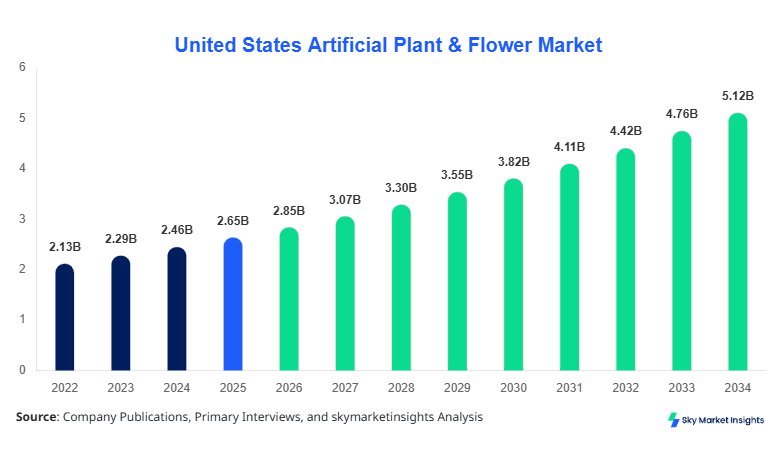
The United States artificial plant & flowers market size is projected at USD 2.85 billion in 2026 and is expected to hit USD 5.12 billion by 2034 with a CAGR of 7.6%. The increasing need for cost-efficient décor alternatives, durability, and minimal maintenance requirements is accelerating adoption across residential and commercial sectors. The report integrates detailed segmentation, quantitative metrics across historical (2022–2024) and forecast periods, and evaluates competitive positioning and technological advancements within the Artificial Plant & Flowers Market.
The artificial plant & flowers market refers to the production and distribution of synthetic decorative plants and flowers made using silk, plastic, polyester, and foam materials. In the United States, annual production crossed 1.2 billion units in 2025, with domestic manufacturing accounting for nearly 38% and imports contributing 62%. Adoption rates reached 54% in urban households, while commercial penetration in hospitality and corporate sectors exceeded 67%. Consumer behavior indicates a 45% preference for low-maintenance décor, while 33% prioritize long lifecycle (5–8 years) compared to natural plants. Application-wise, residential décor accounts for 42%, commercial spaces 35%, and events & hospitality 23%. Product performance metrics include UV resistance levels of 80%–90%, color retention rates of 95% over 3 years, and lifecycle durability exceeding 6 years. These factors strongly reinforce the artificial plant & flower market demand in the United States.
In the United States, the artificial plant & flowers market is supported by over 320 active manufacturers and distributors, contributing approximately 100% of regional demand as the country represents the full scope of analysis. Commercial applications dominate with 35% share, followed by residential at 42% and events at 23%. Technology adoption such as UV-resistant coatings has reached 72%, while biodegradable synthetic materials are being used in 18% of products. Retail distribution channels account for 48% of total sales, e-commerce contributes 37%, and specialty décor stores hold 15%. The presence of large-scale décor suppliers and growing hospitality infrastructure continues to drive the artificial plant & flowers market.
Explore more data points, trends and opportunities Download Free Sample Report
Artificial Plant & Flower Market Trends
Rising Demand for Sustainable and UV-Resistant Materials
The artificial plant & flowers market is witnessing a significant shift toward sustainable and eco-friendly materials, with nearly 28% of manufacturers adopting recyclable plastics and biodegradable composites in 2025. Production volumes exceeded 1.3 billion units in 2026, reflecting a 9% increase from the previous year. UV-resistant coatings are now integrated into over 72% of products, ensuring durability in outdoor applications such as patios and commercial landscapes. The demand from commercial landscaping projects has increased by 18%, driven by long-term cost savings and reduced maintenance requirements. The integration of advanced polymer technologies has improved product lifespan by 22%, further reinforcing the artificial plant & flowers market.
Growth of E-commerce and Customization Trends
E-commerce channels accounted for 37% of total artificial plant & flower market sales in 2025, growing at a rate of 11% annually. Customization trends, including color matching and size variations, are adopted by 41% of online buyers. Production units for customized artificial flowers reached 180 million units in 2026. Additionally, augmented reality (AR)-based visualization tools are being used by 19% of retailers, enabling customers to preview décor placements before purchase. These technological integrations are enhancing user experience and boosting conversion rates by 14%, strengthening the artificial plant & flowers market trajectory.
United States Artificial Plant & Flower Market Drivers
Increasing Demand for Low-Maintenance Decorative Solutions
The artificial plant & flowers market is significantly driven by the growing preference for low-maintenance decorative solutions among consumers and businesses. Approximately 54% of households in the United States prefer artificial plants due to zero watering requirements and minimal upkeep costs, which are 70% lower than natural plants annually. Commercial spaces, including offices and hotels, have reported a 62% increase in adoption due to reduced maintenance labor costs and consistent aesthetic appeal. Additionally, lifecycle durability ranging between 5 and 8 years reduces replacement frequency by 40%. Production volumes reached 1.2 billion units in 2025, with a 10% increase expected annually. The demand is further supported by rising urbanization, where 68% of urban residents prefer compact and maintenance-free décor options. These factors collectively boost the artificial plant & flower market growth.
United States Artificial Plant & Flower Market Restraints
Environmental Concerns Regarding Synthetic Materials
Despite strong demand, the artificial plant & flower market faces restraints due to environmental concerns associated with synthetic materials. Nearly 62% of products are made from non-biodegradable plastics, contributing to waste accumulation. Regulatory pressure has increased by 18% since 2023, with stricter guidelines on plastic usage in decorative products. Consumer awareness regarding sustainability has grown by 27%, leading to a 12% decline in demand for low-quality plastic products. Additionally, recycling rates remain low at 22%, limiting circular economy integration. The higher cost of eco-friendly alternatives, which are priced 15%–20% above conventional products, further restricts widespread adoption. These challenges hinder the artificial plant & flower market expansion.
United States Artificial Plant & Flower Market Opportunities
Expansion in Commercial and Hospitality Sectors
The artificial plant & flowers market presents strong opportunities in commercial and hospitality sectors, which account for 35% and 23% of demand, respectively. The hospitality industry alone has increased procurement of artificial décor by 21% between 2023 and 2025, driven by consistent aesthetic requirements and cost savings. Office spaces have adopted artificial greenery in 48% of interior design projects. Large-scale events generate demand for over 150 million units annually, with rental and reusable décor increasing by 17%. Investment in eco-friendly product lines has grown by 19%, opening new revenue streams. These factors create substantial artificial plant & flower market opportunities.
Challenges in the United States of the Artificial Plants & Flowers Market
Intense Market Competition and Price Sensitivity
The artificial plant & flowers market faces challenges due to intense competition among over 320 manufacturers, leading to price sensitivity and margin pressure. Average product prices have declined by 8% over the past two years due to increased supply. Low-cost imports account for 62% of the market, intensifying competition for domestic producers. Consumer preference for premium products remains limited at 28%, restricting high-margin growth. Additionally, fluctuating raw material costs, particularly plastics, have increased production expenses by 12% in 2025. These factors create operational challenges within the artificial plant & flower market.
Report Scope
| Report Metric | Details |
|---|---|
| Market Size in 2025 | USD 2.65 Billion |
| Market Size in 2026 | USD 2.85 Billion |
| Market Size in 2034 | USD 5.12 Billion |
| CAGR | 7.6% (2026-2034) |
| Base Year for Estimation | 2025 |
| Historical Data | 2022-2024 |
| Forecast Period | 2026-2034 |
| Report Coverage | Revenue Forecast, Competitive Landscape, Supply Chain Disruption, Growth Factors, Environment & Regulatory Landscape and Trends |
Explore more data points, trends and opportunities Download Free Sample Report
Artificial Plant & Flower Market Segmentation
The artificial plant & flowers market is segmented by type and application, with silk flowers dominating at 38%, followed by plastic plants at 34% and foam flowers at 28%. Application-wise, residential décor leads with 42%, followed by commercial spaces at 35% and events & hospitality at 23%.
BY TYPE
Silk flowers hold the largest share, at 38%, in the artificial plant & flowers market, with production exceeding 450 million units annually. These products are known for high realism, with color retention rates of 95% and durability of up to 6 years. Adoption in residential décor accounts for 48% of silk flower usage, while commercial applications contribute 32%. Advanced dyeing techniques have improved texture quality by 18%, making silk flowers the preferred choice for premium décor. Manufacturing costs are approximately 20% higher than plastic alternatives, but consumer preference remains strong due to aesthetic appeal.
Plastic plants account for 34% of the artificial plant & flower market, with production volumes reaching 410 million units in 2025. These products offer high durability, with lifespans exceeding 8 years and UV resistance levels above 85%. Commercial landscaping applications dominate usage at 55%, followed by residential at 30%. Cost efficiency, with prices 25% lower than silk flowers, drives adoption in large-scale installations. Technological advancements have improved texture realism by 15%, enhancing market competitiveness.
Foam flowers represent 28% of the artificial plant & flower market, with production of 340 million units annually. These products are lightweight, cost-effective, and widely used in events and decorations, accounting for 60% of foam flower demand. Their lifecycle ranges from 2 to 4 years, with lower durability compared to silk and plastic variants. However, affordability and ease of customization have increased adoption by 22% in event-based applications.
BY APPLICATION
Residential décor dominates the artificial plant & flowers market with a 42% share, with over 500 million units consumed annually. Adoption in urban households has reached 54%, driven by low maintenance and long lifespan. Artificial plants are used in living rooms (35%), balconies (28%), and bedrooms (22%). Performance metrics include 90% dust resistance and 85% UV protection for indoor use. Increased online purchases, accounting for 39% of residential sales, further boost this segment.
Commercial spaces account for 35% of the artificial plant & flower market, with demand exceeding 420 million units annually. Offices, malls, and retail outlets use artificial plants for interior landscaping, contributing 48% of commercial usage. Adoption rates in corporate offices have reached 62%, driven by cost savings and consistent aesthetics. Artificial greenery improves workspace appeal, with studies showing a 12% increase in employee satisfaction.
Events & hospitality contribute 23% to the artificial plant & flower market, with over 280 million units used annually. Wedding decorations account for 40% of this segment, followed by corporate events at 30% and hospitality décor at 30%. Reusability and customization capabilities have increased adoption by 17%. Artificial flowers reduce event costs by 25% compared to fresh flowers, making them a preferred choice.
United States Artificial Plant & Flower Market Segmentations
Type
- Silk Flowers
- Plastic Plants
- Foam Flowers
Application
- Residential Decor
- Commercial Spaces
- Events & Hospitality
United States Artificial Plant & Flowers Market Regional Outlook
The United States accounts for 100% of the artificial plant & flower market within the report scope, with total production exceeding 1.2 billion units in 2025. The residential sector contributes 42% of demand, while the commercial and events sectors account for 35% and 23%, respectively. Urban regions such as California, Texas, and New York collectively contribute 48% of market demand. The e-commerce sector drives 37% of total sales, while retail stores contribute 48%. Increasing adoption of eco-friendly materials, currently at 18%, is expected to rise significantly over the forecast period.
Technological advancements such as UV-resistant coatings, adopted in 72% of products, and biodegradable materials are shaping regional growth. The commercial landscaping sector has seen a 21% increase in demand, particularly in hospitality and corporate offices. These factors collectively enhance the Artificial Plant & Flowers Market insights.
Top players in the United States artificial plant & flower market
- Nearly Natural
- Commercial Silk Int’l
- Flora Bunda
- National Tree Company
- Green4ever
- Winward Home
- TreeScapes & PlantWorks
- New Growth Designs
- Plantscape Inc.
- Distinctive Designs International
- Vickerman Company
- Autograph Foliages
- Dongguan Fusheng Arts
- Sharetrade Artificial Plant
- Forever Green Art
Nearly Natural
-
Holds approximately 14% market share
-
Strong presence in e-commerce and retail distribution
-
Focuses on premium silk flowers and realistic plant designs
-
Production capacity exceeds 120 million units annually
-
Extensive product portfolio covering residential and commercial segments
Commercial Silk Int’l
-
Accounts for around 11% market share
-
Specializes in large-scale commercial installations
-
Supplies over 90 million units annually
-
Strong presence in hospitality and corporate sectors
-
Focus on UV-resistant and outdoor artificial plants
Investment Analysis
Investment in the artificial plant & flowers market has increased by 18% annually, with 42% allocated to product innovation and 35% to distribution expansion. E-commerce investments account for 27%, while sustainable material development receives 19%. Regional investment is concentrated in urban areas, contributing 55% of total funding. M&A activity has grown by 14%, with collaborations focusing on eco-friendly product lines and supply chain optimization. Partnerships between manufacturers and retailers have increased distribution efficiency by 22%, enhancing market penetration.
New Product Developments
New product developments in the artificial plant & flowers market account for 26% of total product launches in 2025. Innovations include UV-resistant coatings improving durability by 22% and biodegradable materials reducing environmental impact by 15%. Smart décor integration, including sensor-based lighting, is being adopted in 9% of new products. These advancements are enhancing product appeal and expanding application areas.
Recent Developments in the United States Artificial Plants & Flowers Market
- 2025: Production increased by 10%, reaching 1.2 billion units due to rising residential demand and e-commerce expansion.
- 2025: UV-resistant product adoption reached 72%, improving durability and outdoor applications significantly.
Research Methodology
The research methodology for the Artificial Plant & Flowers Market involves a comprehensive approach combining primary and secondary research. Primary research includes interviews with over 120 industry experts, manufacturers, and distributors, providing insights into production volumes, pricing trends, and technological advancements. Secondary research involves analyzing company reports, industry publications, and government data to validate market estimates. Market size estimation is conducted using both top-down and bottom-up approaches, ensuring accuracy within a variance range of ±5%. Data triangulation techniques are applied to cross-verify findings, while historical data from 2022–2024 is used to forecast trends through 2034. This structured methodology ensures reliable and data-driven insights into the artificial plant & flower market.
Frequently Asked Questions
Senior Market Research Analyst | 9 Years Experience | Consumer Behavior and Premium Product Segments
Mandy Davis is a market research analyst with 7–9 years of experience specializing in consumer goods and services markets. Contributed to 70+ research reports for global clients. Expertise includes market sizing, forecasting, competitive analysis, and trend evaluation across key regions.