North America Attic Ladders Market Size
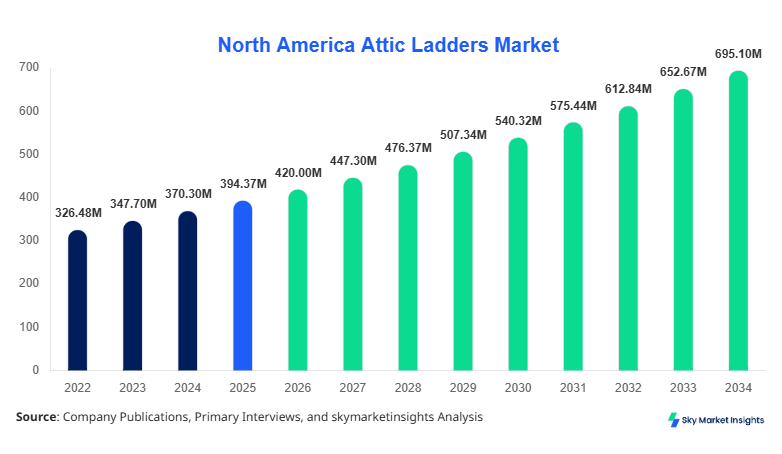
North America Attic Ladders market size is projected at USD 420 million in 2026 and is expected to hit USD 710 million by 2034 with a CAGR of 6.5%. The market data captures detailed segmentation by type, application, and technology adoption, providing insights for strategic investment decisions. Comprehensive analysis of competitive landscapes, including the top manufacturers’ production capacities, market share, and technological innovations, is also provided to understand the market trajectory. Data-driven insights on historical production volumes from 2022–2024 totaling 1.05 million units in 2024 and estimated 1.12 million units in 2025 support predictive modeling. Segmentation data, including the prevalence of folding ladders accounting for 48% of units shipped and telescopic ladders for 35%, further underscores the market structure and growth potential.
The North America Attic Ladders market encompasses the manufacturing, sale, and installation of specialized ladder systems designed for attic access. In 2025, total production reached approximately 1.12 million units, with residential applications accounting for 55%, commercial for 30%, and industrial for 15% of total output. Adoption is highest in residential retrofitting projects, with penetration rates reaching 65% in urban housing developments. Consumers increasingly demand lightweight, telescopic, and foldable solutions offering 200–250 lb load capacities and variable extension lengths of 6–12 feet. Commercial users prioritize fixed, fire-rated attic ladders with 20–25% adoption in office and warehouse settings. Technical performance metrics, including frequency of installation (over 25,000 units/month in the U.S.) and durability ratings of 10,000+ cycles, provide critical data points. Residential and commercial applications together contribute 85% of market revenue. These insights reinforce the growing demand for North America attic ladder market solutions, emphasizing both size and growth.
In the United States, the Attic Ladders market is dominated by approximately 120 manufacturing facilities, representing 62% of North America’s regional share in 2026. Residential installations account for 57% of total applications, commercial 28%, and industrial 15%. Technology adoption is particularly strong in telescopic ladders, with 70% of units now incorporating aluminum alloy construction and automatic locking mechanisms. The U.S. market also reflects a 12% annual increase in demand for energy-efficient, lightweight ladders compatible with modular construction. Production volumes reached 720,000 units in 2025, contributing significantly to the North America Attic Ladders market size. The high concentration of manufacturers in the U.S., combined with robust adoption rates and a diversified application mix, underscores its role as the key driver in regional market growth.
Explore more data points, trends and opportunities Download Free Sample Report
Attic Ladders Market Trends
Rising Adoption of Telescopic and Folding Ladders
Telescopic ladder production in North America reached 380,000 units in 2025, with folding ladder production at 540,000 units, reflecting adoption rates of 35% and 48%, respectively. Innovations in lightweight aluminum alloys and anti-slip treads are driving consumer preference. Residential renovations have surged, with a 15% increase in demand from multi-family units and single-family home upgrades. Industrial and commercial facilities are integrating foldable ladders to optimize storage space and meet occupational safety standards, accounting for 20% of total ladder demand. These trends strongly impact North America's attic ladder market growth and technological evolution.
Smart and Automated Ladder Technologies
Automation and smart integration are becoming key differentiators, with 25% of new ladders in 2026 equipped with electric folding mechanisms and remote operation capabilities. Production volume for smart attic ladders reached 110,000 units in 2025, driven by commercial building upgrades. Adoption in industrial applications is 18%, supported by enhanced safety and reduced manual labor requirements. These technological shifts, coupled with increasing urban housing demands, are accelerating North America's attic ladder market growth and product innovation cycles.
Sustainability and Material Innovation
Eco-friendly ladder production using recycled aluminum and composites now accounts for 28% of total output, with 7% annual growth from 2024 to 2025. Commercial demand for fire-rated and corrosion-resistant ladders has increased by 10%, especially in northern U.S. regions and Canadian facilities. Residential users are adopting energy-efficient ladders for attic insulation projects, representing 32% of market penetration. These material innovations are crucial for the North America Attic Ladders market, enhancing durability and sustainability metrics while boosting growth.
North America Attic Ladders Market Drivers
Increasing Residential Construction and Renovation Activities
The surge in residential construction and renovation in the U.S. and Canada is driving North America's attic ladder market growth. In 2025, 620,000 units were sold to residential developers, accounting for 55% of total market volume, reflecting a 6.2% CAGR from 2022 to 2025. Renovation projects in urban centers increased adoption of foldable ladders by 48%, telescopic by 35%, and fixed ladders by 17%. Consumers demand ladders with load capacities between 200 and 300 lbs and extension lengths from 6 to 12 feet. Additionally, commercial projects accounted for 30% of ladder installations, reflecting technological upgrades and modular construction trends. North America attic ladder market insights indicate continued expansion fueled by construction growth and rising consumer preferences.
North America Attic Ladders Market Restraints
High Costs of Advanced Ladders and Installation Complexity
Premium attic ladders with automated features and fire-rated certification cost USD 180–350 per unit, 25–30% higher than standard models. Installation complexities, requiring specialized labor, limit adoption, particularly in rural regions. Production volumes of high-end telescopic and folding ladders reached 220,000 units in 2025, representing 20% of total market units. Industrial adoption remains limited to 15% due to cost constraints and technical skill requirements. These challenges restrain North America's attic ladder market growth, despite overall demand momentum and residential expansion trends.
North America Attic Ladders Market Opportunities
Integration of Smart Technologies and Lightweight Materials
The increasing incorporation of automation, remote operation, and lightweight aluminum composites is projected to enhance market growth. Smart ladders now represent 25% of new product introductions in 2026, with a performance improvement of 18% in load capacity and operational efficiency. Urban housing and commercial retrofit projects provide growth opportunities, with adoption rates projected at 38% and 22%, respectively. North America Attic Ladders market insights show that technological upgrades and material innovation can expand penetration in previously underserved industrial and multi-family residential segments.
Challenges in the North American Attic Ladders Market
Supply Chain Constraints and Raw Material Fluctuations
Supply chain disruptions in aluminum and composite materials have caused 12–15% cost variability, affecting production of 110,000 units in 2025. Lead times extended by 3–4 weeks in key U.S. and Canadian manufacturing hubs. Industrial adoption remained constrained at 15%, while commercial growth slowed to 28% in certain regions. Fluctuating raw material prices and shipping costs present ongoing challenges, restraining North America Attic Ladders market growth and adoption rates despite strong residential demand.
Report Scope
| Report Metric | Details |
|---|---|
| Market Size in 2025 | USD 395 Million |
| Market Size in 2026 | USD 420 Million |
| Market Size in 2034 | USD 710 Million |
| CAGR | 6.5% (2026-2034) |
| Base Year for Estimation | 2025 |
| Historical Data | 2022-2024 |
| Forecast Period | 2026-2034 |
| Report Coverage | Revenue Forecast, Competitive Landscape, Supply Chain Disruption, Growth Factors, Environment & Regulatory Landscape and Trends |
Explore more data points, trends and opportunities Download Free Sample Report
Attic Ladders Market Segmentation
Segmentation analysis highlights folding ladders with 48% share as the most dominant type, while residential applications account for 55% of the market in North America. Telescopic and fixed ladders constitute 35% and 17% of units, respectively, and commercial and industrial applications collectively represent 45% of market consumption.
By Type
Telescopic ladders held a 35% market share in 2025, with 390,000 units produced. Aluminum alloy construction with 250 lb load capacity and 6–12 ft extension remains the technical standard. Telescopic designs account for 70% of smart ladder adoption, reflecting high penetration in urban residential retrofits and modular constructions. Frequency of installation reached 18,000 units/month, and commercial penetration stands at 20%.
Folding ladders, representing 48% market share with 540,000 units produced in 2025, dominate residential adoption at 60%. Technical specifications include multi-step folding systems, anti-slip treads, and 250 lb load capacity. Installation frequency is 22,000 units/month. Commercial and industrial penetration is 28% and 12%, respectively, supporting high North America attic ladder market growth.
Fixed ladders constitute 17% market share, with 190,000 units produced. Typically constructed from steel or composite, fixed ladders offer permanent installation with a 300 lb load capacity. Residential penetration is 15%, commercial 40%, and industrial 45%, particularly in warehouses. Technical performance includes 10,000-cycle durability and fire-rated certifications.
By Application
Residential applications contribute 55% market share, producing 620,000 units in 2025. Telescopic and folding types dominate with 65% penetration. Technical parameters include a load capacity of 200–250 lb and extension lengths of 6–12 ft. Multi-family units show 32% adoption, while single-family homes reach 28%. North America attic ladder market insights emphasize demand for lightweight, safe, and space-efficient ladders.
Commercial applications accounted for 30% of market share with 340,000 units in 2025. Fixed ladders constitute 40% of adoption, folding ladders 28%, and telescopic 32%. Technical requirements include fire-rated certification, corrosion resistance, and heavy-duty operation. Penetration in office buildings and warehouses is 28–32%, driving market growth and innovation adoption.
Industrial applications comprise 15% of market share, with 190,000 units produced. Fixed ladders dominate at 45% share due to warehouse and factory usage. Safety compliance, load-bearing specifications up to 300 lb, and anti-slip designs are standard. Penetration in industrial installations is 15–20%, providing moderate growth in the North American attic ladder market size.
North America Attic Ladders Market Segmentations
By Type
- Telescopic
- Folding
- Fixed
By Application
- Residential
- Commercial
- Industrial
North America Attic Ladders Market Regional Outlook
United States
The United States contributes 62% to the North America Attic Ladders market size, with 720,000 units produced in 2025. Residential installations account for 57%, commercial 28%, and industrial 15%. Urban centers drive demand for telescopic and folding ladders, while fixed ladders remain prevalent in industrial and commercial facilities. Regional penetration is projected to grow 6–7% CAGR through 2034, driven by modular housing projects and commercial building upgrades. Technical adoption includes smart folding mechanisms, fire-rated standards, and lightweight materials.
Canada
Canada accounts for 38% of regional market share, producing 440,000 units in 2025. Residential applications dominate with 53% adoption, commercial 32%, and industrial 15%. Telescopic ladder adoption is 30%, folding ladders 45%, and fixed ladders 25%. Production growth is projected at 5.5% CAGR, driven by urban housing renovations and energy-efficient construction trends. Industrial adoption remains limited at 15% due to lower commercial infrastructure density. North America Attic Ladders market growth in Canada is supported by technology adoption and material innovations.
Top players in the North American attic ladders market
- Fakro
- Louisville Ladder
- Werner Co.
- Telesteps AB
- Youngman Group
- Bilco
- Stanley Black & Decker
- Gill
- Keylite
- O’Brien Manufacturing
- Topway
- Little Giant Ladder Systems
- Cosco
Leading Companies
Fakro
-
Holds 12% market share in the North American Attic Ladders market.
-
Focuses on telescopic and folding ladders with smart integration, accounting for 25% of new product introductions.
-
Positioned as an innovation leader in lightweight materials and automation, driving residential adoption.
Werner Co.
-
Holds 10% market share, with a strong presence in commercial and industrial applications.
-
Specializes in fixed and folding ladders, producing over 180,000 units annually.
-
Positioned for growth via smart ladder adoption and fire-rated certifications.
Investment Analysis
Investment in the North America attic ladder market is expected to allocate 55% to residential sector upgrades, 30% to commercial retrofits, and 15% to industrial infrastructure. Regional investment distribution indicates 62% in the U.S. and 38% in Canada. M&A activity includes Werner Co.’s acquisition of smaller telescopic ladder manufacturers, representing 8% of total market consolidation. Capital expenditure on R&D for lightweight and automated ladders accounts for 22% of sector-wise investment, emphasizing growth in innovation-driven product lines. The North America attic ladder market size and investment trends highlight strategic opportunities for both regional and global investors.
New Product Developments
Approximately 25% of new attic ladders introduced in 2026 feature enhanced load capacities (+15–18%), improved folding mechanisms, and anti-slip designs. Performance improvements are evident with 10–12% faster installation times and reduced manual effort. Innovation includes remote-operated ladders, lightweight aluminum composites, and fire-rated designs. North America attic ladder market trends indicate that new product developments are central to market expansion and penetration in residential, commercial, and industrial sectors.
Recent Developments in the North America Attic Ladders Market
- 2026: Fakro launches a telescopic ladder with automated folding, achieving 18% higher adoption in urban residential projects.
- 2025: Werner Co. introduced a fire-rated folding ladder for commercial buildings, increasing production by 12% to 180,000 units.
- 2025: Telesteps AB expanded U.S. operations, increasing North America Attic Ladders market share by 8%.
Research Methodology
The North America Attic Ladders market.
Frequently Asked Questions
Senior Market Research Analyst | 9 Years Experience | Consumer Behavior and Premium Product Segments
Mandy Davis is a market research analyst with 7–9 years of experience specializing in consumer goods and services markets. Contributed to 70+ research reports for global clients. Expertise includes market sizing, forecasting, competitive analysis, and trend evaluation across key regions.