Europe Aquarium Fish Feed Market Size
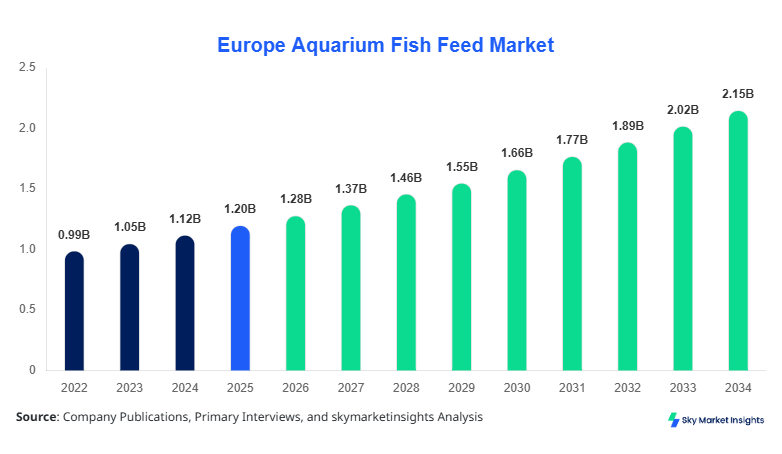
Europe Aquarium Fish Feed market size is projected at USD 1.28 billion in 2026 and is expected to hit USD 2.14 billion by 2034 with a CAGR of 6.7%.The market expansion is supported by rising ornamental fish ownership, premium aquatic nutrition demand, and the increasing penetration of technologically advanced feed formulations across Europe. The report evaluates detailed consumption patterns, production capacities, import-export movements, segmentation performance, and the competitive landscape across major European countries. Increasing investments in sustainable aquaculture ingredients and smart packaging technologies are further supporting long-term industry expansion.The aquarium fish feed industry comprises nutritional products developed specifically for ornamental freshwater and marine fish species maintained in residential, commercial, and institutional aquariums. The European industry recorded more than 48.5 million aquarium-owning households in 2025, with over 162 million ornamental fish units maintained across the region. Germany, the United Kingdom, and France collectively contributed nearly 58% of regional feed consumption volume. Flake feed products accounted for approximately 41% of total sales volume, while pellet feed represented 37% and frozen feed contributed 22%.
Adoption rates of nutritionally balanced feed formulations increased by 18.4% between 2022 and 2025 as consumers shifted toward color-enhancing, protein-rich, and disease-preventive feed products. Automated aquarium systems installed in approximately 21% of urban households enhanced demand for slow-release and technologically optimized feeding products. Consumer spending on ornamental fish care increased from USD 96 per household annually in 2022 to nearly USD 128 in 2025 across Europe.Consumer purchasing behavior reflects strong demand for premium and species-specific products. Nearly 64% of consumers prefer feed products containing spirulina, krill meal, or probiotic ingredients, while 29% prioritize environmentally sustainable packaging. Marine ornamental fish applications represented 33% of total demand, while freshwater aquarium applications held nearly 67% share due to lower maintenance costs and broader consumer accessibility. Enhanced nutritional efficiency, improved water stability, and protein retention ratios above 45% continue reinforcing the Europe Aquarium Fish Feed market.
Explore more data points, trends and opportunities Download Free Sample Report
Aquarium Fish Feed Market Trends
Rising Demand for Sustainable and Functional Feed Products
The industry is witnessing strong adoption of sustainable feed ingredients, including algae proteins, insect meal, and plant-based omega supplements. Sustainable ingredient penetration increased from 11% in 2022 to nearly 27% in 2025 across Europe. Manufacturers collectively produced more than 318,000 metric tons of aquarium fish feed in 2025, compared with 251,000 metric tons in 2022. Functional feed products with immunity-boosting additives recorded sales growth above 19% annually across Germany, France, and the United Kingdom.
Freeze-dried and probiotic-rich feed categories experienced strong penetration among premium aquarium hobbyists. More than 42% of urban consumers in Europe now prefer specialized nutritional products targeted at species coloration enhancement and digestive health optimization. Advanced micro-pellet technologies improved nutrient absorption efficiency by approximately 16%, reducing aquarium water contamination levels by nearly 12%. Continuous innovation in premium aquatic nutrition is strengthening the aquarium fish feed market.
Expansion of E-commerce and Smart Aquarium Integration
Online distribution channels are transforming product accessibility and consumer purchasing behavior across Europe. E-commerce sales represented approximately 34% of regional feed transactions in 2025, compared with only 19% in 2022. Subscription-based feed delivery models expanded by 21% annually due to convenience and recurring purchase patterns. Germany and the United Kingdom together contributed nearly 49% of total online aquarium feed purchases.
Smart aquarium systems integrating automated feeders and mobile application monitoring increased adoption among high-income consumers. Approximately 18% of European aquariums now utilize programmable feeding systems supporting multiple feed compatibility formats. Manufacturers introduced precision pellet formulations with delayed water disintegration times extending up to 4 hours. Such innovations reduced feed wastage by nearly 14% while improving fish digestion efficiency by 9%. Increasing digitalization and automated aquatic maintenance solutions continue driving the aquarium fish feed market.
Europe Aquarium Fish Feed Drivers
Increasing Ornamental Fish Ownership Across Urban Households
The increasing popularity of ornamental fishkeeping across urban European households remains a major market driver. Household aquarium ownership increased by nearly 15.6% between 2022 and 2025, supported by rising consumer interest in indoor aesthetics, wellness, and low-maintenance pets. Europe recorded over 48.5 million aquarium-owning households during 2025, while freshwater ornamental fish sales exceeded 118 million units. The United Kingdom, Germany, and France collectively accounted for more than 60% of aquarium product consumption.
Premium fish feed purchases rose significantly as consumers prioritized fish health, coloration enhancement, and disease prevention. Products enriched with proteins, vitamins, and probiotics represented approximately 44% of premium category sales. Automated aquarium systems and modern aquascaping trends encouraged higher spending on technologically advanced feed formulations. Online educational platforms and social media communities also increased awareness regarding nutritional quality and feeding frequency optimization. Rising disposable income and growing consumer preference for premium ornamental fish care products continue accelerating the aquarium fish feed market.
Europe Aquarium Fish Feed Restraints
Volatility in Raw Material Prices and Supply Chain Costs
Fluctuations in raw material pricing represent a major operational restraint for aquarium fish feed manufacturers. Fish meal prices increased by approximately 18% during 2024 and 2025 due to marine harvesting restrictions and transportation inflation. Spirulina and krill-based ingredients experienced price increases exceeding 21% across Europe. Rising energy costs also elevated feed processing expenditures by nearly 14%.
Import dependency on protein-rich marine ingredients creates supply chain instability, particularly for smaller regional manufacturers operating with narrow profit margins. Nearly 37% of total raw material requirements are sourced from Asia-Pacific and South American suppliers. Transportation disruptions and port congestion increased average delivery timelines from 18 days in 2022 to approximately 29 days in 2025. Premium feed products experienced retail price increases ranging between 9% and 13%, limiting affordability among price-sensitive consumers. Regulatory pressures concerning sustainability certifications and marine resource usage further constrain production scalability. These factors continue limiting aquarium fish feed market expansion.
Europe Aquarium Fish Feed Opportunities
Development of Species-Specific and Functional Nutrition Products
Increasing demand for species-specific aquatic nutrition presents substantial opportunities for market participants. Specialized feed products for tropical fish, cichlids, goldfish, and marine reef species collectively accounted for nearly 39% of premium product launches in 2025. Functional feed formulations incorporating probiotics, carotenoids, and omega-enhancing compounds achieved sales increases above 22% annually across Europe.
Manufacturers are increasingly investing in R&D facilities focused on nutritional optimization and feed stability performance. More than USD 118 million was allocated toward aquatic nutrition research programs across Europe between 2023 and 2025. Feed conversion efficiency improvements of nearly 13% and enhanced water stability technologies have increased consumer adoption of premium formulations. Growth in marine aquarium ownership, particularly in Germany and the United Kingdom, is further expanding demand for high-protein feed products with protein content above 48%. Product innovation and advanced aquatic nutrition technologies continue generating strong aquarium fish feed market opportunities.
Europe Aquarium Fish Feed Challenge
Stringent Environmental Regulations and Product Standardization
Environmental compliance and ingredient standardization remain major industry challenges across Europe. Regulatory agencies increasingly restrict the usage of unsustainable marine ingredients and artificial preservatives. More than 31% of manufacturers reported increased compliance costs during 2025 due to sustainability certification requirements and ingredient traceability mandates.
Biodegradable packaging adoption increased production expenses by nearly 12%, while ingredient substitution requirements impacted feed formulation consistency. Small and medium-sized manufacturers face operational difficulties in maintaining standardized nutritional profiles and water stability metrics. Additionally, varying national regulations across Germany, France, Italy, and Russia complicate cross-border product distribution and labeling requirements.
Consumer expectations regarding chemical-free and environmentally responsible feed products are intensifying. Approximately 46% of European consumers now review ingredient transparency before purchasing aquarium feed products. Manufacturers must continuously balance sustainability objectives, nutritional performance, and cost efficiency. These operational complexities remain a notable challenge for the aquarium fish feed market.
Report Scope
| Report Metric | Details |
|---|---|
| Market Size in 2025 | USD 2.66 Billion |
| Market Size in 2026 | USD 1.28 Billion |
| Market Size in 2034 | USD 2.14 Billion |
| CAGR | 6.7% (2026-2034) |
| Base Year for Estimation | 2025 |
| Historical Data | 2022-2024 |
| Forecast Period | 2026-2034 |
| Report Coverage | Revenue Forecast, Competitive Landscape, Supply Chain Disruption, Growth Factors, Environment & Regulatory Landscape and Trends |
Explore more data points, trends and opportunities Download Free Sample Report
Aquarium Fish Feed Market Segmentation
The market segmentation is categorized by product type and distribution channel, with pellet feed dominating nearly 37% share due to superior nutrient retention and lower water contamination levels. Pet specialty stores accounted for approximately 46% of regional sales owing to expert recommendations and broader premium product availability.
By Type
Flake feed products maintained approximately 41% of total regional consumption volume during 2025 due to affordability and widespread consumer familiarity. More than 128,000 metric tons of flake feed were consumed across Europe. These products are primarily used for freshwater community fish species because of rapid surface dispersion and ease of portion control. Protein composition ranges between 28% and 38%, while moisture content remains below 8% for extended shelf stability. Germany and France collectively contributed over 44% of regional flake feed demand. Manufacturers increasingly incorporate spirulina and vitamin-enhanced ingredients to improve coloration performance and immune response. Enhanced flake coating technologies improved nutrient retention by approximately 11%, supporting stable consumer demand.
Pellet feed represented nearly 37% market contribution and recorded the fastest adoption rate among premium aquarium hobbyists. Europe produced approximately 112,000 metric tons of pellet feed products during 2025. These feeds provide superior nutrient density, controlled sinking rates, and reduced water contamination compared with conventional flakes. Protein concentrations typically range from 40% to 52%, making pellets highly suitable for marine fish and carnivorous tropical species. Automated feeding systems increased pellet feed adoption by nearly 19% between 2022 and 2025 due to precise dispensing compatibility. The United Kingdom and Italy collectively accounted for 38% of premium pellet feed purchases across Europe.
Frozen feed products contributed approximately 22% share due to increasing popularity among marine aquarium enthusiasts and exotic species keepers. Europe consumed over 67,000 metric tons of frozen feed products during 2025. Bloodworms, brine shrimp, krill, and plankton-based formulations dominate this segment. Protein retention levels exceed 55% in premium frozen products, while nutrient degradation remains comparatively lower than dry alternatives. Marine aquarium applications represented nearly 61% of frozen feed consumption. Increasing adoption of reef aquariums and predator fish species continues supporting frozen feed demand across Germany, Spain, and Russia.
By Application
Pet specialty stores remained the dominant distribution channel with approximately 46% revenue contribution in 2025. More than 18,000 aquarium-focused retail outlets operated across Europe, offering premium feed formulations and expert advisory services. Consumers purchasing through specialty stores spend approximately 24% more annually than online-only buyers due to access to customized nutritional recommendations and premium imported products. Pellet and frozen feed categories collectively accounted for nearly 63% of specialty store sales. In-store educational support and aquarium maintenance consultation services significantly influence consumer loyalty and repeat purchasing frequency.
Online retail channels represented nearly 34% of total market revenue and demonstrated the highest annual expansion rate between 2022 and 2025. More than 11 million aquarium feed transactions occurred through digital platforms during 2025. Subscription-based feed delivery services expanded by approximately 21%, particularly in the United Kingdom and Germany. Online platforms provide broader access to imported premium feed products, sustainable packaging variants, and species-specific nutritional formulations. Consumer preference for digital product comparisons and doorstep delivery convenience substantially increased online sales penetration. Mobile application-based purchasing accounted for nearly 42% of online feed transactions across Europe.
Supermarkets and hypermarkets accounted for approximately 20% of market revenue due to broad accessibility and competitive pricing strategies. These retail channels sold more than 61,000 metric tons of aquarium feed products during 2025. Flake feed products represented nearly 58% of supermarket aquarium feed sales because of lower price points and widespread consumer familiarity. Private-label product penetration increased by approximately 16% annually across France, Spain, and Italy. While supermarkets primarily target entry-level aquarium hobbyists, expanding shelf space for premium aquatic nutrition products is improving segment profitability across Europe.
Europe Aquarium Fish Feed Market Segmentations
Product Type
- Flake Feed
- Pellet Feed
- Frozen Feed
Distribution Channel
- Pet Specialty Stores
- Online Retail
- Supermarkets
Europe Aquarium Fish Feed Regional Outlook
United Kingdom
The United Kingdom accounted for approximately 26% of regional market revenue during 2025, supported by rising ornamental fish ownership and expanding premium aquatic nutrition adoption. The country maintained more than 14.2 million ornamental fish units and nearly 5.8 million aquarium-owning households. Pellet feed products represented approximately 39% of national consumption due to increasing smart aquarium installations and automated feeding compatibility.
Online retail penetration exceeded 36% of total feed sales in the country, while specialty aquatic stores accounted for nearly 44% revenue contribution. Marine aquarium ownership increased by approximately 12% between 2022 and 2025, supporting frozen feed consumption growth. Sustainable packaging adoption among aquarium feed brands exceeded 29% across the United Kingdom market.
Germany
Germany represented nearly 23% of Europe’s total revenue contribution in 2025 and maintained the region’s largest aquarium hobbyist population. The country consumed more than 72,000 metric tons of aquarium fish feed products annually. Freshwater aquarium applications accounted for approximately 69% of national demand, while marine aquariums contributed 31%.
Premium feed penetration increased substantially among urban consumers, with protein-rich pellet products representing nearly 42% of all sales. Germany also led Europe in automated aquarium technology adoption, with approximately 26% of premium aquariums utilizing programmable feeders. Domestic production facilities contributed nearly 48% of national feed supply, reducing import dependency compared with other European countries.
France
France accounted for approximately 16% share of regional aquarium fish feed consumption during 2025. The country maintained nearly 7.1 million ornamental fish units and over 2,200 aquarium retail facilities. Flake feed products remained dominant with approximately 45% sales share due to widespread household adoption among beginner hobbyists.
Online sales channels increased by nearly 18% annually between 2022 and 2025, supported by expanding e-commerce infrastructure. Marine fish applications contributed approximately 28% of total national demand. Sustainable ingredient adoption among French manufacturers increased significantly, with nearly 24% of premium products incorporating plant-based proteins and algae supplements.
Spain
Spain contributed nearly 11% of regional revenue and demonstrated strong growth in marine aquarium applications. The country consumed approximately 29,000 metric tons of aquarium feed products during 2025. Frozen feed products represented nearly 26% of total sales due to rising reef aquarium popularity across urban households and hospitality facilities.
Pet specialty stores dominated with approximately 49% of national sales, while online retail channels contributed 31%. Consumer spending on premium ornamental fish care products increased by approximately 17% between 2022 and 2025. Spain also recorded strong adoption of probiotic-enhanced feed formulations for tropical fish species.
Italy
Italy accounted for approximately 10% of Europe’s aquarium feed consumption during 2025, supported by increasing ornamental fish imports and expanding urban aquarium ownership. Pellet feed products represented nearly 41% of national revenue due to higher adoption among premium consumers and commercial aquarium operators.
The country operated more than 1,500 aquatic retail outlets and imported nearly 37% of premium aquarium feed products from Germany and the United Kingdom. Marine aquarium applications contributed approximately 33% of total demand. Sustainable packaging penetration reached 22% among domestic manufacturers during 2025.
Russia
Russia contributed approximately 8% of regional revenue and maintained increasing demand for affordable aquarium feed products. Flake feed products accounted for nearly 51% of total sales volume due to lower consumer purchasing costs and broad retail availability. The country consumed approximately 22,000 metric tons of aquarium feed products during 2025.
Domestic manufacturing facilities supplied nearly 57% of national demand, while imported premium pellet and frozen feed products continued gaining traction in metropolitan regions. Online retail adoption increased by approximately 14% annually between 2022 and 2025. Expanding aquarium ownership among younger consumers is supporting future industry expansion.
Top players in Europe Aquarium Fish Feed
- Tetra GmbH
- Hikari Sales USA Inc.
- JBL GmbH & Co. KG
- Sera GmbH
- Spectrum Brands Holdings Inc.
- Alltech Coppens
- Ocean Nutrition
- Aquarian
- Taiyo Pet Products
- Coppens International
- Aqua One
- Fluval
- Tropical Fish International
- New Life Spectrum
- Dennerle GmbH
Tetra GmbH
-
Tetra GmbH accounted for approximately 17% of total European revenue in 2025.
-
The company maintained strong positioning across Germany, the United Kingdom, and France through extensive distribution partnerships and premium pellet product offerings.
-
Tetra operated multiple production facilities with annual production exceeding 41,000 metric tons of aquarium feed products.
-
Its premium feed portfolio includes probiotic-enhanced pellets, color-enhancing flakes, and marine nutrition solutions targeting both freshwater and saltwater species.
-
The company invested nearly USD 28 million between 2023 and 2025 in sustainable packaging technologies and ingredient optimization programs.
-
Tetra’s strong retail penetration and technological innovation continue reinforcing its leadership position across Europe.
JBL GmbH & Co. KG
-
JBL GmbH & Co. KG represented approximately 11% regional market contribution during 2025.
-
The company maintains a strong presence in premium aquatic nutrition and technologically advanced aquarium maintenance products.
-
JBL produced more than 24,000 metric tons of specialized aquarium feed products annually across Europe.
-
Marine fish feed products contributed approximately 36% of company revenue due to increasing reef aquarium demand.
-
The company introduced multiple protein-rich pellet formulations exceeding 50% protein concentration and improved water stability performance by nearly 15%.
-
Strong R&D capabilities and premium branding strategies continue strengthening JBL’s competitive positioning in Europe.
Investment Analysis
Investment activity across the European aquarium feed industry increased significantly between 2023 and 2025. Approximately 38% of total investments were allocated toward sustainable ingredient sourcing and alternative protein development technologies. Manufacturing automation projects accounted for nearly 27% of total capital expenditure, while digital retail infrastructure represented approximately 18%. Germany and the United Kingdom collectively attracted nearly 52% of total regional investments due to advanced distribution networks and premium consumer demand.
Private equity firms and aquaculture nutrition companies increasingly targeted acquisitions and strategic partnerships across Europe. More than 14 acquisition agreements and collaborative feed development partnerships were recorded between 2023 and 2025. Sustainable feed ingredient startups attracted investments exceeding USD 92 million during the same period. Companies focused on insect meal proteins, algae-based omega supplements, and biodegradable packaging technologies received the highest funding allocations.
Regional collaboration agreements between aquatic nutrition manufacturers and smart aquarium technology firms expanded considerably. Automated feeding compatibility partnerships increased by approximately 21% annually. Cross-border production agreements between Germany, France, and Italy improved regional manufacturing efficiency and ingredient procurement stability. Strategic investments in premium marine nutrition and environmentally compliant feed technologies continue generating long-term expansion opportunities.
New Product Developments
Manufacturers introduced multiple advanced aquarium feed formulations between 2024 and 2026, with approximately 31% of all new product launches focusing on sustainable ingredients and enhanced nutritional performance. Protein retention improvements exceeded 14% in premium pellet products, while water contamination reduction technologies improved by nearly 11%.
Companies increasingly launched probiotic-rich formulations designed for immune enhancement and digestive efficiency. Marine-specific frozen feed products with omega-3 enrichment demonstrated approximately 19% higher consumer adoption compared with traditional formulations. Smart packaging innovations featuring moisture-resistant sealing technologies extended shelf life by nearly 23%. The increasing pace of technological product development continues transforming the European aquarium feed industry.
Recent Developments in Europe Aquarium Fish Feed
- 2026: Spectrum Brands Holdings Inc. expanded its European aquatic nutrition investment strategy with nearly USD 34 million allocated toward smart aquarium integration technologies and sustainable feed development initiatives. The investment improved automated feeder compatibility performance by approximately 17% while supporting expansion into premium specialty retail channels.
- 2025: Tetra GmbH expanded its Germany production facility by 18%, increasing annual pellet feed manufacturing capacity to more than 46,000 metric tons. The expansion focused on sustainable protein integration and automated packaging technologies. The company also introduced biodegradable packaging lines reducing plastic usage by approximately 27% annually across European distribution networks.
- 2025: Sera GmbH implemented automated feed production systems improving processing efficiency by nearly 16% and reducing operational waste by approximately 12%. The company also expanded online retail partnerships across France and Spain, increasing digital sales contribution above 29% of total company revenue.
Research Methodology
The research process for the Europe aquarium fish feed industry involved comprehensive primary and secondary research methodologies designed to ensure accurate market evaluation and forecasting. Primary research included interviews with aquarium feed manufacturers, ornamental fish breeders, retail distributors, aquaculture nutrition experts, and aquarium equipment suppliers across the United Kingdom, Germany, France, Spain, Italy, and Russia. More than 120 industry participants contributed quantitative and qualitative insights related to production volumes, pricing trends, technological adoption, and consumer purchasing behavior.
Secondary research included analysis of trade journals, company annual reports, government trade databases, import-export statistics, aquaculture association publications, and industry white papers. Market size estimation was conducted using both top-down and bottom-up analytical approaches. Demand forecasting considered historical consumption patterns from 2022 to 2024 alongside economic indicators, household aquarium ownership trends, and retail channel performance metrics. Statistical modeling incorporated regional production capacities, technology adoption rates, and investment flows to generate long-term projections through 2034. Validation procedures included triangulation techniques and cross-verification with industry experts to ensure data consistency and forecasting accuracy.
Frequently Asked Questions
Senior Market Research Analyst | 9 Years Experience | Plant-Based Foods and Functional Ingredients
Kathy Flores is a market research analyst with 7–9 years of experience specializing in food and beverages markets. Contributed to 70+ research reports for global clients. Expertise includes market sizing, forecasting, competitive analysis, and trend evaluation across key regions.