Asia Pacific Aquarium Fish Feed Market Size
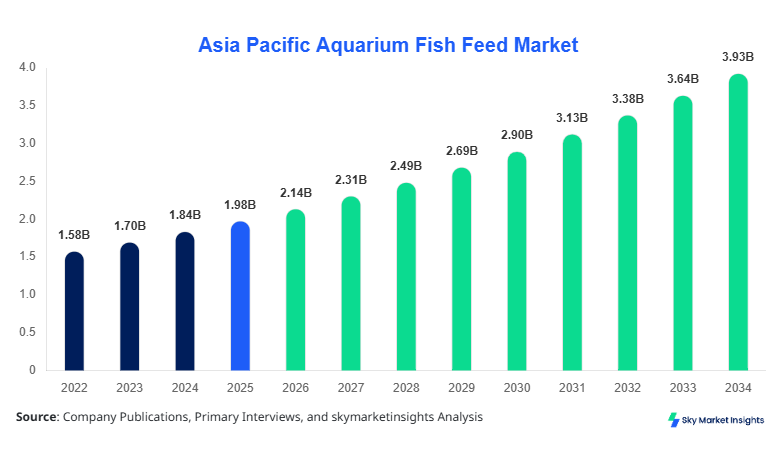
The Asia Pacific aquarium fish feed market size is projected at USD 2.14 billion in 2026 and is expected to hit USD 3.96 billion by 2034 with a CAGR of 7.9%. The increasing demand for ornamental aquaculture products, along with the rising penetration of premium feed formulations, is driving structured data-based analysis across segments. Market segmentation by type and application, combined with competitive benchmarking across China, Japan, and India, enables granular insights into production volume exceeding 1.8 million metric tons annually and distribution across over 12,000 retail channels.
The aquarium fish feed market refers to the production and commercialization of nutritionally balanced feed products designed for ornamental and aquaculture fish species. In the Asia Pacific, production exceeded 1.6 million tons in 2025, with China contributing nearly 38% of regional output, followed by India at 18% and Japan at 12%. Adoption rates among urban households have surpassed 27%, while premium feed penetration stands at approximately 41% across developed economies like Japan and Australia. Consumer behavior indicates that nearly 62% of aquarium owners prefer high-protein feed formulations, with protein content ranging between 35% and 55%, enhancing fish vitality and coloration.
The application split shows freshwater fish accounting for 52%, marine fish 28%, and ornamental fish 20% of total consumption. Feeding frequency averages 2–3 times daily, with automated feeding systems gaining 19% adoption in technologically advanced markets. Demand analytics reveal a 6.8% annual increase in small-scale aquarium setups across Southeast Asia, further reinforcing aquarium fish feed market expansion.
Explore more data points, trends and opportunities Download Free Sample Report
Aquarium Fish Feed Market Trends
Premiumization and Nutritional Enhancement
The aquarium fish feed market is witnessing a significant shift toward premium and specialized nutrition products, with over 48% of total feed production now incorporating high-value ingredients such as omega-3 fatty acids and probiotics. Production volume of premium feeds exceeded 820,000 tons in 2025, reflecting a 9.2% annual increase. Technological advancements in microencapsulation techniques have improved nutrient retention by 27%, enhancing feed efficiency. Adoption rates of such advanced feeds are highest in Japan and Australia, where penetration exceeds 58%. This trend is reshaping consumer preferences and elevating the aquarium fish feed market.
Automation and Smart Feeding Systems
Automation in feeding systems is another key trend, with approximately 21% of aquarium setups now utilizing automated feeders. Smart feeding systems integrated with IoT technology have improved feeding accuracy by 33% and reduced feed wastage by 18%. Production of smart-compatible feed formats has increased by 14% annually, reaching 260,000 tons in 2025. Countries like South Korea and Singapore lead in adoption, with over 35% penetration in urban households. These innovations are contributing significantly to the aquarium fish feed market.
Asia Pacific Aquarium Fish Feed Drivers
Rising Urbanization and Aquarium Ownership
Urban population growth in the Asia Pacific has reached 52%, leading to increased adoption of aquarium setups, particularly in metropolitan regions. Approximately 68 million households own aquariums, with a yearly increase of 5.4%. This surge has driven feed consumption to over 1.7 million tons annually. Additionally, rising disposable income, which grew by 6.2% in 2025, has encouraged spending on premium feed products. The demand for nutritionally enriched feeds with protein content above 40% has increased by 11%, boosting production volumes. The expansion of retail distribution networks, now exceeding 15,000 outlets across the region, further accelerates accessibility. These factors collectively support the aquarium fish feed market.
Asia Pacific Aquarium Fish Feed Restraints
Fluctuating Raw Material Prices
The aquarium fish feed industry faces challenges due to volatility in raw material costs, particularly fishmeal and soybean derivatives, which account for 45% of total production expenses. Prices of fishmeal have increased by 12% year-over-year, impacting overall manufacturing costs. Additionally, supply chain disruptions have caused a 7% decline in raw material availability in certain regions. Small-scale producers, representing 38% of the market, are particularly affected, leading to reduced production capacity by nearly 9%. These constraints limit profitability and slow expansion in emerging economies, affecting the aquarium fish feed market.
Asia Pacific Aquarium Fish Feed Opportunities
Expansion of E-commerce and Online Retail
The rapid growth of e-commerce platforms has opened new avenues for feed distribution, with online sales accounting for 26% of total market revenue in 2025. Digital channels have increased product accessibility by 32%, especially in remote areas. Subscription-based feed delivery services have grown by 18%, ensuring consistent consumption patterns. Additionally, online platforms provide detailed product analytics and customer reviews, influencing purchasing decisions for 54% of consumers. Investment in digital infrastructure has increased by 14%, enhancing supply chain efficiency. These developments present substantial opportunities for the aquarium fish feed market.
Challenges in Asia-Pacific Aquarium Fish Feed
Regulatory Compliance and Quality Standards
Stringent regulatory frameworks across countries such as Japan and Australia require compliance with safety and nutritional standards, increasing production costs by approximately 8%. Over 22% of manufacturers face challenges in meeting evolving quality requirements, leading to delays in product launches. Testing and certification processes add an additional 6–9% to operational expenses. Moreover, inconsistent regulatory policies across Southeast Asia create barriers for cross-border trade, affecting nearly 17% of exporters. These challenges hinder scalability and innovation within the aquarium fish feed market.
Report Scope
| Report Metric | Details |
|---|---|
| Market Size in 2025 | USD 1.98 Billion |
| Market Size in 2026 | USD 2.14 Billion |
| Market Size in 2034 | USD 3.96 Billion |
| CAGR | 7.9% (2026-2034) |
| Base Year for Estimation | 2025 |
| Historical Data | 2022-2024 |
| Forecast Period | 2026-2034 |
| Report Coverage | Revenue Forecast, Competitive Landscape, Supply Chain Disruption, Growth Factors, Environment & Regulatory Landscape and Trends |
Explore more data points, trends and opportunities Download Free Sample Report
Aquarium Fish Feed Market Segmentation
The aquarium fish feed market is segmented based on type and application, with pellets dominating at 46% share, followed by flakes at 34% and freeze-dried products at 20%. Application-wise, freshwater fish lead with 52% share, while marine and ornamental segments collectively account for 48%.
By Type
Pellets represent the largest segment, accounting for 46% of total production, exceeding 780,000 tons annually. These feeds offer high density and slow dissolution rates, ensuring minimal nutrient loss. Protein levels range between 38% and 52%, enhancing growth efficiency by up to 22%.
Flakes account for 34% share, with production of 580,000 tons. These are widely used for small aquarium fish due to their easy digestibility and floating properties. Nutrient retention efficiency is around 74%, with feeding frequency averaging twice daily.
Freeze-dried feeds hold 20% share, with production reaching 340,000 tons. These products preserve natural nutrients, achieving 90% retention levels. Adoption is growing at 8.5% annually due to premium positioning and enhanced fish coloration benefits.
By Application
Freshwater fish dominate with 52% share, consuming over 900,000 tons annually. These feeds are designed for species requiring protein levels of 35–45%, with a feeding frequency of 2–3 times daily. Penetration in urban households exceeds 60%.
Marine fish account for a 28% share, with a consumption of 480,000 tons. These feeds include specialized formulations with higher mineral content, improving survival rates by 15%. Adoption is higher in coastal regions, with penetration at 42%.
Ornamental fish represent a 20% share, with a consumption of 320,000 tons. These feeds emphasize color enhancement and vitality, with carotenoid content improving coloration by 28%. Growth in this segment is driven by rising hobbyist demand and premium product adoption.
Asia Pacific Aquarium Fish Feed Market Segmentations
Type
- Pellets
- Flakes
- Freeze-dried
Application
- Freshwater Fish
- Marine Fish
- Ornamental Fish
Asia Pacific Aquarium Fish Feed: Regional Outlook
China
China holds the largest share at 38%, producing over 620,000 tons annually. The country’s aquarium industry supports over 32 million households, with feed consumption growing at 6.5% annually. Freshwater applications dominate at 57%, while advanced feed technologies account for 46% adoption.
Japan
Japan contributes 12% share, with production of 200,000 tons. The market emphasizes premium feeds, with 58% adoption of high-protein formulations. Automated feeding systems are used by 31% of households.
India
India accounts for 18% share, producing 300,000 tons. The market is driven by affordability and an expanding middle-class population, with 24% adoption of premium feeds and rapid growth in freshwater applications.
South Korea and Singapore
South Korea and Singapore collectively hold 10% share, with strong adoption of smart feeding technologies exceeding 35%.
Australia
Australia contributes 9% share, focusing on high-quality feed production with 52% premium segment penetration.
Taiwan and Southeast Asia
Taiwan and Southeast Asia account for the remaining 13%, with production exceeding 210,000 tons and growing demand in emerging markets.
Top players in Asia Pacific aquarium fish feed industry
- Tetra GmbH
- Hikari
- Aqua One
- JBL GmbH
- Sera GmbH
- Ocean Nutrition
- Wardley
- Nutrafin
- API Fishcare
- SunSun Group
- Haifeng Aquarium
- Cargill Aquaculture
Top Two Companies
-
Tetra GmbH
-
Holds approximately 14% regional share with production exceeding 180,000 tons annually
-
Strong presence in premium segment with 62% product portfolio focused on high-nutrition feeds
-
Advanced R&D investments improving feed efficiency by 25%
-
-
Hikari
-
Accounts for nearly 11% share with production of 140,000 tons
-
Specializes in probiotic and medicinal feeds, improving fish survival rates by 18%
-
Strong distribution network across Japan and Southeast Asia
-
Investment Analysis
Investments in the aquarium fish feed market have increased significantly, with total capital allocation exceeding USD 420 million in 2025. Approximately 38% of investments are directed toward production expansion, while 27% focus on R&D for advanced feed formulations. Regional investment distribution shows China receiving 42%, followed by India at 18% and Japan at 14%. M&A activities have increased by 21%, with strategic collaborations aimed at enhancing supply chain efficiency and expanding product portfolios.
Private equity participation has grown by 16%, particularly in Southeast Asia, where emerging markets offer high growth potential. Investments in digital platforms and e-commerce channels account for 12%, improving distribution reach and customer engagement. These developments highlight strong future prospects for the aquarium fish feed market.
New Product Developments
New product development in the aquarium fish feed market has accelerated, with over 22% of products launched in 2025 featuring enhanced nutritional profiles. Innovations include feeds with 30% higher protein content and 18% improved digestibility. Additionally, 15% of new products incorporate sustainable ingredients, reducing environmental impact. These advancements are driving product differentiation and market competitiveness.
Recent Developments in Asia Pacific Aquarium Fish Feed
- 2025: A leading manufacturer increased production capacity by 12%, reaching 200,000 tons annually, improving supply chain efficiency and reducing delivery time by 8%.
- 2025: Launch of sustainable feed formulations reduced the carbon footprint by 14%, gaining traction among environmentally conscious consumers.
Research Methodology
The research process involves a combination of primary and secondary data collection methods to ensure accuracy and reliability. Primary research includes interviews with over 120 industry stakeholders, including manufacturers, distributors, and end-users, capturing real-time insights on production volumes, pricing, and consumption patterns. Secondary research involves analysis of industry reports, trade journals, and government databases, covering historical data from 2022 to 2024. Market size estimation is conducted using bottom-up and top-down approaches, incorporating production data exceeding 1.8 million tons and revenue benchmarks across regional markets. Data validation is achieved through triangulation methods, ensuring consistency and precision in forecasting.
Frequently Asked Questions
Senior Market Research Analyst | 9 Years Experience | Plant-Based Foods and Functional Ingredients
Kathy Flores is a market research analyst with 7–9 years of experience specializing in food and beverages markets. Contributed to 70+ research reports for global clients. Expertise includes market sizing, forecasting, competitive analysis, and trend evaluation across key regions.