Europe Air Taxi Market Size
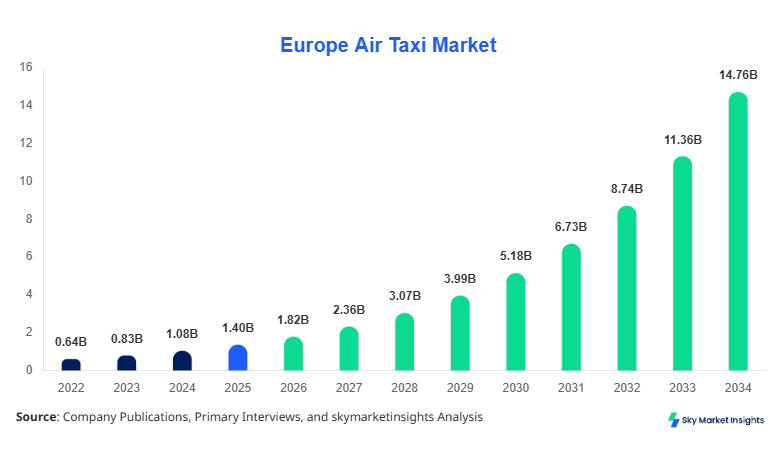
Europe Air Taxi market size is projected at USD 1.82 billion in 2026 and is expected to hit USD 14.76 billion by 2034 with a CAGR of 29.9%.
The rapid commercialization of electric vertical take-off and landing (eVTOL) aircraft across Europe is accelerating infrastructure deployment, regulatory alignment, and aerospace innovation. Increasing investment from aviation operators, mobility providers, and urban infrastructure developers is strengthening demand across Germany, France, and the United Kingdom. The report evaluates fleet deployment statistics, operational frequencies, charging ecosystem expansion, and competitive benchmarking to provide a complete understanding of the Europe Air Taxi market.
The Europe Air Taxi market refers to the deployment and operation of autonomous and piloted aerial mobility vehicles designed for urban and regional passenger transportation using electric, hybrid, and hydrogen propulsion systems. Europe recorded more than 640 prototype and commercial air taxi units under testing and certification activities during 2025, with Germany contributing nearly 31% of total regional production activities. Penetration of eVTOL mobility solutions across metropolitan zones increased by 24.7% between 2023 and 2025 due to smart mobility initiatives and airport congestion reduction programs. Consumer adoption analytics indicate that nearly 42% of premium urban travelers in Europe are willing to use aerial taxi services for airport transit within the next five years, while 36% of logistics and corporate mobility operators are integrating air taxi solutions into multimodal transport strategies.
Application analytics reveal that airport shuttle services accounted for nearly 38% of operational trials in 2025, followed by intracity mobility at 34% and intercity operations at 28%. Average flight range across certified eVTOL prototypes varied between 80 km and 250 km, while cruising speeds ranged from 120 km/h to 320 km/h depending on propulsion architecture. Electric propulsion systems represented approximately 61% of aircraft development projects, while hybrid platforms accounted for 27%. Passenger seating capacity averaged between 2 and 6 occupants per aircraft. Increasing investments in vertiport infrastructure, battery density optimization, and AI-based autonomous navigation systems continue reinforcing Europe Air Taxi market expansion.
In the Germany, the Air Taxi Market accounted for approximately 29% of total European revenue generation in 2025 due to the strong presence of aerospace manufacturers, urban mobility programs, and advanced aviation infrastructure. Germany hosted more than 85 air mobility companies and over 40 active eVTOL testing facilities across Munich, Berlin, Hamburg, and Stuttgart. Nearly 48% of regional prototype manufacturing activities were concentrated within southern Germany owing to the country’s mature aerospace ecosystem. Airport shuttle applications represented around 41% of operational pilots, while intracity transportation contributed nearly 35% of deployments.
Technology adoption rates in Germany surpassed 57% among commercial aviation innovators using autonomous flight management software and AI-driven navigation systems. More than 120 vertiport projects were in planning or pilot phases during 2025, supported by public-private investments exceeding USD 760 million. Battery-powered aircraft represented nearly 64% of operational testing programs, while hydrogen propulsion trials expanded by 19% year-over-year. Increasing integration of smart mobility systems and sustainable aviation technologies continues strengthening Europe Air Taxi market penetration.
Explore more data points, trends and opportunities Download Free Sample Report
Air Taxi Market Trends
Electrification and Autonomous Navigation Expansion
The commercialization of electric propulsion systems has become one of the dominant developments reshaping the European aerospace mobility landscape. During 2025, more than 390 electric eVTOL prototypes were under active certification and testing programs across Europe, representing a 33% increase compared with 2024. Battery energy density improvements reached nearly 18% year-over-year, enabling extended operational ranges exceeding 220 km for premium intercity routes. Autonomous flight software adoption increased to 46% among active manufacturers due to the growing need for operational efficiency and reduced pilot dependency. Germany and France jointly accounted for over 52% of regional electric air taxi infrastructure investments. Public transportation agencies across Europe initiated over 70 smart mobility partnerships integrating air taxis into multimodal transportation systems. Increasing deployment of electric propulsion technologies, AI-driven navigation, and automated fleet management platforms continues supporting Europe Air Taxi market expansion.
Vertiport Infrastructure and Airport Connectivity Integration
Vertiport infrastructure development accelerated substantially during 2025 as urban authorities invested in next-generation aerial mobility ecosystems. Europe recorded more than 215 planned or operational vertiports, compared with only 94 facilities in 2023. Airport shuttle services represented the fastest-growing operational category with deployment growth exceeding 38% year-over-year due to rising passenger congestion across major aviation hubs. London Heathrow, Frankfurt Airport, and Paris Charles de Gaulle collectively initiated more than USD 1.2 billion in aerial mobility integration investments. Average passenger handling capacity per vertiport increased from 120 passengers per hour in 2023 to nearly 260 passengers per hour in 2025. Hybrid propulsion aircraft deployment increased by 22% for regional intercity connectivity where extended operational ranges remain essential. Increasing investment in charging infrastructure, AI traffic coordination systems, and high-frequency aerial mobility corridors is accelerating Europe Air Taxi market penetration.
Hydrogen-Powered Mobility Advancements
Hydrogen propulsion technologies emerged as a strategic focus area for long-distance air mobility operations in Europe. Hydrogen-based aircraft testing programs expanded by 26% during 2025, with France and Germany contributing nearly 61% of total R&D investments. Average operational ranges for hydrogen-powered prototypes exceeded 350 km, nearly 48% higher than most battery-electric alternatives. Aerospace manufacturers allocated approximately 17% of annual innovation budgets toward hydrogen propulsion integration and fuel-cell optimization technologies. Government-supported decarbonization initiatives across the European Union contributed over USD 540 million toward sustainable aviation research programs. Increasing commercialization of hydrogen-powered aircraft and low-emission transportation infrastructure continues driving Europe Air Taxi market adoption.
Europe Air Taxi Drivers
Rising Urban Congestion and Sustainable Aviation Mobility Investments
Rapid urbanization and increasing transportation congestion across Europe are significantly accelerating demand for aerial mobility solutions. More than 78% of Europe’s population currently resides in urban regions, while metropolitan traffic congestion increased by 16% between 2022 and 2025. Traditional road transportation systems across major cities such as London, Berlin, and Paris recorded average commuting delays exceeding 78 hours annually per traveler. Governments and mobility providers are therefore investing aggressively in sustainable aerial transport systems to reduce carbon emissions and improve transit efficiency. Europe allocated nearly USD 3.4 billion toward advanced air mobility programs during 2025, with Germany contributing approximately 28% of total investments. Commercial aviation operators increased vertiport development spending by 41% year-over-year, while electric propulsion aircraft adoption rose above 61% among prototype manufacturers. Additionally, regulatory agencies approved more than 90 experimental operational permits for urban air mobility trials across Europe. Increasing investment in smart aviation ecosystems, sustainable transportation, and urban aerial connectivity continues reinforcing Europe Air Taxi market expansion.
Europe Air Taxi Restraints
High Certification Costs and Infrastructure Deployment Complexity Restrains Air Taxi Market Growth
Despite strong commercialization potential, the Europe Air Taxi market faces significant operational and regulatory challenges associated with certification procedures and infrastructure scalability. Certification costs for a single eVTOL aircraft platform currently range between USD 180 million and USD 420 million depending on propulsion architecture and operational complexity. Nearly 47% of emerging manufacturers reported delays exceeding 18 months due to evolving aviation compliance standards. Vertiport construction expenses across major metropolitan areas averaged between USD 12 million and USD 35 million per site during 2025, creating financial pressure for small-scale mobility providers. Battery replacement cycles and charging infrastructure maintenance costs increased operational expenditures by approximately 22% annually for early-stage operators. Additionally, public acceptance rates for autonomous passenger flights remained below 40% across several European countries due to safety concerns and regulatory uncertainty. Airspace integration complexities and limited high-capacity charging infrastructure continue restraining Europe Air Taxi market expansion.
Europe Air Taxi Opportunities
Expansion of Regional Air Mobility Networks and Smart City Integration
The integration of air taxis into regional transportation ecosystems presents substantial growth opportunities across Europe. More than 140 European smart city projects initiated advanced aerial mobility planning frameworks during 2025 to reduce transportation bottlenecks and carbon emissions. Intercity aerial connectivity demand increased by 31% due to rising business travel requirements and airport traffic expansion. Regional governments allocated nearly USD 920 million toward next-generation urban mobility infrastructure programs supporting vertiports, charging stations, and AI traffic management systems. Hybrid and hydrogen-powered aircraft are expected to address operational limitations associated with long-distance travel, with projected deployment rates increasing above 24% annually through 2030. Tourism and premium transportation sectors also present lucrative opportunities, as luxury urban mobility adoption among high-income travelers surpassed 37% across Western Europe. The expansion of autonomous mobility software, integrated ticketing platforms, and regional air corridors continues creating new opportunities for Europe Air Taxi market participants.
Europe Air Taxi Challenge
Air Traffic Integration and Battery Performance Limitations
Airspace management and energy storage limitations remain major challenges impacting commercial scalability across the European aerial mobility ecosystem. Existing urban aviation infrastructure was not originally designed to accommodate high-frequency low-altitude passenger flights, creating operational complexity for aviation authorities. Europe recorded more than 18,000 annual low-altitude helicopter operations during 2025, and integrating thousands of additional air taxi flights may increase airspace congestion by approximately 27%. Battery-powered aircraft currently achieve operational flight durations averaging only 30–45 minutes under full passenger load conditions, limiting scalability for longer routes. Charging times ranging between 25 and 60 minutes reduce fleet utilization efficiency by nearly 21% compared with traditional aviation systems. Weather-related operational restrictions also impacted nearly 14% of trial flights across northern Europe during 2025. Addressing energy density optimization, autonomous air traffic management systems, and weather-resilient operational frameworks remains essential for Europe Air Taxi market development.
Report Scope
| Report Metric | Details |
|---|---|
| Market Size in 2025 | USD 384 Billion |
| Market Size in 2026 | USD 1.82 Billion |
| Market Size in 2034 | USD 14.76 Billion |
| CAGR | 29.9% (2026-2034) |
| Base Year for Estimation | 2025 |
| Historical Data | 2022-2024 |
| Forecast Period | 2026-2034 |
| Report Coverage | Revenue Forecast, Competitive Landscape, Supply Chain Disruption, Growth Factors, Environment & Regulatory Landscape and Trends |
Explore more data points, trends and opportunities Download Free Sample Report
Air Taxi Market Segmentation
The Europe Air Taxi market is segmented based on propulsion type and operational range. Electric propulsion systems dominated nearly 61% of regional deployments during 2025 due to low-emission mobility initiatives and battery technology advancements. Airport shuttle applications represented approximately 38% of operational usage owing to increasing airport congestion and premium passenger transportation requirements.
By Type
Electric propulsion systems accounted for approximately 61% of total Europe Air Taxi deployments during 2025. More than 390 electric eVTOL aircraft prototypes were under certification testing across Europe, with Germany and France jointly contributing nearly 54% of production activities. Average operational ranges varied between 80 km and 220 km depending on passenger load and battery configuration. Battery capacities across premium aircraft platforms ranged from 180 kWh to 420 kWh, enabling flight speeds exceeding 280 km/h in advanced prototypes. Electric propulsion systems reduced direct carbon emissions by nearly 92% compared with conventional helicopter transportation systems. Passenger demand for electric air mobility increased by approximately 29% year-over-year due to sustainability preferences and reduced urban commute times.
Hybrid air taxi platforms represented nearly 27% of regional development projects in 2025 owing to their extended operational capabilities and fuel flexibility. More than 170 hybrid aircraft units were undergoing pilot testing and operational simulations across Europe. Average flight ranges for hybrid systems exceeded 320 km, approximately 42% higher than standard battery-electric alternatives. Hybrid propulsion technologies achieved fuel consumption reductions of nearly 38% compared with traditional turbine-powered helicopters. Intercity transportation operators accounted for almost 46% of hybrid platform adoption due to the requirement for extended regional mobility. Increasing demand for long-range aerial transportation continues strengthening hybrid segment deployment.
Hydrogen-powered aircraft accounted for approximately 12% of Europe’s aerial mobility innovation ecosystem during 2025. More than 45 hydrogen prototype aircraft entered testing phases across Germany, France, and the United Kingdom. Operational ranges surpassed 350 km for advanced hydrogen-powered systems, while fuel-cell efficiency improved by nearly 24% compared with earlier prototypes. Aerospace manufacturers invested over USD 480 million toward hydrogen propulsion R&D initiatives during 2025. Long-distance passenger transport and sustainable aviation programs continue accelerating adoption across regional mobility operators.
By Application
Intercity operations represented approximately 28% of total Europe Air Taxi deployments during 2025. More than 110 regional aerial mobility routes were under pilot evaluation across Germany, France, and Spain. Average travel distances ranged from 120 km to 350 km, while operational cruising speeds exceeded 250 km/h in hybrid and hydrogen-powered aircraft. Business travelers accounted for nearly 52% of intercity passenger demand due to reduced travel times between major commercial hubs. Intercity aerial mobility systems reduced average commute durations by approximately 58% compared with traditional road transportation. Hybrid aircraft represented nearly 49% of intercity operations because of extended range capabilities.
Intracity transportation accounted for nearly 34% of total Europe Air Taxi deployments in 2025. Urban aerial mobility networks expanded significantly across London, Paris, Berlin, and Milan due to rising urban congestion and smart city investments. Average operational ranges for intracity applications varied between 20 km and 80 km, while passenger turnaround times averaged below 15 minutes per trip. Electric propulsion systems represented approximately 72% of intracity operations due to zero-emission requirements and reduced operational noise. Passenger penetration among premium urban commuters increased by nearly 31% year-over-year. Increasing smart mobility integration continues driving intracity air taxi deployment.
Airport shuttle services dominated approximately 38% of regional operational deployments during 2025. Major European airports collectively initiated more than 85 air taxi infrastructure projects integrating vertiports, charging facilities, and passenger transfer systems. Average operational flight times ranged between 8 and 22 minutes depending on airport distance and urban density. Passenger handling capacity at integrated vertiports exceeded 260 passengers per hour in high-traffic airports. Airport shuttle demand increased by nearly 36% due to rising aviation congestion and premium traveler preferences. Increasing airport-air mobility partnerships continue strengthening operational scalability.
Europe Air Taxi Market Segmentations
Propulsion Type
- Electric
- Hybrid
- Hydrogen
Range
- Intercity
- Intracity
- Airport Shuttle
Europe Air Taxi Regional Outlook
United Kingdom
The United Kingdom accounted for approximately 22% of Europe’s aerial mobility investments during 2025 due to strong regulatory support and smart transportation initiatives. London represented nearly 61% of national operational pilots, while airport shuttle applications contributed approximately 43% of total deployments. The UK government allocated over USD 520 million toward advanced air mobility infrastructure and certification programs. More than 34 active eVTOL testing projects were recorded across London, Manchester, and Birmingham. Electric propulsion systems represented approximately 63% of operational trials, while hybrid platforms accounted for 25%. Passenger penetration among premium business travelers increased by nearly 28% during 2025. Expansion of smart aviation corridors and airport mobility integration continues supporting regional adoption.
Germany
Germany dominated the European market with nearly 29% regional revenue contribution during 2025. The country hosted more than 85 active air mobility firms and over 120 planned vertiport projects. Southern Germany accounted for approximately 48% of total aircraft manufacturing activities due to its advanced aerospace ecosystem. Airport shuttle operations represented 41% of national deployments, while intracity applications contributed 35%. More than USD 760 million was invested in advanced mobility infrastructure across Berlin, Munich, and Hamburg. Electric aircraft adoption exceeded 64% among active manufacturers. Germany continues leading technological innovation and commercialization activities across Europe.
France
France accounted for approximately 17% of regional deployments during 2025 owing to rising aerospace innovation and government-backed decarbonization programs. Paris represented nearly 58% of national operational pilots due to urban mobility expansion projects linked to airport modernization initiatives. Hydrogen propulsion systems accounted for approximately 18% of prototype testing programs in France, higher than the European average. More than 28 vertiport projects were under development across major metropolitan areas. Passenger demand for premium urban mobility increased by approximately 24% year-over-year. France remains a key innovation center for sustainable aviation technologies.
Spain
Spain represented nearly 11% of regional market deployment activities during 2025 due to increasing tourism mobility and smart transportation infrastructure. Madrid and Barcelona collectively contributed approximately 67% of national air taxi testing operations. Airport shuttle services accounted for nearly 46% of total deployments due to strong tourism traffic and airport congestion. Spain initiated over USD 240 million in urban aerial mobility investments across 2024–2025. Electric propulsion systems represented 59% of prototype operations, while hybrid aircraft deployment increased by 18% year-over-year. Rising tourism-driven transportation demand continues supporting air mobility expansion.
Italy
Italy accounted for approximately 9% of Europe’s operational air mobility ecosystem during 2025. Milan and Rome represented nearly 62% of national pilot projects due to strong commercial aviation connectivity and urban mobility initiatives. Airport shuttle applications contributed around 44% of deployments, while intercity routes represented approximately 31%. Italy recorded more than 22 active vertiport planning projects during 2025. Passenger penetration for premium urban transportation increased by nearly 21% year-over-year. Increasing smart transportation investments continue supporting regional aerial mobility deployment.
Russia
Russia represented approximately 12% of regional prototype manufacturing and testing activities during 2025, supported by long-distance regional mobility requirements and aerospace manufacturing capabilities. Hybrid propulsion systems accounted for nearly 39% of national prototype deployments due to extensive operational range requirements. More than 30 active development projects were recorded across Moscow and Saint Petersburg. Intercity transportation represented approximately 47% of operational focus areas owing to large geographic coverage needs. Investments in autonomous aviation technologies increased by nearly 19% during 2025. Expansion of regional transportation infrastructure continues contributing to aerial mobility development.
Top players in Europe Air Taxi
- Volocopter GmbH
- Lilium GmbH
- Vertical Aerospace
- Joby Aviation
- Archer Aviation
- EHang Holdings
- Airbus SE
- Pipistrel
- Urban Aeronautics
- Bell Textron
- Embraer Eve Air Mobility
- AutoFlight
- SkyDrive Inc.
- Jaunt Air Mobility
- Overair
Volocopter GmbH
-
Volocopter GmbH accounted for approximately 13% of total Europe Air Taxi operational pilot activities during 2025 and maintained a strong presence across Germany and France.
-
The company operated more than 15 active testing corridors and collaborated with over 20 airport infrastructure providers for vertiport integration.
-
Volocopter invested nearly USD 180 million in battery optimization and autonomous navigation systems between 2024 and 2025.
-
The company focused heavily on airport shuttle and intracity applications, which jointly contributed approximately 74% of its deployment portfolio.
-
Strong partnerships with aviation regulators and urban mobility authorities continue reinforcing the company’s regional positioning.
Lilium GmbH
-
Lilium GmbH represented approximately 11% of regional prototype deployment activities during 2025 and specialized primarily in long-range intercity transportation systems.
-
The company’s hybrid-electric jet architecture achieved operational ranges exceeding 250 km and cruising speeds above 300 km/h during certification trials.
-
Lilium allocated approximately 22% of annual R&D expenditure toward autonomous systems and battery energy density enhancement.
-
Germany accounted for nearly 48% of the company’s operational pilot projects, while France and Spain jointly contributed 27%.
-
Strategic collaborations with airport authorities and regional aviation operators continue strengthening the company’s commercial expansion across Europe.
Investment Analysis
Europe’s advanced air mobility sector attracted more than USD 5.6 billion in cumulative investments between 2022 and 2025. Venture capital firms accounted for approximately 42% of total investment activity, while government-backed sustainability programs contributed nearly 28%. Germany and the United Kingdom jointly represented approximately 51% of total infrastructure investments due to early-stage vertiport deployment and certification programs. Electric propulsion technologies received nearly 57% of total capital allocation, while hydrogen mobility systems attracted approximately 19% of regional funding.
Infrastructure development remained a major investment priority across Europe during 2025. Vertiport construction and charging ecosystem deployment represented nearly 36% of total sector investments. Airport mobility integration projects across London, Frankfurt, and Paris collectively exceeded USD 1.4 billion. Mergers and collaborations increased substantially, with more than 34 strategic agreements recorded between aerospace manufacturers, energy firms, and mobility software providers. Autonomous navigation software partnerships increased by approximately 31% year-over-year due to the growing need for integrated airspace management systems.
Commercial aviation companies also expanded investment in passenger service platforms and integrated mobility ecosystems. Subscription-based premium transportation services accounted for approximately 17% of new business model investments. Aerospace manufacturers increasingly collaborated with telecommunications providers to improve 5G-based navigation systems and real-time fleet coordination. Rising investment in AI traffic management and sustainable propulsion technologies continues strengthening long-term commercialization potential.
New Product Developments
Manufacturers across Europe accelerated innovation in next-generation eVTOL aircraft and autonomous navigation systems during 2025. More than 48% of newly introduced aircraft prototypes incorporated AI-based autonomous flight controls and predictive maintenance software. Battery efficiency improvements reached approximately 18% compared with 2024 models, enabling longer operational ranges and reduced charging cycles. Lightweight composite materials reduced aircraft structural weight by nearly 14%, improving passenger payload capacity and operational efficiency.
Hydrogen propulsion innovation also expanded significantly during 2025. More than 22 new hydrogen-powered prototype systems entered early-stage testing programs across Germany and France. Noise reduction technologies improved operational acoustic performance by approximately 27%, supporting urban deployment across densely populated metropolitan regions. Increasing focus on sustainable aviation and passenger safety continues accelerating next-generation product development.
Recent Developments in Europe Air Taxi
- 2025: Germany expanded its advanced air mobility infrastructure with more than 25 new vertiport projects across Berlin and Munich, increasing national passenger handling capacity by approximately 34%. Investments exceeded USD 320 million, while airport shuttle pilot operations increased by 28% year-over-year. The expansion significantly strengthened operational readiness for commercial air taxi deployment across major urban centers.
- 2025: France initiated a hydrogen-powered air taxi development program involving multiple aerospace manufacturers and government agencies. The initiative allocated approximately USD 210 million toward fuel-cell optimization and sustainable aviation technologies. Hydrogen prototype operational range improved by nearly 24%, supporting extended regional connectivity and reducing carbon emissions across commercial mobility operations.
Research Methodology
The Europe Air Taxi market study was developed using a combination of primary research, secondary research, and quantitative market estimation methodologies to ensure high data accuracy and industry validation. The research process included extensive analysis of aerospace manufacturing databases, aviation authority publications, infrastructure development reports, mobility investment records, and company financial disclosures across Europe. More than 65 industry stakeholders, including eVTOL manufacturers, airport operators, mobility technology providers, and aviation consultants, were interviewed during the primary research phase to evaluate operational deployment patterns, technology penetration, and investment allocation trends.
Secondary research involved examination of aerospace journals, transportation white papers, sustainability initiatives, government mobility frameworks, and urban transportation analytics. Market size estimation was conducted using bottom-up and top-down analytical models integrating aircraft production volumes, operational deployment statistics, infrastructure investments, passenger adoption rates, and regional revenue benchmarks. Historical data from 2022–2024 was validated against operational testing records and public aviation databases to ensure consistency and forecasting accuracy for 2026–2034. Advanced forecasting models incorporating CAGR analysis, demand simulations, regulatory developments, and infrastructure expansion projections were used to estimate long-term market potential across Europe.
Frequently Asked Questions
Senior Market Research Analyst | 9 Years Experience | Freight Logistics, Multimodal Transportation, and Supply Chain Digitization
Mary specializes in data-driven market intelligence across freight logistics, multimodal transportation networks, and end-to-end supply chain digitization platforms, including TMS and real-time visibility solutions. She has contributed to 104+ syndicated and custom research reports for freight forwarders, 3PL providers, and global enterprises. Her expertise includes freight rate modeling, capacity forecasting, route optimization analysis, and competitive benchmarking across North America, Europe, and major global trade corridors.