Europe AI Infrastructure Market Size
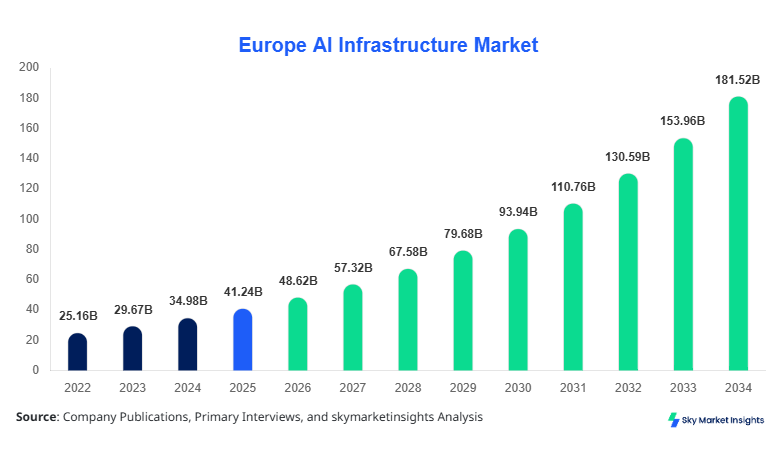
Europe AI Infrastructure market size is projected at USD 48.62 billion in 2026 and is expected to hit USD 182.47 billion by 2034 with a CAGR of 17.9%. The rapid expansion of hyperscale data centers, AI-ready cloud ecosystems, and GPU-intensive computing architecture across Europe is accelerating the demand for advanced AI infrastructure systems. The market is witnessing strong investment in edge computing, liquid cooling systems, AI networking switches, and accelerated processors to support high-performance AI workloads across healthcare, BFSI, manufacturing, and telecom industries. Competitive developments among cloud providers, semiconductor manufacturers, and infrastructure vendors are significantly reshaping the Europe AI Infrastructure Market.
The AI infrastructure ecosystem includes computing hardware, AI storage systems, networking solutions, orchestration software, and AI deployment services designed to support machine learning and generative AI applications. Europe recorded more than 1,920 operational AI-enabled data center facilities in 2025, with Germany accounting for nearly 26% of total regional deployments. AI server shipments in Europe crossed 1.8 million units in 2025, while GPU accelerator adoption increased by 38% year-over-year. AI infrastructure penetration among large enterprises exceeded 61%, whereas medium-sized enterprises reached nearly 34% adoption. Consumer demand for AI-powered digital services expanded by 42% in 2025, largely driven by cloud AI applications, autonomous systems, and predictive analytics platforms.
AI infrastructure deployment across Europe is highly concentrated in cloud and enterprise environments. Cloud-based deployments contributed nearly 57% of total installations, while on-premise architecture represented 28%, and hybrid deployment accounted for 15%. AI-enabled semiconductor systems operating at 5nm and 3nm fabrication technologies achieved processing frequencies exceeding 3.7 GHz with memory bandwidth above 1.5 TB/s. BFSI applications represented 24% of market utilization, healthcare contributed 18%, manufacturing held 16%, telecom represented 14%, and retail contributed 11% of overall deployments. Growing enterprise automation, AI model training requirements, and sovereign cloud initiatives continue to reinforce the Europe AI Infrastructure Market.
In the Germany, the AI Infrastructure Market accounted for approximately 31% of the overall Europe revenue contribution in 2025 due to the presence of advanced industrial automation facilities, hyperscale cloud operators, and semiconductor engineering centers. Germany operated more than 460 AI-ready data centers and over 3,200 AI-focused enterprises involved in cloud infrastructure, edge computing, and accelerated computing platforms. AI adoption in manufacturing reached 54%, while BFSI represented 21% of Germany’s infrastructure deployment volume. GPU cluster installations increased by 41% between 2024 and 2025, with average AI training workloads exceeding 2.5 petaflops in enterprise environments.
Germany also witnessed rapid adoption of liquid-cooled server racks, with adoption rates surpassing 37% in hyperscale facilities. AI networking systems with 800G Ethernet connectivity grew by 29%, while edge AI deployment in automotive applications expanded by 33%. Berlin, Frankfurt, and Munich collectively accounted for more than 62% of Germany’s AI infrastructure spending. Public-private investment programs exceeded USD 6.4 billion in 2025 to accelerate sovereign AI cloud development and semiconductor manufacturing expansion, strengthening the Europe AI Infrastructure Market.
Explore more data points, trends and opportunities Download Free Sample Report
AI Infrastructure Market Trends
Expansion of Hyperscale AI Data Centers
Europe witnessed substantial expansion in hyperscale AI data center construction during 2025, with more than 128 new facilities under development across Germany, the United Kingdom, France, and Spain. AI server rack density increased from 18 kW per rack in 2023 to over 42 kW in 2025 due to generative AI model training requirements. GPU accelerator shipments exceeded 2.4 million units in Europe, while liquid cooling integration reached 39% of newly deployed AI facilities. Major cloud operators expanded AI computing capacity by nearly 47%, primarily to support large language models, enterprise AI agents, and multimodal AI systems. AI network switching systems supporting 400G and 800G bandwidth configurations represented over 52% of total enterprise networking investments. These developments continue to accelerate the Europe AI Infrastructure Market.
Rapid Adoption of Edge AI Infrastructure
Edge AI infrastructure adoption is increasing rapidly across manufacturing, automotive, healthcare, and telecom industries. Europe deployed nearly 3.8 million edge AI processing units during 2025, reflecting annual deployment expansion of 36%. Telecom operators invested more than USD 9.2 billion in AI-enabled 5G edge systems to support low-latency applications below 10 milliseconds. Industrial AI gateways equipped with ARM-based processors achieved power efficiency improvements of 28%, while edge inference acceleration expanded by 31% in automotive production facilities. Retail AI infrastructure supporting real-time customer analytics increased by 26%, and healthcare edge AI imaging platforms expanded by 22%. Rising edge AI integration continues to strengthen the Europe AI Infrastructure Market.
Shift Toward Sovereign AI Cloud Platforms
European governments and enterprises are increasingly prioritizing sovereign AI cloud infrastructure to comply with GDPR and regional data governance regulations. Sovereign AI cloud investments increased by 44% in 2025, with over 210 enterprise cloud modernization projects launched across Europe. AI-ready cloud storage systems exceeded 680 exabytes of deployed capacity, while AI orchestration software adoption reached 58% among large organizations. Public sector AI cloud spending increased by 35%, and AI cybersecurity infrastructure investments expanded by 27% due to rising concerns over AI model integrity and data security. Enhanced sovereign AI computing ecosystems are emerging as a major strategic focus area within the Europe AI Infrastructure Market.
Europe AI Infrastructure Market Drivers
Rising Generative AI Workloads and Enterprise AI Deployment
The increasing deployment of generative AI models across Europe is significantly driving infrastructure demand. More than 71% of enterprises in Europe initiated AI modernization projects during 2025, while AI training workloads expanded by nearly 63%. Enterprises are deploying GPU-intensive computing clusters capable of supporting over 100 billion parameter AI models. AI-enabled cloud spending exceeded USD 24 billion, and enterprise AI storage demand increased by 39% due to rising unstructured data volumes exceeding 720 zettabytes globally. BFSI institutions increased AI infrastructure investments by 33%, while manufacturing companies expanded AI robotics deployments by 29%. Telecom companies accelerated AI-enabled network optimization infrastructure by 26%, contributing to higher processor, memory, and networking requirements. Europe also recorded a 37% increase in AI infrastructure software licensing agreements, further stimulating regional deployment activity and strengthening the Europe AI Infrastructure Market.
Europe AI Infrastructure Market Restraints
High Energy Consumption and Infrastructure Operating Costs
AI infrastructure systems consume substantial energy resources, creating major operational challenges across Europe. Large-scale AI data centers require energy consumption levels exceeding 80 MW per facility, while GPU-intensive AI model training can consume over 1,200 MWh during large-scale deployment cycles. Electricity costs in Europe increased by nearly 19% during 2025, placing additional pressure on infrastructure operators. Cooling systems represented approximately 31% of operational expenditure in hyperscale AI facilities, while advanced semiconductor procurement costs increased by 22% due to supply chain constraints. AI networking hardware prices also expanded by 17%, limiting affordability for medium-sized enterprises. Furthermore, environmental sustainability regulations imposed stricter emissions compliance requirements, increasing capital expenditures for renewable-powered data centers and liquid cooling systems. These cost pressures remain key limiting factors for the Europe AI Infrastructure Market.
Europe AI Infrastructure Market Opportunities
Expansion of AI Sovereignty and Semiconductor Manufacturing
The rapid expansion of European semiconductor manufacturing initiatives and sovereign AI programs presents substantial opportunities for infrastructure vendors. Europe announced more than USD 18 billion in semiconductor fabrication investments during 2025, with Germany and France leading regional manufacturing projects. AI chip demand increased by 46%, while domestic AI accelerator production capacity expanded by 24%. Edge AI deployments across industrial automation applications are projected to surpass 5 million units by 2028, creating strong opportunities for infrastructure providers. Public-sector AI modernization budgets increased by 32%, while sovereign cloud partnerships among telecom operators and hyperscale providers expanded by 28%. AI storage systems utilizing NVMe architectures witnessed deployment growth of 41%, and AI cybersecurity infrastructure investments rose by 25%. These advancements are expected to create long-term expansion opportunities for the Europe AI Infrastructure Market.
Europe AI Infrastructure Market Challenge
Shortage of Skilled AI Infrastructure Professionals
The shortage of highly skilled AI infrastructure engineers, semiconductor architects, and cloud AI specialists remains a critical challenge across Europe. More than 42% of enterprises reported delays in AI deployment projects due to talent shortages during 2025. Europe experienced a deficit of nearly 210,000 AI infrastructure professionals, particularly in GPU optimization, AI networking, and AI orchestration software engineering. The average implementation timeline for hyperscale AI clusters increased from 7 months to 11 months because of integration complexities and workforce limitations. AI security compliance expertise shortages affected 29% of public-sector modernization initiatives, while edge AI deployment projects experienced delays averaging 18 weeks. Training and upskilling costs for AI operations personnel increased by 21%, significantly impacting operational scalability. These workforce challenges continue to affect deployment efficiency within the Europe AI Infrastructure Market.
Report Scope
| Report Metric | Details |
|---|---|
| Market Size in 2025 | USD 41.24 Billion |
| Market Size in 2026 | USD 48.62 Billion |
| Market Size in 2034 | USD 182.47 Billion |
| CAGR | 17.9% (2026-2034) |
| Base Year for Estimation | 2025 |
| Historical Data | 2022-2024 |
| Forecast Period | 2026-2034 |
| Report Coverage | Revenue Forecast, Competitive Landscape, Supply Chain Disruption, Growth Factors, Environment & Regulatory Landscape and Trends |
Explore more data points, trends and opportunities Download Free Sample Report
AI Infrastructure Market Segmentation
The Europe AI Infrastructure Market is segmented based on component and deployment architecture. Hardware infrastructure dominated the market with approximately 48% revenue contribution in 2025 due to accelerated GPU adoption and hyperscale AI server expansion. Cloud-based deployment represented nearly 57% of total implementation volume because enterprises increasingly prefer scalable AI computing resources and managed infrastructure ecosystems.
By Type
Hardware infrastructure accounted for nearly 48% of total market contribution in 2025. AI servers equipped with GPU accelerators represented over 62% of hardware spending, while AI networking hardware contributed 21%. Europe deployed more than 1.8 million AI servers during 2025, with average rack density exceeding 42 kW. AI processors manufactured using 5nm and 3nm process nodes delivered computing speeds above 3.7 GHz and memory bandwidth greater than 1.5 TB/s. Liquid cooling deployment in AI server infrastructure expanded by 39%, improving thermal efficiency by 28%. Germany and the United Kingdom jointly represented over 52% of Europe’s AI hardware installations. Hardware infrastructure continues to remain the backbone of the Europe AI Infrastructure Market.
AI infrastructure software represented approximately 29% of market deployment volume during 2025. AI orchestration platforms, infrastructure automation software, and workload management systems experienced adoption growth of 34%. Containerized AI deployment systems accounted for 44% of software implementation across hyperscale cloud environments. AI infrastructure monitoring platforms capable of predictive resource allocation improved server utilization efficiency by 31%. Kubernetes-based AI orchestration deployment exceeded 58% among enterprise cloud operators, while AI cybersecurity software integration increased by 27%. AI infrastructure software platforms continue to accelerate operational scalability across the Europe AI Infrastructure Market.
Infrastructure services contributed nearly 23% of total market demand in 2025. Managed AI infrastructure services represented 47% of the service segment, while consulting and deployment services accounted for 36%. Enterprises increasingly outsourced AI infrastructure management to optimize operational expenditure and reduce deployment complexity. AI infrastructure maintenance contracts increased by 33%, while cloud migration services supporting AI workloads expanded by 29%. Telecom and BFSI sectors collectively represented 41% of AI infrastructure service demand. Growing complexity in AI operations is fueling service expansion within the Europe AI Infrastructure Market.
By Application
Cloud-based deployment dominated the market with approximately 57% share during 2025. AI cloud infrastructure supported more than 72% of generative AI workloads across Europe. Public cloud AI infrastructure capacity exceeded 680 exabytes of storage deployment, while GPU virtualization adoption increased by 37%. Enterprises using cloud-native AI infrastructure reduced deployment costs by nearly 24% and improved workload scalability by 31%. Telecom, retail, and healthcare sectors represented major cloud deployment adopters. Cloud-based infrastructure remains the dominant deployment architecture across the Europe AI Infrastructure Market.
On-premise deployment represented nearly 28% of total installations during 2025 due to data sovereignty and low-latency processing requirements. Manufacturing and defense industries accounted for over 46% of on-premise AI infrastructure demand. Enterprises deployed high-performance AI clusters with processing capacities exceeding 2.5 petaflops for industrial analytics and robotics applications. AI storage systems with NVMe architectures improved data retrieval speeds by 41%. Organizations handling sensitive financial and healthcare information continued investing heavily in on-premise AI systems within the Europe AI Infrastructure Market.
Hybrid deployment accounted for nearly 15% of implementation volume in 2025. Hybrid AI infrastructure allows enterprises to combine public cloud scalability with private data control capabilities. Hybrid AI networking deployments increased by 32%, while multi-cloud AI orchestration adoption expanded by 28%. BFSI and healthcare industries represented over 39% of hybrid deployment utilization due to compliance-driven infrastructure flexibility requirements. AI-enabled hybrid infrastructure continues to gain traction across the Europe AI Infrastructure Market.
Europe AI Infrastructure Market Segmentations
Component
- Hardware
- Software
- Services
Deployment
- Cloud-based
- On-premise
- Hybrid
Europe AI Infrastructure Regional Outlook
United Kingdom
The United Kingdom represented approximately 24% of Europe’s AI infrastructure deployment during 2025. The country operated more than 390 AI-ready data centers, with London accounting for 58% of national infrastructure investment. Cloud AI adoption among enterprises reached 67%, while AI accelerator deployments increased by 34%. Telecom and BFSI sectors jointly represented 43% of infrastructure utilization. AI cloud spending exceeded USD 8.2 billion during 2025, while sovereign AI cloud modernization projects increased by 29%. AI infrastructure investments in edge computing expanded significantly across retail and telecom applications.
Germany
Germany accounted for nearly 31% of total regional market contribution due to strong industrial AI deployment and semiconductor infrastructure investments. Manufacturing represented 38% of national AI infrastructure demand, while automotive AI applications contributed 24%. Germany deployed over 460 AI-enabled data centers and more than 2.5 million edge AI processing systems. AI infrastructure utilization in industrial robotics expanded by 36%, while cloud AI deployment among enterprises exceeded 63%. Frankfurt emerged as the largest AI cloud hub in continental Europe, supporting large-scale AI computing environments.
France
France contributed approximately 15% of Europe’s AI infrastructure deployment volume in 2025. AI cloud modernization programs supported over 240 enterprise AI deployment projects during the year. Public-sector AI infrastructure spending increased by 31%, while healthcare AI implementation expanded by 26%. AI accelerator imports increased by 28%, and sovereign AI cloud initiatives exceeded USD 3.4 billion in funding allocation. France also accelerated investments in energy-efficient AI data centers using renewable energy systems.
Spain
Spain represented nearly 9% of regional deployment contribution in 2025. AI infrastructure growth was driven primarily by telecom modernization, cloud adoption, and smart city initiatives. AI edge deployment across transportation and logistics expanded by 27%, while enterprise AI cloud adoption exceeded 49%. Spain deployed more than 140 AI-enabled data facilities, with Barcelona and Madrid accounting for 61% of infrastructure spending. Renewable-powered AI data centers increased by 22% during 2025.
Italy
Italy accounted for approximately 8% of Europe’s AI infrastructure implementation during 2025. Manufacturing and BFSI sectors represented over 44% of AI deployment demand. AI cloud migration spending increased by 24%, while edge AI deployment in industrial automation expanded by 21%. Italy invested heavily in AI cybersecurity infrastructure and sovereign cloud modernization projects to strengthen enterprise AI capabilities.
Russia
Russia contributed nearly 7% of regional deployment volume in 2025. Domestic AI processor development programs increased by 18%, while AI cloud infrastructure spending expanded by 23%. Government-led AI infrastructure projects focused on defense, telecom, and industrial automation. AI server deployment increased by 26%, while sovereign AI cloud initiatives continued to strengthen local infrastructure ecosystems.
Top players in Europe AI Infrastructure Market
- NVIDIA Corporation
- Intel Corporation
- Advanced Micro Devices Inc.
- Cisco Systems Inc.
- IBM Corporation
- Dell Technologies Inc.
- Hewlett Packard Enterprise
- Lenovo Group Limited
- Amazon Web Services Inc.
- Microsoft Corporation
- Google LLC
- Oracle Corporation
- Super Micro Computer Inc.
- Equinix Inc.
- Schneider Electric SE
NVIDIA Corporation
-
NVIDIA Corporation accounted for nearly 19% of Europe’s AI accelerator deployment volume in 2025.
-
The company maintained strong positioning in hyperscale GPU computing and generative AI infrastructure.
-
NVIDIA expanded AI server partnerships with over 140 European cloud and enterprise operators.
-
Its H100 and Blackwell GPU architectures improved AI model training efficiency by approximately 32%.
-
The company also increased investments in AI networking technologies supporting 800G Ethernet and InfiniBand deployments across hyperscale AI clusters.
Microsoft Corporation
-
Microsoft Corporation represented approximately 14% of Europe’s AI cloud infrastructure contribution in 2025.
-
The company expanded sovereign AI cloud projects across Germany, France, and the United Kingdom.
-
Azure AI infrastructure capacity increased by 38%, while enterprise AI adoption through Microsoft ecosystems surpassed 61%.
-
Microsoft strengthened partnerships with telecom operators and government agencies to accelerate AI modernization initiatives.
-
AI-enabled cloud security infrastructure and edge AI integration remain major strategic priorities for the company.
Investment Analysis
Europe recorded more than USD 42 billion in AI infrastructure investment allocation during 2025. Hyperscale cloud expansion represented 39% of total investment volume, while semiconductor manufacturing accounted for 24%. AI networking infrastructure received approximately 14% of funding allocation, and edge AI deployment represented 11%. Germany, the United Kingdom, and France jointly accounted for over 68% of total regional AI infrastructure investment activity.
Private equity firms and sovereign wealth funds significantly increased AI infrastructure exposure across Europe. Data center acquisition transactions expanded by 28%, while AI semiconductor partnerships increased by 22%. Telecom companies allocated nearly 17% of annual capital expenditure toward AI-enabled network infrastructure modernization. AI cybersecurity infrastructure investments increased by 25%, reflecting growing concerns over AI model security and data governance.
Mergers, acquisitions, and strategic collaborations accelerated throughout 2025 as infrastructure providers sought to expand AI computing capacity. More than 48 AI infrastructure partnership agreements were signed across Europe, involving cloud providers, semiconductor manufacturers, and telecom operators. Joint ventures focused heavily on sovereign AI cloud ecosystems, advanced GPU manufacturing, and liquid cooling technologies. AI infrastructure colocation agreements increased by 31%, while AI cloud interoperability partnerships expanded by 27%. Infrastructure operators increasingly pursued renewable-powered AI facilities to reduce long-term operating costs and comply with sustainability regulations.
New Product Developments
AI infrastructure vendors introduced numerous advanced products across Europe during 2025. More than 34% of newly launched AI infrastructure systems featured liquid cooling integration, while energy-efficient AI processors improved computational efficiency by 29%. AI networking switches supporting 800G Ethernet achieved latency reductions below 3 microseconds and improved data throughput by 41%.
Cloud providers introduced AI orchestration platforms capable of reducing infrastructure provisioning times by 38%. Edge AI systems equipped with ARM-based accelerators improved power efficiency by 24%, while AI storage systems utilizing NVMe-over-Fabrics improved data transfer speeds by 36%. Approximately 27% of newly introduced AI infrastructure products targeted sovereign cloud and AI cybersecurity applications across Europe.
Recent Developments in Europe AI Infrastructure Market
- In 2025, NVIDIA expanded its AI infrastructure partnerships across Germany and France, increasing GPU accelerator shipments by 37% and supporting AI computing deployments exceeding 120 exaflops across hyperscale cloud environments. The initiative significantly accelerated generative AI adoption across enterprise and telecom sectors.
- In 2025, Microsoft announced sovereign AI cloud infrastructure expansion across Europe with investments exceeding USD 4 billion. The company increased AI cloud data center capacity by 33% and improved enterprise AI deployment scalability across BFSI and healthcare industries.
- In 2025, Dell Technologies partnered with European telecom providers to deploy edge AI infrastructure supporting 5G and low-latency AI applications. The collaboration increased edge AI deployment capacity by 26% and improved industrial AI processing performance across manufacturing facilities.
Research Methodology
The research process for the Europe AI Infrastructure Market involved extensive primary and secondary analysis focusing on infrastructure deployment, AI cloud adoption, semiconductor manufacturing, and enterprise AI modernization trends across Europe. Primary research included interviews with AI infrastructure vendors, hyperscale cloud providers, semiconductor manufacturers, telecom operators, and enterprise IT decision-makers. More than 120 industry participants were consulted to validate deployment trends, investment patterns, and competitive developments across the regional AI infrastructure ecosystem.
Secondary research involved analysis of annual reports, regulatory databases, enterprise filings, technology whitepapers, AI infrastructure deployment statistics, semiconductor shipment data, and cloud infrastructure investment reports. Market size estimation was conducted using both top-down and bottom-up methodologies, incorporating infrastructure spending, deployment capacity, AI server shipments, GPU adoption rates, and cloud modernization expenditure across Europe. Data triangulation techniques ensured accuracy across regional and segment-level estimates. Forecast modeling incorporated macroeconomic indicators, AI adoption rates, hyperscale data center expansion, semiconductor supply chain trends, sovereign AI initiatives, and enterprise digital transformation spending patterns to provide comprehensive market intelligence for the Europe AI Infrastructure Market.
Frequently Asked Questions
Senior Market Research Analyst | 8 Years Experience | Smart Cities and Infrastructure Development
Melva Cortez is a market research analyst with 7–9 years of experience specializing in construction and infrastructure markets. Contributed to 70+ research reports for global clients. Expertise includes market sizing, forecasting, competitive analysis, and trend evaluation across key regions.