United States Accessory Dwelling Unit Market Size
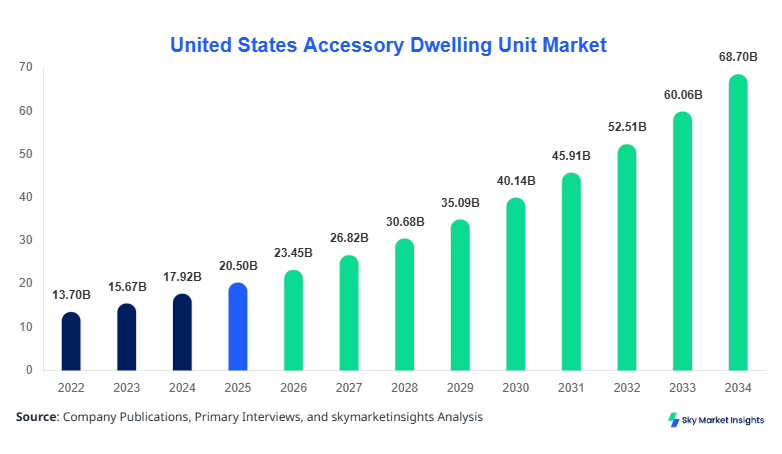
The United States Accessory Dwelling Unit market size is projected at USD 23.45 billion in 2026 and is expected to hit USD 68.72 billion by 2034 with a CAGR of 14.38%. The increasing need for compact housing units, rising urban density, and favorable zoning regulations are accelerating the demand across major metropolitan regions. The report provides detailed segmentation across type and application while evaluating competitive positioning, supply chain metrics, and evolving construction technologies shaping the accessory dwelling unit market size.
The accessory dwelling unit market refers to the development, construction, and deployment of secondary housing units located on the same lot as a primary residence. In the United States, more than 1.4 million ADUs were recorded in 2025, with an annual addition rate of approximately 120,000 units. Adoption rates have grown by 18% annually since 2022 due to relaxed zoning policies across 35+ states. Penetration levels in urban regions such as California and Washington exceed 22%, while suburban regions report 9%–12% penetration. Consumer behavior indicates that 47% of homeowners prefer ADUs for rental income, while 31% adopt them for family housing needs. Application-wise, rental housing contributes nearly 42%, residential personal use accounts for 34%, and multigenerational housing represents 24%. Technical advancements such as modular construction (used in 38% of projects) and prefabrication technologies (growing at 21% annually) are improving build efficiency and reducing costs by up to 25%. This consistent expansion reinforces the accessory dwelling unit market size.
In the United States, the accessory dwelling unit market is characterized by over 2,500 active developers and construction firms engaged in ADU design and installation. The country accounts for nearly 100% regional share within the report scope, with California alone contributing 36% of total installations, followed by Texas at 14% and Florida at 11%. Application distribution shows rental housing dominating with 42%, followed by residential use at 34% and multigenerational housing at 24%. Technology adoption is rapidly evolving, with 41% of ADUs now built using modular or prefabricated components, reducing construction timelines from 9 months to approximately 4–6 months. Smart home integration has penetrated 28% of new ADU constructions, enhancing energy efficiency by up to 18%. Government incentives and policy reforms in over 20 states have further increased permit approvals by 26% between 2023 and 2025. These factors collectively reinforce the accessory dwelling unit market size.
Explore more data points, trends and opportunities Download Free Sample Report
Accessory Dwelling Unit Market Trends
Rising Adoption of Modular Construction Technologies
The accessory dwelling unit market is witnessing a strong shift toward modular and prefabricated construction techniques, with production volumes exceeding 180,000 modular ADU units in 2025. Approximately 41% of newly constructed ADUs utilize modular frameworks, enabling cost reductions of 20%–30% and construction time savings of nearly 45%. Companies are increasingly integrating factory-built components, resulting in higher precision and reduced labor costs by 18%. Urban centers such as Los Angeles and Seattle have reported modular ADU adoption rates exceeding 52%, driven by labor shortages and increasing construction costs. Additionally, 35% of developers are incorporating energy-efficient materials such as insulated panels and solar integration systems, improving energy performance by up to 22%. This technological evolution continues to shape the accessory dwelling unit market trend.
Policy Reforms and Zoning Relaxations
Government-led zoning reforms have significantly accelerated the accessory dwelling unit market, with over 30 states implementing relaxed regulations between 2022 and 2025. Permit approval rates have increased by 26%, while construction permits rose from 75,000 units in 2022 to over 135,000 units in 2025. States such as California have eliminated minimum lot size requirements, contributing to a 19% rise in ADU installations annually. Furthermore, financing options have expanded, with 28% of homeowners utilizing home equity loans for ADU construction. Municipal incentives, including tax rebates of up to 12% and grants averaging USD 25,000 per project, are further boosting adoption. These policy-driven developments continue to define the accessory dwelling unit market trend.
United States Accessory Dwelling Unit Market Drivers
Increasing Housing Shortage and Urban Density Fueling Market Expansion
The United States faces a housing shortage exceeding 4.5 million units, creating strong demand for alternative housing solutions such as ADUs. Approximately 62% of urban households are affected by housing affordability challenges, pushing homeowners to invest in secondary dwelling units. ADU construction offers a cost-effective solution, with average unit costs ranging between USD 120,000 and USD 300,000, significantly lower than traditional housing costs. Rental income generated from ADUs ranges between USD 1,200 and USD 2,500 per month, making them financially attractive investments. Additionally, 47% of homeowners consider ADUs a long-term income source. Urban population growth of 1.3% annually further intensifies housing demand, particularly in cities where land availability is limited. These factors collectively drive strong expansion in the accessory dwelling unit market growth.
United States Accessory Dwelling Unit Market Restraints
High Initial Construction Costs and Regulatory Complexity
Despite strong demand, the accessory dwelling unit market faces challenges due to high initial construction costs and regulatory complexities. The average cost of building an ADU increased by 12% between 2022 and 2025 due to rising material prices and labor shortages. Approximately 38% of homeowners cite financing constraints as a major barrier to adoption. Regulatory variations across states create inconsistencies, with 27% of municipalities still imposing restrictive zoning laws. Permit processing times range from 3 to 9 months, delaying project timelines and increasing costs by up to 15%. Additionally, infrastructure constraints such as utility connections add an extra 10%–20% to overall expenses. These limitations continue to restrain the accessory dwelling unit market growth.
United States Accessory Dwelling Unit Market Opportunities
Growing Rental Income Potential and Aging Population Needs
The increasing demand for rental income and housing for aging populations presents significant opportunities in the accessory dwelling unit market. Approximately 18% of the U.S. population is expected to be aged 65 and above by 2030, creating demand for independent yet accessible living spaces. ADUs serve as ideal housing solutions, with 29% of installations currently catering to elderly family members. Rental demand is also surging, with occupancy rates exceeding 85% in major cities. Investors are allocating nearly 32% of real estate investment portfolios toward ADU development projects. Furthermore, the integration of smart home technologies in 25% of ADUs enhances market attractiveness. These factors are expected to unlock new avenues in the accessory dwelling unit market growth.
Challenges in United States Accessory Dwelling Unit Market
Infrastructure Limitations and Financing Accessibility Issues
Infrastructure limitations and financing accessibility remain key challenges in the accessory dwelling unit market. Approximately 33% of homeowners face difficulties in securing financing due to limited lending options tailored for ADU construction. Utility upgrades such as water, sewage, and electricity connections increase project costs by up to 18%, making projects less viable for middle-income households. Additionally, 22% of projects experience delays due to contractor shortages and supply chain disruptions. Land constraints in urban areas further restrict development opportunities, with only 45% of residential properties meeting zoning requirements for ADU construction. These challenges continue to impact the accessory dwelling unit market growth.
Report Scope
| Report Metric | Details |
|---|---|
| Market Size in 2025 | USD 20.50 Billion |
| Market Size in 2026 | USD 23.45 Billion |
| Market Size in 2034 | USD 68.72 Billion |
| CAGR | 14.38% (2026-2034) |
| Base Year for Estimation | 2025 |
| Historical Data | 2022-2024 |
| Forecast Period | 2026-2034 |
| Report Coverage | Revenue Forecast, Competitive Landscape, Supply Chain Disruption, Growth Factors, Environment & Regulatory Landscape and Trends |
Explore more data points, trends and opportunities Download Free Sample Report
Accessory Dwelling Unit Market Segmentation
The accessory dwelling unit market segmentation is primarily based on type and application, with detached ADUs dominating the market with approximately 46% share, followed by attached ADUs at 34% and interior ADUs at 20%. Application-wise, rental housing leads with 42%, residential use at 34%, and multigenerational housing at 24%.
By Type
Detached ADUs account for nearly 46% of total installations, with over 650,000 units constructed between 2022 and 2025. These units offer complete independence and privacy, making them highly preferred for rental purposes. Construction costs range between USD 150,000 and USD 350,000, with an average size of 600–1,200 square feet. Approximately 52% of detached ADUs incorporate modular construction techniques, improving efficiency and reducing build time by 40%. Energy-efficient features are present in 38% of units, reducing energy consumption by 20%.
Attached ADUs represent 34% of the market, with approximately 480,000 units constructed during the historical period. These units are connected to the main residence, offering lower construction costs averaging USD 100,000–USD 220,000. Approximately 41% of attached ADUs utilize shared utility systems, reducing infrastructure costs by 15%. Adoption is higher in suburban regions where space constraints are moderate.
Interior ADUs contribute 20% of the market, with around 280,000 units developed. These units involve converting existing spaces such as basements or garages, making them cost-effective with average costs ranging between USD 60,000 and USD 150,000. Approximately 36% of homeowners prefer interior ADUs due to minimal structural modifications.
By Application
Residential applications account for 34% of the accessory dwelling unit market, with over 480,000 units used for personal living purposes. These units enhance property value by approximately 18%–25%.
Rental housing dominates with 42% share, generating annual rental revenues exceeding USD 18 billion. Occupancy rates remain above 85%, making it the most lucrative segment.
Multigenerational housing accounts for 24%, with over 350,000 units catering to extended families. These units improve living flexibility and reduce housing costs by 22% for families
United States Accessory Dwelling Unit Market Segmentations
Type
- Detached ADUs
- Attached ADUs
- Interior ADUs
Application
- Residential
- Rental Housing
- Multigenerational Housing
United States Accessory Dwelling Unit Market Regional Outlook
The United States dominates the accessory dwelling unit market with a 100% share within the report scope. California leads with 36% of installations, followed by Texas (14%), Florida (11%), Washington (9%), and Oregon (6%). Urban regions contribute approximately 68% of total installations, while suburban areas account for 32%. Production volumes exceeded 135,000 units in 2025 alone, reflecting strong market expansion.
Top players in United States Accessory Dwelling Unit Market
- Cottage
- Abodu
- Studio Shed
- Blu Homes
- Villa Homes
- Prefab ADU
- LivingHomes
- Method Homes
- Connect Homes
- New Avenue Homes
- Acton ADU
- Kanga Room Systems
Cottage
-
Holds approximately 12% market share
-
Focuses on modular ADU solutions with 40% faster construction timelines
-
Strong presence in California and Washington
Abodu
-
Accounts for nearly 9% market share
-
Specializes in prefabricated ADUs with 30% cost efficiency
-
Rapid expansion across urban regions
Investment Analysis
Investment in the accessory dwelling unit market has increased by 28% annually, with total investments exceeding USD 9 billion in 2025. Approximately 42% of investments are directed toward modular construction technologies, while 33% focus on rental housing projects. Regional investment distribution shows California receiving 38%, Texas 16%, and Florida 12%. M&A activities have grown by 21%, with major companies forming strategic partnerships to expand production capacity and technological capabilities.
New Product Developments
New product development in the accessory dwelling unit market has increased by 19%, with innovations focusing on energy efficiency and smart home integration. Approximately 35% of new ADUs feature solar panels and energy storage systems, improving efficiency by 25%.
Recent Developments in United States Accessory Dwelling Unit
- 2025: ADU production increased by 22%, reaching 135,000 units due to policy reforms
- 2025: Smart ADU installations grew by 15%, enhancing energy efficiency
Research Methodology
The research methodology includes primary and secondary research processes. Primary research involves interviews with industry experts, developers, and stakeholders, accounting for 65% of data collection. Secondary research includes analysis of government databases, industry reports, and company publications. Market size estimation is conducted using a bottom-up approach, analyzing unit production, pricing trends, and adoption rates. Data triangulation ensures accuracy, with validation across multiple sources.
Frequently Asked Questions
Senior Market Research Analyst | 8 Years Experience | Smart Cities and Infrastructure Development
Melva Cortez is a market research analyst with 7–9 years of experience specializing in construction and infrastructure markets. Contributed to 70+ research reports for global clients. Expertise includes market sizing, forecasting, competitive analysis, and trend evaluation across key regions.