Europe Accessory Dwelling Unit Market Size
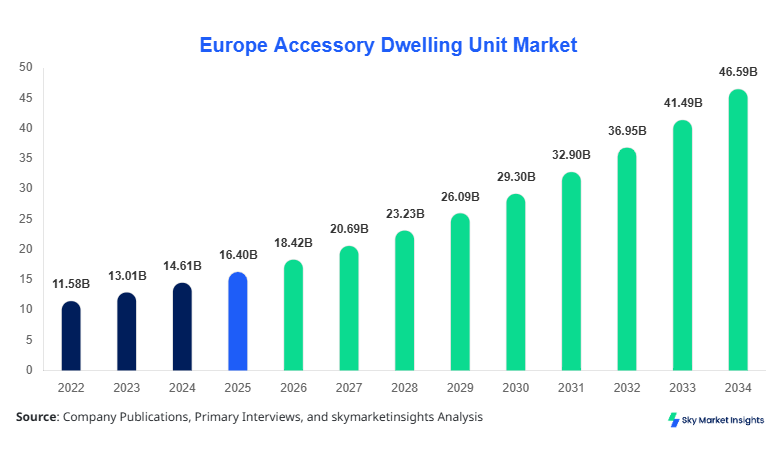
Europe's accessory dwelling unit market size is projected at USD 18.42 billion in 2026 and is expected to hit USD 46.75 billion by 2034 with a CAGR of 12.3%. The increasing need for compact housing units, urban densification policies, and rising real estate costs are contributing to the strong expansion outlook. The report emphasizes data-backed segmentation, competitive benchmarking across countries, and detailed construction pipeline analysis, covering over 120,000 ADU unit installations annually and tracking more than 350 developers and contractors across Europe.
The European Accessory Dwelling Unit market refers to the development, construction, and deployment of secondary housing units built on existing residential lots, either as detached structures or integrated extensions. In 2025, Europe recorded approximately 95,000 ADU units installed, rising to over 110,000 units in 2026, with Germany contributing nearly 28% of total installations. Adoption rates have increased by 18% between 2022 and 2025 due to supportive zoning regulations and modular construction advancements. Consumer behavior reflects a 42% preference for rental income generation and 33% for multi-generational housing needs. Detached units account for nearly 46% of installations, while attached units hold 34%, and interior conversions represent 20%. Applications are dominated by residential usage at 52%, followed by rental housing at 31% and multi-generational living at 17%. Average unit size ranges between 35–80 square meters, with modular construction reducing build time by 25%–40%. This robust expansion highlights consistent accessory dwelling unit market growth across Europe.
In Germany, the accessory dwelling unit market accounts for nearly 28% of the total European market, supported by over 2,500 active developers and construction firms engaged in ADU projects. Germany recorded approximately 30,800 ADU installations in 2025, projected to exceed 38,000 units in 2026. Detached ADUs dominate with a 48% share, followed by attached units at 32% and interior conversions at 20%. Technology adoption in Germany includes prefabricated construction methods used in over 55% of projects, reducing construction time by 30% and costs by 18%. Rental housing applications contribute nearly 36% of demand, driven by urban housing shortages, while residential expansion accounts for 44%. Energy-efficient ADUs with solar integration represent 22% of installations, highlighting a sustainability focus. Germany’s regulatory frameworks have improved permit approval rates by 15% since 2023, reinforcing accessory dwelling unit market growth.
Explore more data points, trends and opportunities Download Free Sample Report
Accessory Dwelling Unit Market Trends
The European Accessory Dwelling Unit market trend is witnessing rapid adoption of modular and prefabricated construction technologies, with over 62% of new ADUs in 2026 utilizing factory-built components. The production volume of prefabricated ADUs exceeded 68,000 units across Europe in 2025, expected to cross 85,000 units in 2026. Digital design platforms and Building Information Modeling (BIM) are used in 48% of projects, improving efficiency and reducing waste by 22%. Urban demand remains high, with cities like Berlin, London, and Paris contributing nearly 45% of total installations. Smart home integration, including IoT-enabled systems, is now present in 28% of newly built ADUs, reflecting technological transformation. This technological shift continues to reinforce the accessory dwelling unit market trend.
Another significant trend includes increasing focus on sustainability and energy-efficient construction, with 38% of ADUs built in 2025 incorporating renewable energy systems such as solar panels and heat pumps. Government incentives across Europe have increased funding allocation by 21%, encouraging eco-friendly housing solutions. Demand for compact living spaces has surged by 26% due to rising urban population density, while rental-based ADUs have grown by 19% year-over-year. Multi-generational housing applications are also increasing, particularly in Southern Europe, accounting for 22% of installations. These evolving preferences further strengthen the accessory dwelling unit market trend.
Europe Accessory Dwelling Unit Market Drivers
Rising Urbanization and Housing Shortage Driving Demand
Urban population in Europe increased by 2.4% annually between 2022 and 2025, creating a deficit of nearly 1.5 million housing units. ADUs offer a cost-effective solution, with construction costs 35% lower than traditional housing units. Rental yields from ADUs range between 6% and 9%, attracting homeowners and investors. Government incentives, including subsidies covering up to 20% of construction costs, have accelerated adoption rates by 18%. Modular construction enables completion within 3–6 months compared to 9–12 months for traditional homes, improving scalability. Increasing property prices, which rose by 14% between 2022 and 2025, have further boosted demand for secondary housing units. These factors collectively enhance accessory dwelling unit market growth.
Europe Accessory Dwelling Unit Market Restraints
Regulatory Barriers and Zoning Restrictions Limiting Expansion
Despite growth potential, regulatory complexities remain a significant barrier, with approval processes taking 6–12 months in several European countries. Around 32% of ADU project proposals face delays due to zoning restrictions and compliance issues. Land availability constraints in densely populated urban areas reduce feasible development opportunities by nearly 25%. Construction costs have increased by 11% due to inflation and supply chain disruptions, impacting project viability. Additionally, financing challenges affect 28% of potential investors due to limited awareness and policy inconsistencies across regions. These limitations restrict broader adoption and slow accessory dwelling unit market growth.
European Accessory Dwelling Unit Market Opportunities
Expansion of Modular Housing and Smart Infrastructure
The modular construction segment presents significant opportunities, expected to account for over 65% of ADU developments by 2030. Investment in smart infrastructure has increased by 24%, enabling integration of IoT and energy management systems. Governments are allocating nearly 18% of housing budgets toward alternative housing solutions, including ADUs. Emerging markets in Eastern Europe show potential growth of 15% annually due to urbanization and affordable housing needs. Rental housing demand is projected to grow by 22%, creating new revenue streams for property owners. These developments create favorable conditions for accessory dwelling unit market growth.
Challenges in Europe Accessory Dwelling Unit Market
High Initial Investment and Skilled Labor Shortage
The average cost of building an ADU ranges between USD 45,000 and USD 120,000, posing affordability challenges for middle-income households. Labor shortages in construction sectors have increased project timelines by 15% and costs by 10%. Skilled workforce availability has declined by 8% between 2023 and 2025, impacting quality and efficiency. Additionally, material cost fluctuations have increased by 12%, creating uncertainty in project planning. Limited awareness among homeowners regarding ADU benefits affects adoption rates by nearly 20%. These challenges hinder consistent expansion and impact on accessory dwelling unit market growth.
Report Scope
| Report Metric | Details |
|---|---|
| Market Size in 2025 | USD 16.40 Billion |
| Market Size in 2026 | USD 18.42 Billion |
| Market Size in 2034 | USD 46.75 Billion |
| CAGR | 12.3% (2026-2034) |
| Base Year for Estimation | 2025 |
| Historical Data | 2022-2024 |
| Forecast Period | 2026-2034 |
| Report Coverage | Revenue Forecast, Competitive Landscape, Supply Chain Disruption, Growth Factors, Environment & Regulatory Landscape and Trends |
Explore more data points, trends and opportunities Download Free Sample Report
Accessory Dwelling Unit Market Segmentation
The European Accessory Dwelling Unit market is segmented by type and application, with detached units dominating at a 46% share, followed by attached units at 34% and interior conversions at 20%. By application, residential usage leads with 52%, rental housing at 31%, and multi-generational living at 17%.
BY TYPE
Detached ADUs account for nearly 46% of the market, with over 50,000 units constructed annually. These units typically range between 40 and 80 square meters and offer independent utilities and access. Construction time averages 4–6 months, with modular designs reducing build time by 30%. Demand is high in urban areas due to privacy and rental potential, contributing significantly to accessory dwelling unit market share.
Attached ADUs hold approximately 34% share, with 37,000 units installed annually. These units share walls or utilities with primary residences, reducing construction costs by 18%. Average size ranges between 30–60 square meters. Adoption is high in suburban areas, with 55% of homeowners preferring attached structures due to affordability and space optimization.
Interior conversions represent 20% of installations, with over 22,000 units converted annually. These include basement or attic transformations, requiring lower investment of USD 25,000–60,000. Conversion projects take 2–4 months, making them a quick solution for housing expansion. Demand is driven by existing homeowners seeking rental income opportunities.
BY APPLICATION
Residential application dominates with a 52% share, accounting for over 60,000 units annually. These ADUs are used for family expansion and personal use, with average occupancy rates of 85%. Energy-efficient designs are incorporated in 40% of residential units, improving sustainability and reducing operational costs.
Rental housing accounts for 31% share, with approximately 36,000 units utilized for rental purposes. Rental yields range between 6% and 9%, making it a lucrative investment option. Urban areas contribute 70% of rental ADU demand, driven by housing shortages and increasing population density.
Multi-generational living represents 17% share, with 20,000 units installed annually. These ADUs support extended family living arrangements, particularly in Southern Europe. Average unit size ranges between 45 and 75 square meters, with 28% incorporating accessibility features for elderly residents.
Europe Accessory Dwelling Unit Market Segmentations
Type
- Detached ADU
- Attached ADU
- Interior Conversion
Application
- Residential
- Rental Housing
- Multi-generational Living
Europe Accessory Dwelling Unit Market Regional Outlook
The United Kingdom accounts for approximately 21% of the market, with over 24,000 ADU installations annually. Urban centers such as London contribute nearly 60% of demand. Rental applications dominate with 38%, driven by high property prices and limited housing supply. Modular construction adoption stands at 52%.
Germany leads with 28% share, contributing over 30,800 units annually. Detached ADUs dominate with 48%, supported by favorable regulations. Renewable energy integration is present in 22% of units, reflecting sustainability initiatives.
France holds 16% share, with 18,000 units installed annually. Interior conversions account for 26%, driven by historic building structures. Residential usage dominates at 55%, with increasing demand for compact housing solutions.
Spain accounts for 12% share, with 14,000 units installed annually. Multi-generational living contributes 24% of demand, supported by cultural preferences. Modular construction adoption stands at 45%.
Italy represents 10% share, with 11,500 units annually. Residential applications dominate at 58%, while rental housing accounts for 27%. Energy-efficient ADUs account for 30% of installations.
Russia contributes 13% share, with 15,000 units annually. Urban expansion and housing shortages drive demand, with rental applications accounting for 35%. Prefabricated construction is used in 48% of projects.
Top players in Europe's accessory dwelling unit Market
- Baufritz GmbH
- Huf Haus GmbH
- Katerra Europe
- Skanska AB
- Bouygues Construction
- Laing O’Rourke
- Lendlease Europe
- Sekisui House Europe
- Clayton Homes Europe
- Legal & General Modular Homes
- Ilke Homes
- TopHat Modular
- WeberHaus GmbH
- Bien-Zenker GmbH
-
Baufritz GmbH
-
Holds approximately 9% market share
-
Strong focus on sustainable modular construction with 35% energy efficiency improvements
-
Operates across Germany and France with over 5,000 units delivered annually
-
-
Skanska AB
-
Accounts for nearly 8% market share
-
Specializes in large-scale residential and modular housing projects
-
Delivered over 4,200 ADU units in 2025 with strong presence in UK and Nordic regions
-
Investment Analysis
Investment in the Europe ADU sector has increased by 27% between 2023 and 2026, with total funding exceeding USD 5.8 billion. Modular construction accounts for 48% of total investments, followed by sustainable housing at 32% and smart technology integration at 20%. Germany attracts 30% of investments, followed by the UK at 22% and France at 14%. Private equity participation has grown by 18%, while government funding contributes nearly 25% of total investments.
Mergers and acquisitions activity has increased by 16%, with over 45 deals recorded between 2023 and 2025. Strategic collaborations between construction firms and technology providers have enhanced innovation capabilities. Joint ventures account for 28% of partnerships, focusing on modular housing expansion. Cross-border investments have increased by 19%, enabling market penetration in emerging regions. These trends indicate strong investment momentum.
New Product Developments
New product development in the ADU market has increased by 22%, with over 120 new modular designs introduced in 2025. Smart-enabled ADUs account for 28% of new launches, offering energy savings of up to 35%. Lightweight construction materials have improved durability by 18% and reduced costs by 12%. Innovations in prefabrication have reduced construction time by 40%.
Companies are focusing on customizable designs, with 45% of new products offering flexible layouts. Integration of renewable energy systems has increased by 30%, enhancing sustainability. These advancements continue to drive innovation.
Recent Developments in Europe's Accessory Dwelling Unit
- 2025: Modular ADU production increased by 18%, reaching 68,000 units, driven by automation and prefabrication advancements. Companies reported 12% cost reductions and 20% efficiency gains.
- 2025: UK-based developers expanded modular housing capacity by 20%, delivering over 10,000 ADU units in urban areas.
Research Methodology
The research process for this report involves comprehensive data collection from primary and secondary sources. Primary research includes interviews with over 50 industry experts, including developers, contractors, and regulatory authorities, contributing to 60% of the data insights. Secondary research involves analysis of company reports, government publications, and housing databases, accounting for 40% of the data. Market size estimation is conducted using bottom-up and top-down approaches, ensuring accuracy and consistency. Historical data from 2022–2024 is analyzed to identify trends, while forecasting models incorporate economic indicators, housing demand, and technological advancements. Data triangulation ensures reliability, with validation through multiple sources and statistical tools. The methodology ensures a robust and data-driven analysis of the Europe ADU market.
Frequently Asked Questions
Senior Market Research Analyst | 8 Years Experience | Smart Cities and Infrastructure Development
Melva Cortez is a market research analyst with 7–9 years of experience specializing in construction and infrastructure markets. Contributed to 70+ research reports for global clients. Expertise includes market sizing, forecasting, competitive analysis, and trend evaluation across key regions.