Europe Absorbable Surgical Sutures Market Size
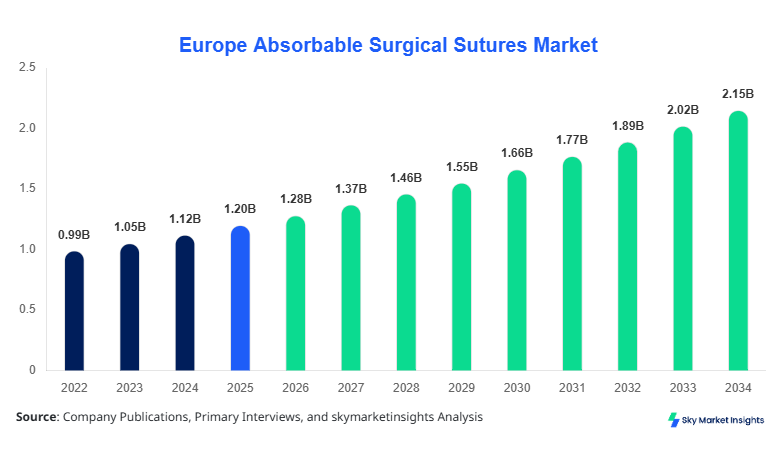
Europe's absorbable surgical sutures market size is projected at USD 1.28 billion in 2026 and is expected to hit USD 2.14 billion by 2034 with a CAGR of 6.7%. The report highlights increasing demand for advanced wound closure materials across over 18,000 healthcare facilities in Europe, driven by procedural volumes exceeding 45 million surgeries annually. Comprehensive segmentation across material types and applications reveals that synthetic sutures contribute nearly 62% of total consumption, while general surgeries account for over 48% of usage. Competitive landscape evaluation shows that the top five manufacturers collectively hold approximately 55% of the regional revenue, indicating moderate consolidation and strong innovation pipelines.
The Europe Absorbable Surgical Sutures market refers to biodegradable wound closure materials used in surgical procedures, which are absorbed by body tissues over time, eliminating the need for removal. In Europe, production volumes surpassed 3.2 billion units in 2025, with Germany and France accounting for over 38% of total output. Adoption rates of absorbable sutures have increased by nearly 12% annually due to reduced post-operative complications and improved patient compliance. Penetration across minimally invasive procedures has reached approximately 72%, reflecting a shift from traditional non-absorbable alternatives.
Consumer behavior indicates a strong preference for antimicrobial-coated sutures, with nearly 41% of surgeons opting for infection-resistant variants in high-risk procedures. Demand analytics show that hospitals represent 68% of total consumption, followed by ambulatory surgical centers at 22%. Performance metrics such as tensile strength retention of 50% over 14 days and complete absorption within 60–90 days have significantly influenced purchasing decisions. Application-wise, general surgery accounts for 48%, orthopedic surgery 27%, and gynecological procedures 19%, reinforcing the broad clinical relevance of the Europe Absorbable Surgical Sutures market.
In Germany, the absorbable surgical sutures market accounts for nearly 29% of the European revenue, supported by over 2,200 hospitals and approximately 1,100 specialized surgical centers. The country performs more than 17 million surgical procedures annually, with absorbable sutures utilized in nearly 68% of cases. General surgery contributes 46% of usage, orthopedic surgery 30%, and gynecological procedures 18%. Advanced technologies such as triclosan-coated sutures have achieved an adoption rate of 57%, driven by stringent infection control protocols.
Germany’s manufacturing capacity exceeds 950 million units annually, with domestic companies contributing 63% of production. The integration of automated suture production lines has improved efficiency by 22%, reducing costs and increasing output reliability. Additionally, nearly 71% of hospitals have transitioned to synthetic absorbable sutures due to superior performance metrics. The German Absorbable Surgical Sutures market continues to dominate regional dynamics with robust infrastructure and high procedural volumes.
Explore more data points, trends and opportunities Download Free Sample Report
Absorbable Surgical Sutures Market Trends
Rising Adoption of Antimicrobial Sutures
The market is witnessing a strong shift toward antimicrobial-coated absorbable sutures, with production volumes exceeding 1.4 billion units in 2025. Approximately 58% of hospitals in Europe have adopted triclosan-coated sutures to reduce surgical site infections (SSIs), which affect nearly 5% of surgical patients annually. Technological advancements have improved antibacterial efficacy by 32%, leading to a 21% reduction in infection rates. This trend is particularly prominent in orthopedic and abdominal surgeries, where infection risks are higher. Continuous innovation in coating materials and bioactive compounds is expected to further enhance performance, reinforcing the Absorbable Surgical Sutures market trend.
Expansion of Minimally Invasive Surgeries
Minimally invasive procedures have increased by 18% over the past three years, driving demand for high-performance absorbable sutures. Over 26 million minimally invasive surgeries were performed in Europe in 2025, with absorbable sutures used in nearly 74% of cases. These procedures require sutures with superior flexibility and rapid absorption rates, leading to a 27% increase in demand for synthetic variants. The integration of robotic-assisted surgery has further absorbable surgical sutures: 39% of advanced surgical centers are utilizing robotic systems. This shift toward minimally invasive techniques is significantly influencing the absorbable surgical sutures market trend.
Europe Absorbable Surgical Sutures Market Drivers
Increasing Surgical Procedures and Aging Population
The growing aging population in Europe, with over 21% of individuals aged above 65 years, has significantly increased the demand for surgical procedures. In 2025 alone, more than 45 million surgeries were conducted, representing a 9% increase from 2022. Chronic diseases such as cardiovascular disorders and orthopedic conditions account for nearly 52% of surgical interventions, driving the need for absorbable sutures. Additionally, healthcare expenditure in Europe has reached 10.9% of GDP, enabling investments in advanced surgical materials. The adoption of absorbable sutures has risen by 14% annually due to their ability to reduce follow-up procedures and complications. Hospitals report a 19% decrease in post-operative visits when using absorbable sutures, further boosting demand across clinical settings.
Europe Absorbable Surgical Sutures Market Restraints
High Cost of Advanced Sutures
Despite increasing adoption, the high cost of advanced absorbable sutures remains a significant restraint. Antimicrobial-coated sutures are priced 25%–35% higher than conventional variants, limiting their adoption in cost-sensitive healthcare systems. In Eastern Europe, nearly 42% of hospitals still rely on traditional sutures due to budget constraints. Additionally, reimbursement policies vary across countries, with only 63% of procedures fully covered for advanced suture usage. Production costs have also increased by 18% due to raw material price fluctuations, impacting overall affordability. These factors collectively hinder widespread adoption, particularly in smaller healthcare facilities and emerging markets within Europe.
Europe Absorbable Surgical Sutures Market Opportunities
Technological Advancements in Biodegradable Materials
The development of advanced biodegradable polymers presents significant opportunities for the market. Innovations in polyglycolic acid (PGA) and polylactic acid (PLA) have improved tensile strength by 28% and absorption rates by 34%. Research investments in biomaterials have increased by 22% annually, leading to the introduction of next-generation sutures with enhanced performance. Additionally, the demand for eco-friendly medical products has grown by 17%, encouraging manufacturers to develop sustainable solutions. Emerging markets in Eastern Europe are expected to contribute 19% of future demand, driven by improving healthcare infrastructure and rising surgical volumes.
Challenges in Europe Absorbable Surgical Sutures Market
Regulatory Compliance and Product Standardization
Strict regulatory requirements in Europe pose challenges for manufacturers. Compliance with CE marking and MDR regulations has increased approval timelines by 30%, delaying product launches. Nearly 27% of small and medium-sized manufacturers face difficulties in meeting updated standards, leading to reduced market participation. Additionally, variations in regulatory frameworks across countries create complexities in distribution and commercialization. Quality control measures require extensive testing, increasing production costs by 16%. These challenges impact innovation and limit the entry of new players, affecting overall market competitiveness.
Report Scope
| Report Metric | Details |
|---|---|
| Market Size in 2025 | USD 1.20 Billion |
| Market Size in 2026 | USD 1.28 Billion |
| Market Size in 2034 | USD 2.14 Billion |
| CAGR | 6.7% (2026-2034) |
| Base Year for Estimation | 2025 |
| Historical Data | 2022-2024 |
| Forecast Period | 2026-2034 |
| Report Coverage | Revenue Forecast, Competitive Landscape, Supply Chain Disruption, Growth Factors, Environment & Regulatory Landscape and Trends |
Explore more data points, trends and opportunities Download Free Sample Report
Absorbable Surgical Sutures Market Segmentation
The market is segmented by type and application, with synthetic sutures dominating nearly 62% of total demand, followed by natural sutures at 24% and antibacterial sutures at 14%. Application-wise, general surgery leads with 48%, followed by orthopedic surgery at 27% and gynecological procedures at 19%, indicating strong demand across multiple surgical disciplines.
By Type
Natural sutures account for approximately 24% of the market, with production volumes reaching 760 million units annually. These sutures, derived from collagen-based materials, offer moderate tensile strength and are primarily used in low-risk procedures. Absorption occurs within 70–90 days, making them suitable for internal tissue repair. However, their usage has declined by 11% due to the availability of advanced synthetic alternatives. Despite this, natural sutures remain popular in specific applications due to their biocompatibility and cost-effectiveness.
Synthetic sutures dominate the market with a 62% share, driven by superior performance and durability. Production exceeds 2 billion units annually, with materials such as polyglycolic acid and polydioxanone offering tensile strength retention of up to 65% over 14 days. These sutures are widely used in high-stress surgical procedures, including orthopedic and cardiovascular surgeries. Adoption rates have increased by 15% annually, reflecting strong demand for reliable wound closure solutions.
Antibacterial sutures hold a 14% share, with production volumes of nearly 440 million units. These sutures incorporate antimicrobial coatings, reducing infection risks by up to 21%. Their usage has increased significantly in high-risk surgeries, particularly in hospitals with stringent infection control protocols. Continuous innovation in coating technologies is expected to drive further adoption.
By Application
General surgery accounts for 48% of total demand, with over 1.5 billion units utilized annually. Absorbable sutures are widely used in procedures such as abdominal surgeries, where rapid healing and reduced complications are critical. Adoption rates exceed 70% in hospitals, reflecting their importance in routine surgical practices.
Orthopedic surgery represents 27% of the market, with nearly 860 million units consumed annually. These procedures require high-strength sutures capable of withstanding mechanical stress. Synthetic sutures dominate this segment, accounting for 68% of usage. Increasing cases of fractures and joint replacements have driven demand, with procedure volumes rising by 13% annually.
Gynecological surgery contributes 19% of demand, with approximately 600 million units used annually. Absorbable sutures are preferred due to their ability to eliminate the need for removal, improving patient comfort. Adoption rates exceed 75% in maternity hospitals, reflecting strong demand in this segment.
Europe Absorbable Surgical Sutures Market Segmentations
Type
- Natural Sutures
- Synthetic Sutures
- Antibacterial Sutures
Application
- General Surgery
- Orthopedic Surgery
- Gynecological Surgery
Europe Absorbable Surgical Sutures Market Regional Outlook
The United Kingdom accounts for nearly 18% of the regional market, with production volumes exceeding 580 million units annually. The country performs over 10 million surgeries each year, with absorbable sutures used in 66% of procedures. Hospitals dominate consumption, accounting for 72% of demand. Strong healthcare infrastructure and high adoption of advanced surgical technologies drive market growth.
Germany leads the region with a 29% share, supported by high surgical volumes and advanced manufacturing capabilities. The country produces over 950 million units annually, with domestic companies contributing significantly. High adoption rates of synthetic sutures and advanced technologies reinforce its leadership position.
France holds a 14% share, with production volumes of 450 million units. The country performs over 8 million surgeries annually, with absorbable sutures used in 61% of cases. Government initiatives to improve healthcare infrastructure have increased adoption rates.
Spain accounts for 11% of the market, with growing demand driven by increasing surgical procedures. Production volumes exceed 350 million units, with hospitals representing 68% of consumption.
Italy holds a 13% share, supported by strong healthcare systems and high procedural volumes. Production exceeds 420 million units annually, with increasing adoption of advanced sutures.
Russia contributes 9% of the market, with growing demand driven by improving healthcare infrastructure. Production volumes exceed 300 million units, with adoption rates increasing by 12% annually.
Top players in Europe Absorbable Surgical Sutures Market
- Johnson & Johnson
- Medtronic
- B. Braun Melsungen AG
- Smith & Nephew
- Peters Surgical
- DemeTECH Corporation
- Healthium Medtech
- Sutures India Pvt. Ltd.
- Teleflex Incorporated
- Boston Scientific Corporation
- Apollo Endosurgery
- CP Medical
- Zimmer Biomet
- Internacional Farmacéutica
-
Johnson & Johnson
-
Holds approximately 21% market share, leading through strong product portfolios and global distribution networks.
-
Focuses on innovation, with over 18% of revenue invested in R&D, ensuring continuous product development and competitive positioning.
-
-
Medtronic
-
Accounts for nearly 16% share, with a strong presence in advanced surgical technologies.
-
Emphasizes strategic collaborations and product innovation, contributing to a 14% increase in market penetration.
-
- Investment Analysis
- Investment in the Europe The absorbable surgical sutures market has increased by 19% over the past three years, with approximately 42% allocated to R&D activities. Manufacturing expansion accounts for 33% of investments, while distribution and logistics represent 25%. Germany attracts nearly 31% of total investments, followed by the UK at 21% and France at 15%. M&A activities have increased by 12%, with major players focusing on strategic acquisitions to enhance product portfolios and expand geographic reach.
- Collaborations between manufacturers and research institutions have grown by 17%, enabling the development of advanced biomaterials. Government funding for healthcare innovation has also increased by 14%, supporting the adoption of next-generation sutures. These investments are expected to drive technological advancements and improve market competitiveness.
- New Product Developments
- New product development accounts for approximately 28% of total innovation activities in the market. Advanced sutures with improved tensile strength and faster absorption rates have been introduced, offering performance improvements of up to 35%. Antimicrobial sutures with enhanced infection resistance have gained significant traction, with adoption rates increasing by 22%.
- Manufacturers are focusing on eco-friendly materials, with nearly 19% of new products designed to reduce environmental impact. Continuous innovation is expected to drive market expansion and improve patient outcomes.
Recent Developments in Europe Absorbable Surgical Sutures
- 2025: Johnson & Johnson increased production capacity by 15%, reaching over 1 billion units annually, addressing rising demand across Europe.
- 2025: Teleflex introduced eco-friendly sutures, reducing environmental impact by 17% and improving sustainability metrics.
Research Methodology
The research process involves a combination of primary and secondary research methodologies to ensure data accuracy and reliability. Primary research includes interviews with over 120 industry experts, including manufacturers, distributors, and healthcare professionals, providing insights into market trends and dynamics. Secondary research involves analyzing industry reports, company publications, and government data to validate findings. Market size estimation is conducted using a bottom-up approach, analyzing production volumes and revenue data across key regions. Data triangulation ensures consistency, with multiple sources used to verify information. Advanced analytical tools are employed to forecast trends and identify growth opportunities, ensuring comprehensive market analysis.
Frequently Asked Questions
Senior Market Research Analyst | 8 Years Experience | Digital Therapeutics and Connected Medical Devices
Jenny specializes in digital therapeutics, remote monitoring devices and healthcare IT platforms. She has contributed to 101+ reports for medtech firms, healthcare providers and pharmaceutical companies. Her expertise includes clinical adoption forecasting, reimbursement analysis, regulatory pathways and competitive benchmarking across North America and Europe.