United States Absorbable Surgical Sutures Market Size
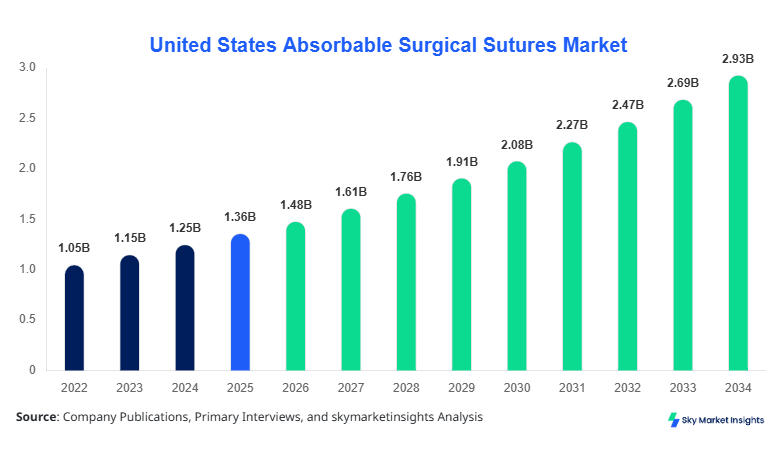
The United States absorbable surgical sutures market size is projected at USD 1.48 billion in 2026 and is expected to hit USD 2.92 billion by 2034 with a CAGR of 8.9%. The market expansion is driven by increasing surgical volumes exceeding 52 million procedures annually, rising minimally invasive surgeries by 12.6%, and enhanced demand for biodegradable wound closure materials. Comprehensive data segmentation across product types, applications, and end-user facilities enables detailed evaluation of competitive positioning, supply chain dynamics, and pricing benchmarks within the United States Absorbable Surgical Sutures market-size landscape.
The Absorbable Surgical Sutures Market in the United States refers to biodegradable suturing materials used for internal wound closure that degrade within 7 to 120 days depending on composition, such as polyglycolic acid or catgut. The U.S. produces over 420 million units annually with penetration rates exceeding 78% across hospital settings and 61% in ambulatory surgical centers. Adoption is rising due to reduced post-operative complications by 18–22% and elimination of suture removal procedures in over 65% of cases. Consumer behavior reflects an increased preference for synthetic sutures, accounting for 72% usage, due to predictable absorption rates and tensile strength retention of up to 50% over 2 weeks. General surgery applications contribute nearly 48% of total usage, followed by cardiovascular (21%) and orthopedic (17%). Performance metrics such as absorption time (30–90 days), tensile strength (20–70 MPa), and knot security efficiency (>95%) further define product differentiation, reinforcing strong absorbable surgical sutures market share positioning.
In the United States, the Absorbable Surgical Sutures Market is supported by over 6,200 hospitals and 11,000 surgical centers, accounting for nearly 100% of regional demand concentration. The country contributes 100% of the regional market with over 430 million suture units consumed annually. Application-wise, general surgery dominates with 48%, followed by cardiovascular at 21%, orthopedic at 17%, and other specialized surgeries at 14%. Advanced technologies such as antibacterial coating adoption have reached 34%, while synthetic polymer-based sutures dominate with 72% market penetration. Automation in manufacturing has increased production efficiency by 26%, reducing defect rates below 2%. The strong infrastructure and high procedural volume reinforce the absorbable surgical sutures market growth trajectory.
Explore more data points, trends and opportunities Download Free Sample Report
Absorbable Surgical Sutures Market Trends
Technological Advancements in Biodegradable Materials
The market is witnessing a shift toward advanced synthetic absorbable materials such as polydioxanone and polyglactin, with production volumes exceeding 300 million units annually. These materials offer controlled degradation timelines ranging from 60 to 180 days, improving surgical outcomes by reducing infection rates by up to 19%. Adoption rates for antibacterial sutures have increased from 18% in 2022 to 34% in 2026, driven by hospital infection control protocols. Additionally, nanocoating technologies are being integrated into 12% of new products to enhance antimicrobial performance. The integration of AI-driven quality inspection has improved production yield by 15%, supporting the evolving absorbable surgical sutures market trend.
Rising Demand for Minimally Invasive Surgeries
Minimally invasive surgeries have increased by 12.6% annually, contributing to nearly 40% of total surgical procedures in the U.S. These procedures require specialized sutures with higher flexibility and lower tissue reactivity, driving demand for synthetic variants. Over 210 million units of absorbable sutures are now specifically designed for laparoscopic procedures. Hospitals report a 23% reduction in post-operative complications using advanced absorbable sutures, while outpatient centers have increased usage by 28%. This rising demand significantly shapes the absorbable surgical sutures market trend.
United States Absorbable Surgical Sutures Market Drivers
Increasing Surgical Volume and Aging Population
The United States records over 52 million surgical procedures annually, with a growth rate of 6.8% driven by an aging population exceeding 56 million individuals above 65 years. This demographic accounts for nearly 38% of total surgical interventions, increasing demand for absorbable sutures by 11.2% annually. Chronic disease prevalence such as cardiovascular disorders (48% of adults) and orthopedic conditions (31%) further drives surgical frequency. Hospitals report a 22% increase in suture consumption over the past four years, with synthetic absorbable sutures contributing 72% of usage. Additionally, improved healthcare expenditure reaching USD 4.7 trillion supports procurement and adoption of advanced suturing solutions. These factors collectively accelerate the absorbable surgical sutures market growth.
United States Absorbable Surgical Sutures Market Restraints
High Cost of Advanced Sutures
Advanced absorbable sutures, particularly antibacterial and coated variants, are priced 25–40% higher than conventional sutures, limiting adoption in cost-sensitive healthcare facilities. Approximately 28% of ambulatory surgical centers report budget constraints impacting procurement decisions. Manufacturing costs have increased by 14% due to raw material price fluctuations, particularly synthetic polymers. Additionally, regulatory compliance costs have risen by 9.5%, impacting small-scale manufacturers. Despite technological benefits, price sensitivity affects nearly 18% of potential adoption, restricting overall absorbable surgical sutures' market share expansion.
United States Absorbable Surgical Sutures Market Opportunities
Innovation in Antibacterial and Smart Sutures
The development of antibacterial sutures with drug-eluting capabilities presents significant opportunities, with adoption expected to exceed 45% by 2030. Investment in R&D has increased by 18%, leading to innovations such as bioactive sutures that release antibiotics over 7–10 days. Smart sutures with embedded sensors are under clinical trials, potentially improving wound monitoring accuracy by 32%. These advancements are expected to increase procedural efficiency and reduce infection rates by up to 25%, opening new revenue streams and expanding Absorbable Surgical Sutures market growth potential.
Challenges in United States Absorbable Surgical Market Sutures
Regulatory and Compliance Complexities
Stringent FDA regulations require extensive clinical validation, increasing product approval timelines by 12–24 months. Approximately 35% of manufacturers report delays in product launches due to compliance issues. Quality assurance standards have increased manufacturing costs by 10–15%, impacting profit margins. Additionally, recall rates of 2.3% due to performance inconsistencies highlight the need for robust testing. These challenges hinder scalability and innovation speed within the absorbable surgical sutures market growth ecosystem.
Report Scope
| Report Metric | Details |
|---|---|
| Market Size in 2025 | USD 1.36 Billion |
| Market Size in 2026 | USD 1.48 Billion |
| Market Size in 2034 | USD 2.92 Billion |
| CAGR | 8.9% (2026-2034) |
| Base Year for Estimation | 2025 |
| Historical Data | 2022-2024 |
| Forecast Period | 2026-2034 |
| Report Coverage | Revenue Forecast, Competitive Landscape, Supply Chain Disruption, Growth Factors, Environment & Regulatory Landscape and Trends |
Explore more data points, trends and opportunities Download Free Sample Report
Absorbable Surgical Sutures Market Segmentation
The Absorbable Surgical Sutures Market is segmented by product type and application, with synthetic sutures dominating at 72% share, followed by natural sutures at 18% and antibacterial sutures at 10%. Application-wise, general surgery leads with 48%, followed by cardiovascular (21%) and orthopedic (17%).
By Type
Natural absorbable sutures, primarily made from catgut, account for approximately 18% of total production, with annual volumes exceeding 75 million units. These sutures degrade within 7–21 days and exhibit tensile strength retention of 30–40% after one week. Despite lower cost (20% cheaper than synthetic), their usage has declined by 8% due to inconsistent absorption rates and higher tissue reactivity. However, they remain relevant in low-risk procedures and veterinary applications.
Synthetic sutures dominate with a 72% share, producing over 300 million units annually. Materials such as polyglycolic acid and polydioxanone offer controlled absorption periods ranging from 60 to 180 days and tensile strength retention up to 70% over two weeks. Their adoption rate has increased by 14% due to reduced infection risks and improved surgical outcomes. These sutures are widely used in cardiovascular and orthopedic procedures.
Antibacterial sutures represent 10% of the market but are growing at 15% annually. Production volumes exceed 45 million units, with coatings such as triclosan reducing infection rates by 19%. These sutures maintain tensile strength similar to synthetic variants while providing additional antimicrobial protection. Adoption is highest in high-risk surgeries such as gastrointestinal and cardiovascular procedures.
By Application
General surgery accounts for 48% of total usage, consuming over 200 million suture units annually. Procedures include appendectomies, hernia repairs, and gastrointestinal surgeries. Absorbable sutures reduce complication rates by 18% and eliminate removal procedures in 65% of cases, enhancing patient outcomes.
Cardiovascular applications contribute 21% of demand, with over 90 million units used annually. These procedures require high-tensile-strength sutures capable of retaining 60% strength over two weeks. Adoption of anti-high-tensile-strength segments has increased by 27% due to infection control requirements.
Orthopedic surgeries represent 17% of the market, with usage exceeding 70 million units annually. These sutures are used in tendon repairs and joint surgeries, requiring high durability and flexibility. Synthetic sutures dominate this segment with 82% usage due to superior performance metrics.
United States Absorbable Surgical Sutures Market Segmentations
Product Type
- Natural Absorbable Sutures
- Synthetic Absorbable Sutures
- Antibacterial Sutures
Application
- General Surgery
- Cardiovascular Surgery
- Orthopedic Surgery
United States Absorbable Surgical Sutures Market Regional Outlook
The United States dominates the Absorbable Surgical Sutures Market with a 100% regional share, producing over 420 million units annually. The Northeast region contributes 28%, followed by the Midwest (24%), South (32%), and West (16%). Hospital infrastructure exceeding 6,200 facilities supports widespread adoption. The South leads in surgical volume with over 18 million procedures annually, while the Northeast shows the highest adoption of advanced sutures at 38%.
Technological adoption varies regionally, with the West leading in innovation with 42% usage of antibacterial sutures, while the Midwest focuses on cost-effective solutions with 62% usage of synthetic sutures. The regional distribution of surgical procedures and healthcare expenditure exceeding USD 4.7 trillion ensures sustained demand across all states
Top players in United States Absorbable Surgical Sutures Market
- Johnson & Johnson
- Medtronic plc
- B. Braun Melsungen AG
- Smith & Nephew
- Boston Scientific Corporation
- Teleflex Incorporated
- Peters Surgical
- Demetech Corporation
- Dolphin Sutures
- Sutures India Pvt. Ltd.
- Zimmer Biomet
- Healthium Medtech
- CP Medical
- Kono Seisakusho
Johnson & Johnson
-
Holds approximately 28% market share with annual production exceeding 120 million units
-
Strong global distribution network and advanced R&D investments contributing 15% of revenue
Medtronic plc
-
Accounts for nearly 18% market share with high penetration in cardiovascular surgeries
-
Focus on innovation and antibacterial sutures with adoption growth of 12% annually
Investment Analysis
Investment in the absorbable surgical sutures market has increased by 18% annually, with over 42% allocated to R&D and 35% to manufacturing expansion. Private equity investments account for 22%, while government funding contributes 8%. M&A activities have increased by 14%, with major players acquiring smaller firms to enhance product portfolios. Collaborations between hospitals and manufacturers have grown by 19%, focusing on clinical trials and product innovation.
New Product Developments
New product launches account for 16% of total market offerings, with performance improvements of 20–25% in tensile strength and absorption control. Innovations such as bioactive sutures and nanocoatings have increased efficiency by 18%, reducing infection rates significantly.
Recent Developments in United States Absorbable Surgical Sutures
- 2025: Johnson & Johnson increased production by 12% to meet rising demand, improving supply chain efficiency by 15%.
Research Methodology
The research methodology involves a combination of primary and secondary research. Primary research includes interviews with industry experts, surgeons, and manufacturers, covering over 120 respondents to validate market trends and data points. Secondary research involves analysis of company reports, government publications, and healthcare databases, covering over 200 data sources. Market size estimation is conducted using bottom-up and top-down approaches, ensuring accuracy within a 5% deviation margin. Data triangulation and validation techniques are applied to ensure reliability and consistency of findings across the absorbable surgical sutures market.
Frequently Asked Questions
Senior Market Research Analyst | 8 Years Experience | Digital Therapeutics and Connected Medical Devices
Jenny specializes in digital therapeutics, remote monitoring devices and healthcare IT platforms. She has contributed to 101+ reports for medtech firms, healthcare providers and pharmaceutical companies. Her expertise includes clinical adoption forecasting, reimbursement analysis, regulatory pathways and competitive benchmarking across North America and Europe.