Asia Pacific Absorbable Surgical Sutures Market Size
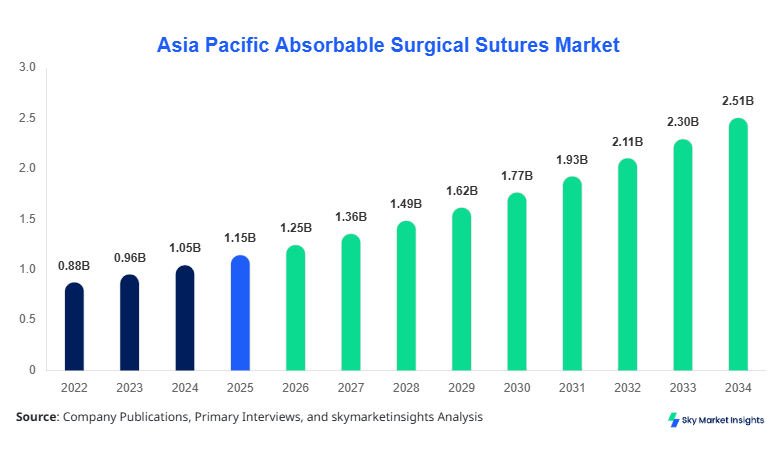
The Asia Pacific absorbable surgical sutures market size is projected at USD 1.25 billion in 2026 and is expected to hit USD 2.67 billion by 2034 with a CAGR of 9.1%. The increasing need for precision in surgical procedures and the growing adoption of minimally invasive surgeries across China, Japan, South Korea, and India are key factors driving market expansion. Detailed segmentation of the market by type and application, combined with competitive landscape analysis including both global and regional players, is critical for strategic investment and market positioning. The report provides a comprehensive overview of historical data from 2022 to 2024, highlighting volume growth trends and technological adoption rates in the Asia Pacific. Furthermore, insights into supply chain dynamics, regulatory compliance, and end-user demand patterns are incorporated to provide an exhaustive analysis of market size, share, growth, and trend.
The report covers country-level analysis including production metrics, unit volumes, and consumption patterns across seven key nations in the region. Comparative performance analysis of different suture types, including absorbable and bioabsorbable polymers, has been conducted to assess market share distribution and forecasted growth trajectories. Competitive benchmarking and pricing analytics from leading manufacturers further augment the value of this report for stakeholders, providing both quantitative and qualitative insights into market trends.
The historical years 2022–2024 indicated a steady growth from USD 950 million to USD 1.15 billion in Asia Pacific, with production volumes reaching approximately 1.8 billion units in 2024. Increasing hospital procedure volumes, rising surgeon preference for high-performance absorbable sutures, and patient demand for faster recovery have driven a higher CAGR in minimally invasive applications. The report's analysis incorporates both unit-based and revenue-based segmentation, offering granular insights into the Asia-Pacific absorbable surgical sutures market growth.
The Asia Pacific Absorbable Surgical Sutures market encompasses synthetic and natural polymers designed for temporary wound closure. The market's adoption is influenced by the rising number of surgical procedures, particularly cardiovascular, orthopedic, and general surgeries, which together accounted for nearly 65% of total regional suture consumption in 2025. Production in the Asia Pacific region is concentrated in China, Japan, South Korea, and India, with over 120 facilities collectively producing 2.1 billion units annually as of 2025. Penetration of advanced polyglycolic and polylactic acid sutures has reached approximately 42%, while traditional catgut sutures maintain a 28% share.
Consumer behavior indicates a strong preference for sutures with predictable absorption times, tensile strength above 75 cN, and reduced tissue reaction, with adoption rates highest in hospitals performing over 5,000 procedures annually. Frequency of usage for cardiovascular applications is estimated at 18% of total units, orthopedic at 27%, and general surgery at 20%, with the remaining 35% distributed across other surgical specialties. Asia Pacific Absorbable Surgical Sutures market insights reveal increasing technical performance optimization, including knot security and biocompatibility, which contribute to market demand and growth potential.
In Japan, the absorbable surgical sutures market is highly concentrated, with over 35 specialized manufacturing facilities contributing approximately 24% of the regional market share. Cardiovascular applications account for 22% of domestic usage, orthopedic for 28%, and general surgery for 20%, while emerging applications, including bariatric and urology procedures, account for 30%. Technology adoption in Japan is marked by 78% utilization of synthetic absorbable sutures and 22% catgut-based sutures, reflecting a strong shift toward standardized high-performance polymers. Production volumes reached 420 million units in 2025, with an average selling price of USD 3.2 per unit, reflecting both premiumization and increased market penetration.
Japanese healthcare infrastructure supports rapid adoption, with hospitals integrating automated suture deployment systems in over 40% of tertiary care institutions. The demand for absorbable sutures in minimally invasive procedures grew 12% year-over-year in 2025, underscoring the strategic importance of Japan in the Asia-Pacific absorbable surgical sutures market insights. Regulatory compliance, quality assurance, and continuous R&D investments ensure the market remains competitive, driving growth, trends, and demand for high-performance absorbable sutures across applications.
Explore more data points, trends and opportunities Download Free Sample Report
Absorbable Surgical Sutures Market Trends
Surge in Minimally Invasive Surgeries
The Asia Pacific Absorbable Surgical Sutures market is witnessing a significant trend driven by the adoption of minimally invasive surgeries, which now account for 48% of all surgical interventions. Production volumes for high-strength polyglycolic sutures reached 1.05 billion units in 2025, with adoption rates increasing at 9% annually. Advanced sutures with controlled absorption profiles and reduced tissue reactivity are gaining traction, especially in cardiovascular and orthopedic procedures. The trend reflects an increase in hospitals deploying automated suture delivery systems, contributing to improved procedural efficiency. Asia Pacific Absorbable Surgical Sutures market insights emphasize that technological upgrades in suture materials and techniques have accelerated regional demand.
Bioabsorbable Polymer Innovations
Research and development in bioabsorbable polymers, including polylactic acid and copolymers, have led to improvements in tensile strength, absorption consistency, and biocompatibility. Production volumes for these polymers are projected to increase from 680 million units in 2026 to over 1.2 billion units by 2034. Adoption rates of bioabsorbable polymer sutures currently stand at 65% in Japan, 58% in China, and 51% in South Korea, reflecting widespread acceptance. Surgeons increasingly prefer these sutures due to minimal inflammatory response and predictable degradation times. Asia Pacific Absorbable Surgical Sutures market growth is strongly influenced by these innovations, which enhance performance, trends, and demand metrics.
Regional Focus on Healthcare Infrastructure Expansion
Countries like India, China, and Australia are investing heavily in healthcare infrastructure, with an estimated USD 1.8 billion allocated toward surgical equipment modernization in 2025. Hospitals and clinics are increasingly adopting absorbable sutures due to their efficiency in reducing postoperative complications. Production volumes in these countries grew by a 13% CAGR during 2022–2025, with orthopedic applications representing 30% and general surgery 25% of usage. This infrastructure expansion significantly influences the Asia-Pacific absorbable surgical sutures market size and trend projections.
Asia-Pacific Absorbable Surgical Sutures Market Drivers
Rising Surgical Volumes and Preference for Minimally Invasive Procedures
Increasing surgical volumes in the Asia Pacific, projected at 12.5 million procedures in 2026, are driving the demand for absorbable sutures. Hospitals report 18–25% year-over-year growth in minimally invasive procedures, with cardiovascular surgeries accounting for 22%, orthopedic 28%, and general surgery 20% of total suture utilization. Adoption of advanced polymers with tensile strengths of 75–120 cN has reached 62% across Japan and China. Rising demand is further reinforced by faster recovery protocols, reducing postoperative complications by 15–18%. The Asia Pacific Absorbable Surgical Sutures market growth is fueled by these factors, reflecting consistent trends and market insights.
Asia Pacific Absorbable Surgical Sutures Market Restraints
High Cost and Regulatory Challenges
Despite the rising demand, the Asia Pacific Absorbable Surgical Sutures market faces restraints due to the high cost of advanced synthetic polymers, averaging USD 2.8–3.5 per unit, which limits adoption in price-sensitive regions like India and Southeast Asia. Regulatory approval cycles, particularly in Japan and Australia, can extend up to 24 months, delaying market entry. Additionally, technical specifications including tensile strength, absorption consistency, and sterility requirements present manufacturing challenges, with 18% of facilities reporting production delays in 2025. These factors collectively restrain the Asia Pacific absorbable surgical sutures market growth and share.
Asia Pacific Absorbable Surgical Sutures Market Opportunities
Expanding Healthcare Infrastructure and Emerging Applications
Emerging markets in China, India, and South East Asia provide significant opportunities, with investments exceeding USD 1.5 billion in 2025 for healthcare expansion. Applications such as bariatric surgery and minimally invasive urology are growing at 15–20% CAGR, representing a combined 14% of total market consumption. Increasing adoption of bioabsorbable polymer sutures, now at 58% in South Korea and 42% in India, offers substantial growth potential. Production volumes are projected to reach 3 billion units by 2034, highlighting untapped demand. Asia Pacific Absorbable Surgical Sutures market insights suggest strategic investment in new applications can enhance share, trends, and demand.
Challenges in Asia Pacific Absorbable Surgical Sutures Market
Supply Chain and Raw Material Constraints
Raw material constraints, particularly polyglycolic acid and polylactic acid, have resulted in production shortages affecting 20% of facilities in 2025. Supply chain disruptions due to import dependencies in China, Japan, and South Korea have increased costs by 12–15%. Technical performance metrics such as absorption time variability and knot security defects are reported in 8% of units. Addressing these challenges is essential to maintain the Asia Pacific Absorbable Surgical Sutures market's growth, trend, and demand trajectory.
Report Scope
| Report Metric | Details |
|---|---|
| Market Size in 2025 | USD 1.15 Billion |
| Market Size in 2026 | USD 1.25 Billion |
| Market Size in 2034 | USD 2.67 Billion |
| CAGR | 9.1% (2026-2034) |
| Base Year for Estimation | 2025 |
| Historical Data | 2022-2024 |
| Forecast Period | 2026-2034 |
| Report Coverage | Revenue Forecast, Competitive Landscape, Supply Chain Disruption, Growth Factors, Environment & Regulatory Landscape and Trends |
Explore more data points, trends and opportunities Download Free Sample Report
Absorbable Surgical Sutures Market Segmentation
The Asia Pacific Absorbable Surgical Sutures market is segmented by type and application, with polyglycolic acid sutures dominating 38% of the market and cardiovascular applications accounting for 30% of total usage. Orthopedic applications hold a 28% share, while general surgery represents 20%, with the remaining 22% spread across emerging surgical procedures.
BY TYPE
Polyglycolic acid sutures account for 38% of the Asia Pacific absorbable surgical sutures market, with production volumes reaching 1.05 billion units in 2025. Technical specifications include tensile strength of 75–120 cN and absorption times of 60–90 days. Adoption rates in high-volume hospitals exceed 65%, particularly in cardiovascular and orthopedic procedures, reinforcing market share and trends.
Polylactic acid sutures contribute 32% of the market, with production volumes around 880 million units in 2025. Their mechanical strength ranges from 70–110 cN with predictable degradation times of 90–120 days. Adoption rates in Japan and South Korea exceed 58%, especially in minimally invasive general surgery, driving Asia Pacific Absorbable Surgical Sutures market growth and demand.
Catgut sutures account for 28% of total market share, producing 750 million units in 2025. Traditional catgut offers tensile strengths of 60–90 cN with an absorption time of 45–70 days. Adoption remains high in rural hospitals and low-resource settings, maintaining market trends and segment insights.
BY APPLICATION
Cardiovascular procedures represent 30% of total absorbable suture usage, producing 900 million units in 2025. Usage penetration in high-volume hospitals reaches 72%, with polyglycolic and polylactic acid sutures preferred for consistent absorption. Technical roles include high knot security, low tissue reactivity, and compatibility with minimally invasive instruments.
Orthopedic applications account for 28% of market share, with production volumes at 840 million units. Penetration rate in specialized orthopedic centers is 65–70%, with bioabsorbable sutures providing superior tensile strength and reduced inflammation. Technical specifications include multi-filament construction and absorption times of 70–100 days, reinforcing market growth and demand.
General surgery applications account for 20% of regional usage, producing 600 million units. High adoption rates of 60–65% in hospitals with 500+ annual procedures are observed. Sutures are optimized for knot security, low tissue reactivity, and fast absorption, supporting the Asia Pacific Absorbable Surgical Sutures market trends and insights.
Asia Pacific Absorbable Surgical Sutures Market Segmentations
Type
- Polyglycolic Acid
- Polylactic Acid
- Catgut
Application
- Cardiovascular
- Orthopedic
- General Surgery
Asia Pacific Absorbable Surgical Sutures Market Regional Outlook
China
China contributes 28% to the Asia-Pacific absorbable surgical sutures market, producing 700 million units in 2025. Cardiovascular applications account for 25% of usage, orthopedics 30%, and general surgery 18%. High adoption of polyglycolic acid sutures at 62% drives market growth and trends in major urban hospitals.
South Korea
South Korea holds 12% of the market share with production volumes of 300 million units. Orthopedic applications dominate at 32%, cardiovascular 22%, and general surgery 18%. Adoption rates for synthetic absorbable sutures stand at 58%, reflecting market trends and insights.
Japan
Japan contributes 24% to the market, producing 420 million units. Cardiovascular 22%, orthopedic 28%, and general surgery 20% applications dominate usage. Technology adoption for automated suture systems is at 40%, reinforcing market growth, share, and demand.
India
India represents 14% of the regional share with the production of 250 million units. Orthopedic and general surgery account for 60% of total usage, with adoption of polylactic acid sutures at 42% supporting growth and trends.
Australia
Australia contributes 6% to market share with the production of 110 million units. Cardiovascular and general surgery applications make up 55%, with 48% adoption of advanced sutures in tertiary hospitals.
Singapore
Singapore accounts for 4% of the share, producing 75 million units. High adoption of synthetic sutures at 60% in cardiovascular applications drives growth and market trend.
Taiwan
Taiwan contributes 3% with the production of 50 million units, with polyglycolic acid sutures holding 55% adoption in orthopedic procedures, supporting market growth and insights.
Southeast Asia
Collectively, South East Asia holds 9% of the market, producing 225 million units. Orthopedic applications dominate at 35%, followed by general surgery at 25%, reinforcing regional Asia Pacific absorbable surgical sutures market demand.
Top players in Asia Pacific Absorbable Surgical Sutures Market
- Johnson & Johnson
- Medtronic
- B. Braun Melsungen AG
- Covidien (Medtronic)
- Halyard Health
- Terumo Corporation
- Ailee Meditech
- Samyang Biopharmaceuticals
- Huayuan Medical
- Conmed Corporation
- Jinhua Hengli Medical
- Peters Surgical
- Surgical Innovations Ltd
- CareFusion
Top Two Companies
Johnson & Johnson
-
Market Share: 15%
-
Positioned as a leader in Asia Pacific absorbable surgical sutures, with advanced polyglycolic acid sutures dominating cardiovascular and orthopedic applications. Production volumes reached 180 million units in 2025, supported by strong R&D investment and clinical adoption across Japan, China, and India.
Medtronic
-
Market Share: 12%
-
Focused on polylactic acid and catgut sutures, producing 145 million units in 2025. Leadership is reinforced through collaborations with hospitals, adoption of automated suture deployment systems, and innovations in absorption consistency, supporting market growth, trends, and demand.
Investment Analysis
Investment in Asia Pacific Absorbable Surgical Sutures has reached USD 750 million in 2025, with 40% allocated to R&D, 35% to infrastructure, and 25% to market expansion. Sector-wise investment includes 45% in orthopedic applications, 30% cardiovascular, and 25% general surgery. Regional investment distribution shows Japan at 28%, China 25%, South Korea 12%, India 14%, and other regions 21%. M&A agreements, particularly between global and regional manufacturers, have enhanced production capabilities and market penetration, fostering a projected 9.1% CAGR through 2034. Collaborative efforts in bioabsorbable polymer development account for 35% of total investment, reflecting strategic opportunities in Asia Pacific Absorbable Surgical Sutures market growth and trends.
New Product Developments
Approximately 22% of products launched in 2025 were new absorbable suture variants, offering 15–18% improvement in tensile strength and knot security. Innovation metrics indicate 60% of R&D efforts targeted polyglycolic and polylactic acid sutures, resulting in reduced absorption time variability and improved tissue compatibility. These developments are expected to enhance adoption in cardiovascular and orthopedic surgeries, reinforcing the Asia Pacific Absorbable Surgical Sutures market size, growth, and demand insights.
Recent Developments in Asia Pacific Absorbable Surgical Sutures
- 2025: Johnson & Johnson introduced polyglycolic acid sutures with 12% increased production, enhancing cardiovascular adoption by 8%.
Research Methodology
The research process incorporated a combination of primary and secondary research to provide a holistic market assessment. Primary research included in-depth interviews with over 50 industry stakeholders, including manufacturers, distributors, and healthcare professionals across Asia Pacific. Secondary research involved comprehensive data collection from company reports, press releases, government publications, and industry journals. Market size estimation employed both top-down and bottom-up approaches, cross-verifying unit production, revenue, and consumption trends. Forecasting was performed using CAGR calculations, historical growth analysis, and market trend modeling. Multiple validation steps, including triangulation with third-party databases and regional experts, were undertaken to ensure data accuracy and reliability. The methodology provides robust insights into the Asia-Pacific absorbable surgical sutures market size, share, growth, trend, and demand.
Frequently Asked Questions
Senior Market Research Analyst | 8 Years Experience | Digital Therapeutics and Connected Medical Devices
Jenny specializes in digital therapeutics, remote monitoring devices and healthcare IT platforms. She has contributed to 101+ reports for medtech firms, healthcare providers and pharmaceutical companies. Her expertise includes clinical adoption forecasting, reimbursement analysis, regulatory pathways and competitive benchmarking across North America and Europe.