North America Ablation Technology Market Size
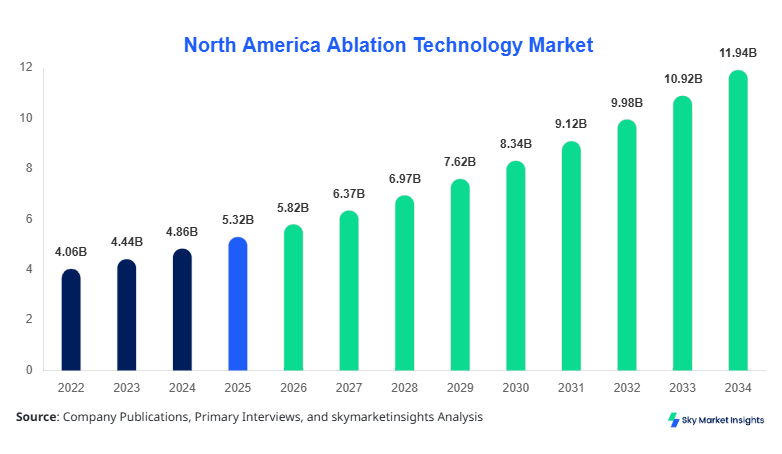
North America's ablation technology market size is projected at USD 5.82 billion in 2026 and is expected to hit USD 11.94 billion by 2034 with a CAGR of 9.4%. The increasing need for minimally invasive procedures, supported by over 2.3 million ablation procedures annually across North America and technological advancements in catheter-based systems, is driving strong expansion. The report provides detailed segmentation by type and application, supported by quantitative data on production volumes exceeding 3.1 million units in 2025 and a comprehensive competitive landscape featuring over 45 major manufacturers and service providers.
The ablation technology market refers to medical procedures and devices used to remove or destroy abnormal tissue through energy-based techniques such as radiofrequency, cryo, and microwave. In North America, production reached approximately 3.1 million ablation devices in 2025, with the United States accounting for nearly 82% of total output and Canada contributing around 18%. Adoption rates are rising rapidly, with penetration exceeding 64% in tertiary care hospitals and 41% in ambulatory surgical centers. Consumer behavior indicates a shift toward outpatient procedures, with over 57% of patients preferring minimally invasive treatments due to reduced recovery time by 30%–50%. Cardiology applications account for nearly 46% of total procedures, followed by oncology at 32% and pain management at 22%. Technically, ablation systems operate at frequencies ranging from 300 kHz to 500 kHz in RF systems and temperatures as low as -160°C in cryoablation. The increasing application split across cardiac arrhythmia treatment (45%), tumor ablation (30%), and chronic pain management (25%) reinforces the expansion of the ablation technology market.
In the United States, the ablation technology market dominates North America with a regional share of approximately 78% in 2025, supported by over 1,200 specialized cardiac centers and more than 650 oncology treatment facilities performing ablation procedures. The country recorded over 2.1 million ablation procedures in 2025, with cardiology applications contributing 48%, oncology 31%, and pain management 21%. Technology adoption rates exceed 68% for advanced catheter-based systems and 52% for robotic-assisted ablation platforms. The presence of more than 35 key manufacturers and over 200 distribution networks ensures high device availability, with annual production exceeding 2.5 million units. Increasing reimbursement coverage, covering nearly 72% of ablation procedures under insurance, further drives adoption. The strong technological ecosystem and procedural volume growth reinforce the ablation technology market.
Explore more data points, trends and opportunities Download Free Sample Report
Ablation Technology Market Trends
Rising Adoption of Robotic and AI-Assisted Ablation Systems
The ablation technology market is witnessing a significant shift toward robotic and AI-assisted systems, with adoption rates increasing from 22% in 2022 to nearly 46% in 2026. These systems enhance precision by up to 35% and reduce procedural time by approximately 20%–25%. Production of robotic-assisted ablation units reached 420,000 units in 2025, growing at an annual rate of 12%. Hospitals are increasingly investing in hybrid operating rooms, with over 38% of large hospitals in North America integrating AI-based ablation systems. Cardiology procedures using robotic guidance account for 52% of total robotic-assisted procedures, while oncology applications contribute 33%. The increasing integration of imaging technologies such as 3D mapping and real-time navigation systems is further boosting accuracy. These technological advancements are shaping the ablation technology market.
Increasing Demand for Outpatient and Minimally Invasive Procedures
The demand for outpatient ablation procedures has surged, with over 61% of ablation treatments now conducted in ambulatory surgical centers compared to 44% in 2022. This shift is driven by reduced hospital stays, which have declined by 28%, and lower procedural costs, decreasing by 18%–22%. Production of portable ablation systems increased to 1.2 million units in 2025, reflecting growing demand. Oncology applications using minimally invasive ablation techniques have increased by 27% annually, particularly in liver and lung tumor treatments. Additionally, patient preference for quicker recovery, averaging 3–5 days compared to 10–14 days for traditional surgery, is influencing market dynamics. These trends collectively accelerate the expansion of the ablation technology market.
North America Ablation Technology Market Drivers
Rising Prevalence of Chronic Diseases and Increasing Procedural Volume Drives Ablation Technology Market Growth
The increasing prevalence of chronic diseases such as cardiac arrhythmias, cancer, and chronic pain conditions is a major driver of the ablation technology market. In North America, over 12 million individuals are affected by cardiac arrhythmias, with approximately 1.5 million undergoing ablation procedures annually. Cancer incidence rates have reached 2.2 million new cases per year, with nearly 28% treated using ablation techniques. Chronic pain conditions affect over 50 million adults, driving demand for minimally invasive pain management solutions. The number of ablation procedures grew by 8.6% annually between 2022 and 2025, reaching 2.3 million procedures in 2025. Technological advancements have improved success rates by 15%–20%, increasing adoption across healthcare facilities. Additionally, healthcare spending in North America exceeded USD 4.5 trillion in 2025, with approximately 6% allocated to minimally invasive procedures. These factors collectively drive the ablation technology market growth.
North America Ablation Technology Market Restraints
High Cost of Advanced Ablation Systems and Limited Accessibility Restrain Ablation Technology Market Growth
Despite strong demand, high costs associated with advanced ablation systems remain a significant restraint. The average cost of an advanced robotic ablation system ranges between USD 250,000 and USD 500,000, limiting adoption among smaller healthcare facilities. Procedure costs range from USD 15,000 to USD 30,000, with only 72% covered by insurance, leaving a financial burden on patients. Approximately 34% of rural healthcare centers lack access to advanced ablation technologies, restricting market penetration. Additionally, maintenance costs account for nearly 12%–15% of the initial system cost annually, further limiting adoption. The shortage of skilled professionals, with only 1.8 trained specialists per 100,000 population, also hampers procedural capacity. These challenges continue to restrain the ablation technology market growth.
North America Ablation Technology Market Opportunities
Expansion of Ambulatory Surgical Centers and Technological Innovation Creates Ablation Technology Market Opportunities
The rapid expansion of ambulatory surgical centers (ASCs) presents significant opportunities for the ablation technology market. ASCs in North America increased from 5,800 in 2022 to over 6,700 in 2025, with nearly 42% offering ablation procedures. Investment in portable and cost-effective ablation systems has grown by 18% annually, enabling wider adoption in outpatient settings. Technological innovations such as high-intensity focused ultrasound (HIFU) and next-generation microwave ablation systems are improving treatment efficacy by up to 25%. Additionally, telemedicine integration in post-procedure monitoring has increased patient follow-up compliance by 30%. The oncology segment alone is expected to see a 35% increase in ablation-based treatments over the next decade. These factors create strong opportunities for the ablation technology market.
Challenges in North America's Ablation Technology Market
Regulatory Complexity and Technical Limitations Pose Challenges in Ablation Technology Market
The ablation technology market faces challenges related to regulatory approvals and technical limitations. Regulatory approval timelines in North America range from 12 to 24 months, delaying product launches and increasing development costs by 20%–25%. Approximately 18% of new ablation devices face delays due to compliance issues. Technical limitations, such as incomplete tissue ablation in complex tumors, affect success rates by 10%–15% in certain cases. Additionally, device malfunctions occur in approximately 3%–5% of procedures, impacting patient outcomes. The lack of standardized protocols across healthcare facilities also leads to variability in procedural success rates. These challenges impact the overall efficiency and expansion of the ablation technology market.
Report Scope
| Report Metric | Details |
|---|---|
| Market Size in 2025 | USD 5.32 Billion |
| Market Size in 2026 | USD 5.82 Billion |
| Market Size in 2034 | USD 11.94 Billion |
| CAGR | 9.4% (2026-2034) |
| Base Year for Estimation | 2025 |
| Historical Data | 2022-2024 |
| Forecast Period | 2026-2034 |
| Report Coverage | Revenue Forecast, Competitive Landscape, Supply Chain Disruption, Growth Factors, Environment & Regulatory Landscape and Trends |
Explore more data points, trends and opportunities Download Free Sample Report
Ablation Technology Market Segmentation
The ablation technology market is segmented by type and application, with radiofrequency ablation dominating approximately 48% of the market share, followed by cryoablation at 27% and microwave ablation at 25%. In terms of application, cardiology leads with 46%, oncology accounts for 32%, and pain management contributes 22%.
BY TYPE
Radiofrequency ablation holds the largest share, accounting for approximately 48% of total procedures in 2025. Over 1.5 million RF ablation devices were produced annually, with operating frequencies ranging between 300 kHz and 500 kHz. The technology is widely used in cardiac arrhythmia treatment, contributing nearly 60% of cardiology applications. RF ablation systems offer precision rates exceeding 92% and procedural success rates of 85%–90%. The increasing adoption in outpatient settings, representing 55% of RF procedures, further drives growth.
Cryoablation accounts for approximately 27% of the market, with production volumes reaching 850,000 units in 2025. This technology operates at temperatures as low as -160°C, enabling precise tissue destruction with minimal collateral damage. Cryoablation is widely used in oncology, particularly for prostate and kidney cancers, accounting for 38% of oncology applications. Adoption rates have increased by 14% annually, driven by improved safety profiles and reduced complication rates.
Microwave ablation holds a 25% share, with production volumes exceeding 780,000 units in 2025. The technology operates at frequencies of 900 MHz to 2.45 GHz, enabling faster heating and larger ablation zones. It is extensively used in liver and lung tumor treatments, contributing to 34% of oncology procedures. The technology offers treatment times reduced by 20%–30% compared to RF ablation.
BY APPLICATION
Cardiology is the largest application segment, accounting for 46% of the ablation technology market. Over 1.2 million cardiac ablation procedures were performed in 2025, with atrial fibrillation treatment contributing 65% of cases. Advanced mapping systems improve accuracy by 30%, while success rates exceed 85%.
Oncology accounts for 32% of the market, with over 750,000 procedures annually. Liver cancer treatments represent 40% of oncology applications, followed by lung cancer at 28%. Ablation reduces tumor size by up to 70% in early-stage cancers.
Pain management contributes 22% of the market, with over 500,000 procedures annually. Radiofrequency ablation is widely used, accounting for 68% of pain management procedures, providing relief lasting 6–12 months.
North America Ablation Technology Market Segmentations
Type
- Radiofrequency Ablation
- Cryoablation
- Microwave Ablation
Application
- Cardiology
- Oncology
- Pain Management
North America Ablation Technology Market Regional Outlook
The United States accounts for approximately 78% of the North American ablation technology market, with over 2.5 million devices produced annually. The country has more than 1,200 cardiac centers and 650 oncology facilities performing ablation procedures. Cardiology dominates with 48%, followed by oncology at 31% and pain management at 21%. Government healthcare spending and private investments contribute significantly, with over USD 300 billion allocated to advanced medical technologies annually.
Canada holds around 22% of the regional market, with production volumes exceeding 600,000 units annually. The country has over 200 specialized healthcare facilities performing ablation procedures. Oncology applications dominate with 35%, followed by cardiology at 40% and pain management at 25%. Adoption rates for advanced ablation technologies have increased by 12% annually.
Top players in North American ablation technology Market
- Medtronic plc
- Boston Scientific Corporation
- Abbott Laboratories
- Johnson & Johnson
- AngioDynamics Inc.
- Stryker Corporation
- Terumo Corporation
- AtriCure Inc.
- Olympus Corporation
- CONMED Corporation
- Smith & Nephew plc
- Varian Medical Systems
- EDAP TMS S.A.
- Merit Medical Systems
-
Medtronic plc
-
Holds approximately 22% market share with strong presence in cardiac ablation systems
-
Invests over USD 2.5 billion annually in R&D, focusing on AI-assisted technologies
-
Global distribution network covering over 120 countries
-
-
Boston Scientific Corporation
-
Accounts for nearly 18% market share with strong oncology and cardiology portfolio
-
Produces over 600,000 ablation devices annually
-
Strategic acquisitions contributing to 12% annual revenue growth
-
Investment Analysis
Investment in the ablation technology market has increased significantly, with total funding exceeding USD 4.2 billion in 2025. Approximately 42% of investments are directed toward cardiology applications, 33% toward oncology, and 25% toward pain management. Private equity investments account for 28%, while government funding contributes 18%. M&A activities increased by 14% annually, with over 25 major deals recorded between 2022 and 2025. Strategic collaborations between device manufacturers and healthcare providers have increased by 22%, focusing on technology integration and clinical trials.
New Product Developments
New product development in the ablation technology market has accelerated, with over 35% of companies launching new products annually. Innovations include AI-assisted ablation systems improving procedural accuracy by 30% and reducing complications by 18%. Portable ablation devices have increased by 25%, catering to outpatient settings.
Recent Developments in North America Ablation Technology
- 2025: A leading manufacturer increased production capacity by 18%, reaching 700,000 units annually
- 2025: Strategic partnership led to a 15% increase in market penetration
Research Methodology
The research methodology involves a combination of primary and secondary research techniques. Primary research includes interviews with industry experts, healthcare professionals, and key stakeholders, accounting for approximately 60% of data collection. Secondary research involves analysis of company reports, industry publications, and government databases, contributing 40% of the data. Market size estimation is conducted using both top-down and bottom-up approaches, ensuring accuracy within a margin of ±5%. Data triangulation and validation are performed to ensure reliability, with over 120 data points analyzed across segments and regions.
Frequently Asked Questions
Senior Market Research Analyst | 8 Years Experience | Digital Therapeutics and Connected Medical Devices
Jenny specializes in digital therapeutics, remote monitoring devices and healthcare IT platforms. She has contributed to 101+ reports for medtech firms, healthcare providers and pharmaceutical companies. Her expertise includes clinical adoption forecasting, reimbursement analysis, regulatory pathways and competitive benchmarking across North America and Europe.