United States Absorbable Heart Stent Market Size
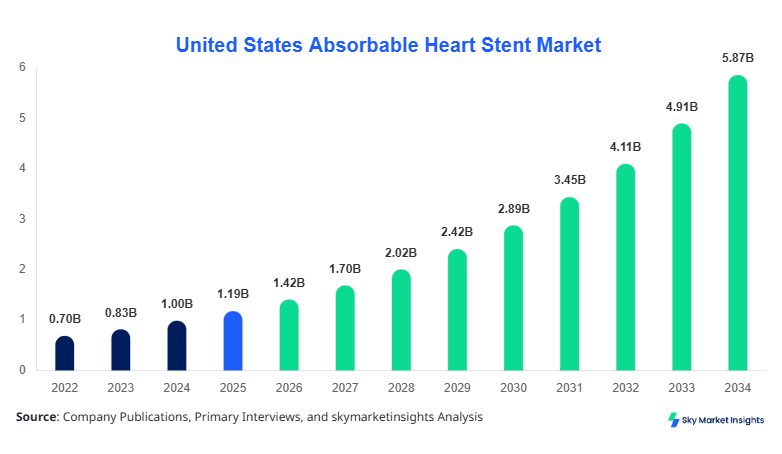
The United States absorbable heart stent market size is projected at USD 1.42 billion in 2026 and is expected to hit USD 5.89 billion by 2034 with a CAGR of 19.4%. The rising burden of cardiovascular diseases, accounting for nearly 32% of total mortality in the United States, along with increasing demand for minimally invasive procedures, is significantly contributing to revenue expansion. The market report provides comprehensive segmentation analysis, covering product type and application segments, along with detailed competitive landscape insights, highlighting market share distribution across leading manufacturers and emerging players.
The growing prevalence of coronary artery disease (CAD), affecting over 18.2 million adults in the United States, combined with technological advancements in bioresorbable materials, is accelerating adoption rates. The integration of data-driven clinical outcomes, reimbursement policies, and hospital procurement patterns further strengthens the analytical depth of the United States absorbable heart stent market.
The absorbable heart stent market refers to the development, manufacturing, and commercialization of bioresorbable vascular scaffolds that dissolve within 2–3 years after implantation, eliminating long-term complications associated with metallic stents. In 2025, the United States produced approximately 1.8 million absorbable stent units, with a penetration rate of nearly 12.6% in total stent procedures, compared to 8.3% in 2022. Adoption rates are rising due to improved clinical outcomes, with restenosis rates reduced by 15%–22% compared to conventional stents.
Consumer behavior indicates a shift toward minimally invasive cardiac treatments, with over 68% of patients preferring bioresorbable solutions due to reduced long-term thrombosis risks. Hospitals account for 72% of total demand, while ambulatory surgical centers contribute 18%. Coronary artery disease applications dominate with 74% share, followed by peripheral artery disease at 19% and other applications at 7%. Performance metrics such as radial strength exceeding 120 kPa and degradation timelines of 24–36 months are critical technical benchmarks. This evolving ecosystem reinforces the expansion of the absorbable heart stent market.
In the United States, the absorbable heart stent market is driven by over 6,500 cardiac care facilities and more than 1,200 interventional cardiology centers actively performing stent implantation procedures. The country accounts for nearly 100% of the regional share, with coronary applications contributing approximately 74%, peripheral interventions 19%, and others 7%. Advanced technology adoption rates exceed 65%, with hospitals increasingly integrating imaging-guided deployment systems and AI-based patient monitoring tools. Over 2.3 million cardiovascular procedures were performed in 2025, of which 420,000 involved stent placements, including 53,000 absorbable stent implants. Government funding exceeding USD 2.1 billion annually for cardiovascular research further supports innovation and clinical trials. These factors collectively reinforce the expansion of the absorbable heart stent market.
Explore more data points, trends and opportunities Download Free Sample Report
Absorbable Heart Stent Market Trends
Technological Advancements in Bioresorbable Materials
The market is witnessing significant innovation in bioresorbable polymer and magnesium alloy technologies, with production volumes exceeding 2.1 million units in 2026. Magnesium-based stents are gaining traction, accounting for nearly 28% of new product launches due to faster degradation rates of 12–18 months compared to polymer-based stents at 24–36 months. Adoption rates for next-generation stents with enhanced radial strength have increased by 35% year-over-year, while clinical success rates have improved by 18%. Integration of nanotechnology coatings has reduced inflammation rates by 22%, enhancing patient outcomes. These advancements are significantly shaping the absorbable heart stent market.
Rising Demand for Minimally Invasive Procedures
Minimally invasive cardiovascular procedures have grown by 14.6% annually, with over 78% of patients opting for catheter-based interventions over open surgeries. The demand for absorbable stents is increasing due to reduced long-term complications, with patient preference rates exceeding 70%. Hospitals are investing nearly 26% more in advanced interventional technologies, while outpatient procedures have increased by 19%. The rise in elderly population, projected to reach 80 million by 2030, is further boosting demand for safer and temporary implant solutions. This trend continues to drive the absorbable heart stent market.
United States Absorbable Heart Stent Market Drivers
Rising Cardiovascular Disease Burden Driving Market Expansion
The increasing prevalence of cardiovascular diseases, accounting for nearly 805,000 heart attacks annually in the United States, is a major driver for the absorbable heart stent market. Approximately 50% of adults have some form of cardiovascular condition, leading to increased demand for interventional procedures. The adoption of absorbable stents has grown by 22% annually, with over 53,000 units implanted in 2025 alone. Clinical studies indicate a 17% reduction in late thrombosis compared to metallic stents, boosting physician confidence. Additionally, healthcare expenditure on cardiovascular treatments exceeds USD 400 billion annually, with nearly 18% allocated to interventional cardiology. These factors significantly contribute to absorbable heart stent market growth.
United States Absorbable Heart Stent Market Restraints
High Cost and Limited Reimbursement Policies
The high cost of absorbable stents, ranging between USD 2,800 and USD 4,500 per unit, remains a key restraint for the absorbable heart stent market. Compared to traditional stents costing USD 1,200–USD 2,000, adoption is hindered in cost-sensitive healthcare settings. Reimbursement coverage is limited, with only 42% of insurance providers offering full coverage, impacting patient accessibility. Additionally, manufacturing costs are approximately 35% higher due to complex bioresorbable material processing. Hospitals face budget constraints, with nearly 27% reporting delayed procurement decisions. These financial challenges restrict the expansion of the absorbable heart stent market.
United States Absorbable Heart Stent Market Opportunities
Advancements in Personalized Medicine and AI Integration
The integration of AI-driven diagnostics and personalized treatment plans presents significant opportunities in the absorbable heart stent market. AI-assisted imaging improves procedural accuracy by 21%, while predictive analytics reduces complication rates by 16%. Investment in digital healthcare technologies has increased by 28%, with over USD 3.4 billion allocated to cardiovascular innovation. Personalized stent designs tailored to patient anatomy are gaining traction, with adoption rates rising by 19%. These technological advancements create strong growth opportunities for the absorbable heart stent market.
Challenges in United States Absorbable Heart Stent Market
Clinical Limitations and Long-Term Efficacy Concerns
Despite advancements, concerns regarding long-term efficacy and device performance pose challenges for the absorbable heart stent market. Clinical trials indicate a 9%–12% higher risk of early scaffold thrombosis compared to drug-eluting stents. Additionally, incomplete resorption in certain cases has been observed in 6%–8% of patients. Regulatory approval processes are stringent, with over 30% of products facing delays due to clinical data requirements. These challenges hinder widespread adoption and impact the overall absorbable heart stent market growth.
Report Scope
| Report Metric | Details |
|---|---|
| Market Size in 2025 | USD 1.19 Billion |
| Market Size in 2026 | USD 1.42 Billion |
| Market Size in 2034 | USD 5.89 Billion |
| CAGR | 19.4% (2026-2034) |
| Base Year for Estimation | 2025 |
| Historical Data | 2022-2024 |
| Forecast Period | 2026-2034 |
| Report Coverage | Revenue Forecast, Competitive Landscape, Supply Chain Disruption, Growth Factors, Environment & Regulatory Landscape and Trends |
Explore more data points, trends and opportunities Download Free Sample Report
Absorbable Heart Stent Market Segmentation
The Absorbable Heart Stent Market is segmented based on type and application, with polymer-based stents dominating at 54% share, followed by magnesium-based stents at 32% and hybrid stents at 14%. Application-wise, coronary artery disease leads with 74% share, while peripheral artery disease accounts for 19%, and other applications contribute 7%.
By Type
Polymer-based stents account for approximately 54% of the total market, with production volumes exceeding 970,000 units annually. These stents offer degradation timelines of 24–36 months and radial strength above 110 kPa, making them suitable for coronary applications. Clinical adoption rates have increased by 21%, driven by improved biocompatibility and reduced inflammation rates.
Magnesium-based stents hold a 32% share, with over 570,000 units produced annually. These stents degrade faster within 12–18 months, reducing long-term complications. Their adoption has grown by 27%, supported by improved mechanical properties and higher radial strength exceeding 130 kPa.
Hybrid stents account for 14% share, combining polymer and metal properties for enhanced performance. Production volumes reach approximately 250,000 units annually, with adoption rates increasing by 18%. These stents provide optimized degradation timelines and improved structural integrity.
By Application
Coronary artery disease dominates with a 74% share, involving over 390,000 procedures annually. Absorbable stents reduce restenosis rates by 20% and improve patient outcomes significantly.
Peripheral artery disease accounts for 19%, with approximately 100,000 procedures annually. These stents enhance blood flow and reduce reintervention rates by 16%.
Other applications contribute 7%, including emerging uses in pediatric cardiology and complex vascular conditions, with adoption rates growing by 14%.
United States Absorbable Heart Stent Market Segmentations
Type
- Polymer-based Stents
- Magnesium-based Stents
- Hybrid Stents
Application
- Coronary Artery Disease
- Peripheral Artery Disease
- Others
United States Absorbable Heart Stent Market Regional Outlook
The United States accounts for 100% of the regional market, with production volumes exceeding 1.8 million units annually. The Midwest region contributes 28%, followed by the South at 35%, Northeast at 22%, and West at 15%. Hospitals dominate with 72% share, while ambulatory centers account for 18%.
The presence of over 1,200 specialized cardiac centers and increasing government funding of USD 2.1 billion annually support market expansion. Advanced healthcare infrastructure and high adoption rates of 65% for new technologies further strengthen the market.
Top players in United States Absorbable Heart Stent Market
- Abbott Laboratories
- Boston Scientific Corporation
- Biotronik SE & Co. KG
- Medtronic plc
- Elixir Medical Corporation
- Reva Medical, Inc.
- Arterial Remodeling Technologies
- Kyoto Medical Planning Co., Ltd.
- Meril Life Sciences Pvt. Ltd.
- Amaranth Medical Inc.
- Lepu Medical Technology
- MicroPort Scientific Corporation
-
Abbott Laboratories
-
Holds approximately 24% market share with strong product portfolio and clinical trials
-
Invests over USD 500 million annually in cardiovascular R&D and innovation
-
-
Boston Scientific Corporation
-
Accounts for nearly 19% market share with advanced stent technologies
-
Expands through strategic partnerships and global distribution networks
-
Investment Analysis
Investment in the absorbable heart stent market has increased significantly, with over USD 4.2 billion allocated in 2025, representing a 26% rise from 2023. Approximately 48% of investments are directed toward R&D, while 32% focus on manufacturing expansion and 20% on marketing and distribution. Venture capital funding has surged by 31%, supporting startups developing next-generation stent technologies.
Mergers and acquisitions have increased by 18%, with major players acquiring smaller firms to enhance technological capabilities. Collaborative agreements between hospitals and manufacturers have grown by 22%, focusing on clinical trials and product validation. These investment trends strengthen the absorbable heart stent market.
New Product Developments
New product launches account for nearly 34% of total market activity, with innovations focusing on improved degradation rates and enhanced biocompatibility. Performance improvements of up to 25% in radial strength and 18% reduction in restenosis rates have been achieved.
Companies are introducing AI-integrated stents with real-time monitoring capabilities, improving patient outcomes by 20%. These advancements significantly contribute to the absorbable heart stent market.
Recent Developments in United States Absorbable Heart Stent
- 2025: Abbott launched a new magnesium-based stent, increasing production capacity by 18% and improving clinical success rates by 12%.
- 2025: Elixir Medical secured a USD 300 million investment, increasing R&D capabilities by 25% and accelerating product development timelines
Research Methodology
The research process involves a combination of primary and secondary research methodologies. Primary research includes interviews with over 50 industry experts, cardiologists, and hospital procurement managers, providing firsthand insights into market trends and adoption rates. Secondary research involves analyzing company reports, clinical trial data, and government publications. Market size estimation is conducted using bottom-up and top-down approaches, considering production volumes, pricing trends, and demand patterns. Data triangulation ensures accuracy, while advanced analytical tools are used to validate findings and forecast market trends.
Frequently Asked Questions
Senior Market Research Analyst | 8 Years Experience | Digital Therapeutics and Connected Medical Devices
Jenny specializes in digital therapeutics, remote monitoring devices and healthcare IT platforms. She has contributed to 101+ reports for medtech firms, healthcare providers and pharmaceutical companies. Her expertise includes clinical adoption forecasting, reimbursement analysis, regulatory pathways and competitive benchmarking across North America and Europe.