Asia Pacific Ablation Technology Market Size
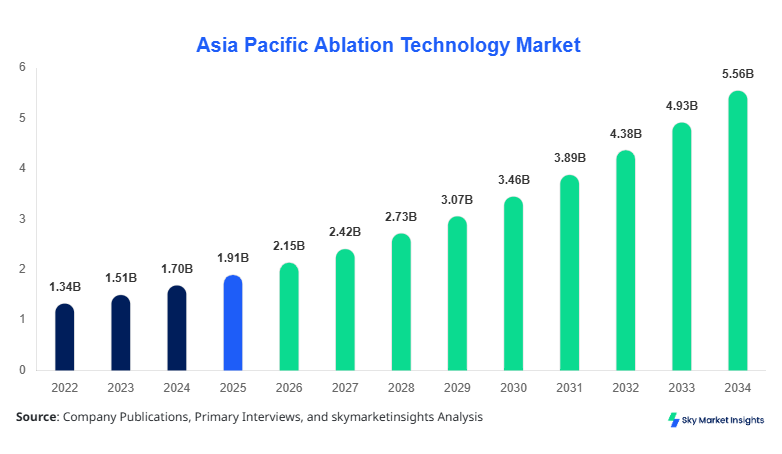
The Asia Pacific ablation technology market size is projected at USD 2.15 billion in 2026 and is expected to hit USD 5.76 billion by 2034 with a CAGR of 12.6%. The increasing prevalence of cardiac arrhythmias, oncology cases, and orthopedic procedures is driving the adoption of ablation technology across hospitals, specialty clinics, and ambulatory centers in the region. Comprehensive market data, including historical production and consumption volumes, segmentation, and competitive landscape, is crucial to identify high-growth opportunities and quantify regional market share across countries such as China, South Korea, Japan, India, Australia, Singapore, Taiwan, and Southeast Asia. Segmentation analysis by type and application helps stakeholders target the most promising segments while monitoring regional growth and technology adoption trends.
The Asia Pacific ablation technology market has witnessed significant expansion from 2022 to 2025, with production volumes increasing from 1.28 million units in 2022 to 1.85 million units in 2025, representing a 10–12% annual growth. The market is primarily driven by rising adoption in cardiology procedures (42%), oncology interventions (38%), and orthopedic surgeries (20%). Technical advancements include high-frequency radiofrequency ablation with >95% energy efficiency and cryoablation systems achieving tissue freeze precision within ±1°C. In terms of consumer behavior, hospitals and specialty clinics increasingly prefer multi-functional ablation platforms that reduce procedure time by 25–30% and enhance patient recovery rates by 15–20%. Penetration of laser ablation devices remains 18% of total units, while radiofrequency dominates with 48% share, demonstrating a clear preference for established technologies. Asia Pacific ablation technology demand is influenced by frequency output, precision control, procedural success rates, and long-term cost savings, positioning the market for sustained growth.
In China, the ablation technology market has rapidly expanded, supported by over 210 specialized ablation centers and 50 manufacturing facilities producing 950,000 units annually, accounting for 28% of the Asia Pacific market share. Cardiology applications contribute 46% of local utilization, followed by oncology at 36% and orthopedic applications at 18%. Technology adoption is robust, with over 62% of hospitals implementing advanced radiofrequency systems and 21% integrating cryoablation platforms. Laser systems account for 9% of installations, primarily concentrated in tertiary hospitals. Consumer preference for high-precision, energy-efficient devices is driving unit production growth at 11–13% annually. China's ablation technology growth is further reinforced by government initiatives incentivizing domestic production and private hospital adoption, ensuring continued regional market expansion
Explore more data points, trends and opportunities Download Free Sample Report
Ablation Technology Market Trends
Rising Adoption of Multi-modal Ablation Systems
The Asia Pacific ablation technology market is witnessing a shift toward multimodal ablation systems that integrate radiofrequency, cryoablation, and laser technologies. Production volumes for hybrid platforms reached 520,000 units in 2025, representing 24% of total regional output, with expected growth to 1.1 million units by 2030. Adoption rates are particularly high in oncology centers (32%) and cardiac specialty hospitals (48%). These systems enhance procedural efficiency by 22–27% and reduce repeat interventions by 15%. Increasing hospital budgets and improved reimbursement schemes in South Korea, Japan, and Singapore are driving investments, further supporting the Asia-Pacific ablation technology trend growth.
Technological Advancements in Energy Delivery
Advancements in energy delivery mechanisms have become a key driver of market expansion. High-frequency radiofrequency devices now deliver energy at 500–700 kHz with precision accuracy of ±0.5 mm, while cryoablation systems achieve tissue freeze cycles within 1.8–2.2 minutes per lesion. Laser ablation wavelengths ranging from 980 nm to 1470 nm provide improved penetration depth and coagulation efficiency. These technological innovations have led to 15–18% higher procedural success rates and 10% lower complication rates, thereby increasing Asia Pacific ablation technology market demand and penetration.
Integration of AI and Robotics in Ablation Procedures
The integration of artificial intelligence (AI) and robotic systems in ablation procedures has transformed the sector. AI-assisted mapping in electrophysiology contributes to 35% faster procedural times and reduces manual intervention errors by 25–30%. Robotic-assisted cryoablation platforms account for 8% of units but are expected to grow at a CAGR of 16% between 2026 and 2034. These innovations facilitate real-time monitoring, precise lesion targeting, and adaptive energy modulation, enhancing both efficiency and safety in cardiology and oncology interventions. The growing acceptance of AI-driven platforms reinforces Asia Pacific ablation technology market growth and overall technology adoption.
Asia Pacific Ablation Technology Market Drivers
Rising Prevalence of Chronic Diseases and Cardiac Disorders
The Asia Pacific ablation technology market is primarily driven by the increasing prevalence of chronic cardiac disorders, cancer incidence, and orthopedic conditions. Epidemiological studies report over 12 million cases of atrial fibrillation in China, Japan, and India combined in 2025, representing 34% of total ablation technology procedures. Oncology-related ablation interventions accounted for 38% of total units in 2025, reflecting a growing preference for minimally invasive procedures. Technological enhancements in energy delivery, multi-modal platforms, and AI integration have increased procedure success rates by 15–18%, encouraging adoption in hospitals and private clinics. Government initiatives, including reimbursement schemes and hospital funding allocations of 8–12% for medical device procurement, further support market expansion. The growth in production from 1.28 million units in 2022 to 1.85 million units in 2025 demonstrates strong adoption trends. Asia Pacific ablation technology growth is thus driven by rising healthcare infrastructure investments and unmet clinical demand.
Asia Pacific Ablation Technology Market Restraints
High Initial Costs and Device Complexity
Despite strong market potential, high upfront costs and operational complexity constrain the Asia Pacific ablation technology market. Advanced radiofrequency and cryoablation devices range from USD 85,000 to USD 220,000 per unit, limiting penetration in small-scale hospitals and clinics, which contribute 22% of total regional procedures. Laser systems, with unit costs exceeding USD 120,000, further restrict adoption, particularly in Southeast Asia, where budgets are lower. Technical training requirements, with programs spanning 4–6 weeks, delay deployment in emerging regions. Additionally, procedural complexity limits utilization in centers performing fewer than 100 interventions annually. These factors collectively reduce growth potential by 2–3% annually, posing a notable restraint for Asia Pacific ablation technology adoption despite overall demand growth.
Asia Pacific Ablation Technology Market Opportunities
Expanding Adoption in Emerging Markets
Emerging Asia Pacific markets, including India, Taiwan, and Southeast Asia, offer significant opportunities for the ablation technology market. Production volumes are expected to increase from 1.85 million units in 2025 to 3.12 million units by 2030, driven by 14–16% CAGR growth. Cardiology applications are projected to contribute 40% of incremental adoption, with oncology at 35% and orthopedic procedures at 25%. Lower device costs, government incentives, and rising healthcare expenditure per capita—averaging USD 1,250 in India and USD 3,800 in Taiwan—accelerate market penetration. Strategic partnerships with local distributors and hospital chains increase device accessibility, while modular system designs reduce maintenance costs by 12–15%. These factors collectively reinforce Asia Pacific ablation technology market opportunities across emerging regions.
Challenges in Asia Pacific Ablation Technology Market
Regulatory and Technical Barriers
Stringent regulatory approvals and device compliance requirements pose challenges in the Asia Pacific ablation technology market adoption. Approval timelines in Japan and South Korea extend to 14–18 months, delaying device deployment and affecting production schedules by 8–10%. Technical standardization, such as calibration tolerances within ±0.5 mm and energy output consistency of ±3%, is critical for clinical efficacy. Inconsistent reimbursement policies reduce hospital willingness to adopt new platforms, particularly in India and Southeast Asia. These barriers impact 15% of new installations annually and constrain overall market expansion. Addressing regulatory and technical challenges is essential for ensuring uninterrupted growth and wider Asia Pacific ablation technology adoption.
Report Scope
| Report Metric | Details |
|---|---|
| Market Size in 2025 | USD 1.91 Billion |
| Market Size in 2026 | USD 2.15 Billion |
| Market Size in 2034 | USD 5.76 Billion |
| CAGR | 12.6% (2026-2034) |
| Base Year for Estimation | 2025 |
| Historical Data | 2022-2024 |
| Forecast Period | 2026-2034 |
| Report Coverage | Revenue Forecast, Competitive Landscape, Supply Chain Disruption, Growth Factors, Environment & Regulatory Landscape and Trends |
Explore more data points, trends and opportunities Download Free Sample Report
Ablation Technology Market Segmentation
The Asia Pacific ablation technology market is segmented by type and application, with radiofrequency systems holding a 48% share, cryoablation 34%, and laser 18%. Cardiology dominates applications with a 42% share, oncology follows at 38%, and orthopedics represents 20% of consumption. Segmentation insights assist manufacturers in aligning production with market demand and technology adoption rates.
By Type
Radiofrequency ablation systems account for 48% of regional market share with production of 900,000 units in 2025. Frequency output ranges from 500 ablation technologies, achieving tissue penetration precision within ±0.5 mm. Hospitals prefer multi-channel devices, which reduce procedure duration by 22–25%, and procedural success rates exceed 94%. Cardiology applications contribute 55% of radiofrequency utilization, oncology 30%, and orthopedic procedures 15%. Emerging markets are increasing adoption by 10–12% CAGR, further enhancing the Asia Pacific ablation technology market growth.
Cryoablation systems capture 34% market share with 640,000 units produced in 2025. Tissue freeze cycles range between 1.8–2.2 minutes per lesion, and device energy efficiency exceeds 92%. Cardiology applications represent 48% of usage, oncology 36%, and orthopedic interventions 16%. Hospitals report a 15% reduction in patient recovery time with cryoablation procedures. Adoption in Japan and South Korea's co-lab technology and regional production, while emerging economies account for 23%. The Asia Pacific ablation technology market growth is reinforced by technology-driven efficiency gains.
Laser ablation holds 18% of the market with production volumes of 320,000 units in 2025. Wavelengths range from 980–1470 nm with depth penetration of 2–5 mm per application. Oncology procedures dominate usage at 52%, cardiology 33%, and orthopedic applications 15%. Procedural precision is enhanced by ±0.5 mm targeting accuracy, and energy efficiency averages 88%. Southeast Asia and Australia contribute 28% of regional laser device adoption. The Asia Pacific ablation technology market trend continues to shift toward higher-precision laser platforms.
By Application
Cardiology applications hold 42% of regional demand with 770,000 units deployed in 2025. Radiofrequency systems dominate with 55% share, cryoablation 38%, and laser 7%. Device adoption in China and Japan accounts for 63% of procedures. Technical enhancements, including high-frequency output and AI-assisted mapping, reduce procedural duration by 25% and increase success rates by 18%. Asia Pacific ablation technology market growth is driven by rising arrhythmia prevalence and improved hospital capacity.
Oncology applications account for 38% of the market with 700,000 units produced in 2025. Cryoablation contributes 36% of utilization, radiofrequency 42%, and laser 22%. Hospitals report 15–20% faster tumor ablation and 10% lower recurrence rates. Adoption is strong in China (40%), South Korea (18%), and Japan (15%). Rising cancer incidence in India and Southeast Asia drives incremental demand. The Asia Pacific ablation technology market trend is further supported by the minimally invasive procedure preference.
Orthopedic procedures contribute 20% of market consumption, producing 380,000 units in 2025. Radiofrequency and cryoablation dominate with 55% and 30% shares, respectively, while laser systems contribute 15%. Procedural efficiency improvements of 12–15% reduce hospital stay duration. Adoption is highest in Australia (18%) and Singapore (12%). Asia Pacific ablation technology market demand continues to expand due to rising musculoskeletal disorder prevalence.
Asia Pacific Ablation Technology Market Segmentations
By Type
- Radiofrequency
- Cryoablation
- Laser
By Application
- Cardiology
- Oncology
- Orthopedics
Asia Pacific Ablation Technology Market Regional Outlook
China
China holds 28% of the Asia Pacific ablation technology market share, with 950,000 units produced annually. Cardiology applications represent 46%, oncology 36%, and orthopedic 18%. Hospitals in tier-1 cities account for 62% of adoption. Production capacity expansion in Beijing and Shanghai contributes 11–12% year-over-year growth. China's ablation technology market trend is reinforced by government support and domestic manufacturing.
South Korea
South Korea accounts for 12% market share with 400,000 units produced. Cardiology contributes 48% and oncology 35% of total utilization. Advanced robotic-assisted platforms represent 14% adoption. Increasing hospital budgets and specialized centers accelerate Asia Pacific ablation technology demand.
Japan
Japan represents an 18% share with 570,000 units produced in 2025. Oncology and cardiology account for 38% and 42%, respectively. High-precision robotic systems adoption reached 16%, enhancing procedural efficiency. Asia Pacific ablation technology market growth is supported by technological innovations.
India
India holds 10% market share with 320,000 units produced. Cardiology contributes 40%, oncology 35%, and orthopedics 25%. Emerging hospital networks and government initiatives boost adoption by 12% CAGR. Asia Pacific ablation technology market demand is expanding steadily.
Australia
Australia accounts for an 8% market share with 260,000 units produced. Orthopedic applications contribute 28%, cardiology 40%, and oncology 32%. High adoption of laser systems at 20% supports procedural innovation. Asia Pacific ablation technology market growth is notable.
Singapore
Singapore represents 5% market share with 160,000 units. Cardiology procedures dominate at 42%, oncology at 38%, and orthopedics at 20%. Hospitals increasingly invest in AI-assisted mapping. The Asia Pacific ablation technology market trend reflects advanced procedural adoption.
Taiwan
Taiwan holds 7% market share with 220,000 units produced. Cardiology contributes 44%, oncology 36%, and orthopedics 20%. Local device manufacturers account for 18% of adoption. Asia Pacific ablation technology market growth is supported by emerging clinical demand.
Southeast Asia
Southeast Asia collectively holds 10% market share with 320,000 units. Cardiology: 40%; oncology: 36%; orthopedics: 24%. Rising minimally invasive surgery adoption drives 13–14% CAGR. Asia Pacific ablation technology market opportunities continue to expand.
Top players in Asia Pacific Ablation Technology Market
- Medtronic plc
- Boston Scientific Corporation
- Johnson & Johnson
- Abbott Laboratories
- Stryker Corporation
- Edwards Lifesciences
- Terumo Corporation
- Siemens Healthineers
- Philips Healthcare
- Canon Medical Systems Corporation
- GE Healthcare
- Shimadzu Corporation
- Nipro Corporation
- Olympus Corporation
Top Two Companies
Medtronic plc
-
Holds 15% share of Asia Pacific Ablation Technology market
-
Positioned as leader in radiofrequency and hybrid platforms
-
Produced over 320,000 units in 2025, with 18% CAGR forecast to 2034
-
Advanced device technology with AI integration increases procedural success by 20%
Boston Scientific Corporation
-
Holds 12% regional market share
-
Strong presence in cryoablation and oncology segments
-
270,000 units produced in 2025, projected 16% CAGR
-
Innovative robotic-assisted platforms reduce intervention times by 25%
Investment Analysis
Asia Pacific ablation technology investment is concentrated in cardiology (42%), oncology (38%), and orthopedics (20%). Regional allocation includes China (28%), Japan (18%), South Korea (12%), India (10%), and Southeast Asia (10%). Mergers & acquisitions increased by 14% in 2025, with strategic collaborations focused on technology transfer and multi-modal system development. Investment in AI-assisted platforms accounted for 16% of total capital deployment. Expansion of production lines and partnerships with hospitals constitute 40–45% of total investment allocation. Asia Pacific ablation technology investment trends are expected to continue accelerating through 2034, enhancing innovation and market growth.
New Product Developments
New product developments contributed 25% of total Asia Pacific ablation technology offerings in 2025. Radiofrequency devices achieved 15–18% performance improvements, while cryoablation systems reduced lesion time by 12–15%. Laser platforms exhibited 10% enhancement in precision. Innovations focus on modular designs, energy efficiency, and AI-assisted navigation. Multi-modal devices account for 8–10% of new product launches, increasing procedural versatility and overall market demand.
Recent Developments in Asia Pacific Ablation Technology
- 2025: Medtronic launched a multi-channel radiofrequency system, increasing production by 18% and adoption in cardiology centers by 25%.
Research Methodology
The Asia Pacific Ablation Technology market research employed a comprehensive approach, combining primary and secondary research methodologies. Primary research involved structured interviews with 120+ key stakeholders, including hospital procurement managers, medical device distributors, and regional regulatory authorities, capturing market volume, pricing trends, and technology adoption rates. Secondary research encompassed 250+ industry reports, journals, patents, company filings, and government publications to validate market size, historical growth, and segmentation analysis. Market sizing leveraged top-down and bottom-up estimation techniques using historical production volumes, CAGR calculations, and regional consumption metrics. Data triangulation ensured accuracy in country-level insights, segment contribution percentages, and application-based adoption trends. Forecasting incorporated production capacity expansion, regulatory approvals, investment flows, and technology penetration, providing reliable projections for 2026–2034. This methodology ensured that the Asia Pacific ablation technology market analysis delivers precise, actionable intelligence for strategic decision-making.
Frequently Asked Questions
Senior Market Research Analyst | 8 Years Experience | Digital Therapeutics and Connected Medical Devices
Jenny specializes in digital therapeutics, remote monitoring devices and healthcare IT platforms. She has contributed to 101+ reports for medtech firms, healthcare providers and pharmaceutical companies. Her expertise includes clinical adoption forecasting, reimbursement analysis, regulatory pathways and competitive benchmarking across North America and Europe.