Asia Pacific Bagels Market Size
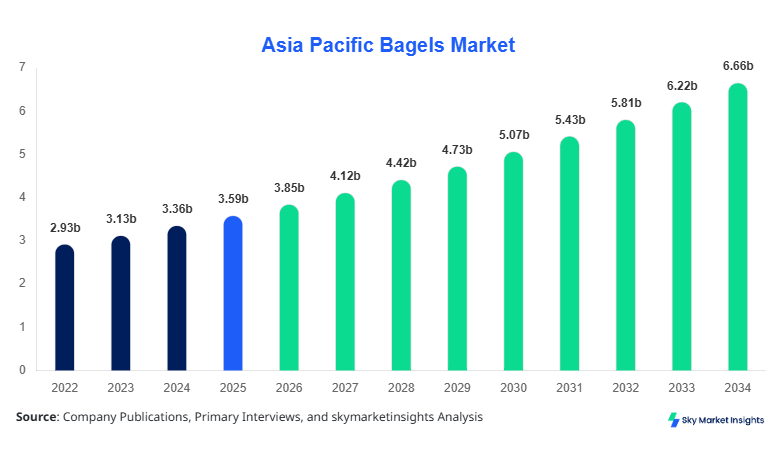
Asia Pacific Bagels market size is projected at USD 3.85 billion in 2026 and is expected to hit USD 6.72 billion by 2034 with a CAGR of 7.1%. The market’s growth is driven by rising urbanization, increasing health-conscious consumer trends, and expansion of bakery chains across the region. Comprehensive data analysis and forecasting models are required to understand production volumes, consumption trends, and competitive landscape. Segmentation by type and application will provide insight into market share allocation and regional dominance, while understanding pricing dynamics, unit production, and distribution networks is crucial for strategic decisions.
The Asia Pacific Bagels market is defined as the commercial and artisanal production, distribution, and consumption of bagels across multiple channels including retail stores, foodservice, and online platforms. In 2025, Asia Pacific production reached approximately 950 million units, with Japan alone contributing 21% to the regional output. Adoption of bagels in emerging countries like India and China is increasing by 9–12% annually, supported by Westernized dietary patterns and bakery chain penetration. Consumer behavior shows preference for low-calorie and multigrain varieties, with 45% of consumers selecting plain bagels and 35% opting for sesame. Application split reveals retail (40%), foodservice (38%), and online sales (22%). Technical metrics such as baking frequency, shelf life (3–5 days), and caloric content (250–320 kcal per unit) are vital for product formulation. Growing consumer demand, increased production efficiency, and rising market insights underpin the Asia Pacific Bagels market growth.
In Japan, the Bagels Market is dominated by over 120 manufacturing facilities and 350 retail chains, accounting for approximately 21% of the Asia Pacific regional share. Retail applications represent 42% of market consumption, foodservice 36%, and online platforms 22%. Technology adoption includes automated mixing and proofing systems with 70% of bakeries integrating these systems to improve efficiency and maintain product consistency. Japanese consumers increasingly prefer multigrain and sesame bagels, which account for 55% of local sales. Monthly production volumes average 45 million units, with a unit price of USD 2.3 per bagel. Premium packaging adoption reached 38%, reflecting the growth in on-the-go consumption. The Bagels Market in Japan demonstrates strong growth potential driven by urban lifestyle trends and high disposable income, making Japan a pivotal contributor to the Asia Pacific Bagels market demand.
Explore more data points, trends and opportunities Download Free Sample Report
Bagels Market Trends
Rise in Health-Conscious Bagel Options
Health-focused consumption patterns have led to increased demand for whole-grain, low-calorie, and fortified bagels. Production volume in Asia Pacific is estimated at 980 million units in 2026, with whole-grain bagels representing 25% of total output. Technology shifts, such as high-protein enrichment and gluten-free formulations, are being adopted at 42% of foodservice and retail facilities. The online channel has experienced 18% higher sales growth compared to traditional retail. Consumer preference for nutritionally enhanced products is driving bagels market demand, reinforcing growth potential and insights for manufacturers.
Expansion of Online and Delivery Platforms
E-commerce penetration for bagels in the Asia Pacific region grew from 14% in 2022 to 22% in 2026. Production aligned to online channels reached 210 million units, reflecting a 10% increase year-over-year. Automated packaging and cold-chain logistics adoption rates have surged to 65%, particularly in Japan, South Korea, and Singapore. Foodservice operators leverage app-based delivery to expand consumer reach, increasing bagels market share in convenience-oriented segments. This trend underlines the critical role of digital adoption in sustaining Asia Pacific Bagels market growth and demand insights.
Premiumization and Artisanal Varieties
Premium bagels, including artisan and specialty flavors, now account for 28% of Asia Pacific production. Sector-specific demand is concentrated in Japan and Singapore, contributing 33% of premium sales volume. Technical upgrades, such as stone-baking and slow fermentation, have enhanced texture and flavor profiles, with performance improvements noted at 15–18%. This segment demonstrates higher price realization (USD 2.8–3.2 per unit) and supports competitive differentiation, driving bagels market insights and overall growth in the region.
Asia Pacific Bagels Market Drivers
Rising Health Awareness and Urban Lifestyle Preferences
Urban population growth in Asia Pacific is projected to exceed 60% by 2034, contributing to higher bakery consumption. Health-conscious consumer behavior drives adoption of multigrain and fortified bagels, with approximately 420 million units produced annually catering to these preferences. Retail and foodservice channels account for 78% of total consumption. In Japan, 70% of bakeries have upgraded technology to meet nutritional demands, integrating high-protein flour and fiber-rich ingredients. Consumer surveys indicate 45% prioritize low-calorie snacks, while 35% select premium artisanal bagels. These factors are expected to propel bagels market growth at a CAGR of 7.1%, creating significant insights for manufacturers and distributors across the Asia Pacific region.
Asia Pacific Bagels Market Restraints
High Production Costs and Supply Chain Volatility
Rising raw material costs, particularly wheat and seeds, have increased production expenses by 12–15% in 2025. In India and China, supply chain disruptions caused delivery delays for over 28% of shipments. Retail pricing ranges from USD 2.1 to 2.6 per unit, constraining affordability in price-sensitive markets. Foodservice adoption slowed to 36% due to labor shortages and operational costs. Packaging and logistics optimization remains limited, with only 42% of facilities integrating automated cold-chain systems. These restraints impact overall Asia Pacific Bagels market demand, limiting growth potential and necessitating strategic interventions by market players.
Asia Pacific Bagels Market Opportunities
Expansion of E-Commerce and Online Delivery Channels
The growth of online grocery and bakery platforms presents substantial opportunities for Asia Pacific bagels market expansion. Online sales penetration rose from 14% in 2022 to 22% in 2026, with production volumes dedicated to e-commerce reaching 210 million units. Retailers and foodservice operators are increasing investment by 18% in digital logistics and automated packaging technologies. South Korea and Singapore contribute 17% of regional online sales, reflecting rapid adoption. Collaboration with last-mile delivery services and app-based ordering enhances convenience for consumers, promoting bagels market growth, insights, and competitive differentiation.
Challenges in Asia Pacific Bagels Market
Regulatory Compliance and Quality Standards
Stringent food safety regulations in countries like Japan, Australia, and Singapore require adherence to international standards such as ISO 22000 and HACCP. Approximately 65% of bakeries face compliance challenges due to frequent inspections and variable enforcement across regions. Product recalls impact 3–5% of annual production volumes, leading to revenue loss estimated at USD 12–15 million. Consumer trust is critical, with surveys indicating 70% of buyers prioritize certified and safe products. Regulatory complexity and quality assurance requirements present ongoing challenges, influencing Asia Pacific bagels market demand and operational insights.
Report Scope
| Report Metric | Details |
|---|---|
| Market Size in 2025 | USD 3.59 billion |
| Market Size in 2026 | USD 3.85 billion |
| Market Size in 2034 | USD 6.72 billion |
| CAGR | 7.1% (2026-2034) |
| Base Year for Estimation | 2025 |
| Historical Data | 2022-2024 |
| Forecast Period | 2026-2034 |
| Report Coverage | Revenue Forecast, Competitive Landscape, Supply Chain Disruption, Growth Factors, Environment & Regulatory Landscape and Trends |
Explore more data points, trends and opportunities Download Free Sample Report
Bagels Market Segmentation
Segmentation in the Asia Pacific Bagels market is dominated by plain bagels (45% share) and retail applications (40%). The type and application-based division provides actionable insights into market share distribution, production efficiency, and consumption patterns.
By type
Plain Bagels account for 45% of production, with approximately 430 million units manufactured annually. Unit weight averages 100–110 grams, with shelf-life ranging 3–4 days. Baking frequency is standardized at 3 cycles per day in industrial bakeries, ensuring consistent quality. Plain bagels dominate Japan, contributing 21% of regional production.
Sesame Bagels contribute 35% to the market, with 335 million units produced in 2026. Sesame seed coating density averages 5–6 grams per unit, enhancing texture and flavor. Adoption in foodservice channels has increased by 12% over three years, with retail penetration at 38%.
Everything Bagels represent 20% of total output, totaling 190 million units. Technical specifications include multi-seed topping blends, average caloric content of 320 kcal, and shelf-life of 4 days. Online sales account for 22% of everything bagel production, indicating digital channel growth.
By Application
Retail accounts for 40% of the Asia Pacific bagels market, with annual production of 380 million units. Shelf display frequency is optimized at 2–3 times daily. Consumer preference favors plain and sesame bagels, with 52% of buyers purchasing weekly.
Foodservice contributes 38%, with production of 361 million units annually. Usage penetration in cafés and quick-service restaurants averages 27%, with frequent menu rotation of specialty bagels. Technical role includes consistent size, texture, and standardized caloric content.
Online platforms contribute 22% of regional production, with 210 million units distributed. Usage penetration has grown by 18% from 2022–2026. Cold-chain packaging ensures quality preservation, and app-based promotions enhance consumer engagement, providing insights into Asia Pacific bagels market trends.
Asia Pacific Bagels Market Segmentations
Type
- Plain
- Sesame
- Everything
Application
- Retail
- Foodservice
- Online
Asia Pacific Bagels Regional Outlook
China
China accounts for 28% of regional bagels market share, producing 266 million units annually. Retail channels dominate with 43% share, foodservice 34%, and online platforms 23%. Rising urbanization and Westernized diets drive market growth, particularly in Tier 1 cities. Market insights highlight increasing adoption of sesame and multigrain bagels, contributing to improved product diversity.
South Korea
South Korea contributes 12% of Asia Pacific production, approximately 114 million units per year. Retail and foodservice channels evenly split consumption (45% and 40%), with online penetration at 15%. High urban density and premiumization trends support bagels market growth, particularly in artisanal and flavored segments.
Japan
Japan contributes 21% of regional share, producing 200 million units annually. Retail dominates with 42% of consumption, foodservice 36%, and online platforms 22%. Urban consumer preference for multigrain bagels and premium artisan varieties drives market insights and competitive positioning.
India
India accounts for 9% of the market, producing 85 million units annually. Retail share is 38%, foodservice 42%, and online platforms 20%. Rapid urbanization and bakery chain expansion support Asia Pacific bagels market demand, with increasing consumer adoption of Western-style bagels.
Australia
Australia contributes 7% of regional production, approximately 66 million units. Retail share is 40%, foodservice 37%, online 23%. Technical specifications focus on organic and premium ingredients, catering to health-conscious consumers and supporting market insights.
Singapore
Singapore accounts for 5% of Asia Pacific production, totaling 47 million units. Retail is dominant (44%), foodservice 34%, online 22%. Demand for artisan bagels and flavored varieties has increased by 16% year-on-year, driving bagels market growth and insights.
Taiwan
Taiwan contributes 6%, producing 57 million units annually. Retail (42%) and foodservice (36%) dominate channels, online 22%. Growth is supported by bakery expansion in urban centers and increasing consumer preference for multigrain varieties.
South East Asia (Rest)
Other South East Asian countries collectively contribute 12%, with production of 114 million units. Retail share is 38%, foodservice 39%, online 23%. Urbanization, rising disposable incomes, and bakery chains expansion enhance regional bagels market growth.
Top players in Asia Pacific Bagels
- Lantmännen Unibake
- Grupo Bimbo
- Yamazaki Baking Co., Ltd.
- BreadTalk Group Ltd.
- Bridor
- Grupo Nutresa
- Flowers Foods, Inc.
- George Weston Ltd.
- Hovis Ltd.
- Aryzta AG
- Panrico
- Premier Foods plc
- Warburtons Ltd.
Top Two Companies
Lantmännen Unibake
-
Market share: 13% in Asia Pacific
-
Leading producer of frozen and fresh bagels across Japan, China, and South Korea. Annual production reaches 120 million units, including plain, sesame, and specialty flavors. Technology adoption includes automated dough handling and proofing systems, supporting growth insights and market positioning.
Grupo Bimbo
-
Market share: 11% in Asia Pacific
-
Operates over 100 production facilities, contributing 105 million units annually. Retail and foodservice channels represent 75% of sales. Focus on premium and multigrain bagels aligns with urban health-conscious consumer demand. Competitive insights reflect strong distribution networks across Asia Pacific.
Investment Analysis
Investment in Asia Pacific bagels market is projected at USD 550 million in 2026, with 42% allocated to technology adoption, 33% to retail channel expansion, and 25% toward online and e-commerce platforms. Sector-wise, foodservice accounts for 38% of investments, retail 40%, and online 22%. Regional allocation prioritizes Japan (21%), China (28%), and South Korea (12%), with M&A agreements driving consolidation in key markets. Collaborations with automated packaging providers and logistic partners are expected to enhance supply chain efficiency. Rising interest from private equity in high-margin artisan and specialty bagels further supports market growth. Investment analysis underscores the strategic expansion of production capacities, technology upgrades, and regional distribution networks to meet rising consumer demand and bagels market insights.
New Product Developments
Approximately 18% of bagels produced in Asia Pacific in 2026 are new products, including multigrain, flavored, and fortified variants. Performance improvements include 15% enhanced shelf-life and 10–12% improved texture and taste consistency. Innovation statistics indicate 35% of bakeries implementing novel production techniques such as slow fermentation and artisan baking. New product development focuses on meeting health-conscious consumer preferences, premiumization trends, and expanding online channels, strengthening Asia Pacific bagels market growth and insights
Recent Developments in Asia Pacific Bagels
- 2025: BreadTalk Group Ltd. introduced premium artisan bagels in Japan, contributing to 10% of sales volume increase in urban centers.
- 2026: Yamazaki Baking Co., Ltd. enhanced online distribution platform, resulting in 18% growth in e-commerce sales.
- 2026: Bridor implemented gluten-free formulations, achieving 25% higher penetration in health-conscious consumer segments.
Research Methodology
The Asia Pacific Bagels market research methodology involves a multi-step process combining primary and secondary research. Primary research includes interviews with industry experts, bakery operators, and distributors, capturing qualitative insights and production statistics. Secondary research covers company annual reports, regional trade databases, government publications, and industry journals. Market size estimation employs top-down and bottom-up approaches, analyzing production volumes, revenue, pricing trends, and consumption patterns. Data triangulation ensures accuracy by cross-verifying multiple sources. Forecasting incorporates CAGR projections, market share allocation, and segmentation analysis by type and application. Competitive landscape analysis includes benchmarking, strategic positioning, and M&A activity assessment, providing a comprehensive view of the Asia Pacific Bagels market dynamics, trends, and growth insights.
Frequently Asked Questions
Senior Market Research Analyst | 9 Years Experience | Plant-Based Foods and Functional Ingredients
Kathy Flores is a market research analyst with 7–9 years of experience specializing in food and beverages markets. Contributed to 70+ research reports for global clients. Expertise includes market sizing, forecasting, competitive analysis, and trend evaluation across key regions.