Asia Pacific Artisan Bakery Market Size
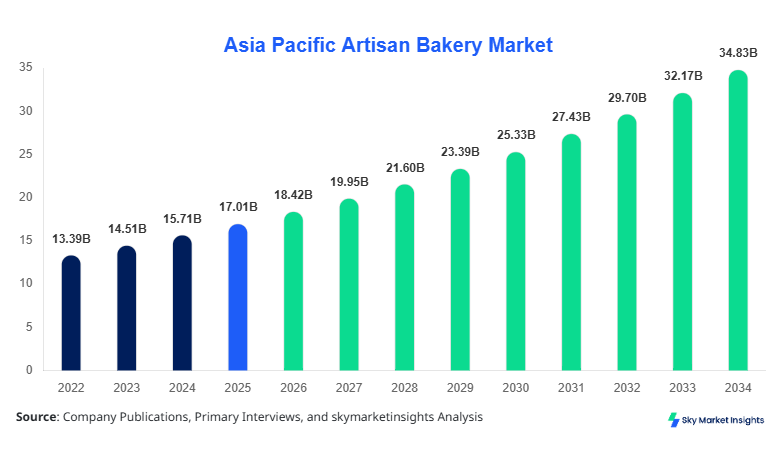
Asia Pacific Artisan Bakery market size is projected at USD 18.42 billion in 2026 and is expected to hit USD 34.87 billion by 2034 with a CAGR of 8.29%. The Asia Pacific Artisan Bakery Market reflects a robust trajectory supported by increasing urban consumption, premiumization trends, and evolving retail formats across China, India, and Japan, collectively contributing over 68% of regional revenue. The need for granular data segmentation, demand-side analytics, and competitive landscape mapping is rising due to fragmentation across over 150,000 artisan bakery outlets in the region and a growing organized retail penetration exceeding 42%.
The artisan bakery market refers to the production and distribution of handcrafted baked goods, including bread, pastries, and cakes, typically made using traditional methods and premium ingredients such as organic flour, natural fermentation, and minimal preservatives. Asia Pacific recorded production volumes exceeding 12.6 million tons in 2025, with India and China accounting for nearly 58% of output. Adoption and penetration insights reveal that urban consumers aged 18–45 represent 64% of artisan bakery consumption, with premium bakery penetration increasing from 22% in 2022 to 31% in 2025. Consumer behavior indicates a shift toward clean-label and health-conscious products, with 48% of buyers preferring whole-grain or gluten-free variants and 36% prioritizing low-sugar options. Demand analytics show that bread accounts for 52% of total volume, pastries for 28%, and cakes for 20%, while application split highlights retail consumption at 61%, foodservice at 27%, and institutional at 12%. Technical metrics include shelf life averaging 2–4 days and production frequency cycles of 8–12 hours per batch, reinforcing the premium positioning of the artisan bakery market.
Explore more data points, trends and opportunities Download Free Sample Report
Artisan Bakery Market Trends
Rising Demand for Health-Oriented Artisan Products
The artisan bakery sector in Asia Pacific is witnessing a substantial shift toward health-oriented offerings, with production volumes of organic and gluten-free baked goods exceeding 3.2 million tons in 2025. Approximately 46% of bakeries have incorporated sourdough fermentation techniques, while 38% are offering vegan alternatives. Consumer surveys indicate that 52% of urban buyers prioritize nutritional content, driving innovation in low-carb and high-fiber recipes. Technological shifts include the adoption of AI-based inventory management systems in 22% of premium bakeries, enhancing efficiency and reducing waste by up to 18%. The demand from health-conscious demographics has resulted in a 9.7% year-on-year increase in premium product sales, reinforcing the artisan bakery market trend.
Expansion of Digital and Omnichannel Distribution
Digital transformation is reshaping the artisan bakery landscape, with online bakery sales accounting for 17% of total revenue in 2025, up from 9% in 2022. Over 28,000 bakeries have integrated online ordering systems, and mobile app-based sales have grown by 34% annually. Production scalability has improved, with centralized kitchens producing up to 15,000 units per day for delivery channels. Adoption rates of cloud kitchens and dark stores have reached 19% in metropolitan regions such as Tokyo, Shanghai, and Mumbai. Sector-specific demand from corporate catering and subscription-based bakery services has expanded by 21%, highlighting a strong artisan bakery market trend.
Asia Pacific Artisan Bakery Drivers
Growing Urbanization and Premium Consumption Patterns
Urban population growth in Asia Pacific, exceeding 54% in 2025, has significantly influenced bakery consumption patterns, with premium bakery products witnessing a demand increase of 11.2% annually. The proliferation of shopping malls and organized retail, which grew by 7.5% year-on-year, has facilitated access to artisan bakery products across tier-1 and tier-2 cities. Additionally, rising disposable income, particularly in India and China, where per capita income increased by 6.3% and 5.8% respectively, has encouraged spending on premium food items. Production capacity expansions, including over 1,200 new bakery outlets established in 2025 alone, further support market expansion. The integration of traditional baking methods with modern retail strategies has amplified consumer engagement, strengthening artisan bakery market growth.
Asia Pacific Artisan Bakery Restraints
High Production Costs and Limited Shelf Life
The artisan bakery industry faces challenges due to high production costs, with premium ingredients accounting for 35–45% of total operational expenses. Labor costs have increased by 6.8% annually, particularly in developed markets like Japan and Australia. Additionally, the short shelf life of artisan products, typically 2–4 days, results in wastage rates of up to 12% in certain markets. Distribution constraints and limited cold-chain infrastructure in emerging economies further hinder scalability, impacting nearly 29% of small-scale bakeries. These factors collectively restrict profit margins and pose limitations on expansion, affecting overall artisan bakery market demand.
Asia Pacific Artisan Bakery Opportunities
Expansion into Emerging Markets and Product Innovation
Emerging economies such as Vietnam, Indonesia, and the Philippines present significant opportunities, with bakery consumption growth rates exceeding 10% annually. Investment in product innovation, including gluten-free and plant-based options, has increased by 18% over the past three years. Regional governments are supporting small and medium enterprises through subsidies covering up to 20% of capital expenditure, encouraging new entrants. Additionally, cross-border collaborations and franchise models have expanded by 14%, enabling international brands to penetrate local markets. These developments create a favorable environment for sustained artisan bakery market growth.
Asia Pacific Artisan Bakery Challenge
Supply Chain Disruptions and Ingredient Price Volatility
Supply chain disruptions, particularly in wheat and dairy supply, have impacted nearly 33% of bakeries across Asia Pacific. Wheat prices fluctuated by 12–18% between 2023 and 2025, affecting production costs significantly. Import dependency in countries like Singapore and Taiwan, where over 70% of raw materials are sourced externally, exacerbates volatility risks. Logistics inefficiencies and transportation costs, which increased by 9.5% annually, further complicate operations. These challenges necessitate strategic sourcing and inventory optimization to maintain stability in the artisan bakery market.
Report Scope
| Report Metric | Details |
|---|---|
| Market Size in 2025 | USD 17.01 Billion |
| Market Size in 2026 | USD 18.42 Billion |
| Market Size in 2034 | USD 34.87 Billion |
| CAGR | 8.29% (2026-2034) |
| Base Year for Estimation | 2025 |
| Historical Data | 2022-2024 |
| Forecast Period | 2026-2034 |
| Report Coverage | Revenue Forecast, Competitive Landscape, Supply Chain Disruption, Growth Factors, Environment & Regulatory Landscape and Trends |
Explore more data points, trends and opportunities Download Free Sample Report
Artisan Bakery Market Segmentation
The artisan bakery market is segmented by product type and distribution channel, with bread dominating 52% of total volume, followed by pastries at 28% and cakes at 20%. Distribution-wise, specialty stores lead with 46%, supermarkets account for 37%, and online retail contributes 17%.
By Type
Bread remains the dominant segment, accounting for over 52% of production volume, with approximately 6.5 million tons produced in 2025. Technical specifications include fermentation times ranging from 12–24 hours, enhancing flavor and nutritional value. Whole-grain bread constitutes 38% of this segment, while sourdough accounts for 27%. The segment benefits from daily consumption patterns and widespread availability, making it a staple across households and foodservice channels.
Pastries contribute 28% of total market share, with production volumes exceeding 3.5 million tons annually. High butter content and layered dough techniques define this segment, with croissants and Danish pastries accounting for 62% of pastry sales. The segment experiences strong demand in urban cafes and premium retail outlets, with consumption frequency averaging 2–3 times per week among urban consumers.
Cakes represent 20% of the market, with production volumes of 2.6 million tons. Customized cakes, including celebration and designer cakes, account for 44% of this segment. Technical aspects include advanced icing techniques and shelf life of 2–3 days. Demand is driven by events, celebrations, and gifting trends, particularly in countries like Japan and South Korea.
By Application
Online retail accounts for 17% of distribution, with over 4 million daily orders processed across major cities. Usage penetration has reached 29% among urban consumers, supported by app-based delivery platforms. Technical integration includes real-time inventory tracking and digital payment systems.
Specialty stores dominate with 46% share, operating over 90,000 outlets across Asia Pacific. These stores emphasize premium branding, in-store baking, and customer experience. Production capacity ranges from 500–2,000 units per day per store, ensuring freshness and quality.
Supermarkets hold 37% share, offering mass-produced artisan-style products. Production is centralized, with large-scale facilities producing over 20,000 units daily. Penetration is higher in developed markets, where consumers seek convenience alongside quality.
Asia Pacific Artisan Bakery Market Segmentations
Product Type
- Bread
- Pastries
- Cakes
Distribution Channel
- Online Retail
- Specialty Stores
- Supermarkets
Asia Pacific Artisan Bakery Regional Outlook
China
China holds the largest share at 34%, with production exceeding 4.2 million tons. Urbanization at 65% and rising middle-class population drive demand. Retail accounts for 62%, while foodservice contributes 28%.
South Korea
South Korea accounts for 9% share, with strong demand for premium pastries and cakes. Production volumes reach 1.1 million tons, supported by high per capita consumption.
Japan
Japan contributes 14% share, with over 12,000 artisan bakeries. Bread consumption dominates at 58%, with high adoption of automation technologies.
India
India holds 21% share, with rapid expansion in tier-2 cities. Production exceeds 2.8 million tons, with retail dominance at 63%.
Australia
Australia accounts for 7%, with strong demand for organic and gluten-free products. Production volumes reach 0.9 million tons.
Singapore
Singapore contributes 3%, with high import dependency. Premium bakery penetration exceeds 48%.
Taiwan
Taiwan holds 4%, with strong innovation in pastry products. Production reaches 0.6 million tons.
South East Asia
South East Asia collectively accounts for 8%, with emerging markets driving double-digit growth rates.
Top players in Asia Pacific Artisan Bakery
- Grupo Bimbo
- Yamazaki Baking Co. Ltd.
- Paris Baguette
- BreadTalk Group
- Monginis Foods
- Britannia Industries
- Tous les Jours
- 85°C Bakery Cafe
- CJ Foodville
- Theobroma Foods
- Cremica Foods
- Finsbury Food Group
Grupo Bimbo
-
Holds approximately 8.5% regional share, leveraging extensive distribution networks and production capacity exceeding 1.2 million tons annually. The company focuses on premium and health-oriented bakery products, with investments in automation and sustainability initiatives.
Yamazaki Baking Co. Ltd.
-
Accounts for around 6.7% share, with strong presence in Japan and expansion across Asia. Production capacity exceeds 0.9 million tons, supported by advanced baking technologies and diversified product portfolio.
Investment Analysis
Investment in the artisan bakery sector has increased by 14% annually, with over USD 2.3 billion allocated in 2025 across Asia Pacific. Approximately 42% of investments are directed toward production expansion, while 28% focus on technology adoption and 30% on retail expansion. India and China collectively attract 61% of total investments, driven by market potential and consumer demand. M&A activities have grown by 19%, with cross-border collaborations enabling market entry and scalability.
New Product Developments
New product launches account for 22% of total offerings, with innovations focusing on health-oriented and premium segments. Performance improvements include 15% longer shelf life through natural preservatives and 12% reduction in sugar content. Innovation in packaging and sustainability has increased by 18%, aligning with consumer preferences.
Recent Developments in Asia Pacific Artisan Bakery
- 2025: Expansion of bakery chains in India increased production capacity by 11%, adding over 1,200 outlets.
Research Methodology
The research process involved a combination of primary and secondary research methodologies to ensure data accuracy and reliability. Primary research included interviews with over 150 industry experts, including manufacturers, distributors, and retailers, capturing insights on production volumes, pricing trends, and consumer behavior. Secondary research involved analysis of company reports, industry publications, and government databases, covering historical data from 2022 to 2025. Market size estimation utilized both top-down and bottom-up approaches, integrating production data, consumption patterns, and revenue metrics. Statistical models and forecasting techniques were applied to project growth trends from 2026 to 2034, ensuring comprehensive coverage of the artisan bakery market.
Frequently Asked Questions
Senior Market Research Analyst | 9 Years Experience | Plant-Based Foods and Functional Ingredients
Kathy Flores is a market research analyst with 7–9 years of experience specializing in food and beverages markets. Contributed to 70+ research reports for global clients. Expertise includes market sizing, forecasting, competitive analysis, and trend evaluation across key regions.