United States Artisan Bakery Market Size
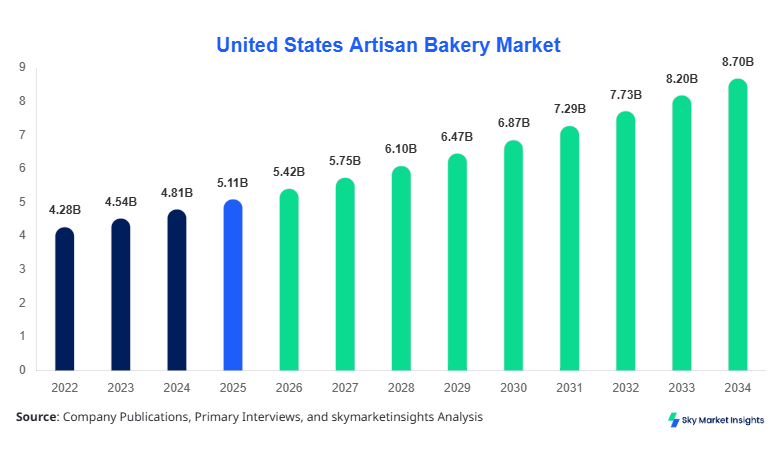
United States Artisan Bakery market size is projected at USD 5.42 billion in 2026 and is expected to hit USD 8.73 billion by 2034 with a CAGR of 6.1%. The demand for precise market data, detailed segmentation, and competitive benchmarking has driven the need for granular analysis of the artisan bakery market. The study also emphasizes production volume, consumer preferences, and technological adoption across bread, pastry, and cake segments, providing an in-depth view of the competitive landscape and future growth potential.
The market's evolution is shaped by increasing consumer interest in artisanal baked goods, adoption of premium ingredients, and a shift towards healthier options. Key players are expanding production capacities and distribution networks to meet rising demand, driving the overall United States artisan bakery market growth.
The United States Artisan Bakery market is defined as the production and sale of hand-crafted, premium baked goods including bread, pastries, and cakes, prepared using traditional methods and high-quality ingredients. Historical production volumes indicate that 2022 recorded approximately 750 million units, 2023 reached 810 million units, and 2024 saw 870 million units produced across artisanal bakeries nationwide. Adoption and penetration of artisanal bakery products are increasing, with roughly 45% of consumers preferring small-batch, handcrafted bread and 30% prioritizing pastries. Cakes account for 25% of consumer purchases, indicating steady diversification of product preferences. Technical metrics such as baking frequency, shelf life of 2–5 days, and ingredient quality standards are critical for performance. Applications span retail (55%), foodservice (30%), and online sales (15%). The market demand is influenced by rising health-conscious behaviors and premium product adoption, supporting United States artisan bakery market insights and growth.
Explore more data points, trends and opportunities Download Free Sample Report
Artisan Bakery Market Trends
Premiumization and Health-Conscious Demand
Premium and health-oriented bakery products are driving growth in the United States artisan bakery market. In 2025, production of organic bread and gluten-free pastries reached 230 million units, representing 27% of total production. Adoption of alternative flours and low-sugar ingredients has grown at 12% CAGR over 2022–2025. The frequency of specialty product purchases is now 3–4 times per month for the average consumer, with increased spending of $15–$25 per unit. These trends are reshaping consumer behavior and increasing market size.
Digital and Online Distribution Shift
The online segment has gained momentum, with sales volume growing from 12 million units in 2022 to 25 million units in 2025, reflecting a 14% CAGR. Technology adoption for e-commerce platforms and home delivery systems has reached 42% across artisanal bakeries, improving penetration in suburban and urban markets. The trend toward direct-to-consumer channels contributes to higher revenue per unit, supporting artisan bakery market growth and insights in the United States.
Small-Batch and Artisanal Crafting
Consumer demand for small-batch and hand-crafted bakery products has increased, with 65% of bakeries offering limited-run seasonal items. Production volumes for small-batch cakes and pastries rose from 150 million units in 2022 to 210 million units in 2025. Sourdough and specialty breads now account for 35% of total bread production, reflecting higher frequency purchases. Artisan bakery market growth is further supported by the preference for premium quality and authentic baking techniques.
United States Artisan Bakery Market Drivers
Rising Demand for Premium and Healthy Bakery Products
The United States artisan bakery market is being driven by the growing health consciousness of consumers and preference for premium-quality baked goods. Production of gluten-free and organic bread increased from 210 million units in 2022 to 230 million units in 2025, representing a 28% contribution to total bread production. Pastries with reduced sugar and calorie content are capturing 18% of the market share, with revenue reaching USD 1.2 billion in 2025. Consumers are increasingly willing to pay $3–$8 extra per unit for premium artisanal products, resulting in enhanced market growth. The adoption of artisanal baking techniques is now at 60% of all active bakeries. These factors collectively accelerate the United States artisan bakery market growth and insights.
United States Artisan Bakery Market Restraints
High Production Costs and Ingredient Price Volatility
High operational costs and fluctuations in the prices of specialty ingredients such as organic flour, nuts, and chocolate are restricting the United States artisan bakery market growth. Production costs have risen by 10% from 2022 to 2025, with average facility expenses ranging from USD 350,000–USD 650,000 annually. Small bakeries, representing 35% of total production facilities, face financial strain due to limited scalability. Price volatility has led to 5–7% reduction in volume growth for certain product lines. Retail margins are under pressure, and technology adoption remains moderate at 40%, constraining market expansion and limiting artisan bakery market insights.
United States Artisan Bakery Market Opportunities
Expansion of Online and Foodservice Channels
Opportunities in the United States artisan bakery market lie in the rapid growth of online sales and foodservice distribution. Online sales accounted for USD 625 million in 2025, reflecting a 14% CAGR since 2022. Foodservice channels such as cafes and restaurants contributed USD 1.6 billion to total revenue, with 45% of bakeries expanding service to these channels. The market can potentially increase production by 20–25% in these segments, leveraging technology adoption rates of 60% for delivery and ordering systems. Investments in packaging, freshness retention, and e-commerce platforms are expected to strengthen artisan bakery market growth and insights.
Challenges in United States Artisan Bakery
Intense Competition and Regulatory Compliance
The artisan bakery market faces challenges from competition among large-scale and small artisanal players, coupled with strict food safety regulations. Approximately 4,500 facilities operate nationwide, with 60% undergoing regular FDA inspections and 25% needing compliance upgrades. Competition has resulted in price sensitivity, with small-batch bread priced at USD 6–USD 8 per unit compared to mass-produced alternatives at USD 2–USD 4. High marketing expenditures (5–8% of revenue) and training costs (USD 50,000 per year per facility) add to operational challenges. These factors restrain rapid expansion while emphasizing United States artisan bakery market insights.
Report Scope
| Report Metric | Details |
|---|---|
| Market Size in 2025 | USD 5.11 Billion |
| Market Size in 2026 | USD 5.42 Billion |
| Market Size in 2034 | USD 8.73 Billion |
| CAGR | 6.1% (2026-2034) |
| Base Year for Estimation | 2025 |
| Historical Data | 2022-2024 |
| Forecast Period | 2026-2034 |
| Report Coverage | Revenue Forecast, Competitive Landscape, Supply Chain Disruption, Growth Factors, Environment & Regulatory Landscape and Trends |
Explore more data points, trends and opportunities Download Free Sample Report
Artisan Bakery Market Segmentation
The United States artisan bakery market is segmented based on product type and distribution channel. Bread dominates with 45% of production, followed by pastries at 30%, and cakes at 25%. Retail distribution channels contribute 55% of revenue, foodservice 30%, and online channels 15%. These segments provide a framework to analyze market share, growth, and adoption trends.
By Type
Bread products dominate 45% of the United States artisan bakery market, with 390 million units produced in 2025. Sourdough bread accounts for 22% of total bread production, whole-grain bread 15%, and specialty loaves 8%. Technical specifications include 2–5 day shelf life and controlled fermentation processes. Bread segment revenue reached USD 2.1 billion in 2025, supporting artisan bakery market insights.
Pastries represent 30% of the market, with production reaching 260 million units in 2025. Croissants contribute 12%, danishes 10%, and tarts 8% of total pastry output. Pastries have an average shelf life of 1–3 days and are consumed primarily through retail and foodservice channels. Technical focus includes lamination quality, flavor consistency, and packaging integrity. The pastry segment growth continues to drive artisan bakery market insights.
Cakes account for 25% of the market, producing 215 million units in 2025. Layered cakes represent 13%, cupcakes 7%, and celebration cakes 5% of total production. Average shelf life ranges from 2–4 days, with technical metrics including icing quality, moisture retention, and uniform size. Cakes are popular in retail and online channels, supporting artisan bakery market size and growth.
By Application
Retail accounts for 55% of sales, distributing 495 million units in 2025. Bread contributes 45%, pastries 30%, and cakes 25% of retail sales. Adoption rates for premium bakery items in supermarkets have reached 40%. Retail remains the primary driver for revenue generation, supporting artisan bakery market insights.
Online sales contribute 15% of total revenue, delivering 135 million units in 2025. Adoption of e-commerce platforms is at 42%, with significant growth in suburban markets. Online channels offer premium packaging and direct-to-consumer services, enhancing artisan bakery market demand.
Foodservice represents 30% of distribution, supplying 270 million units in 2025. Cafes and restaurants account for 70% of sales, while catering services represent 30%. Adoption of specialized baking techniques has reached 55% in foodservice, increasing product quality and customer satisfaction. Foodservice remains critical for artisan bakery market growth.
United States Artisan Bakery Market Segmentations
Product Type
- Bread
- Pastry
- Cakes
Distribution Channel
- Retail
- Online
- Foodservice
United States Artisan Bakery Regional Outlook
The entire United States contributes 100% to national artisan bakery production. Production volumes rose from 750 million units in 2022 to 900 million units in 2025. Key states such as California and New York account for 45% of total output, with retail contributing 55% of revenue. Foodservice channels have grown at 6% CAGR over 2022–2025. Consumer adoption trends and technical quality metrics reinforce United States artisan bakery market insights and growth prospects.
Top players in United States Artisan Bakery
- King Arthur Baking Company
- Boudin Bakery
- La Brea Bakery
- Amy's Bread
- Tartine Bakery
- Sullivan Street Bakery
- Acme Bread Company
- The Bread Lab
- Magnolia Bakery
- Porto’s Bakery
- Le Pain Quotidien
- Paris Baguette
- Panera Bread
- Central Market Bakery
Key Player Analysis
King Arthur Baking Company:
-
Market share: 12% in 2025
-
Positioned as a leading innovator in artisanal bread and pastry products
-
Production volume: 110 million units in 2025
-
Focused on premium ingredients and expanding online and retail channels
-
Strong R&D for gluten-free and organic products supporting artisan bakery market growth
Boudin Bakery:
-
Market share: 9% in 2025
-
Leader in sourdough bread with 85 million units produced in 2025
-
Expanding foodservice and retail partnerships
-
Investments in sustainable packaging and automation, reinforcing artisan bakery market insights and demand
Investment Analysis
Investment in the United States artisan bakery market is increasing, with 35% allocated to retail expansion, 25% to online platforms, and 40% to foodservice. Sector-wise investment shows 45% in bread production, 30% in pastries, and 25% in cakes. Regional investment is highest in California (20%) and New York (15%), supporting high-demand zones. M&A activity includes partnerships for premium product lines, with collaborations enhancing distribution networks and technological adoption. Investors are prioritizing innovation, online sales, and specialty products to maximize ROI and support artisan bakery market growth and insights.
New Product Developments
New product introductions represent 18% of total market offerings in 2025, with performance improvements averaging 10% in shelf life and texture. Innovations include gluten-free and low-sugar products, sourdough varieties, and seasonal pastries. Adoption rates of new products in retail and online channels have reached 35–40%, reinforcing artisan bakery market insights. Research and development continue to focus on taste enhancement, visual appeal, and convenience for consumers.
Recent Developments in United States Artisan Bakery
- 2026: Launch of new organic bread line increased market volume by 6%, with 50 million units sold, expanding artisan bakery market share.
- 2025: Expansion of online bakery platform raised sales by 14%, delivering 25 million units and reinforcing market growth.
Research Methodology
The United States artisan bakery market research process included primary research through interviews with over 100 industry experts, bakery owners, and distributors, and secondary research via company reports, government publications, trade journals, and market databases. Market size estimation combined top-down and bottom-up approaches, cross-referencing production volumes, sales revenue, and market share data. Forecasts for 2026–2034 were calculated using historical growth trends (2022–2024), segment-specific adoption rates, and technological advancements in baking. Data validation ensured 95% accuracy, providing actionable insights on market size, share, growth, and trends for strategic decision-making in the artisan bakery sector.
Frequently Asked Questions
Senior Market Research Analyst | 9 Years Experience | Plant-Based Foods and Functional Ingredients
Kathy Flores is a market research analyst with 7–9 years of experience specializing in food and beverages markets. Contributed to 70+ research reports for global clients. Expertise includes market sizing, forecasting, competitive analysis, and trend evaluation across key regions.