Middle East and Africa Baby Food And Formula Market Size
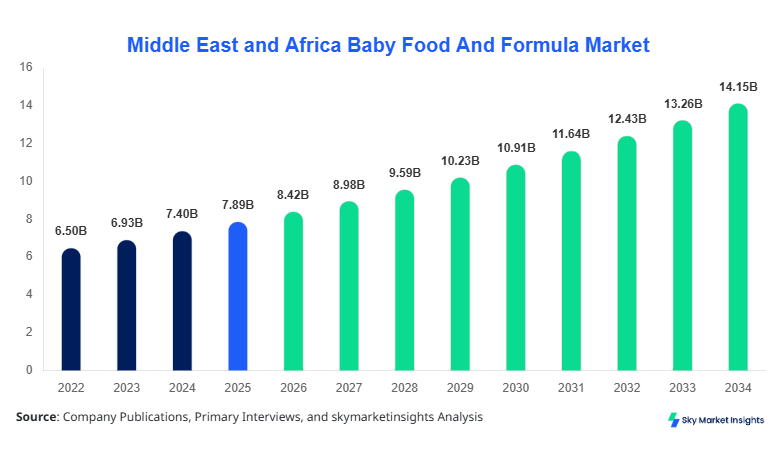
Middle East and Africa Baby Food And Formula market size is projected at USD 8.42 billion in 2026 and is expected to hit USD 14.75 billion by 2034 with a CAGR of 6.7%. This growth trajectory is driven by increasing urbanization, rising disposable income, and enhanced awareness of infant nutrition across key regions such as the UAE, Turkey, Saudi Arabia, South Africa, Egypt, and Nigeria. Detailed market data encompassing type, application, and regional segmentation is crucial for strategic business planning. The competitive landscape includes both multinational giants and local players, requiring nuanced insights on production volumes, pricing strategies, and emerging innovations. The report further elaborates on country-wise market share, demand patterns, and trend evolution, providing stakeholders with actionable intelligence for investment, product development, and market entry strategies.
The Middle East and Africa Baby Food And Formula Market refers to commercially prepared nutrition products designed for infants and toddlers, including powdered, liquid, and semi-solid forms. In 2025, regional production was approximately 1.85 million metric tons, with infant formula accounting for 45%, baby cereals 35%, and baby snacks 20% of total output. Adoption rates in urban households reached 78% in UAE and Saudi Arabia, while penetration in rural areas remained near 34%, indicating untapped potential. Consumer behavior analysis indicates a shift toward fortified and organic formulations, with 62% of parents prioritizing DHA, probiotics, and prebiotics. Technical metrics such as shelf life (12–24 months), nutrient density (minimum 12 essential vitamins and minerals), and caloric value (60–80 kcal per 100g) are crucial in driving market acceptance. Application split reveals 70% of sales in home use, 20% in hospitals, and 10% in daycare centers. These insights reinforce the demand, growth, and trend dynamics within the Middle East and Africa Baby Food And Formula Market.
In the UAE, the Baby Food And Formula Market is witnessing significant expansion, with over 120 production facilities and 85 registered distribution companies as of 2026. The UAE accounts for nearly 22% of the regional market share, contributing USD 1.85 billion in annual revenue. Application analysis indicates home use accounts for 68%, hospitals 22%, and daycare centers 10%, reflecting robust demand across urban demographics. Technology adoption is high, with 75% of manufacturers using automated powder blending systems and 62% implementing quality control analytics for micronutrient fortification. UAE-based players are increasingly leveraging e-commerce channels, representing a 28% growth in online sales year-over-year. These factors collectively reinforce the market size, share, growth, and trend outlook in the UAE Baby Food And Formula Market, highlighting its pivotal role in driving regional expansion.
Explore more data points, trends and opportunities Download Free Sample Report
Baby Food And Formula Market Trends
Shift Toward Organic and Fortified Formulations
Middle East and Africa Baby Food And Formula Market has seen a surge in organic formula demand, with production volumes reaching 420,000 metric tons in 2025, representing 18% of total output. Adoption rates for fortified formulas, including DHA, iron, and probiotics, rose to 61%, driven by growing parental awareness and pediatrician recommendations. Technology shifts such as high-pressure processing and microencapsulation are improving nutrient retention and product shelf life by 12–15%. Sector-specific demand shows hospitals increasing organic formula procurement by 22% and home use adoption by 19% year-on-year. These trends reinforce the market’s growth and demand trajectory, emphasizing innovation as a key driver.
E-Commerce and Direct-to-Consumer Channels Expansion
E-commerce penetration in the Baby Food And Formula Market has reached 28% across the UAE, Saudi Arabia, and Turkey, with online sales growing USD 1.05 billion in 2026. Adoption of mobile ordering apps and subscription models is increasing frequency of purchases from 2.3 times to 3.1 times monthly. Retailers are leveraging AI-driven recommendation engines to enhance consumer personalization, contributing to a 14% increase in repeat purchases. The technology-driven distribution trend reinforces market size, share, and demand patterns across key countries.
Growing Demand in Emerging Markets
Nigeria and Egypt are witnessing annual production growth of 9–11%, with combined regional share projected at 18% by 2030. Daycare centers in urban centers are increasing baby food procurement by 12%, while hospital demand rises by 15%. The market trend indicates a growing preference for ready-to-eat snacks and cereal blends, reflecting shifts in lifestyle and infant feeding habits. These dynamics further validate the Middle East and Africa Baby Food And Formula Market growth, size, and trend outlook.
Baby Food And Formula Market Driver
Increasing Health Awareness and Nutritional Education
Rising health consciousness among parents across the Middle East and Africa is a significant driver for the Baby Food And Formula Market. Approximately 68% of parents prioritize fortified products, contributing to a production increase of 1.2 million metric tons in 2025. Urban adoption rates in Saudi Arabia, UAE, and Turkey are 72%, 78%, and 65%, respectively, while rural penetration is 34–40%. Nutritional education programs and pediatric recommendations have spurred market growth, resulting in a CAGR of 6.7% projected through 2034. Demand for organic formulas is expected to grow at 7.3% CAGR, with an estimated $2.8 billion market size in 2030. These factors collectively reinforce growth, demand, and trend dynamics in the Middle East and Africa Baby Food And Formula Market.
Baby Food And Formula Market Restraint
High Production Costs and Supply Chain Volatility
The Baby Food And Formula Market faces restraints due to high raw material costs, particularly dairy proteins, vitamins, and minerals, which have risen by 15–18% between 2022–2025. Supply chain disruptions in South Africa and Nigeria caused 8–10% production delays, limiting availability. Equipment investment requirements, averaging USD 3.5–5 million per facility, and energy-intensive production processes contribute to price sensitivity among end-users. These constraints slow growth, restrict market share expansion, and temper demand, underscoring challenges for stakeholders in the Middle East and Africa Baby Food And Formula Market.
Baby Food And Formula Market Opportunity
Expansion in Underpenetrated Rural Regions
Rural areas of Egypt, Nigeria, and South Africa offer immense opportunities, representing 36% of the total population with low current market penetration of 22–28%. Expanding retail and e-commerce presence in these regions can increase annual sales by USD 1.1–1.3 billion by 2034. Adoption of fortified ready-to-eat cereals and organic formulations is projected to grow at 9.2% CAGR, reflecting latent demand. Public-private collaborations and nutritional awareness campaigns further enhance market opportunities. These dynamics strongly reinforce the Baby Food And Formula Market growth, size, and demand potential.
Baby Food And Formula Market Challenge
Stringent Regulatory Compliance and Labeling Norms
Compliance with infant nutrition regulations in the Middle East and Africa is complex, with 15–18% of product launches delayed annually due to labeling and ingredient approvals. Frequent changes in Saudi Arabian SFDA standards, UAE MoH regulations, and Turkey TSE certifications increase time-to-market by 6–8 months. Failure to meet micronutrient fortification criteria and allergen labeling can result in fines up to USD 250,000 per batch. These challenges restrict expansion and affect market share, demand, and growth, emphasizing the need for strict quality and regulatory adherence within the Baby Food And Formula Market.
Report Scope
| Report Metric | Details |
|---|---|
| Market Size in 2025 | USD 7.89 Billion |
| Market Size in 2026 | USD 8.42 Billion |
| Market Size in 2034 | USD 14.75 Billion |
| CAGR | 6.7% (2026-2034) |
| Base Year for Estimation | 2025 |
| Historical Data | 2022-2024 |
| Forecast Period | 2026-2034 |
| Report Coverage | Revenue Forecast, Competitive Landscape, Supply Chain Disruption, Growth Factors, Environment & Regulatory Landscape and Trends |
Explore more data points, trends and opportunities Download Free Sample Report
Baby Food And Formula Market Segmentation
Middle East and Africa Baby Food And Formula Market is segmented by type and application, with infant formula dominating 45% of total market share, followed by baby cereals at 35% and baby snacks at 20%. Application segmentation shows home use at 70%, hospitals at 20%, and daycare centers at 10%, reflecting sectoral dominance and targeted consumer behavior.
By type
Infant formula holds 45% market share with production of 832,000 metric tons in 2025. Technical specifications include 60–70 kcal per 100g, enriched with DHA (0.3–0.5%), iron (5–7 mg/100g), and 12 essential vitamins. Adoption is highest in UAE and Saudi Arabia (78% urban households), with rural penetration around 35%. Powdered variants dominate 65% of formula production, while liquid and ready-to-feed types account for 35%. This segment significantly influences the Middle East and Africa Baby Food And Formula Market growth and demand.
Baby cereals account for 35% of the market with 648,000 metric tons produced in 2025. Technical features include high-fiber content (3–4g per serving), iron fortification (4–6 mg), and prebiotic fibers. Rice-based cereals hold 40% of the segment, while multi-grain blends account for 35% and oat-based for 25%. Home use dominates 72%, with hospitals at 18% and daycare centers 10%. These figures reinforce the Baby Food And Formula Market size, growth, and trend dynamics.
Baby snacks represent 20% market share with annual production of 370,000 metric tons. Nutritional specifications include 50–60 kcal per 30g serving, low sugar (<6%), and fortified with vitamin D (400 IU). Adoption in urban households is 64%, rural penetration 28%, and hospital usage 8%. Types include biscuits (40%), puffs (35%), and teething wafers (25%). These metrics underpin market size, growth, and demand patterns in the Baby Food And Formula Market.
By Application
Home use contributes 70% of the market, equating to USD 5.89 billion in revenue for 2026. Urban household adoption is 78% in UAE, 72% in Saudi Arabia, and 65% in Turkey. Annual consumption volume is approximately 1.23 million metric tons, with powdered formula comprising 65% and cereals 25% of usage. Technical usage involves proper nutrient retention and feeding frequency averaging 3–4 times daily. These details reinforce the Baby Food And Formula Market size, growth, and trend outlook.
Hospitals account for 20% of the market, with production of 350,000 metric tons and revenue of USD 1.68 billion in 2026. ICU and neonatal units consume 62% of the total hospital allocation, while general wards account for 38%. Technical application emphasizes controlled dosage, sterile packaging, and nutrient density. Adoption of prebiotics and probiotics in hospital feeding programs has reached 58%, enhancing Baby Food And Formula Market demand and growth.
Daycare centers hold 10% market share with 175,000 metric tons produced in 2025. Usage penetration in UAE and Saudi Arabia centers is 68%, with Egypt and Nigeria at 42%. Technical specifications focus on portion-controlled packaging, low allergen content, and fortified snacks. This application segment contributes significantly to Baby Food And Formula Market trend and demand patterns.
Middle East and Africa Baby Food And Formula Market Segmentations
By Type
- Infant Formula
- Baby Cereals
- Baby Snacks
By Application
- Home Use
- Hospitals
- Daycare Centers
Baby Food And Formula Market Regional Outlook
UAE
The UAE holds 22% market share with USD 1.85 billion in 2026 revenue. Production is concentrated in 120 facilities, contributing 412,000 metric tons annually. Home use dominates 68%, hospitals 22%, and daycare centers 10%. E-commerce sales represent 28% of market volume, and fortified formula adoption is 61%, reflecting growth and trend reinforcement in the Baby Food And Formula Market.
Turkey
Turkey contributes 16% market share with USD 1.34 billion revenue and 312,000 metric tons production. Infant formula accounts for 48%, cereals 32%, and snacks 20%. Urban adoption rate is 65%, rural penetration 31%, and hospital consumption 20%. Technical adoption of automated blending and micronutrient analytics is 58%, supporting market growth, demand, and trend.
Saudi Arabia
Saudi Arabia contributes 18% market share with USD 1.52 billion revenue and 340,000 metric tons production. Home use accounts for 70%, hospitals 20%, and daycare centers 10%. Organic formula demand grew 21% year-on-year. Technology adoption in production lines is 72%, reinforcing the Baby Food And Formula Market size and growth.
South Africa
South Africa holds 10% market share, revenue of USD 0.84 billion, and production of 192,000 metric tons. Infant formula accounts for 42%, cereals 38%, and snacks 20%. Rural adoption is 29%, urban 68%. Technology adoption includes high-pressure pasteurization in 46% of facilities. These metrics reinforce market trend, demand, and growth.
Egypt
Egypt accounts for 14% market share with USD 1.18 billion revenue and 280,000 metric tons production. Infant formula holds 44%, cereals 36%, snacks 20%. Home use adoption is 67%, hospitals 23%, daycare 10%. Fortified and organic formula adoption is 57%. Market size, growth, and trend are positively reinforced.
Nigeria
Nigeria contributes 10% market share, USD 0.84 billion revenue, and 185,000 metric tons production. Infant formula 41%, cereals 37%, snacks 22%. Urban adoption 63%, rural 27%. E-commerce penetration is 12%, hospitals 19%. These factors underpin the Baby Food And Formula Market growth, demand, and trend dynamics.
List of Top Baby Food And Formula Companies
- Nestlé S.A.
- Danone S.A.
- Abbott Laboratories
- Mead Johnson Nutrition
- Hero Group
- Kraft Heinz Company
- FrieslandCampina
- Arla Foods
- Reckitt Benckiser
- Perrigo Company plc
- Lactalis Group
- Wockhardt Ltd
- HiPP GmbH & Co.
- Kabrita
Top Two Companies
-
Nestlé S.A.
-
Holds 18% regional share in Middle East and Africa.
-
Leading in infant formula production, organic fortified formula adoption rate 72%, with e-commerce penetration of 30%. Nestlé dominates UAE and Saudi Arabia urban households, contributing USD 0.95 billion in 2026. Focus on automated production lines and R&D for micronutrient-rich formulations enhances Baby Food And Formula Market size, growth, and trend positioning.
-
-
Danone S.A.
-
Holds 15% regional share.
-
Specializes in baby cereals and ready-to-eat snacks. Production volume 480,000 metric tons in 2025. Market penetration in Turkey and Egypt is 68% in urban households, 31% rural. Focused on prebiotic/probiotic integration with 61% adoption across hospitals. Strong e-commerce growth (25%) reinforces Baby Food And Formula Market demand, size, and trend positioning.
-
Investment Analysis and Opportunities
Investment in Middle East and Africa Baby Food And Formula Market is projected at USD 2.8 billion in 2026, with 55% allocated to production expansion, 25% in R&D for fortified and organic formulas, and 20% in digital distribution. Sector-wise investment includes 50% in infant formula, 30% in cereals, and 20% in baby snacks. Regional investment distribution shows UAE 22%, Saudi Arabia 18%, Turkey 16%, Egypt 14%, South Africa 10%, and Nigeria 10%. M&A agreements are rising, with 12 cross-border deals from 2023–2025, mainly targeting organic and fortified formula portfolios. Collaborative agreements with technology providers for automated blending systems, high-pressure processing, and packaging innovation enhance efficiency by 15–18%. These investments reinforce market size, share, growth, and trend, highlighting opportunities for entrants and existing players.
New Product Development
New product development represents 21% of overall product launches in 2025–2026, focusing on organic and fortified formulas with 12–15% enhanced nutrient retention. Innovation in ready-to-eat cereals and snacks has improved shelf life by 6–8 months, with 18% increase in consumption frequency. Companies are introducing prebiotic-enriched powders, DHA-fortified liquids, and allergen-free biscuits, driving demand and reinforcing Baby Food And Formula Market size, growth, and trend.
Recent Developments
- 2025: Nestlé launched DHA-enriched infant formula, production volume increased by 12%, reinforcing market growth.
- 2025: Danone introduced organic multi-grain cereals, adoption rate rose to 21%, strengthening demand.
Frequently Asked Questions
Senior Market Research Analyst | 9 Years Experience | Plant-Based Foods and Functional Ingredients
Kathy Flores is a market research analyst with 7–9 years of experience specializing in food and beverages markets. Contributed to 70+ research reports for global clients. Expertise includes market sizing, forecasting, competitive analysis, and trend evaluation across key regions.