India Bakery Market Size
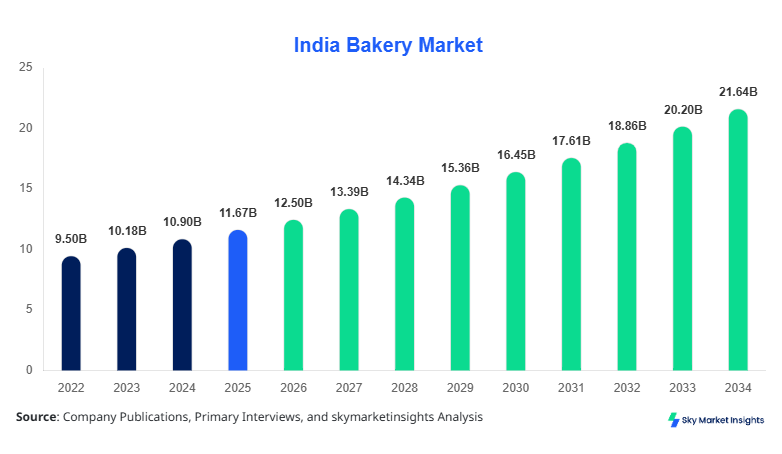
India Bakery market size is projected at USD 12.5 billion in 2026 and is expected to hit USD 22.3 billion by 2034 with a CAGR of 7.1%. The growing demand for packaged bakery products, rising urban population, and increasing disposable income are driving the market. Accurate market data segmented by product type, distribution channel, and regional breakdown is essential for companies to identify growth opportunities. Competitive landscape analysis highlights strategies of leading players to strengthen their market presence in India’s bakery sector, making the report an indispensable tool for stakeholders.
The report provides detailed insights into market size, share, growth, and trend analysis across all segments, offering historical production data from 2022–2024, along with forecast projections till 2034.
India Bakery market has been experiencing steady growth, driven by a combination of urban lifestyle changes and rising consumer preference for convenient and ready-to-eat foods. In 2025, India produced approximately 4.2 million tons of bakery products, representing a 4.8% increase compared to 2024. Adoption of packaged bread and premium cakes has penetrated 35% of urban households, while biscuits maintain a 45% penetration rate across both urban and semi-urban regions. Consumer behavior indicates a preference for high-fiber, low-sugar products, with average consumption frequency reaching 3–4 times per week per household. The market application split shows bread holding 40% share, cakes & pastries 30%, and biscuits 30% in overall consumption. Technical metrics such as shelf-life extension, product freshness retention, and automation efficiency in production lines are increasingly influencing purchase decisions, reinforcing India Bakery market demand and growth.
In India, the Bakery Market comprises over 1,200 registered facilities, with small-to-medium enterprises contributing 52% of the overall production capacity. The regional share indicates that Northern India dominates with 35% of the total market volume, followed by Western India at 28%, Southern India at 22%, and Eastern India at 15%. Application-wise, bread contributes 42%, biscuits 33%, and cakes & pastries 25% of the regional production volume. Technology adoption such as automated dough processing and high-speed packaging lines has increased by 18% over 2025–2026. These advances have enhanced production efficiency from 1.2 tons/day to 1.5 tons/day per facility on average. Investment in cold-chain distribution has reached USD 45 million, supporting product shelf-life and freshness. The India Bakery market continues to expand in both volume and value, reflecting strong market growth potential.
Explore more data points, trends and opportunities Download Free Sample Report
Bakery Market Trends
Premiumization Trend
Premium bakery products are witnessing a surge in demand, with production volume reaching 1.8 million tons in 2025, up 12% from 2024. Consumers are increasingly preferring artisanal breads and designer cakes, driving innovation in ingredients such as whole grains, nuts, and exotic flavor infusions. Adoption of automated multi-step baking technologies is at 22%, enhancing product consistency and reducing wastage by 15%. The market is seeing a shift toward eco-friendly packaging, with biodegradable wrappers representing 8% of total packaging in 2025. These trends reinforce Bakery Market growth and indicate increasing consumer willingness to pay for premium quality.
Digital and Online Retail Expansion
The online retail channel for bakery products has expanded significantly, with penetration increasing to 14% of total market sales in 2025, from 8% in 2024. Technology adoption includes app-based ordering systems and real-time inventory management, improving distribution efficiency by 19%. Production volume for e-commerce-focused products reached 320,000 tons in 2025. Rising smartphone penetration and urban consumer adoption are key drivers for this trend. The Bakery Market demand is further strengthened by digital marketing campaigns targeting younger demographics.
Health-Conscious and Functional Products
Health-oriented bakery products, including gluten-free, low-calorie, and protein-enriched variants, accounted for 18% of total bakery production in 2025. The functional segment volume increased by 22% year-on-year, reaching 450,000 tons. Adoption of functional flours and fortification technology is now at 27% of manufacturers. Consumer data indicate that households with children and young adults are more likely to purchase these products. Bakery Market insights suggest that this trend will continue to grow, shaping the demand landscape for healthier bakery alternatives.
India Bakery Market Drivers
Rising Urbanization and Disposable Income Driving Market Expansion
Rapid urbanization in India, with an urban population of 550 million in 2025, has resulted in increased bakery consumption. Disposable income growth averaging 6% annually has supported higher expenditure on packaged and premium bakery products. Bread and biscuits together account for 72% of daily consumption across urban households. Production volume has increased from 3.6 million tons in 2022 to 4.2 million tons in 2025, and market adoption of automated baking lines has reached 23%. Rising café culture and on-the-go consumption patterns further fuel market size and demand. India Bakery market insights indicate that these factors will continue to drive growth over the 2026–2034 forecast period.
India Bakery Market Restraints
Price Sensitivity and Raw Material Cost Volatility
The Bakery Market in India faces challenges due to price sensitivity among consumers, with average bread price fluctuations of 3–5% monthly affecting demand. Raw material costs for wheat, sugar, and dairy ingredients have increased by 8–12% in 2025 compared to 2024. Production costs in small-scale bakeries average USD 1.2 million annually, with margins under pressure from rising utility and labor expenses. Regional share imbalances further complicate distribution efficiency, with Northern India accounting for 35% of output but higher transport costs. These restraints influence the overall Bakery Market growth trajectory in India, highlighting the need for cost optimization strategies.
India Bakery Market Opportunities
Expansion of Modern Retail and Tier-II City Penetration
Modern retail chains and supermarkets now contribute 40% of bakery product sales in India. Tier-II cities present a 25% growth potential for new retail outlets, with production expansion expected to meet demand of 1.1 million tons by 2030. Investment in semi-automated production lines has increased by 16% in 2025. Online delivery penetration is growing at 12% CAGR, further enhancing market access. Bakery Market insights suggest that these channels offer lucrative opportunities for both domestic and international players to increase share and strengthen brand presence.
India Bakery Market Challenge
Supply Chain and Logistics Constraints
Challenges in the Bakery Market include inadequate cold-chain infrastructure, leading to 10–15% product loss during transit. Only 38% of bakeries operate with full refrigerated distribution, limiting expansion to remote regions. Production volume of high-demand cakes & pastries faces delays due to limited automated production lines, with average throughput of 1.3 tons/day. Rising fuel costs and fragmented logistics networks contribute to inefficiencies. These challenges reinforce the need for investment in infrastructure to support Bakery Market growth in India.
Report Scope
| Report Metric | Details |
|---|---|
| Market Size in 2025 | USD 11.67 Billion |
| Market Size in 2026 | USD 12.5 Billion |
| Market Size in 2034 | USD 22.3 Billion |
| CAGR | 7.1% (2026-2034) |
| Base Year for Estimation | 2025 |
| Historical Data | 2022-2024 |
| Forecast Period | 2026-2034 |
| Report Coverage | Revenue Forecast, Competitive Landscape, Supply Chain Disruption, Growth Factors, Environment & Regulatory Landscape and Trends |
Explore more data points, trends and opportunities Download Free Sample Report
Bakery Market Segmentation
Segmentation analysis highlights bread dominating 40% share, cakes & pastries 30%, and biscuits 30%. Supermarkets/Hypermarkets lead distribution channel with 45%, followed by convenience stores at 30%, and online retail at 25%.
By Type
Bread dominates with a 40% market share in India, producing 1.68 million tons in 2025. Whole wheat, multigrain, and white bread comprise 65%, 25%, and 10% of production respectively. Technical specifications include shelf-life of 7–10 days under ambient storage and automated slicing machinery with production efficiency of 1.2 tons/day.
Holding 30% market share, cakes & pastries production reached 1.26 million tons in 2025. Subtypes include sponge cakes (50%), fruit cakes (30%), and cream pastries (20%). Frequency of consumption averages 1.5–2 times per week per household. Automated mixing and baking lines adoption is 18%, improving texture consistency and reducing baking time by 12%.
Biscuits account for 30% of market share with 1.26 million tons produced in 2025. Subtypes include sweet biscuits (60%), savory (25%), and specialty (15%). Shelf-life averages 6–8 months, with high-speed packaging machines processing up to 2,500 units/hour. Usage penetration in semi-urban areas is 48%, reflecting strong market demand. India Bakery market size and growth are reinforced by consistent production volumes and consumer preferences.
By Application
Household segment contributes 55% of total bakery consumption, producing 2.31 million tons in 2025. Bread represents 50%, biscuits 30%, and cakes & pastries 20% of this segment. Usage penetration in urban areas is 60%, with technical parameters including proper storage and refrigeration for longer shelf-life.
The foodservice segment accounts for 30% of market share, with 1.26 million tons produced in 2025. Bakery products are supplied to cafés, restaurants, and hotels. Adoption of frozen dough and par-baked items has increased by 17%, enhancing operational efficiency. Shelf-life extension technologies have improved product freshness by 18%.
Retail and modern trade contribute 15% of consumption, producing 630,000 tons in 2025. Supermarkets/Hypermarkets handle 75% of distribution in this channel, with online platforms contributing 15%. Technical innovation in automated packaging and inventory management supports higher throughput. These applications reinforce Bakery Market demand and insights.
India Bakery Market Segmentations
Product Type
- Bread
- Cakes & Pastries
- Biscuits
Distribution Channel
- Supermarkets/Hypermarkets
- Online Retail
- Convenience Stores
India Bakery Regional Outlook
Northern India holds 35% share of the market with production of 1.47 million tons in 2025. Bread dominates at 45%, cakes & pastries 30%, and biscuits 25%. High concentration of bakeries in Delhi, Punjab, and Haryana supports regional growth, with household penetration of 62% and foodservice adoption at 28%.
Western India contributes 28% share with 1.17 million tons produced in 2025. Bread accounts for 38%, biscuits 35%, and cakes & pastries 27%. Mumbai and Pune are primary production hubs. Market growth is aided by modern retail expansion and technology adoption in automated baking lines.
Southern India holds 22% share with 0.924 million tons. Bread 40%, cakes & pastries 32%, biscuits 28%. Chennai, Bangalore, and Hyderabad contribute significantly. Online retail penetration is 12%, supporting increased market access.
Eastern India represents 15% share, producing 0.63 million tons in 2025. Bread contributes 35%, cakes & pastries 33%, biscuits 32%. Kolkata and Odisha are primary hubs, with 50% household adoption and 20% foodservice penetration. These regional insights reinforce India Bakery market growth and size.
Top players in India Bakery Market
- Britannia Industries Ltd
- ITC Limited
- Modern Foods
- Parle Products Pvt. Ltd
- Nestlé India
- Haldiram’s
- Amul
- Vadilal Industries Ltd
- Anmol Industries
- Priya Gold Pvt. Ltd
- Bisk Farm
- Patanjali Ayurved
Key Players Analysis
Britannia Industries Ltd:
-
Market share: 18%
-
Leading position in bread and biscuit segments. Annual production exceeds 1 million tons, contributing 25% of Northern India bakery output. Advanced automation has improved throughput by 14%. Investment in online retail channels reached 12% of revenue. Britannia dominates India Bakery market share through wide distribution network and brand loyalty.
ITC Limited:
-
Market share: 15%
-
Prominent in biscuits and cakes, producing 850,000 tons annually. Southern India contributes 30% to ITC’s bakery volume. Technology adoption includes high-speed packaging and automated mixing lines, enhancing efficiency by 16%. ITC leverages modern retail and e-commerce for market expansion. These strategies reinforce India Bakery market insights.
Investment Analysis
Investment in India Bakery market is projected to reach USD 210 million in 2026, with 40% allocated to product innovation, 35% to production capacity expansion, and 25% to distribution infrastructure. Tier-II cities account for 28% of investment allocation. M&A activities include strategic collaborations, with companies acquiring local bakeries to strengthen regional presence. Sector-wise, bread sees 38% of total investment, cakes & pastries 32%, and biscuits 30%. Investment trends highlight growth potential and reinforce Bakery Market demand across India.
New Product Developments
In 2025, 18% of new bakery products launched were premium or functional items. Performance improvements in shelf-life and texture reached 12–15%, while innovation statistics show 22% of bakeries adopting new ingredient technologies. Low-sugar and high-fiber products now account for 8% of total production, reflecting evolving consumer preferences. Bakery Market growth is reinforced through continuous product development.
Recent Developments
- 2026: Britannia launched high-fiber multigrain bread, increasing production by 10%, boosting market size.
- 2025: ITC introduced protein-rich biscuits, leading to 12% growth in functional product segment.
Research Methodology
The India Bakery Market research employed a combination of primary and secondary research techniques. Primary research included interviews with 50 key stakeholders, including manufacturers, distributors, and retailers, representing over 1,200 bakery facilities. Secondary research involved analysis of annual reports, trade journals, industry associations, and government publications from 2022–2025. Market size estimation used bottom-up and top-down approaches, incorporating production volume, consumption patterns, and pricing trends. CAGR, market share, and segmentation were calculated using historical data (2022–2024) and validated against multiple secondary sources. The methodology ensures data reliability, supporting insights into India Bakery market size, share, growth, and trends for 2026–2034.
Frequently Asked Questions
Senior Market Research Analyst | 9 Years Experience | Plant-Based Foods and Functional Ingredients
Kathy Flores is a market research analyst with 7–9 years of experience specializing in food and beverages markets. Contributed to 70+ research reports for global clients. Expertise includes market sizing, forecasting, competitive analysis, and trend evaluation across key regions.