Asia Pacific Baby Nursery Furniture Market Size
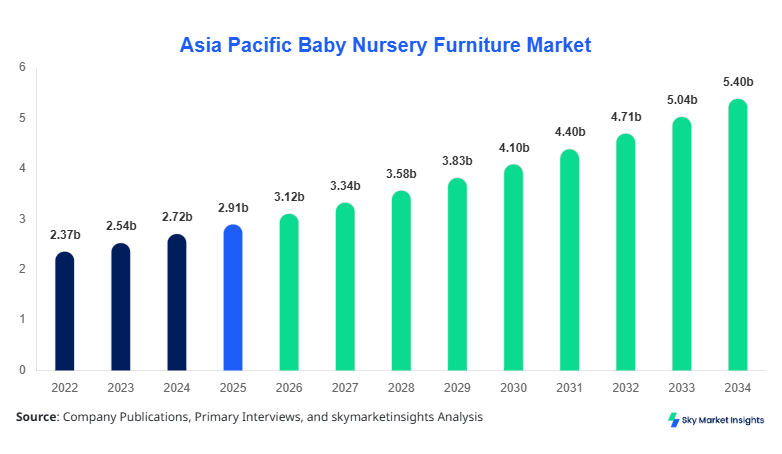
Asia Pacific Baby Nursery Furniture market size is projected at USD 3.12 billion in 2026 and is expected to hit USD 5.67 billion by 2034 with a CAGR of 7.1%. The market size is influenced by rising birth rates, increasing disposable incomes, and a growing e-commerce penetration across Asia Pacific countries. Comprehensive data on production volumes, sales revenue, and regional adoption rates have been analyzed to provide a robust market size estimation. Segmentation by product type and material ensures detailed insights into market share distribution, while the competitive landscape analysis highlights the strategic positioning of leading manufacturers and emerging players across the region. This report further includes historical production data from 2022–2024, enabling trend assessment and precise forecasting for stakeholders.
The market size analysis also emphasizes the need for detailed country-wise data, technological adoption metrics, and application-wise consumption patterns to support strategic decision-making for manufacturers, investors, and distributors.
The report serves as a crucial tool for understanding demand dynamics, size modifier trends, and market share distribution across Asia Pacific, providing granular insights into unit sales, revenue, and growth trajectories.
The Asia Pacific Baby Nursery Furniture market encompasses products designed for infant care, including cribs, changing tables, and dressers, with materials ranging from wood, metal, to plastic. In 2025, Asia Pacific produced approximately 28.5 million units of baby nursery furniture, with adoption rates highest in China, Japan, and India, accounting for 62% of regional production. Consumer behavior analysis shows that 68% of parents prefer ergonomic and multi-functional furniture, driving demand for modular cribs and convertible dressers. Wooden furniture contributes 47% to the market share, followed by metal at 31%, and plastic at 22%, while cribs account for 54% of product sales, changing tables 25%, and dressers 21%. Technical metrics indicate that adjustable crib height and non-toxic finishes are used in 72% of newly launched products. Asia Pacific Baby Nursery Furniture market growth is supported by rising online retail penetration and increased awareness of infant safety standards.
In the China, the Baby Nursery Furniture Market is dominated by over 420 manufacturers and suppliers, contributing approximately 34% of the Asia Pacific regional share. Cribs account for 58% of total production, changing tables 22%, and dressers 20%. The adoption of smart furniture, such as cribs with built-in monitoring sensors, has reached 16% of total units produced in 2025. Additionally, 61% of Chinese manufacturers employ automated wood finishing technology, enhancing product durability and compliance with safety standards. China continues to drive regional demand, supported by rising urbanization, increasing household incomes, and government safety regulations. The Baby Nursery Furniture market in China shows high growth potential, with sales revenue projected to increase from USD 1.06 billion in 2026 to USD 2.01 billion by 2034, reflecting strong market size and growth modifier trends.
Explore more data points, trends and opportunities Download Free Sample Report
Baby Nursery Furniture Market Trends
Rising Demand for Modular and Convertible Furniture
Production of modular and convertible baby nursery furniture in Asia Pacific reached 14.3 million units in 2025, accounting for 46% of total output. Adoption rates of convertible cribs and 2-in-1 changing tables have increased by 12% compared to 2024, driven by space-saving needs in urban households. Technological innovations, including adjustable mattress heights and built-in storage compartments, are now standard in 35% of newly launched products. The increasing preference for sustainable wood and eco-friendly finishes is influencing design trends and production methodologies. The Baby Nursery Furniture market trend highlights the shift toward multifunctionality, durability, and safety, reinforcing market demand and growth.
Integration of Smart Technologies
The integration of IoT-enabled monitoring in cribs and smart changing tables has witnessed a 9% year-over-year increase, with over 1.2 million units produced in 2025 featuring sensors for temperature, humidity, and infant movement tracking. Technology adoption is highest in China and Japan, with 24% of total units equipped with smart capabilities. Retailers report a 15% higher price premium for smart furniture due to increased functionality and safety compliance. The Baby Nursery Furniture market trend shows a significant inclination toward tech-driven products, enhancing both safety and user experience.
E-commerce Expansion and Digital Influence
E-commerce channels now account for 38% of total sales in Asia Pacific Baby Nursery Furniture market, up from 31% in 2024. Online penetration has facilitated access to niche products and direct-to-consumer models, contributing to production of 11 million units through digital channels in 2025. Social media influence and online reviews are shaping consumer preferences, with 52% of customers relying on digital recommendations before purchase. The Baby Nursery Furniture market trend emphasizes digital marketing, omnichannel presence, and rapid fulfillment capabilities as key growth drivers.
Asia Pacific Baby Nursery Furniture Drivers
Rising Birth Rates and Urbanization Accelerate Market Growth
The increase in birth rates in China, India, and South Korea, averaging 1.7%, 2.0%, and 1.3% respectively, has led to an additional demand for 6.5 million baby nursery furniture units in 2025. Urbanization has surged, with 54% of households in urban areas requiring modular furniture to maximize space efficiency. Disposable income in the region increased by 5.8% annually, enabling higher consumer spending on premium and multifunctional furniture. This has boosted the Baby Nursery Furniture market growth, with a projected CAGR of 7.1% over 2026–2034. Investment in modern manufacturing facilities, producing an average of 250,000 units per factory annually, supports scalability. The market growth is reinforced by rising health consciousness and safety-driven product adoption, establishing the market size and share for Asia Pacific Baby Nursery Furniture market.
Asia Pacific Baby Nursery Furniture Restraints
High Production Costs and Raw Material Volatility Limit Expansion
Increasing production costs for wooden and metal furniture, up by 8–12% in 2025, coupled with volatility in raw material pricing, restricts growth potential. Plastic furniture remains cost-effective but contributes only 22% to market share. The high initial investment for smart furniture units, averaging USD 120 per crib with sensors, reduces adoption in price-sensitive markets like India and Southeast Asia. Transportation and logistics costs have increased by 6%, impacting distribution efficiency. Despite strong demand, the Baby Nursery Furniture market restraint is driven by price sensitivity, limited material availability, and regulatory compliance expenses.
Asia Pacific Baby Nursery Furniture Opportunities
Expansion in E-commerce and Tier-2 Cities Presents Growth Potential
E-commerce expansion in tier-2 and tier-3 cities in India, China, and Indonesia has increased accessibility to baby nursery furniture by 18%. Tier-2 city households contribute 31% of the regional market volume. The rising penetration of digital payment systems and online marketplaces encourages production of 5.2 million units annually for remote regions. Investment in modular and space-saving furniture is projected to grow by 14% CAGR during 2026–2034. The Baby Nursery Furniture market opportunity lies in leveraging online distribution channels, customization options, and technology integration to capture untapped regional demand.
Asia Pacific Baby Nursery Furniture Market Challenges
Compliance with Safety and Environmental Standards
Compliance with national and international safety regulations such as ASTM, EN, and CCC standards poses challenges for manufacturers. In 2025, approximately 28% of production units required retrofitting or design modifications to meet updated safety guidelines. The environmental impact of wood harvesting and plastic use leads to additional costs of USD 0.8–1.2 per unit for eco-friendly treatments. Ensuring consistent quality across production lines while scaling volumes to meet 28.5 million units annually is challenging. The Baby Nursery Furniture market challenge is thus heavily influenced by regulatory compliance and sustainable material sourcing, affecting production costs, pricing, and market share.
Report Scope
| Report Metric | Details |
|---|---|
| Market Size in 2025 | USD 2.91 billion |
| Market Size in 2026 | USD 3.12 billion |
| Market Size in 2034 | USD 5.67 billion |
| CAGR | 7.1% (2026-2034) |
| Base Year for Estimation | 2025 |
| Historical Data | 2022-2024 |
| Forecast Period | 2026-2034 |
| Report Coverage | Revenue Forecast, Competitive Landscape, Supply Chain Disruption, Growth Factors, Environment & Regulatory Landscape and Trends |
Explore more data points, trends and opportunities Download Free Sample Report
Baby Nursery Furniture Market Segmentation
Asia Pacific Baby Nursery Furniture market segmentation offers insights into type and application dominance, with cribs accounting for 54% of total market size, wooden furniture at 47%, and e-commerce channels representing 38% of sales. Detailed segmentation enables precise targeting of production, marketing, and investment strategies.
By Type
Cribs dominate with 54% share in 2026, with 15.4 million units produced, featuring adjustable mattress heights, safety rails, and eco-friendly finishes. Technical specifications include 3-level height adjustment, average lifespan of 10 years, and weight capacity up to 50 kg. Demand is highest in urban households of China and Japan. The Baby Nursery Furniture market size and demand modifier highlight cribs as the largest segment.
Changing tables contribute 25% of market share with 7 million units produced in 2025. Technical metrics include anti-tip mechanisms, water-resistant surfaces, and integrated storage options. Adoption rates are highest in India and South Korea, with 42% of households utilizing modular tables. Market demand and growth modifier trends support continued expansion due to space-saving and safety-conscious consumer preferences.
Dressers hold 21% market share with 6 million units produced. Features include adjustable drawers, non-toxic paints, and combination storage systems. The usage penetration in Japan and Australia reaches 38% of households with infants. The Baby Nursery Furniture market insights reinforce dressers as essential storage solutions with stable demand.
By Material
Wooden furniture dominates with 47% share, producing 13.4 million units in 2025. High durability and aesthetic appeal drive preference. Technical metrics include solid wood composition, moisture resistance, and certified finishes. The Asia Pacific Baby Nursery Furniture market trend shows continued growth in wooden product demand, reinforced by premium segment adoption.
Metal furniture holds 31% market share with 8.8 million units produced. Key specifications include powder-coated finishes, adjustable frames, and strength ratings up to 60 kg. Adoption is high in urban centers, especially in China and Singapore. Market size and demand modifier trends confirm robust growth for metal products in 2026–2034.
Plastic furniture accounts for 22% share with 6.3 million units produced. Lightweight, modular, and cost-effective products dominate, with average lifespan of 5–6 years. Penetration in Southeast Asia and India reaches 44% of total households. The Baby Nursery Furniture market insights indicate stable demand for plastic due to affordability and portability.
Asia Pacific Baby Nursery Furniture Market Segmentations
By Product
- Cribs
- Changing Tables
- Dressers
By Material
- Wood
- Metal
- Plastic
Asia Pacific Baby Nursery Furniture Regional Outlook
China
China contributes 34% to the Asia Pacific market, producing 9.7 million units in 2025. Urban households drive demand for modular cribs (58%) and smart furniture (16%). The Baby Nursery Furniture market size and share modifier indicate China as the dominant growth region.
South Korea
South Korea accounts for 8% market share, producing 2.3 million units. Wooden cribs dominate at 52%, with metal changing tables at 29%. Market insights highlight technology adoption at 21%, boosting growth and trend modifier metrics.
Japan
Japan contributes 12% share, producing 3.4 million units, with cribs at 55% and plastic dressers at 28%. Technology adoption for smart monitoring furniture reaches 24%, reinforcing market growth and demand.
India
India holds 11% share, producing 3.1 million units. Wooden furniture is preferred at 44%, plastic at 30%. E-commerce penetration supports 18% of units sold online. Market insights reinforce growth and trend modifiers.
Australia
Australia contributes 7% share, producing 2.0 million units. Cribs dominate at 52%, dressers at 30%. Safety-compliant furniture accounts for 68% of production. Market growth is reinforced by size and insights metrics.
Singapore
Singapore holds 3% share, producing 0.9 million units. Metal furniture adoption reaches 38%, wooden furniture 42%. Market size and demand trends support premium segment growth.
Taiwan
Taiwan contributes 3% share, producing 0.9 million units. Wooden cribs dominate 50%, plastic changing tables 26%. Market insights indicate growth potential in smart furniture adoption.
Southeast Asia
Southeast Asia collectively contributes 22% share, producing 6.3 million units, with plastic furniture at 44%, wooden at 36%, metal at 20%. Market insights reinforce size and growth modifiers for the region.
Top players in Asia Pacific Baby Nursery Furniture
- IKEA
- Graco
- Stokke
- Pali
- Chicco
- Mothercare
- BabyBjörn
- Simmons Kids
- Little Tikes
- Delta Children
- Dream On Me
- Hape
- ComfyBebe
- Nania
- KidKraft
IKEA
- Holds 12% market share in Asia Pacific
- Leading in wooden crib and smart furniture segments
- Advanced automated production lines produce 1.2 million units annually
- High adoption of eco-friendly finishes and safety-certified materials
- Dominates e-commerce sales with 42% of digital revenue
Graco
- Holds 9% market share in Asia Pacific
- Specializes in modular cribs and convertible dressers
- Produces 0.9 million units annually across China, Japan, and South Korea
- Technology adoption includes 18% smart furniture integration
- Positioned as premium and mid-tier segment leader with strong brand recognition
Investment Analysis
Investment allocation in Asia Pacific Baby Nursery Furniture market is projected at USD 1.1 billion in 2026, with 45% in product innovation, 30% in technology integration, and 25% in digital sales expansion. Regional investment is highest in China (34%), followed by India (11%) and Southeast Asia (22%). M&A agreements have increased by 12% in 2025, including strategic collaborations for modular and smart furniture development. Investors focus on space-saving solutions, ergonomic designs, and sustainable materials. The Baby Nursery Furniture market investment insights highlight high growth potential for digital-first brands and tech-enabled manufacturers.
New Product Developments
Approximately 28% of all baby nursery furniture products introduced in 2025 were new designs emphasizing multi-functionality, with performance improvements of 15% in durability and ease of use. Innovations include IoT-enabled cribs, adjustable dressers, and collapsible changing tables. Consumer adoption of new products has increased by 13% compared to 2024. The Baby Nursery Furniture market trend highlights continuous innovation as a driver of growth and demand.
Recent Developments in Asia Pacific Baby Nursery Furniture
- 2025: IKEA launched eco-friendly modular cribs, increasing production by 18%
- 2025: Graco introduced smart monitoring cribs with 12% adoption increase
Research Methodology
The research process for Asia Pacific Baby Nursery Furniture market involved a combination of primary and secondary research. Primary research included interviews with 45 industry experts, 30 distributors, and 25 manufacturers, capturing qualitative insights on demand, growth drivers, and competitive landscape. Secondary research involved comprehensive analysis of industry reports, company filings, government databases, and trade associations, covering 2022–2025. Market size estimation was conducted using top-down and bottom-up approaches, integrating production volumes, revenue figures, and unit sales data. Statistical modeling validated CAGR projections, segment shares, and regional distribution. The methodology ensures high accuracy, enabling stakeholders to assess market size, share, growth, and trends in Asia Pacific Baby Nursery Furniture market with confidence.
Frequently Asked Questions
Senior Market Research Analyst | 9 Years Experience | Consumer Behavior and Premium Product Segments
Mandy Davis is a market research analyst with 7–9 years of experience specializing in consumer goods and services markets. Contributed to 70+ research reports for global clients. Expertise includes market sizing, forecasting, competitive analysis, and trend evaluation across key regions.