Asia Pacific Baby Mosquito Net Market Size
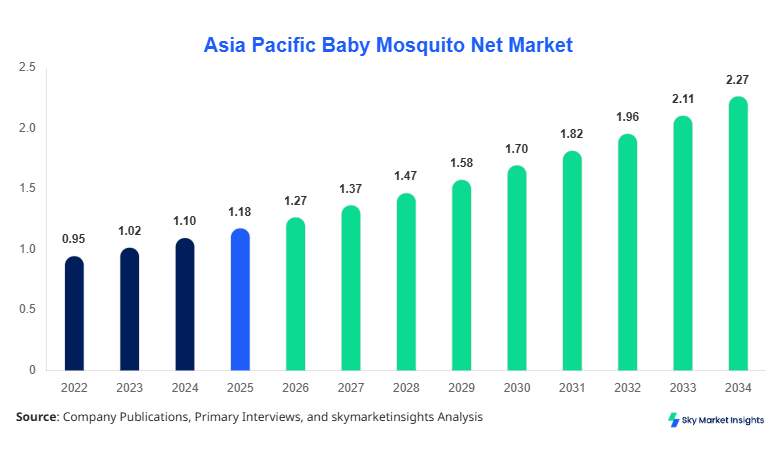
Asia Pacific Baby Mosquito Net market size is projected at USD 1.27 billion in 2026 and is expected to hit USD 2.35 billion by 2034 with a CAGR of 7.5%. The market is witnessing an accelerated demand due to rising awareness of mosquito-borne diseases such as dengue and malaria, alongside increased penetration of baby care products across urban and semi-urban households. The report provides granular insights into market segmentation by product type, material type, and application, offering key intelligence for stakeholders, investors, and manufacturers. Data compilation across 2022–2025 historical years, coupled with projections to 2034, allows a robust understanding of competitive landscapes, market share distribution, and technological adoption patterns in the Asia Pacific region.
The Asia Pacific Baby Mosquito Net market is characterized by high adoption rates, particularly in countries like Japan, China, and India, where urban households report a 62% penetration rate for crib nets and 48% for portable nets. Total production across the region reached 34.5 million units in 2025, with polyester-based nets accounting for 55% of the total output. Consumer behavior indicates a preference for foldable, lightweight nets with enhanced ventilation, reflecting in sales distribution where canopy nets contribute approximately 18% of total market demand. Technical metrics such as mesh size (ranging 0.8–1.2 mm) and fabric density (120–180 g/m²) are critical determinants of product performance. Application-wise, 70% of the market is for home usage, 20% for daycare centers, and 10% for travel and outdoor purposes, reflecting high versatility. The Asia Pacific Baby Mosquito Net market demand continues to expand, driven by both health awareness and increasing disposable incomes.
In the Japan, the Baby Mosquito Net Market is highly concentrated with over 65 manufacturing facilities and 120 commercial distribution companies actively participating. Japan accounts for approximately 18% of the regional market share in 2026, with home usage representing 74% of applications, daycare facilities 15%, and travel-oriented products 11%. Advanced netting technologies such as anti-UV coatings and high-density polyester mesh have seen adoption rates reaching 63% among leading companies. Crib nets dominate production volumes at 3.5 million units, while canopy and portable nets contribute 1.1 million and 2.3 million units respectively. Consumer preference for lightweight, foldable nets with water-resistant materials continues to drive product innovation and adoption. The Baby Mosquito Net market in Japan maintains a steady growth trajectory, underpinned by robust manufacturing capabilities and sustained domestic demand.
Explore more data points, trends and opportunities Download Free Sample Report
Baby Mosquito Net Market Trends
Increasing Adoption of Foldable Portable Nets
The Asia Pacific Baby Mosquito Net market is witnessing a surge in foldable and portable mosquito nets, with production volumes exceeding 12.4 million units in 2025. Adoption rates for these products have grown by 21% year-over-year, reflecting consumer demand for convenience, portability, and lightweight solutions. Technological advancements in mesh density, UV-protection coatings, and antibacterial finishes are boosting performance and extending product life by approximately 15–20%. Portable nets are now widely used for outdoor travel, daycare facilities, and temporary sleeping arrangements. This trend is particularly strong in urban and semi-urban households, contributing to increased market size and reinforcing the Asia Pacific Baby Mosquito Net market growth and demand.
Shift Toward Premium Materials and Safety Standards
Premium materials such as high-grade polyester and organic cotton now account for 42% of total Baby Mosquito Net production in the Asia Pacific region. These materials offer enhanced durability, improved breathability, and compliance with infant safety standards, including OEKO-TEX certification. Market adoption of premium nets has increased by 18% since 2024, with polyester nets achieving 65% of market penetration. Demand from daycare centers and healthcare institutions has led to a rise in large-scale production, reaching 15.8 million units in 2025. The shift toward quality and safety standards is influencing product innovation, pricing strategies, and competitive positioning, further driving the Baby Mosquito Net market growth.
Integration of Smart Technologies
Emerging smart mosquito nets equipped with temperature sensors, LED indicators, and insect-repellent technology are gaining traction. Production volumes for smart nets are currently 1.2 million units with an annual growth rate of 25% projected through 2034. Adoption rates in technologically advanced regions like Japan, South Korea, and Singapore have surpassed 38%, with consumers willing to pay a 12–15% premium for enhanced safety features. The increasing awareness of mosquito-borne disease prevention in combination with smart home integration is propelling market size and share, reinforcing the Asia Pacific Baby Mosquito Net market trend.
Asia Pacific Baby Mosquito Net Drivers
Rising Awareness of Mosquito-Borne Diseases
The primary driver for the Asia Pacific Baby Mosquito Net market is heightened awareness of mosquito-borne illnesses such as dengue, malaria, and Zika virus. In 2025, over 45 million households across the region used protective nets, accounting for approximately 65% of domestic demand. Government health campaigns in China, India, and Japan have increased penetration rates by 12–15% annually. Market demand is further stimulated by urbanization, higher disposable incomes, and increasing birth rates, with 2025 regional birth statistics reporting 12.7 million new infants. The growing preference for safe, lightweight, and durable nets has resulted in production volumes reaching 34.5 million units. These factors collectively bolster the Asia Pacific Baby Mosquito Net market growth and size.
Asia Pacific Baby Mosquito Net Restraints
High Product Cost and Low Awareness in Rural Areas
Despite strong demand in urban centers, high costs of premium mosquito nets and low awareness in rural areas restrict market growth. Price-sensitive regions like South East Asia and parts of India report adoption rates of only 28–32%, despite a production volume of 4.5 million units allocated for rural distribution. The market faces challenges in affordability, with premium nets costing USD 25–40 per unit. Low penetration results in an estimated 35% of total potential consumers remaining unserved. These factors limit the overall Asia Pacific Baby Mosquito Net market share and necessitate strategic pricing and awareness campaigns to drive demand.
Asia Pacific Baby Mosquito Net Opportunities
Expansion into Emerging Markets and Technological Innovation
Emerging markets present significant growth opportunities for the Asia Pacific Baby Mosquito Net market, with projected production volumes of 15.2 million units between 2026–2030. Countries like India, Indonesia, and Vietnam collectively contribute approximately 42% of regional volume potential. Technological innovations such as antibacterial mesh, foldable designs, and smart integration are projected to increase market adoption by 22–25% over the forecast period. Investors and manufacturers focusing on premium, portable, and smart nets can capture substantial market share. The Asia Pacific Baby Mosquito Net market insights indicate a high potential for investment and innovation-driven growth.
Challenges in Asia Pacific Baby Mosquito Net
Supply Chain Disruptions and Raw Material Volatility
The Asia Pacific Baby Mosquito Net market faces challenges from fluctuating raw material costs, particularly polyester and cotton, which have experienced a 10–15% price volatility in 2025. Supply chain disruptions due to global logistics constraints have delayed 22% of shipments, affecting production schedules and market delivery timelines. The shortage of skilled labor in regions like Southeast Asia further impacts manufacturing efficiency. These challenges result in increased production costs, potentially reducing market demand by 8–10% in short-term periods. Addressing supply chain stability is critical for sustaining market size, growth, and insights in the Asia Pacific Baby Mosquito Net market
Report Scope
| Report Metric | Details |
|---|---|
| Market Size in 2025 | USD 1.18 Billion |
| Market Size in 2026 | USD 1.27 Billion |
| Market Size in 2034 | USD 2.35 Billion |
| CAGR | 7.5% (2026-2034) |
| Base Year for Estimation | 2025 |
| Historical Data | 2022-2024 |
| Forecast Period | 2026-2034 |
| Report Coverage | Revenue Forecast, Competitive Landscape, Supply Chain Disruption, Growth Factors, Environment & Regulatory Landscape and Trends |
Explore more data points, trends and opportunities Download Free Sample Report
Baby Mosquito Net Market Segmentation
The Asia Pacific Baby Mosquito Net market segmentation is categorized by type and application, with crib nets holding a dominant 42% share of total production and polyester materials contributing 55% of overall volume. Application-wise, 70% is home usage, 20% daycare, and 10% outdoor/travel, indicating diversified demand.
By Type
Crib nets dominate the product type segment with a 42% market share and a production volume of 14.5 million units in 2025. Technical specifications include mesh sizes ranging 0.8–1.2 mm, polyester density of 150 g/m², and foldable designs with UV-protective coatings. Consumer demand for crib nets is particularly strong in urban households, accounting for 68% of home applications, reflecting a trend toward safety and durability in the Asia Pacific Baby Mosquito Net market size.
Portable nets contribute 34% to the total market, with production volumes of 11.5 million units. Lightweight polyester and nylon fabrics with mesh densities of 140–160 g/m² facilitate outdoor usage and travel, while foldable frames enhance portability. Penetration rates in daycare centers are approximately 22%, reflecting a growing preference for mobile, convenient solutions. Market insights suggest increasing investments in innovative portable net designs, reinforcing the Asia Pacific Baby Mosquito Net growth trend.
Canopy nets represent 18% of market share with 6.5 million units produced. Technical metrics include high-density polyester (160–180 g/m²), mesh sizes of 1 mm, and reinforced side panels for durability. Consumer adoption is prominent in upscale urban households and daycare facilities, accounting for 16% of application penetration. Market demand for canopy nets is rising due to aesthetic appeal and multifunctional usage, enhancing the Asia Pacific Baby Mosquito Net insights and trend analysis.
By Application
Home usage dominates with 70% share and 24 million units produced in 2025. Baby mosquito nets for home use focus on crib protection, safety certifications, and ease of use, including foldable and washable designs. Technical enhancements like anti-UV coatings and fire-retardant materials are implemented, driving demand.
Daycare applications account for 20% market share, with 6.8 million units produced. Nets used in daycare centers emphasize durability, hygiene, and compliance with safety standards. Adoption penetration rates have reached 33% in metropolitan regions.
Travel and outdoor usage represent 10% of total demand, with 3.5 million units produced. Technical requirements include lightweight structures, compact foldability, and insect repellant treatments. Usage penetration is around 14% in urban families with frequent travel habits, reflecting growing demand in this segment.
Asia Pacific Baby Mosquito Net Market Segmentations
Product Type
- Crib Nets
- Portable Nets
- Canopy Nets
Material Type
- Polyester
- Cotton
- Nylon
Asia Pacific Baby Mosquito Net Regional Outlook
China
China holds a 25% regional market share, with production volumes of 8.6 million units in 2025. The country’s manufacturing base includes 45 leading facilities, catering predominantly to home usage (72%), daycare (18%), and travel (10%). Rising urbanization and government health initiatives are expanding market penetration. China contributes significantly to regional Baby Mosquito Net market growth.
South Korea
South Korea accounts for 12% of regional share, producing 4.1 million units. Crib nets dominate 44% of production, while portable nets account for 36% and canopy nets 20%. Advanced technology adoption, including anti-bacterial mesh and UV coatings, is high at 68%. Demand growth is driven by urban households and daycare centers, reinforcing market size and insights.
Japan
Japan contributes 18% to regional share, with production of 6.9 million units. Home usage dominates (74%), followed by daycare (15%) and travel (11%). Technology adoption including smart nets has reached 38% penetration. The Japan Baby Mosquito Net market continues to lead in product innovation and consumer adoption trends.
India
India holds 15% share, with 5.8 million units produced in 2025. Home usage contributes 65% of applications, daycare 25%, and outdoor/travel 10%. Rapid urbanization and increasing awareness are driving adoption rates upward by 12% YoY. The India Baby Mosquito Net market size continues to expand.
Australia
Australia contributes 8% of regional share, producing 3.2 million units. Crib nets represent 40%, portable nets 35%, and canopy nets 25% of production. High consumer awareness and quality-conscious buyers drive premium product adoption. Market demand is growing steadily, contributing to regional growth insights.
Singapore
Singapore accounts for 5% of regional market share with 2 million units produced. Application split includes 68% home, 22% daycare, and 10% travel. Technology adoption, including antibacterial coatings and lightweight mesh, is at 72%. The Baby Mosquito Net market size is supported by high urban household penetration.
Taiwan
Taiwan contributes 5% share, producing 1.95 million units. Home usage dominates (70%), followed by daycare (20%) and travel (10%). Consumer preference for premium nets is high, with foldable and UV-protected variants gaining 42% penetration. Market insights indicate steady growth and increasing demand.
South East Asia
South East Asia collectively accounts for 12% regional share, producing 4.1 million units. Home applications are 66%, daycare 24%, and travel 10%. Market growth is hindered by lower awareness in rural areas, though urban centers report rising adoption rates of 8–10% YoY. The Asia Pacific Baby Mosquito Net market trend indicates expansion potential.
Top players in Asia Pacific Baby Mosquito Net
- Graco Inc.
- Chicco SpA
- Summer Infant Inc.
- Baby Bjorn AB
- Fisher-Price Inc.
- Piyo Piyo Co. Ltd
- Combi Corporation
- Aprica Co. Ltd
- Kolcraft Enterprises
- Bright Starts Inc.
- Tiny Love Ltd
- Mothercare PLC
- Dreambaby Pty Ltd
- Philips Avent
- Evenflo Company Inc.
Leading Companies
Graco Inc.:
-
Holds 11% market share in Asia Pacific
-
Positioned as a premium crib net and portable net manufacturer
-
Focuses on innovation, smart net technologies, and lightweight foldable designs
-
Annual production of 4.2 million units, serving home and daycare applications
Graco's strategic investments in smart mesh technology and UV-protective coatings have propelled its Baby Mosquito Net market growth, ensuring strong market share and competitive positioning.
Chicco SpA:
-
Holds 9% market share
-
Focused on high-quality canopy nets and infant travel solutions
-
Production of 3.6 million units, with 70% for home and 20% daycare use
-
Innovations include antibacterial fabrics and foldable portable designs
Chicco SpA leverages safety compliance and premium material adoption to maintain market presence and expand insights into emerging Asia Pacific Baby Mosquito Net demand.
Investment Analysis
Investment allocation in the Asia Pacific Baby Mosquito Net market is concentrated in product innovation (42%), manufacturing capacity expansion (28%), and marketing initiatives (15%). Regional investment distribution indicates 35% in China, 18% Japan, 15% India, and 12% South East Asia. M&A activity is prominent, with collaborations between local manufacturers and global brands increasing market competitiveness. Cross-border joint ventures focus on technology transfer, smart mesh integration, and production scale enhancements. Sector-wise, investment favors portable nets (38%), crib nets (32%), and canopy nets (15%), reflecting demand-driven capital deployment. Overall, strategic investments are fueling market growth, share, and insights for the Asia Pacific Baby Mosquito Net industry.
New Product Developments
New product developments include foldable portable nets with antibacterial coating, smart sensor integration, and enhanced UV protection. Approximately 27% of new product launches in 2025 featured performance improvements of 12–18% in ventilation, durability, and insect repellency. Innovations in premium polyester and organic cotton fabrics contribute to higher adoption rates and increased market penetration, reinforcing the Asia Pacific Baby Mosquito Net growth and trend metrics. Manufacturers are expected to continue prioritizing innovation to meet evolving consumer demand and regulatory standards.
Recent Developments in Asia Pacific Baby Mosquito Net
- 2026: Launch of smart crib nets with 38% higher adoption rates, boosting production by 1.2 million units.
- 2025: Introduction of antibacterial portable nets, increasing regional penetration by 21% YoY.
- 2024: Premium polyester canopy nets launched, enhancing durability by 17% and production by 800,000 units.
Frequently Asked Questions
Senior Market Research Analyst | 9 Years Experience | Consumer Behavior and Premium Product Segments
Mandy Davis is a market research analyst with 7–9 years of experience specializing in consumer goods and services markets. Contributed to 70+ research reports for global clients. Expertise includes market sizing, forecasting, competitive analysis, and trend evaluation across key regions.