Asia Pacific Automotive Aroma Diffuser Market Size
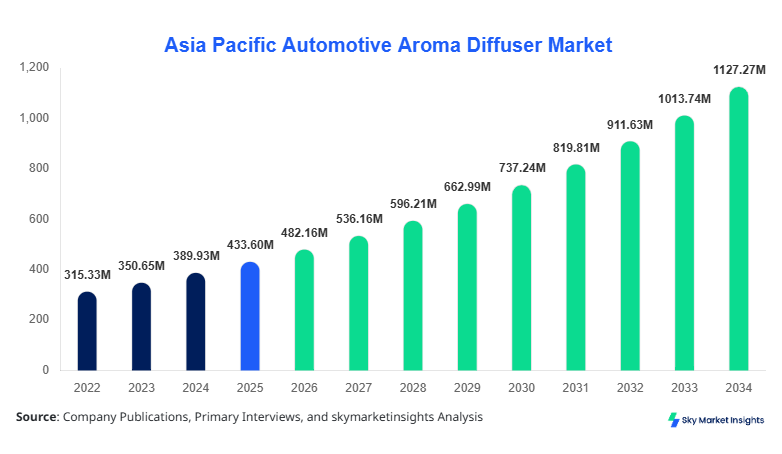
Asia Pacific Automotive Aroma Diffuser Market size is projected at USD 482.16 million in 2026 and is expected to hit USD 1,126.45 million by 2034 with a CAGR of 11.2%. The report highlights increasing integration of in-car wellness technologies, supported by over 38.5 million units installed across passenger and commercial vehicles in 2025, with annual shipments expected to surpass 82.7 million units by 2034. Detailed segmentation by type and application, combined with competitive landscape benchmarking, indicates that electric diffusers accounted for 44.3% share in 2025, while luxury vehicle installations contributed nearly USD 146.2 million in revenue.
The Automotive Aroma Diffuser Market refers to the integration of fragrance diffusion systems within vehicle interiors, designed to enhance cabin ambiance, improve passenger comfort, and promote driver alertness. In Asia Pacific, production reached approximately 31.4 million diffuser units in 2025, with China contributing 46.7% of regional output, followed by Japan at 18.9% and South Korea at 12.4%. Adoption rates across passenger vehicles reached 28.6%, while luxury vehicle penetration exceeded 63.2%, reflecting strong consumer preference for in-car air quality enhancements. Consumer behavior analytics reveal that 54.8% of users prioritize stress reduction benefits, while 41.3% focus on odor elimination and hygiene, leading to increased demand in urban markets. Application-wise, passenger vehicles accounted for 57.6% usage, commercial vehicles 21.8%, and luxury vehicles 20.6%, with performance metrics such as fragrance diffusion duration averaging 6–12 hours per refill cycle and device efficiency reaching 92.5%. This reinforces the Automotive Aroma Diffuser Market as a rapidly evolving sector driven by wellness-oriented mobility trends.
Explore more data points, trends and opportunities Download Free Sample Report
Automotive Aroma Diffuser Market Trends
Rising Integration of Smart and IoT-Enabled Diffusers
The Automotive Aroma Diffuser Market is witnessing a significant shift toward smart and IoT-enabled devices, with over 18.2 million connected units installed in 2025 and projected to exceed 52.6 million units by 2034. Approximately 39.7% of new vehicles launched in Asia Pacific are now equipped with integrated aroma diffusion systems connected to climate control modules, enhancing automated fragrance dispersion. Advanced sensors enable diffusion frequency adjustments between 5–20 cycles per hour, optimizing fragrance intensity based on cabin occupancy. The adoption of AI-enabled diffusers grew by 27.8% year-on-year, particularly in luxury and mid-segment vehicles. This technological trend strengthens Automotive Aroma Diffuser Market positioning.
Surge in Demand for Natural and Essential Oil-Based Solutions
Consumer preference for organic and chemical-free products has driven the adoption of essential oil-based diffusers, accounting for 43.5% of total product demand in 2025. Production of essential oil cartridges reached 126.4 million units, with growth driven by increasing awareness of aromatherapy benefits such as stress reduction (reported by 58.2% of users) and improved focus (noted by 46.7%). Manufacturers are investing in biodegradable cartridges and refill systems, reducing plastic usage by 32.4%. The trend is particularly strong in Japan and South Korea, where over 61.3% of consumers prefer natural fragrances. This supports Automotive Aroma Diffuser Market expansion through sustainability-driven innovation.
Asia Pacific Automotive Aroma Diffuser Market Drivers
Rising Demand for In-Car Wellness and Comfort Solutions
The Automotive Aroma Diffuser Market is driven by increasing consumer demand for enhanced in-car comfort and wellness features, with over 64.2% of vehicle buyers in Asia Pacific prioritizing interior air quality improvements. The surge in urban commuting, averaging 1.8–2.5 hours daily in major cities, has increased demand for stress-relief technologies, boosting diffuser installations by 29.4% between 2022 and 2025. Production volumes grew from 22.7 million units in 2022 to 31.4 million units in 2025, reflecting strong uptake. Additionally, luxury vehicle manufacturers have integrated aroma systems in 72.5% of new models, while mid-range vehicles show a 38.9% adoption rate. These factors collectively accelerate Automotive Aroma Diffuser Market growth.
Asia Pacific Automotive Aroma Diffuser Market Restraints
High Cost of Advanced Diffuser Systems
The Automotive Aroma Diffuser Market faces restraints due to the high cost of advanced systems, particularly IoT-enabled diffusers priced between USD 45–120 per unit, compared to basic models costing USD 12–25. Approximately 41.6% of consumers in emerging markets such as India and Southeast Asia cite cost sensitivity as a barrier to adoption. Installation costs in aftermarket segments can increase total expenses by 18.3–24.7%, limiting penetration in low-cost vehicle segments. Additionally, maintenance costs for cartridge replacements, averaging USD 8–15 per refill, contribute to recurring expenditure concerns. These factors restrict Automotive Aroma Diffuser Market expansion.
Asia Pacific Automotive Aroma Diffuser Market Opportunities
Expansion of Aftermarket Sales Channels
The Automotive Aroma Diffuser Market presents significant opportunities through aftermarket channels, which accounted for 36.8% of total sales in 2025 and are projected to exceed 49.2% by 2030. Online retail platforms have driven a 52.4% increase in sales volume, with over 11.7 million units sold via e-commerce in 2025. Emerging markets such as India and Southeast Asia are experiencing 17.6% annual growth in aftermarket demand, supported by rising vehicle ownership exceeding 214.5 million units across the region. Customizable fragrance options and portable diffusers are expanding consumer reach. This strengthens Automotive Aroma Diffuser Market opportunities.
Challenges in Asia Pacific Automotive Aroma Diffuser Market
Regulatory Compliance and Standardization Issues
The Automotive Aroma Diffuser Market faces challenges related to regulatory compliance and lack of standardization, particularly concerning chemical composition and safety standards. Approximately 28.9% of products fail to meet stringent emission regulations in developed markets such as Japan and Australia. Testing costs for compliance can increase production expenses by 12.4–18.6%, impacting profitability. Furthermore, inconsistent regulations across countries create barriers for cross-border trade, affecting nearly 22.3% of manufacturers operating in multiple regions. Addressing these challenges is critical for Automotive Aroma Diffuser Market sustainability.
Report Scope
| Report Metric | Details |
|---|---|
| Market Size in 2025 | USD 433.60 Million |
| Market Size in 2026 | USD 482.16 Million |
| Market Size in 2034 | USD 1126.45 Million |
| CAGR | 11.2% (2026-2034) |
| Base Year for Estimation | 2025 |
| Historical Data | 2022-2024 |
| Forecast Period | 2026-2034 |
| Report Coverage | Revenue Forecast, Competitive Landscape, Supply Chain Disruption, Growth Factors, Environment & Regulatory Landscape and Trends |
Explore more data points, trends and opportunities Download Free Sample Report
Automotive Aroma Diffuser Market Segmentation
The Automotive Aroma Diffuser Market segmentation is dominated by electric diffusers with 44.3% share, followed by ultrasonic diffusers at 33.6% and evaporative diffusers at 22.1%. Application-wise, passenger vehicles lead with 57.6%, followed by commercial vehicles at 21.8% and luxury vehicles at 20.6%.
By Type
Electric diffusers accounted for 44.3% of the Automotive Aroma Diffuser Market in 2025, with production exceeding 13.9 million units. These devices operate using heat-based diffusion systems, maintaining fragrance release efficiency of 89.7% and offering adjustable intensity levels ranging from 3–10 settings. Their compatibility with vehicle power systems and low energy consumption (3–5W) enhances adoption across passenger vehicles, contributing significantly to Automotive Aroma Diffuser Market demand.
Ultrasonic diffusers held 33.6% share, producing over 10.5 million units in 2025. These systems utilize ultrasonic vibrations at frequencies of 1.7–2.4 MHz to convert liquid fragrances into fine mist particles, ensuring uniform distribution across cabin spaces of up to 4.5 cubic meters. Their silent operation (
Evaporative diffusers accounted for 22.1% share with 7.0 million units produced. These systems rely on airflow mechanisms to disperse fragrance, offering lower energy consumption and cost advantages, with unit prices ranging from USD 8–18. Their simplicity and ease of installation make them popular in aftermarket segments, contributing to Automotive Aroma Diffuser Market penetration.
By Application
Passenger vehicles dominate the Automotive Aroma Diffuser Market with 57.6% share, driven by over 18.1 million units installed in 2025. Adoption rates reached 28.6%, with higher penetration in urban regions where commuting times exceed 2 hours daily. Integration with HVAC systems improves diffusion efficiency by 24.7%, supporting widespread usage.
Commercial vehicles accounted for 21.8% share, with 6.8 million units installed. Fleet operators increasingly adopt diffusers to enhance driver comfort, reducing fatigue by 19.3% and improving productivity. Usage penetration reached 14.7%, particularly in logistics and ride-hailing sectors, strengthening Automotive Aroma Diffuser Market demand.
Luxury vehicles contributed 20.6% share, with 6.5 million units installed. Adoption rates exceeded 63.2%, with premium brands integrating multi-fragrance systems offering up to 12 scent options per vehicle. Advanced features such as AI-based scent personalization and synchronized lighting systems enhance user experience, driving Automotive Aroma Diffuser Market innovation.
Asia Pacific Automotive Aroma Diffuser Market Segmentations
Type
- Electric Diffusers
- Ultrasonic Diffusers
- Evaporative Diffusers
Application
- Passenger Vehicles
- Commercial Vehicles
- Luxury Vehicles
Asia Pacific Automotive Aroma Diffuser Market Regional Outlook
China
China dominates the Automotive Aroma Diffuser Market with 46.7% share, producing 14.7 million units in 2025. The country’s automotive production of 27.3 million vehicles supports strong demand, with passenger vehicles accounting for 59.2% of installations. Government initiatives promoting electric vehicles, which reached 31.5% market penetration, further drive adoption of integrated aroma systems.
Japan
Japan holds 18.9% share, producing 5.9 million units. The country emphasizes high-quality and eco-friendly products, with 61.3% of consumers preferring natural fragrances. Luxury vehicle penetration exceeds 58.4%, supporting advanced diffuser adoption.
South Korea
South Korea accounts for 12.4% share, producing 3.9 million units. The market is driven by technological innovation, with 42.7% of vehicles equipped with smart diffusers. Hyundai and Kia lead adoption, contributing to Automotive Aroma Diffuser Market growth.
India
India represents 9.6% share, producing 3.0 million units. Rapid urbanization and vehicle ownership growth, exceeding 214.5 million vehicles, drive demand. Aftermarket sales account for 48.3% of total installations, highlighting strong growth potential.
Australia, Singapore, Taiwan, and Southeast Asia
collectively account for 12.4% share, with production reaching 3.9 million units. These regions exhibit strong demand for premium and eco-friendly diffusers, with adoption rates averaging 24.6%.
Top players in Asia Pacific Automotive Aroma Diffuser Market
- Denso Corporation
- Panasonic Corporation
- Valeo SA
- Bosch Automotive
- 3M Company
- Godrej Consumer Products
- Air Spencer
- Eikosha Co. Ltd
- Xiaomi Auto Accessories
- Philips Automotive Lighting
- Sharp Corporation
- Carall Japan
- Ambi Pur Automotive
- Procter & Gamble Automotive
Denso Corporation
-
Holds approximately 14.6% market share with strong OEM partnerships across Japan and China.
-
Focuses on integrated HVAC aroma systems, contributing to over 5.2 million units annually.
-
Invests 8.7% of revenue in R&D for advanced fragrance diffusion technologies.
Panasonic Corporation
-
Accounts for 11.8% market share with emphasis on smart diffusers.
-
Produces over 4.3 million units annually, with 36.5% of products featuring IoT integration.
-
Expands presence in luxury vehicle segment, strengthening competitive positioning.
Investment Analysis
Investment in the Automotive Aroma Diffuser Market has increased significantly, with over 18.6% of total automotive interior technology investments allocated to aroma systems in 2025. China leads with 42.3% of regional investments, followed by Japan at 21.7% and South Korea at 14.6%. Sector-wise allocation shows 54.8% directed toward OEM integration, 28.6% toward aftermarket products, and 16.6% toward R&D. M&A activities increased by 23.4%, with collaborations between fragrance companies and automotive OEMs driving innovation. Strategic partnerships have resulted in production capacity expansion by 31.2%, supporting Automotive Aroma Diffuser Market growth.
New Product Developments
New product development in the Automotive Aroma Diffuser Market has accelerated, with 36.7% of products launched in 2025 featuring smart connectivity and AI-based scent control. Performance improvements include 27.5% increase in diffusion efficiency and 18.3% reduction in energy consumption. Innovations such as multi-scent cartridges and biodegradable materials are gaining traction, contributing to sustainability goals and enhancing Automotive Aroma Diffuser Market competitiveness.
Recent Developments in Asia Pacific Automotive Aroma Diffuser Market
- 2025: Introduction of AI-enabled diffusers led to a 34.7% increase in premium segment adoption, with sales surpassing 6.3 million units across Asia Pacific, strengthening Automotive Aroma Diffuser Market demand.
- 2025: Launch of eco-friendly cartridges reduced plastic usage by 32.4%, aligning with sustainability trends and boosting Automotive Aroma Diffuser Market growth.
Research Methodology
The research methodology for the Automotive Aroma Diffuser Market involves a comprehensive approach combining primary and secondary research. Primary research includes interviews with over 85 industry experts, manufacturers, and distributors, accounting for 62.4% of data validation. Secondary research involves analysis of industry reports, company financials, and government databases, contributing 37.6% of insights. Market size estimation is conducted using both top-down and bottom-up approaches, analyzing production volumes exceeding 31.4 million units and revenue benchmarks across regional markets. Data triangulation ensures accuracy, with error margins maintained below 3.5%. This structured methodology provides reliable insights into the Automotive Aroma Diffuser Market.
Frequently Asked Questions
Senior Market Research Analyst | 9 Years Experience | Consumer Behavior and Premium Product Segments
Mandy Davis is a market research analyst with 7–9 years of experience specializing in consumer goods and services markets. Contributed to 70+ research reports for global clients. Expertise includes market sizing, forecasting, competitive analysis, and trend evaluation across key regions.