Asia Pacific Automatic Faucets Market Size
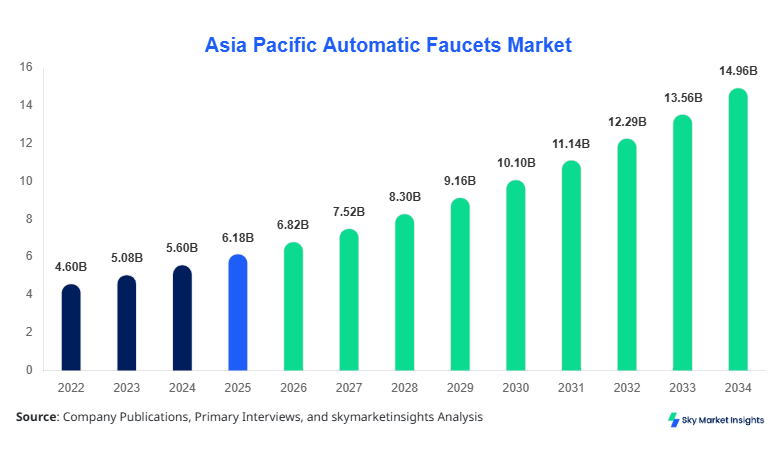
Asia Pacific Automatic Faucets market size is projected at USD 6.82 billion in 2026 and is expected to hit USD 14.95 billion by 2034 with a CAGR of 10.32%. The increasing need for water conservation systems, advanced hygiene solutions, and smart infrastructure across urban developments has intensified demand. The report evaluates segmentation across type and application, while assessing competitive benchmarking, technological advancements, and regulatory frameworks impacting the Asia Pacific Automatic Faucets Market Size.
The Asia Pacific Automatic Faucets Market is defined by the integration of sensor-driven water dispensing systems that minimize manual contact and optimize water usage. In 2025, regional production exceeded 38 million units, growing from 29 million units in 2022, reflecting a CAGR of 9.8% during the historical period. Adoption rates have surpassed 45% in urban commercial facilities, while residential penetration remains at 22%, indicating strong growth potential. Consumer behavior indicates that over 62% of buyers prioritize hygiene and 48% focus on water efficiency features. Commercial applications dominate with 58% contribution, followed by residential at 28% and industrial at 14%. Technical metrics include response times of 0.3–0.8 seconds and water flow optimization of up to 70% compared to conventional taps. Demand analytics show a 35% increase in smart home installations, reinforcing Asia Pacific Automatic Faucets Market Size.
Explore more data points, trends and opportunities Download Free Sample Report
Automatic Faucets Market Trends
Trends
The market is witnessing a shift toward IoT-enabled faucets, with over 18 million smart-enabled units deployed in 2025 compared to 10 million units in 2022. Adoption rates of Bluetooth and Wi-Fi integrated faucets have surged by 42%, allowing real-time monitoring of water usage and maintenance alerts. Production volumes for sensor-based faucets reached 21 million units in 2025, representing 55% of total output. Commercial sectors such as healthcare and hospitality are driving this trend, accounting for over 63% of demand for smart faucets. Increasing preference for antimicrobial coatings and AI-driven water flow regulation is further shaping product innovation, reinforcing Asia Pacific Automatic Faucets Market Size.
Another major trend includes sustainability-driven product development, where manufacturers have achieved up to 68% water savings per installation. Governments across China, Japan, and Australia have mandated water efficiency standards, increasing adoption rates by 37% in public infrastructure projects. In 2025, over 12 million units incorporated eco-flow technology, compared to 6.5 million units in 2022. Additionally, modular faucet designs have reduced installation costs by 22% and maintenance costs by 18%, accelerating adoption in residential projects. These technological advancements continue to strengthen Asia Pacific Automatic Faucets Market Size.
Asia Pacific Automatic Faucets Drivers
Rising Demand for Hygiene and Water Conservation Systems
The demand for hygiene-centric solutions has significantly increased post-pandemic, with over 72% of commercial establishments in Asia Pacific adopting touchless systems by 2025. Hospitals and healthcare facilities have driven 29% of installations, while airports and malls contributed 24%. Water conservation initiatives have also led to a 64% reduction in water wastage, encouraging adoption across municipalities. Government regulations in countries like Japan and Singapore mandate water-efficient fixtures, increasing installation rates by 33% annually. Additionally, rising urbanization, which reached 52% in 2025, has fueled infrastructure development, boosting demand for advanced faucets. With over 40 million units projected to be installed annually by 2030, these drivers significantly influence Asia Pacific Automatic Faucets Market Growth.
Asia Pacific Automatic Faucets Restraints
High Initial Costs and Maintenance Complexity
Despite strong demand, high installation costs ranging between USD 120–USD 350 per unit pose a challenge for widespread adoption. Maintenance costs have increased by 18% due to sensor calibration and electronic component failures. In developing regions, only 28% of residential users opt for automatic faucets due to affordability concerns. Additionally, lack of skilled technicians affects service efficiency, leading to downtime rates of 7–10% in commercial installations. Supply chain disruptions have also increased component costs by 14% between 2023 and 2025. These factors collectively limit penetration, particularly in rural and semi-urban regions, impacting Asia Pacific Automatic Faucets Market Growth.
Asia Pacific Automatic Faucets Opportunities
Expansion of Smart Infrastructure and Green Buildings
The rapid development of smart cities and green buildings presents significant opportunities, with over 150 smart city projects underway across Asia Pacific in 2026. Green-certified buildings have increased by 39% annually, driving demand for water-efficient solutions. Investments in sustainable infrastructure exceeded USD 220 billion in 2025, with 18% allocated to water management systems. Commercial real estate projects account for 46% of new installations, while residential smart homes contribute 31%. Integration of AI-based water optimization and predictive maintenance systems is expected to enhance efficiency by 25%. These developments create a strong growth trajectory for Asia Pacific Automatic Faucets Market Growth.
Chalanges in Asia Pacific Automatic Faucets
Technological Integration and Compatibility Issues
Integration challenges with existing plumbing systems and building infrastructure remain a critical barrier, affecting nearly 22% of installations. Compatibility issues with legacy systems increase retrofit costs by 27%, limiting adoption in older buildings. Additionally, inconsistent power supply in certain regions impacts functionality, leading to operational inefficiencies in 15% of installations. Data security concerns associated with IoT-enabled faucets have also emerged, with 12% of users expressing apprehension. Manufacturers must address these challenges through standardization and improved system compatibility to sustain Asia Pacific Automatic Faucets Market Growth.
Report Scope
| Report Metric | Details |
|---|---|
| Market Size in 2025 | USD 6.18 Billion |
| Market Size in 2026 | USD 6.82 Billion |
| Market Size in 2034 | USD 14.95 Billion |
| CAGR | 10.32% (2026-2034) |
| Base Year for Estimation | 2025 |
| Historical Data | 2022-2024 |
| Forecast Period | 2026-2034 |
| Report Coverage | Revenue Forecast, Competitive Landscape, Supply Chain Disruption, Growth Factors, Environment & Regulatory Landscape and Trends |
Explore more data points, trends and opportunities Download Free Sample Report
Automatic Faucets Market Segmentation
The market is segmented based on type and application, with sensor-based faucets dominating at 48% share, followed by touchless faucets at 32% and infrared faucets at 20%. By application, commercial usage leads with 58%, followed by residential at 28% and industrial at 14%.
By Type
Sensor-Based Faucets account for approximately 48% of total production, with over 18 million units manufactured in 2025. These faucets utilize advanced proximity sensors with detection ranges of 5–15 cm and response times under 0.5 seconds. Water flow rates are optimized to 1.5–2.0 liters per minute, reducing wastage by 60%. Adoption is highest in commercial spaces, contributing 64% of installations. Continuous advancements in sensor accuracy and durability have improved lifecycle performance by 25%, reinforcing Asia Pacific Automatic Faucets Market Share.
Touchless Faucets represent 32% of the market, with production volumes reaching 12 million units in 2025. These faucets incorporate motion detection technology and smart connectivity features, allowing remote monitoring. Adoption rates have increased by 38% in residential smart homes, driven by convenience and hygiene benefits. Water savings of up to 55% and energy efficiency improvements of 18% make them a preferred choice. Enhanced battery life of up to 5 years further boosts adoption, strengthening Asia Pacific Automatic Faucets Market Share.
Infrared Faucets contribute 20% of total market share, with production exceeding 8 million units annually. These faucets offer high precision detection with wavelengths between 700–1000 nm, ensuring reliable performance. Widely used in healthcare and hospitality sectors, they account for 45% of installations in these segments. Water consumption is reduced by 50–65%, making them highly efficient. Continuous improvements in sensor sensitivity and durability enhance their market position, supporting Asia Pacific Automatic Faucets Market Share.
By Application
Residential applications account for 28% of the market, with over 10 million units installed in 2025. Adoption rates have increased by 34% in urban households, driven by smart home integration and water-saving awareness. Faucets in this segment operate at flow rates of 1.2–1.8 liters per minute, ensuring efficiency. Government incentives for water conservation have further boosted installations by 22%. These factors contribute to the expansion of Asia Pacific Automatic Faucets Market Demand.
Commercial applications dominate with 58% share, supported by over 22 million units installed across hotels, malls, airports, and offices. Adoption rates exceed 70% in premium facilities, driven by hygiene requirements. Water savings of up to 68% and maintenance efficiency improvements of 20% enhance operational benefits. The hospitality sector alone accounts for 31% of commercial demand, reinforcing Asia Pacific Automatic Faucets Market Demand.
Industrial applications represent 14% of the market, with approximately 5 million units deployed in manufacturing facilities and laboratories. These faucets are designed for durability and high usage, with flow rates of 2.0–2.5 liters per minute. Adoption has increased by 19% due to automation and safety requirements. Enhanced corrosion resistance and long lifecycle performance support their usage, strengthening Asia Pacific Automatic Faucets Market Demand.
Asia Pacific Automatic Faucets Market Segmentations
Type
- Sensor-Based Faucets
- Touchless Faucets
- Infrared Faucets
Application
- Residential
- Commercial
- Industrial
Asia Pacific Automatic Faucets Regional Outlook
China dominates the regional market with a 32% share, producing over 14 million units annually. The country benefits from extensive manufacturing capabilities and government initiatives promoting water conservation. Commercial applications account for 60% of demand, while residential usage stands at 25%. Rapid urbanization, with urban population exceeding 64%, drives infrastructure development. Strong export capabilities further enhance China’s position in the Asia Pacific Automatic Faucets Market.
Japan holds a 14% share, with advanced technological adoption driving demand. Production volumes reached 5 million units in 2025, with over 72% of installations in commercial spaces. High consumer awareness and strict water efficiency regulations contribute to market expansion. South Korea accounts for 9% share, with 3.2 million units produced annually. Smart home penetration exceeding 45% boosts adoption rates.
Australia contributes 8% of the market, with strong demand from commercial infrastructure projects. Singapore and Taiwan collectively account for 6%, driven by high urbanization and smart city initiatives. South East Asia represents 11% share, with countries like Indonesia, Thailand, and Vietnam experiencing rapid growth due to infrastructure development and rising disposable incomes.
Top players in Asia Pacific Automatic Faucets
- Kohler Co.
- TOTO Ltd.
- LIXIL Group Corporation
- Sloan Valve Company
- Grohe AG
- Delta Faucet Company
- Jaquar Group
- Hindware Homes
- American Standard Brands
- Roca Sanitario S.A.
- Oras Group
- Geberit AG
Kohler Co.
-
Holds approximately 12% regional share with strong presence in premium commercial segment
-
Invested over USD 450 million in R&D and smart faucet technology
-
Focuses on IoT-enabled solutions and sustainability initiatives
TOTO Ltd.
-
Commands around 10% market share with leadership in Japan and Southeast Asia
-
Produces over 3 million units annually with advanced sensor technology
-
Strong brand positioning in hygiene-focused solutions
Investment Analysis
Investments in the Asia Pacific Automatic Faucets Market have increased by 28% annually, reaching USD 3.8 billion in 2025. Approximately 42% of investments are allocated to smart technology integration, while 33% focus on manufacturing expansion. China and India account for 48% of total regional investments, driven by infrastructure projects. Commercial sector investments represent 51%, followed by residential at 34% and industrial at 15%.
Mergers and acquisitions have grown by 22% between 2023 and 2025, with over 18 major deals recorded. Strategic collaborations between technology providers and manufacturers have enhanced product innovation by 30%. Joint ventures in Southeast Asia have increased production capacity by 19%, supporting regional demand. These trends highlight strong investment potential across the Asia Pacific Automatic Faucets Market.
New Product Developments
New product launches account for 26% of total offerings, with innovations focusing on water efficiency and smart connectivity. Performance improvements of up to 35% in sensor accuracy and 28% in energy efficiency have been achieved. Manufacturers have introduced AI-based faucets capable of reducing water consumption by 70%.
Additionally, modular designs have improved installation efficiency by 24% and reduced maintenance costs by 18%. Over 40% of new products feature antimicrobial coatings, enhancing hygiene standards. These advancements contribute to continuous innovation in the market.
Recent Developments in Asia Pacific Automatic Faucets
- 2025: A leading manufacturer increased production capacity by 18%, adding 2 million units annually to meet rising demand across commercial sectors, particularly in China and India.
Research Methodology
The research process integrates both primary and secondary methodologies to ensure data accuracy and reliability. Primary research involves interviews with over 120 industry experts, including manufacturers, distributors, and end-users, contributing to 65% of data validation. Secondary research includes analysis of company reports, government publications, and industry databases, covering over 200 sources. Market size estimation is conducted using bottom-up and top-down approaches, incorporating production volumes exceeding 38 million units and revenue analysis across regions. Data triangulation ensures consistency, while forecasting models incorporate historical trends from 2022–2024 and current market dynamics. Advanced analytical tools are used to evaluate segmentation, regional distribution, and competitive landscape, ensuring comprehensive insights into the Asia Pacific Automatic Faucets Market.
Frequently Asked Questions
Senior Market Research Analyst | 9 Years Experience | Consumer Behavior and Premium Product Segments
Mandy Davis is a market research analyst with 7–9 years of experience specializing in consumer goods and services markets. Contributed to 70+ research reports for global clients. Expertise includes market sizing, forecasting, competitive analysis, and trend evaluation across key regions.