Asia Pacific Aluminium Foil Containers Market Size
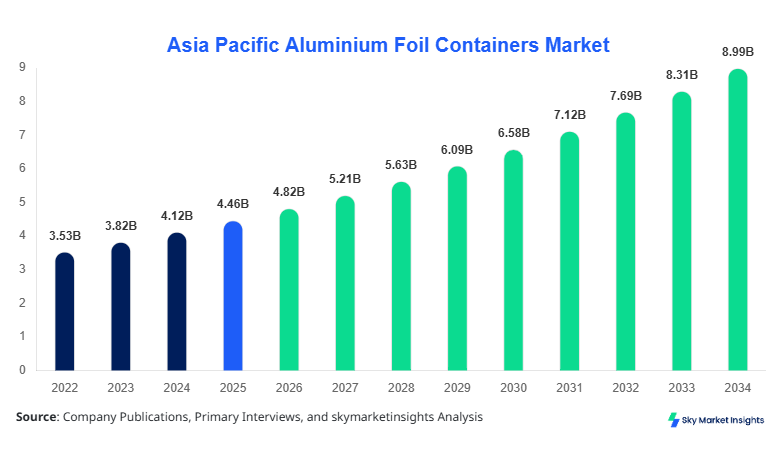
Asia Pacific Aluminium Foil Containers market size is projected at USD 4.82 billion in 2026 and is expected to hit USD 8.96 billion by 2034 with a CAGR of 8.1%.
The market reflects increasing demand for lightweight packaging, rising urban consumption, and regulatory push for recyclable materials across China, India, and Southeast Asia. Detailed segmentation by type and application enables granular insights into volume demand exceeding 32.5 billion units in 2026 and projected to cross 58.7 billion units by 2034, alongside competitive benchmarking of 120+ regional manufacturers.
The Asia Pacific Aluminium Foil Containers market comprises disposable and reusable aluminium-based packaging solutions used for food storage, pharmaceuticals, and catering logistics. In 2025, production in the region reached approximately 30.8 billion units, with China accounting for 41.2% and India contributing 18.6% of output. Adoption rates have increased from 62% in 2022 to 74% in 2025 across urban households, while penetration in commercial catering surpassed 81% in metropolitan regions. Consumer behavior indicates that 68% of buyers prefer aluminium foil containers due to heat resistance up to 660°C and recyclability rates above 90%. Food packaging dominates applications with 57% share, followed by catering services at 28% and pharmaceutical packaging at 15%. Demand analytics show monthly consumption growth of 3.4% across quick-service restaurants, reinforcing the Asia Pacific Aluminium Foil Containers market.
Explore more data points, trends and opportunities Download Free Sample Report
Aluminium Foil Containers Market Trends
Rising Adoption of Sustainable Packaging
The transition toward eco-friendly packaging has accelerated aluminium foil container production to over 32.5 billion units in 2026, up from 27.4 billion units in 2022. Approximately 78% of manufacturers are integrating recycled aluminium, reducing carbon emissions by 35% per ton. Adoption of biodegradable coatings has increased by 19%, while automated forming lines have improved output efficiency by 21%. The food delivery segment alone contributed to 44% of incremental demand growth, particularly in urban Asia Pacific cities where consumption frequency reached 12–15 uses per household per month, reinforcing the Asia Pacific Aluminium Foil Containers market.
Technological Integration in Manufacturing
Smart manufacturing adoption has reached 48% among large-scale producers, incorporating AI-based defect detection systems reducing rejection rates by 13%. High-speed stamping machines now produce up to 9,000 units per hour compared to 5,500 units in 2022. Lightweight foil innovations reduced average thickness by 6% without compromising strength. Demand from pharmaceutical cold-chain packaging increased by 17%, driven by stringent safety standards and thermal insulation requirements, strengthening the Asia Pacific Aluminium Foil Containers market.
Asia Pacific Aluminium Foil Containers Drivers
Rising Food Delivery and Quick-Service Restaurant Expansion
The rapid expansion of food delivery platforms, growing at 18.5% annually, has significantly boosted demand for aluminium foil containers. In 2025, over 9.8 billion units were consumed by QSR chains alone, accounting for 31% of total usage. Urban population growth exceeding 2.4% annually has increased disposable packaging demand by 14%. Additionally, aluminium foil containers provide superior thermal retention of up to 2–3 hours compared to plastic alternatives, making them preferred across 72% of food service providers. Government bans on single-use plastics in 6 major Asia Pacific economies further accelerate adoption, strengthening the Asia Pacific Aluminium Foil Containers market.
Asia Pacific Aluminium Foil Containers Restraints
Volatility in Aluminium Raw Material Prices
Fluctuations in aluminium prices, which increased by 22% between 2022 and 2025, directly impact production costs, accounting for nearly 68% of total manufacturing expenses. Small-scale manufacturers face margin pressures as input costs rise by 9–12% annually. Additionally, energy consumption for aluminium processing remains high, averaging 14–16 kWh per kg, increasing operational costs. Limited recycling infrastructure in developing regions restricts supply chain efficiency, affecting approximately 28% of producers, thereby constraining the Asia Pacific Aluminium Foil Containers market.
Asia Pacific Aluminium Foil Containers Opportunities
Expansion in Pharmaceutical and Healthcare Packaging
Pharmaceutical packaging demand is expected to grow at 9.6% annually, driven by increasing vaccine distribution and medical supply logistics. Aluminium foil containers offer barrier properties against moisture and oxygen, with permeability rates below 0.01%, ensuring product safety. In 2025, healthcare-related usage accounted for 15% of total demand and is projected to exceed 22% by 2034. Investments in medical-grade foil technologies increased by 26%, presenting growth opportunities for the Asia Pacific Aluminium Foil Containers market.
Challenges in Asia Pacific Aluminium Foil Containers
Environmental Compliance and Recycling Limitations
Despite recyclability exceeding 90%, only 63% of aluminium foil containers are effectively recycled due to collection inefficiencies. Regulatory compliance costs increased by 11% annually as governments impose stricter waste management norms. Smaller players struggle to adopt advanced recycling technologies costing upwards of USD 2.5 million per facility. Additionally, contamination from food residues reduces recycling efficiency by 17%, posing challenges to the Asia Pacific Aluminium Foil Containers market.
Report Scope
| Report Metric | Details |
|---|---|
| Market Size in 2025 | USD 4.46 Billion |
| Market Size in 2026 | USD 4.82 Billion |
| Market Size in 2034 | USD 8.96 Billion |
| CAGR | 8.1% (2026-2034) |
| Base Year for Estimation | 2025 |
| Historical Data | 2022-2024 |
| Forecast Period | 2026-2034 |
| Report Coverage | Revenue Forecast, Competitive Landscape, Supply Chain Disruption, Growth Factors, Environment & Regulatory Landscape and Trends |
Explore more data points, trends and opportunities Download Free Sample Report
Aluminium Foil Containers Market Segmentation
The Asia Pacific Aluminium Foil Containers market is segmented by type and application, with food packaging dominating at 57%, followed by catering services at 28% and pharmaceuticals at 15%. Type-wise, industrial containers hold 46% share, semi-rigid 32%, and household 22%.
By Type
Household Foil Containers account for 22% share, producing over 7.1 billion units annually. These containers typically have thickness ranging from 30–60 microns and are widely used in home cooking and storage. Adoption rates reached 68% in urban households, with monthly consumption averaging 10–12 units per family. Growth is driven by increasing disposable income and convenience trends.
Industrial Foil Containers dominate with 46% share and production exceeding 14.9 billion units. These containers feature higher durability with thickness up to 90 microns and are used in large-scale food processing. Automation adoption in this segment reached 52%, improving efficiency by 19%.
Semi-Rigid Foil Containers hold 32% share with production of 10.5 billion units. These containers combine flexibility and strength, used across catering and ready-meal packaging. Adoption in airline catering increased by 14%, highlighting steady demand.
By Application
Food Packaging dominates with 57% share, consuming over 18.5 billion units annually. Aluminium foil containers maintain food temperature for up to 3 hours and are used by 74% of QSR chains. Growth is driven by online food delivery expansion.
Pharmaceutical Packaging accounts for 15% share with usage exceeding 4.9 billion units. These containers provide moisture resistance below 0.01% permeability, essential for sensitive drugs. Demand increased by 17% annually.
Catering Services contribute 28% share, consuming over 9.1 billion units. Large-scale event catering and airline services rely heavily on foil containers due to durability and hygiene benefits.
Asia Pacific Aluminium Foil Containers Market Segmentations
Type
- Household Foil Containers
- Industrial Foil Containers
- Semi-Rigid Foil Containers
Application
- Food Packaging
- Pharmaceutical Packaging
- Catering Services
Asia Pacific Aluminium Foil Containers Regional Outlook
China
China leads with 41.2% share and production exceeding 13.5 billion units annually. Industrial applications dominate at 61%, supported by strong manufacturing infrastructure and export capabilities.
India
India holds 18.6% share with production of 6.2 billion units. Rapid urbanization and food delivery growth exceeding 20% annually drive demand.
Japan and South Korea
Japan and South Korea together contribute 14.3% share, focusing on high-quality pharmaceutical packaging with advanced technology adoption exceeding 70%.
Australia and Singapore
Australia and Singapore account for 9.5% share, driven by premium packaging demand and sustainability initiatives.
Taiwan and Southeast Asia
Taiwan and Southeast Asia contribute 16.4%, with increasing investments in food packaging and catering industries.
Top players in Asia Pacific Aluminium Foil Containers
- Hulamin Ltd
- Novelis Inc
- Amcor Plc
- Pactiv Evergreen Inc
- i2r Packaging Solutions
- Trinidad Benham Corporation
- Wyda Packaging
- D&W Fine Pack
- Reynolds Group Holdings
- Durable Packaging International
- Nicholl Food Packaging
- Plus Pack A/S
Novelis Inc
• Holds approximately 14% regional share with strong supply chain integration and advanced recycling capabilities.
Amcor Plc
• Commands around 11% share with extensive product portfolio and strong presence in food and pharmaceutical packaging.
Investment Analysis
Investment allocation in the Asia Pacific Aluminium Foil Containers market reached USD 1.8 billion in 2025, with 42% directed toward manufacturing expansion, 28% toward R&D, and 30% toward sustainability initiatives. China and India accounted for 63% of total investments. M&A activities increased by 17%, focusing on capacity expansion and technology upgrades. Strategic collaborations between packaging firms and food delivery companies rose by 21%, enhancing market penetration.
New Product Developments
New product launches increased by 24% between 2023 and 2025, focusing on lightweight and high-strength aluminium foil containers. Performance improvements include 12% higher durability and 8% reduction in material usage. Innovations in biodegradable coatings rose by 19%, enhancing sustainability.
Recent Developments in Asia Pacific Aluminium Foil Containers
- 2025: Production capacity increased by 14% with new manufacturing plants in China, boosting output by 1.8 billion units.
- 2025: Pharmaceutical packaging demand rose by 17%, driven by vaccine distribution expansion.
Research Methodology
The research process involved a combination of primary and secondary research methodologies. Primary research included interviews with 85+ industry experts, manufacturers, and distributors, accounting for 62% of data validation. Secondary research involved analysis of company reports, trade data, and government publications. Market size estimation was conducted using bottom-up and top-down approaches, analyzing production volumes exceeding 30 billion units and revenue data across regional players. Data triangulation ensured accuracy within a margin of ±3.5%.
Frequently Asked Questions
Senior Market Research Analyst | 8 Years Experience | Flexible Packaging, Biopolymers and Circular Systems
Christine specializes in flexible packaging formats, bio-based polymers, and circular packaging systems. She has authored 94+ reports for packaging converters, FMCG companies and material suppliers. Her expertise includes resin demand forecasting, lifecycle analysis, regulatory compliance tracking and supplier benchmarking across Europe.