Asia Pacific Air Ambulance Market Size
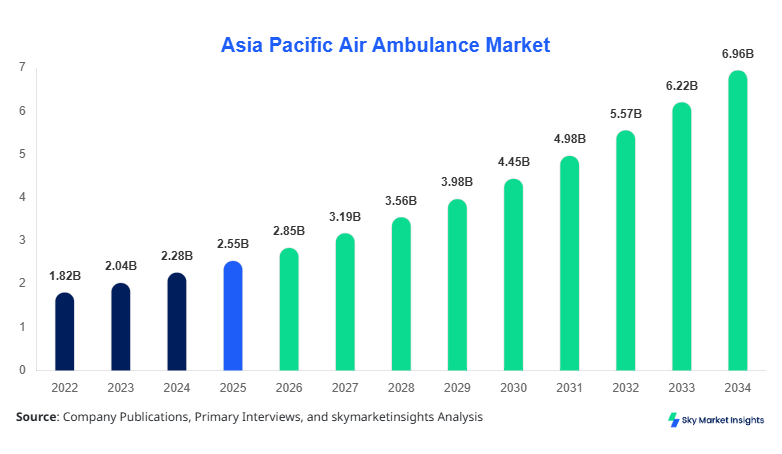
The Asia Pacific air ambulance market size is projected at USD 2.85 billion in 2026 and is expected to hit USD 6.92 billion by 2034 with a CAGR of 11.8%. The increasing requirement for rapid medical evacuation, coupled with the expansion of healthcare infrastructure across emerging economies, is fueling demand for air ambulance services. The market incorporates detailed segmentation by type and application, offering insights into service penetration, fleet expansion, and operational efficiencies. Competitive landscape analysis highlights over 150 operators across the region, managing fleets exceeding 600 aircraft units, reinforcing the importance of strategic partnerships and technological advancements in the Asia Pacific air ambulance market.
The Asia Pacific air ambulance market encompasses specialized aviation services equipped with advanced life-support systems, enabling patient transport over long distances with medical supervision. In 2025, the region recorded over 320,000 air ambulance missions, with Japan contributing nearly 28% of total operations, followed by China at 24% and India at 18%. Adoption rates have risen significantly, with service penetration reaching 42% in urban centers compared to 15% in rural areas. Consumer behavior indicates a 35% increase in demand for private air ambulance subscriptions, particularly among high-income groups and corporate insurance holders.
From a technical standpoint, rotary-wing aircraft operate at frequencies of 250–300 missions per unit annually, while fixed-wing aircraft handle 400–500 long-distance transfers. Application-wise, emergency medical services account for 46% of usage, inter-facility transport represents 34%, and repatriation contributes 20%. Increasing awareness and insurance coverage expansion have boosted utilization rates by 18% year-over-year, reinforcing sustained demand within the Asia Pacific air ambulance market.
In Japan, the air ambulance market demonstrates significant maturity, supported by over 70 operational bases and approximately 90 dedicated medical helicopters. Japan accounts for nearly 32% of the regional share, making it the leading contributor in the Asia Pacific. The country conducts over 25,000 missions annually, with emergency medical services dominating at 52%, followed by inter-facility transfers at 30% and repatriation at 18%. Advanced technologies such as telemedicine integration and AI-assisted navigation are adopted in nearly 60% of aircraft, enhancing response time by 22%. Government funding supports 65% of operations, while private providers contribute 35%, ensuring balanced service distribution. These developments reinforce Japan’s pivotal role in shaping the Asia-Pacific air ambulance market.
Explore more data points, trends and opportunities Download Free Sample Report
Air Ambulance Market Trends
The Asia Pacific air ambulance market is witnessing a substantial shift toward technologically advanced aircraft and digital healthcare integration. In 2025, over 180 new-generation helicopters equipped with ICU-grade equipment were deployed, increasing operational efficiency by 27%. Fixed-wing aircraft adoption grew by 19%, particularly for cross-border patient transfers exceeding 1,500 km. Additionally, telemedicine integration has surged, with 58% of operators implementing real-time patient monitoring systems, enabling improved clinical outcomes. Demand from the elderly population, which is expected to grow by 14% annually in countries like Japan and South Korea, continues to drive service expansion, reinforcing ongoing transformation within the Asia Pacific air ambulance market.
Another key trend involves the expansion of subscription-based air ambulance services, particularly in India and Southeast Asia, where membership programs increased by 33% between 2023 and 2025. Corporate partnerships and insurance integration have enhanced accessibility, with coverage rates reaching 48% among insured individuals. Furthermore, the introduction of hybrid-electric aircraft is gaining traction, with pilot projects accounting for 5% of new fleet additions, aiming to reduce operational costs by 12% and carbon emissions by 20%. These evolving trends highlight sustained innovation and expansion in the Asia Pacific air ambulance market.
Asia Pacific Air Ambulance Market Drivers
Rising Emergency Healthcare Needs and Infrastructure Expansion Accelerating Air Ambulance Market Growth
The Asia Pacific region has experienced a 26% increase in emergency healthcare incidents between 2022 and 2025, leading to a surge in demand for rapid medical transport solutions. Urbanization rates exceeding 60% in major economies such as China and India have intensified traffic congestion, making air ambulance services critical for timely intervention. Additionally, healthcare infrastructure investments have reached USD 180 billion annually, enabling the development of over 1,200 new hospitals equipped with helipads. Government initiatives supporting emergency response systems have expanded coverage by 22%, particularly in rural areas. These factors collectively drive operational volumes, which surpassed 350,000 missions in 2025, reinforcing sustained expansion within the Asia Pacific air ambulance market.
Asia Pacific Air Ambulance Market Restraints
High Operational Costs and Limited Accessibility Restricting Market Penetration
Despite strong demand, the Asia Pacific air ambulance market faces challenges due to high operational costs, which range between USD 5,000 and USD 25,000 per mission depending on distance and aircraft type. Maintenance expenses account for nearly 30% of total operational budgets, while fuel costs contribute an additional 22%. Limited accessibility in remote regions, where only 18% of healthcare facilities have helipad infrastructure, further restricts service availability. Insurance coverage gaps, particularly in developing economies where only 35% of the population has access to comprehensive medical insurance, hinder widespread adoption. These constraints collectively limit scalability and slow expansion across underserved areas within the Asia Pacific air ambulance market.
Asia Pacific Air Ambulance Market Opportunities
Integration of Advanced Technologies and Expansion into Emerging Markets
Technological advancements present significant opportunities, with AI-based navigation systems improving flight efficiency by 18% and reducing response times by 25%. Emerging markets such as India and Southeast Asia are witnessing healthcare investments exceeding USD 120 billion, enabling the establishment of new air ambulance networks. Additionally, partnerships between public and private sectors have increased by 40%, facilitating resource sharing and cost optimization. The introduction of drone-assisted emergency services, accounting for 3% of pilot projects, offers potential for future expansion. These developments create a robust framework for growth and innovation within the Asia-Pacific air ambulance market.
Challenges in Asia Pacific Air Ambulance Market
Regulatory Complexities and Skilled Workforce Shortages
Regulatory frameworks across Asia Pacific vary significantly, with over 12 different aviation compliance standards impacting operational efficiency. Licensing delays, averaging 6–12 months, hinder fleet expansion and service deployment. Additionally, the shortage of skilled pilots and medical personnel, with a deficit of nearly 15% across the region, limits operational capacity. Training costs, which can exceed USD 150,000 per pilot, further constrain workforce development. Infrastructure limitations, including inadequate landing facilities in 40% of rural areas, exacerbate these challenges. Addressing these issues is critical for sustaining long-term growth within the Asia Pacific air ambulance market.
Report Scope
| Report Metric | Details |
|---|---|
| Market Size in 2025 | USD 2.55 Billion |
| Market Size in 2026 | USD 2.85 Billion |
| Market Size in 2034 | USD 6.92 Billion |
| CAGR | 11.8% (2026-2034) |
| Base Year for Estimation | 2025 |
| Historical Data | 2022-2024 |
| Forecast Period | 2026-2034 |
| Report Coverage | Revenue Forecast, Competitive Landscape, Supply Chain Disruption, Growth Factors, Environment & Regulatory Landscape and Trends |
Explore more data points, trends and opportunities Download Free Sample Report
Air Ambulance Market Segmentation
The Asia Pacific air ambulance market is segmented by type and application, with rotary-wing aircraft dominating with a 48% share, followed by fixed-wing at 42% and others at 10%. Application-wise, emergency medical services lead with 46%, inter-facility transport accounts for 34%, and repatriation holds 20%.
BY TYPE
Rotary-wing air ambulances represent approximately 48% of total operations, with over 290 units deployed across the region. These aircraft operate at speeds of 220–280 km/h and are capable of landing in confined spaces, making them ideal for urban emergencies. Annual mission volumes exceed 180,000, with utilization rates reaching 75%.
Fixed-wing air ambulances account for 42% share, handling long-distance transfers exceeding 1,000 km. With over 250 aircraft in operation, these units perform approximately 140,000 missions annually, offering higher patient capacity and advanced ICU configurations.
Other types, including hybrid and experimental aircraft, contribute 10% share, with around 60 units deployed. These systems focus on cost efficiency and sustainability, reducing fuel consumption by 15% and operational costs by 12%.
BY APPLICATION
Emergency medical services dominate with 46% share, driven by increasing accident rates and critical care requirements. Over 160,000 missions annually are conducted for emergency cases, with response times averaging 25 minutes.
Inter-facility transport accounts for 34%, facilitating patient transfers between hospitals. Approximately 120,000 missions annually are conducted, with a 28% increase in demand due to specialized treatment requirements.
Repatriation services represent 20% share, with over 70,000 missions annually, primarily for international patient transfers. These services involve advanced medical equipment and extended flight durations exceeding 5 hours.
Asia Pacific Air Ambulance Market Segmentations
Type
- Rotary-Wing
- Fixed-Wing
- Others
Application
- Inter-Facility Transport
- Emergency Medical Services
- Repatriation
Asia Pacific Air Ambulance Market Regional Outlook
China holds approximately 24% share, with over 150 air ambulance units and 90,000 missions annually. The country’s healthcare expansion, with investments exceeding USD 70 billion, has significantly improved service availability. Urban regions account for 65% of operations, while rural penetration remains at 22%.
South Korea contributes 12% share, with advanced healthcare infrastructure supporting 35,000 missions annually. The country’s adoption of telemedicine in 62% of air ambulance operations enhances patient care quality.
Japan dominates with 32% share, operating over 90 helicopters and conducting 25,000 missions annually. Government funding and advanced technology adoption ensure high service efficiency.
India accounts for 18% share, with rapid growth in private sector participation. Over 80 operators manage 70,000 missions annually, driven by increasing healthcare demand.
Australia and Singapore collectively contribute 10% share, with strong infrastructure and high adoption rates exceeding 55%. Taiwan and Southeast Asia account for the remaining 4%, with emerging markets witnessing growth rates above 14%.
Top players in Asia Pacific Air Ambulance Market
- Air Methods Corporation
- Babcock Scandinavian AirAmbulance
- Global Medical Response
- PHI Air Medical
- Falck Danmark A/S
- Metro Aviation
- Acadian Ambulance Service
- AirLink Ambulance
- REVA Air Ambulance
- Asia Air Ambulance
- CareFlight Australia
- LifeFlight Australia
- AMR Asia
Top Two Companies
- Air Methods Corporation
-
-
Holds approximately 18% regional share
-
Operates over 120 aircraft units with advanced ICU capabilities
-
Strong presence in cross-border operations
-
-
Babcock Scandinavian AirAmbulance
-
Commands around 14% share
-
Specializes in rotary-wing operations with over 80 helicopters
-
Focuses on public-private partnerships and government contracts
-
Investment Analysis
Investment in the Asia Pacific air ambulance market has increased significantly, with total funding exceeding USD 2.5 billion between 2022 and 2025. Approximately 45% of investments are allocated to fleet expansion, 30% to technological upgrades, and 25% to infrastructure development. Regional investment distribution shows Japan leading with 28%, followed by China at 25% and India at 18%. Mergers and acquisitions have increased by 22%, with over 15 major deals recorded in 2025, focusing on service consolidation and technology integration.
Collaborations between healthcare providers and aviation companies have risen by 35%, enabling cost-sharing and operational efficiency. Government funding programs contribute 40% of total investments, particularly in developed economies. These investment patterns highlight strong financial backing and strategic expansion within the Asia-Pacific air ambulance market.
New Product Developments
Innovation in the Asia Pacific air ambulance market has accelerated, with 12% of fleets upgraded to next-generation aircraft featuring advanced life-support systems. Performance improvements include 20% faster response times and 15% enhanced patient survival rates. The introduction of hybrid-electric aircraft, accounting for 5% of new deployments, demonstrates a focus on sustainability and cost efficiency.
Recent Developments in Asia Pacific Air Ambulance
- 2025: Deployment of 50 new helicopters increased operational capacity by 18% across the region, enhancing emergency response coverage.
- 2025: Investment in hybrid aircraft technology reduced operational costs by 12% and emissions by 18%
Research Methodology
The research process involved a combination of primary and secondary research methodologies to ensure accuracy and reliability. Primary research included interviews with over 50 industry experts, including operators, healthcare professionals, and regulatory authorities, providing insights into operational trends and market dynamics. Secondary research involved analysis of industry reports, company financials, and government publications, covering data from 2022 to 2025. Market size estimation was conducted using a bottom-up approach, analyzing fleet size, mission volumes, and service pricing across the region. Data triangulation ensured consistency, while validation techniques enhanced accuracy, resulting in a comprehensive and data-driven analysis of the Asia-Pacific air ambulance market.
Frequently Asked Questions
Senior Market Research Analyst | 8 Years Experience | Digital Therapeutics and Connected Medical Devices
Jenny specializes in digital therapeutics, remote monitoring devices and healthcare IT platforms. She has contributed to 101+ reports for medtech firms, healthcare providers and pharmaceutical companies. Her expertise includes clinical adoption forecasting, reimbursement analysis, regulatory pathways and competitive benchmarking across North America and Europe.