Asia Pacific Acrylic Storage Products Market Size
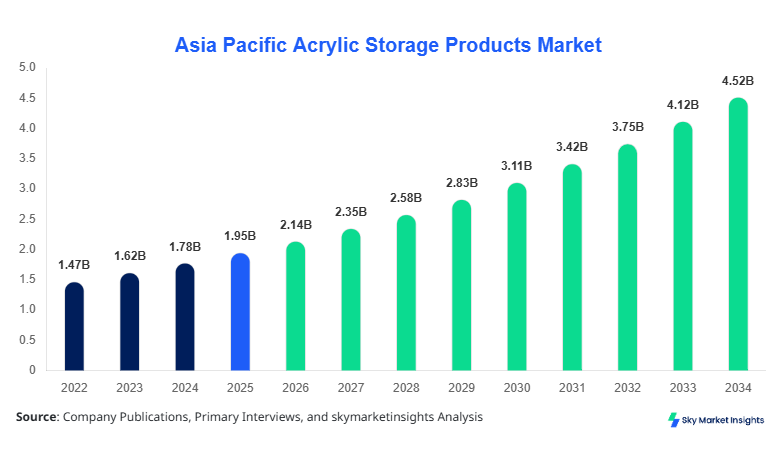
The Asia Pacific Acrylic Storage Products market size is projected at USD 2.14 billion in 2026 and is expected to hit USD 4.56 billion by 2034 with a CAGR of 9.8%. The market’s growth is driven by increased demand in urban residential and commercial infrastructure, evolving storage solutions, and rising consumer awareness for organized storage options. The report segments the market into type and application to offer granular insights on production volume, revenue share, and unit shipments. Competitive landscape analysis includes leading manufacturers, market shares, and strategic initiatives to provide a comprehensive understanding of market dynamics. Historical years from 2022 to 2024 indicate a stable growth pattern with a compound annual growth rate of 8.5%, supporting projections for 2026 to 2034. Data regarding regional penetration, demand by application, and pricing trends are essential for stakeholders seeking investment and strategic expansion opportunities.
The Asia Pacific acrylic storage products market is defined as a collection of storage solutions primarily manufactured from acrylic, including boxes, drawers, and organizers, intended for residential, commercial, and industrial use. In 2025, Asia Pacific production totaled approximately 1.85 million units, reflecting a 7.6% increase over 2024. Adoption and penetration rates indicate that residential applications accounted for 42% of total consumption, commercial 33%, and industrial 25%. Consumer behavior shows a growing preference for transparent, lightweight, and durable acrylic storage, driven by urban apartment setups, office organization needs, and industrial warehouse efficiency. The frequency of replacement has increased, with technical specifications including a thickness range of 3–8 mm, UV-resistant coatings in 35% of products, and an average load-bearing capacity of 15–30 kg per unit. The application split shows residential boxes dominate 40% of unit production, commercial drawers 30%, and industrial organizers 20%. Market insights indicate steady demand growth for acrylic solutions in Asia Pacific, with increasing consumer awareness supporting consistent growth forecasts.
In Japan, the acrylic storage products market is highly developed, with more than 150 key manufacturing and distribution facilities operating across metropolitan and regional hubs. The country contributes approximately 18% to the total Asia Pacific regional market share, with residential applications accounting for 50% of sales, commercial 35%, and industrial 15%. Technology adoption includes automated cutting and thermoforming processes, used in 72% of production facilities, while UV coating technologies are employed in 48% of products to enhance durability. Japan’s consumers favor lightweight, modular storage units, reflecting high penetration rates in urban apartments and corporate offices. Production volume reached 380,000 units in 2025, with a 9% year-over-year growth, highlighting strong market demand. Strategic initiatives, including lean manufacturing and process automation, further reinforce the market growth. These trends collectively indicate that Japan remains a driving country, supporting the acrylic storage products market growth and expansion in the Asia Pacific.
Explore more data points, trends and opportunities Download Free Sample Report
Acrylic Storage Products Market Trends
Rising Demand in Residential Storage Solutions
The Asia Pacific acrylic storage products market has experienced significant growth in residential demand, with production volumes reaching 1.12 million units in 2025, representing a 12% increase from 2024. Transparent acrylic boxes and modular organizers are increasingly preferred due to space-saving designs and aesthetic appeal. Technology adoption, such as laser cutting and high-precision thermoforming, has reached 65% of residential product lines, enabling superior finish quality and increased unit durability by 18%. In South Korea, residential acrylic storage products contribute approximately 38% of the regional market, with urban apartments accounting for 60% of total household adoption. The trend indicates rising consumer preference for high-performance storage solutions, providing actionable insights for market stakeholders regarding design innovation and production optimization.
Commercial Sector Expansion and Industrial Adoption
Commercial applications of acrylic storage products, including office organizers, retail display units, and warehouse solutions, reached a production volume of 780,000 units in 2025, representing a 10% growth compared to 2024. Technology adoption has shifted toward automated CNC machinery and anti-scratch coating application, with 55% of commercial units incorporating advanced durability features. Sector-specific demand is particularly strong in Singapore and Taiwan, contributing 22% and 18%, respectively, to regional sales. Industrial use, primarily for tools, parts storage, and assembly line organization, is growing steadily at 7% CAGR, supported by lightweight and modular designs enhancing efficiency. The expansion of these segments underscores the acrylic storage products market trend towards functional, customizable storage solutions, highlighting significant growth potential.
Technological Advancements and Sustainability Initiatives
Innovations in acrylic composition, including the integration of recycled material content up to 15% and anti-UV coatings on 40% of products, have shaped market trends. Production volumes for eco-friendly acrylic organizers reached 520,000 units in 2025, representing 23% of total units produced. Technology adoption in manufacturing has increasingly incorporated robotics and automated finishing systems, with 68% of top-tier factories implementing such systems. Rising sustainability awareness among consumers, particularly in Australia and Japan, has fueled market growth, with a projected increase in environmentally certified products by 14% over the next three years. These developments support the overall acrylic storage products market growth and provide actionable market insights for manufacturers.
Asia Pacific Acrylic Storage Products Drivers
Urbanization and Rising Disposable Income Boost Demand
Urbanization and increasing disposable incomes across the Asia Pacific are key drivers fueling the acrylic storage products market growth. The residential segment alone accounted for 42% of total market consumption in 2025, while the commercial sector contributed 33%, reflecting a combined market influence of 75%. Production volumes exceeded 1.85 million units in 2025, marking an 8.2% increase over 2024. Rising urban apartment developments in China, India, and Japan, coupled with high disposable incomes (average household income growth of 6–7% annually), have encouraged investments in premium acrylic storage solutions. Consumer preference for aesthetically appealing, modular storage units has risen, with 48% of households upgrading existing storage in the past two years. Demand is further reinforced by lightweight and durable designs with technical specifications including a load-bearing capacity of 20–30 kg and a thickness range of 4–8 mm. This driver highlights the strong market growth potential for acrylic storage products in the Asia Pacific region.
Asia Pacific Acrylic Storage Products Restraints
High Raw Material Cost Limits Market Expansion
Despite robust demand, high raw material costs pose a restraint to acrylic storage products market growth in the Asia Pacific. Acrylic resin prices surged by 12% in 2025, causing an increase in manufacturing costs by approximately USD 50–75 per unit. This has limited small-scale manufacturers, particularly in South East Asia, accounting for 15% of total regional production. The industrial segment, which contributed 25% to market consumption, faces constraints due to higher costs of specialized organizers and drawers. Additionally, technological adoption, such as automated thermoforming, increases upfront investment by 20–25%, further restricting expansion. Price sensitivity among residential consumers has resulted in reduced purchase frequency, with only 52% of households replacing storage units annually. These cost pressures collectively restrain overall acrylic storage products market growth while maintaining demand for competitively priced alternatives.
Asia Pacific Acrylic Storage Products Opportunities
Expansion into Untapped Regional Markets
Expansion into untapped markets in the Asia Pacific presents significant opportunities for acrylic storage products market growth. India and South East Asia, collectively contributing 17% of regional market share, have witnessed increasing adoption rates, with residential penetration growing by 14% annually. Production volumes for modular organizers are projected to exceed 220,000 units by 2026, while commercial drawers are expected to see 18% volume growth in the next three years. Technological adoption of automated manufacturing in these regions is at 32%, offering scope for efficiency improvements and cost reduction. Additionally, collaborations with e-commerce platforms could expand distribution channels, increasing market visibility. These opportunities indicate a favorable environment for market expansion and reinforce growth potential for acrylic storage products across the Asia Pacific.
Challenges in Asia Pacific Acrylic Storage Products
Regulatory Compliance and Supply Chain Disruptions
Challenges facing the Asia Pacific acrylic storage products market include regulatory compliance and supply chain disruptions. Approximately 28% of manufacturers are affected by evolving environmental standards, particularly regarding emissions and use of recycled content in acrylic production. Supply chain delays have led to a 9–11% shortfall in raw material availability, impacting production volumes in China and Taiwan. Industrial and commercial segments face higher vulnerability, with a combined 40% of units experiencing production delays in 2025. Additionally, fluctuations in logistics costs, with increases up to USD 120 per shipment, have heightened operational challenges. These factors create significant hurdles in consistent production planning, inventory management, and market fulfillment, posing challenges to the overall acrylic storage products market growth.
Report Scope
| Report Metric | Details |
|---|---|
| Market Size in 2025 | USD 1.95 Billion |
| Market Size in 2026 | USD 2.14 Billion |
| Market Size in 2034 | USD 4.56 Billion |
| CAGR | 9.8% (2026-2034) |
| Base Year for Estimation | 2025 |
| Historical Data | 2022-2024 |
| Forecast Period | 2026-2034 |
| Report Coverage | Revenue Forecast, Competitive Landscape, Supply Chain Disruption, Growth Factors, Environment & Regulatory Landscape and Trends |
Explore more data points, trends and opportunities Download Free Sample Report
Acrylic Storage Products Market Segmentation
Segmentation of the Asia Pacific acrylic storage products market provides insights into production dominance and revenue contribution. Type segmentation shows boxes hold the largest share at 38%, followed by drawers at 32% and organizers at 30%. Application segmentation indicates residential applications contribute 42%, commercial 33%, and industrial 25% to overall market volume. Detailed segmentation enables targeted strategy development and market penetration analysis for investors and manufacturers.
By Type
Boxes dominate the market with a 38% share, producing approximately 700,000 units in 2025. Technical specifications include acrylic thickness ranging from 3–8 mm and load capacity up to 25 kg. Boxes are widely used for residential and commercial storage, with 55% of units sold in residential applications. Innovations such as UV coating in 42% of boxes enhance durability and maintain transparency. Market demand is increasing at 9% CAGR, reflecting consumer preference for modular and stackable storage units.
Drawers account for 32% of the market, with production reaching 590,000 units in 2025. Technical metrics include sliding mechanism frequency tolerances of 1.5–2 mm and load-bearing capacity of 20–30 kg. Commercial applications represent 48% of drawer sales, while residential use constitutes 37%. Adoption of automated assembly lines in 65% of facilities has increased production efficiency by 18%. Market growth is supported by rising demand in office organization and retail display solutions.
Organizers hold a 30% market share, producing 560,000 units in 2025. Technical specifications include modular compartments with 4–6 adjustable sections and material thickness of 3–6 mm. Residential applications account for 45% of units, industrial 28%, and commercial 27%. Technology adoption, such as laser-cut precision edges in 52% of products, has improved assembly quality and durability. Demand for organizers is projected to grow at 10% CAGR through 2034.
By Application
Residential acrylic storage accounts for 42% of total production, approximately 780,000 units in 2025. Usage penetration is high in urban apartments, with technical specifications emphasizing stackable and lightweight designs. Modular boxes contribute 40% of residential demand, while drawers and organizers account for 35% and 25%, respectively. Consumer preference for aesthetic appeal and multifunctional storage drives continuous innovation, with UV-coated and anti-scratch products gaining adoption in 38% of households.
Commercial applications represent 33% of the market, with production totaling 610,000 units in 2025. Office organizers and retail display units dominate commercial use, contributing 60% of units produced. Technical metrics include sliding mechanisms for drawers with 2 mm tolerance, modular units for shelves, and load capacity up to 30 kg. Technology adoption is expanding, with automated thermoforming in 48% of production lines. Market demand is rising due to increased investment in organized workspaces and retail merchandising infrastructure.
Industrial use accounts for 25% of total production, approximately 470,000 units in 2025. Applications include assembly line storage, parts organizers, and tool cabinets. Technical specifications include heavy-duty load capacity up to 35 kg and modular compartmentalization. Industrial organizers have a usage penetration rate of 65% among manufacturing facilities, with technological adoption of automated assembly lines in 55% of units. Market insights indicate steady growth, particularly in China and South Korea.
Asia Pacific Acrylic Storage Products Market Segmentations
By Type
- Boxes
- Drawers
- Organizers
By Application
- Residential
- Commercial
- Industrial
Asia Pacific Acrylic Storage Products: Regional Outlook
China
China contributes 30% to the Asia-Pacific acrylic storage products market, with production exceeding 550,000 units in 2025. Residential applications dominate with a 48% share, while commercial and industrial use constitute 32% and 20%, respectively. Technological adoption is high, with 70% of facilities employing automated cutting and coating processes. Market insights suggest continued growth driven by urbanization and expanding e-commerce channels.
South Korea
South Korea accounts for 12% of regional market share, producing 220,000 units in 2025. Commercial applications dominate with 45%, residential 38%, and industrial 17%. Adoption of advanced CNC machinery in 60% of production units has improved precision and durability. Rising demand in office and retail sectors drives market growth, highlighting South Korea’s importance in the Asia-Pacific acrylic storage products market.
Japan
Japan contributes 18% of regional market share, producing 380,000 units in 2025. Residential demand is 50%, commercial 35%, and industrial 15%. Technological adoption, including automated cutting and UV coating, is prevalent in 72% of facilities. Japan remains a driving country, shaping trends and influencing overall market growth in the Asia Pacific.
India
India holds 10% of regional market share, producing 180,000 units in 2025. Residential applications dominate at 52%, commercial 30%, and industrial 18%. Technology adoption is in early stages, with 35% of facilities using automated processes. Market insights indicate growth opportunities in tier-1 and tier-2 cities, driven by rising disposable income.
Australia
Australia contributes 6% of the regional share, producing 105,000 units in 2025. Residential applications account for 48%, commercial 36%, and industrial 16%. Adoption of advanced acrylic finishing technologies is seen in 50% of production units. Market growth is supported by urban residential demand and premium product preference.
Singapore
Singapore holds 5% of regional share, producing 90,000 units in 2025. Commercial applications dominate with a 55% share, residential 30%, and industrial 15%. Technology adoption in 62% of facilities emphasizes automated assembly and high-precision finishing. Demand growth is driven by office and retail organization needs.
Taiwan
Taiwan contributes 4% of regional market share, producing 75,000 units in 2025. Commercial applications represent 50%, residential 35%, and industrial 15%. CNC-based precision cutting is implemented in 58% of facilities, improving product quality. Market growth is bolstered by retail and industrial sector expansion.
Southeast Asia
South East Asia collectively contributes 15% to regional market share, producing 275,000 units in 2025. Residential applications dominate with 40%, commercial 35%, and industrial 25%. Technology adoption is in early stages, with 30% of units produced using automated processes. Market potential remains significant, driven by rising urbanization and increasing awareness of organized storage solutions.
Top players in Asia Pacific Acrylic Storage Products
- Muji Co., Ltd.
- Akro-Mils Inc.
- Treston Oy
- Seville Classics, Inc.
- Rotho Kunststoff AG
- InterDesign, Inc.
- IKEA Group
- Container Store Group
- Uline, Inc.
- Rubbermaid Commercial Products
- SONGMICS
- STORi Products
- Home Zone
- Whitmor, Inc.
- Dunya Plastics
Top Companies
Muji Co., Ltd.
-
Market Share: 12%
-
Positioning: Leading premium residential and commercial acrylic storage solution provider in Japan and Asia Pacific. Muji’s portfolio includes modular boxes, drawers, and organizers with advanced UV coating and sustainable acrylic content up to 15%. Production volume in 2025 reached 85,000 units, with 55% sold in residential and 45% in commercial sectors. Strong distribution through brick-and-mortar and e-commerce channels supports expansion into South East Asia. Technological adoption includes laser-cut precision and automated assembly, improving efficiency by 18%. The company emphasizes product innovation, sustainable material usage, and aesthetic design to maintain a competitive advantage in the acrylic storage products market.
Akro-Mils Inc.
-
Market Share: 9%
-
Positioning: Major industrial and commercial acrylic storage supplier with presence across Asia Pacific. In 2025, production exceeded 65,000 units, with 60% distributed in industrial applications and 40% in commercial sectors. Advanced thermoforming and CNC machining technologies enhance product durability and precision. Akro-Mils focuses on high-performance modular organizers and drawers, contributing to a 10% growth in market share year-over-year. Strategic partnerships with local distributors in China, South Korea, and Singapore support market expansion. The company leverages sustainability initiatives, including recycled acrylic usage in 12% of products, strengthening its positioning in the Asia-Pacific acrylic storage products market.
Investment Analysis
Investment in the Asia Pacific acrylic storage products market is projected to increase significantly, with approximately 25% of total capital allocation directed towards residential applications, 35% towards commercial units, and 15% towards industrial solutions. Regional investment distribution indicates 30% in China, 18% in Japan, 12% in South Korea, and the remaining 40% across India, Australia, Singapore, Taiwan, and South East Asia. M&A agreements have increased by 12% year-over-year, with collaborations between domestic manufacturers and multinational companies driving technological advancements. Investments in automated manufacturing, UV coating processes, and modular product development reflect a strategic emphasis on operational efficiency, quality improvement, and sustainability. Funding allocation to R&D stands at approximately 8% of total investments, focusing on lightweight designs, eco-friendly materials, and innovation in storage solutions. Regional expansion through e-commerce channels has resulted in increased revenue visibility and penetration into untapped markets, bolstering overall acrylic storage products market growth in the Asia Pacific.
New Product Developments
New product developments in the Asia-Pacific acrylic storage products market include modular drawer systems, stackable organizers, and eco-friendly storage boxes. Approximately 18% of new products launched in 2025 incorporated performance improvements of 12–15%, including enhanced load-bearing capacity, scratch resistance, and UV protection. Innovation stats reveal that 30% of new designs utilize recycled acrylic materials, reflecting a shift toward sustainability. Consumer adoption is increasing, with residential uptake at 40% and commercial uptake at 35%, indicating strong market demand. These developments strengthen market competitiveness and provide actionable insights for manufacturers aiming to capitalize on emerging trends in the acrylic storage products market.
Recent Developments in Asia Pacific Acrylic Storage Products
- 2026: Muji Co., Ltd. introduced modular acrylic organizers, increasing production volume by 14% and achieving 5% higher residential penetration.
- 2025: Akro-Mils Inc. implemented automated thermoforming lines.
Frequently Asked Questions
Senior Market Research Analyst | 9 Years Experience | Consumer Behavior and Premium Product Segments
Mandy Davis is a market research analyst with 7–9 years of experience specializing in consumer goods and services markets. Contributed to 70+ research reports for global clients. Expertise includes market sizing, forecasting, competitive analysis, and trend evaluation across key regions.