Asia Pacific Acoustic Furniture Market Size
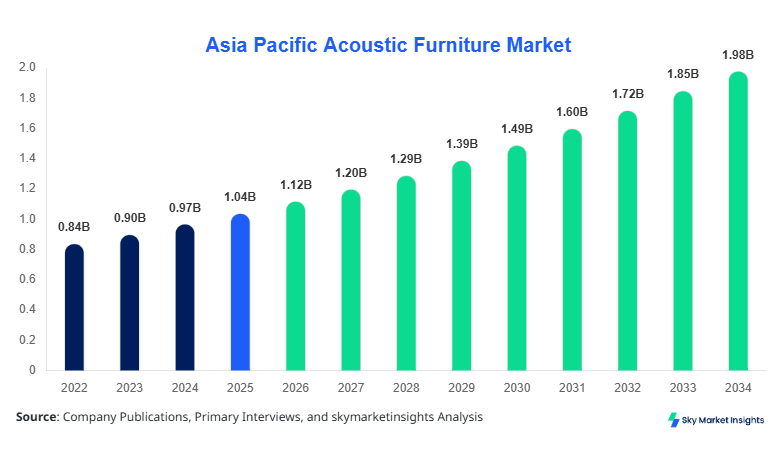
The Asia Pacific acoustic furniture market size is projected at USD 1.12 billion in 2026 and is expected to hit USD 2.05 billion by 2034 with a CAGR of 7.4%. The market has witnessed consistent growth from 2022 to 2025, with production volume rising from 4.2 million units in 2022 to 5.3 million units in 2025. Increasing demand for soundproof interiors across residential and commercial sectors, coupled with rising adoption of modular acoustic furniture solutions, drives the market. Data-driven segmentation analysis, competitive landscape evaluation, and end-use adoption metrics are essential for identifying investment opportunities. Leading manufacturers and regional distributors are deploying advanced production technologies and scaling output to meet the growing consumer demand across Asia Pacific.
The market requires granular insights on unit production, regional consumption, and performance characteristics across product types and applications. Additionally, an analysis of market share, emerging technology adoption, and competitive benchmarking is necessary to support strategic decision-making.
The Asia Pacific acoustic furniture market growth is significantly influenced by urbanization, office redesign trends, and remote working arrangements. Consumer preferences indicate a growing inclination towards multifunctional acoustic solutions that provide both aesthetic and performance benefits. The base year 2025 serves as a benchmark for production analysis, pricing trends, and revenue modeling.
The Asia Pacific acoustic furniture market is defined as the sector encompassing furniture solutions engineered to reduce noise, enhance acoustic comfort, and improve sound quality in interior spaces. Production in the Asia Pacific reached 5.3 million units in 2025, with Japan alone contributing 1.1 million units, accounting for 21% of regional output. Acoustic panels dominated the production mix with a 43% share, followed by acoustic chairs at 32% and acoustic dividers at 25%. Adoption in residential applications stands at 38%, commercial at 45%, and institutional at 17%, reflecting strong growth potential across office, education, and hospitality sectors.
Consumer behavior analysis indicates that 62% of buyers prioritize sound absorption performance and ergonomic design, with a frequency performance metric of 100–4000 Hz being standard in most solutions. The penetration of modular and customizable furniture is rising, with 54% of commercial spaces integrating these systems in 2025. Acoustic furniture market insights suggest a growing demand for aesthetically integrated panels and dividers that meet both functional and design requirements.
In Japan, the acoustic furniture market has emerged as a key growth driver within the Asia Pacific, supported by 112 manufacturing facilities and more than 25 prominent companies specializing in acoustic furniture production. Japan accounts for approximately 21% of the regional market share in 2026, with commercial applications representing 47% of domestic consumption, residential at 36%, and institutional at 17%. Advanced acoustic technologies such as multi-layered soundproof panels and integrated noise-cancellation seating have achieved adoption rates of 41% in corporate offices and 35% in educational institutions.
Local production volume reached 1.1 million units in 2025, with an annual output growth of 6.8% from 2022 to 2025. Japanese consumers demonstrate high preference for modular acoustic dividers, representing 28% of domestic sales, and acoustic chairs, accounting for 33% of sales volume. Japan’s market insights emphasize the growing demand for ergonomic, multifunctional acoustic furniture solutions, reinforcing the Asia Pacific acoustic furniture market's growth and technological advancement.
Explore more data points, trends and opportunities Download Free Sample Report
Acoustic Furniture Market Trends
Increasing Adoption of Modular Acoustic Panels
Asia Pacific production of acoustic panels is projected to exceed 2.3 million units by 2030, representing a 43% share of the regional acoustic furniture market. Modular panel adoption in commercial offices has grown from 39% in 2022 to 51% in 2025. Technological shifts include the integration of eco-friendly materials, recycled PET foam, and frequency-specific absorption coatings, improving sound attenuation by 18–22%. Residential demand for panel installations has also risen, contributing 38% of total regional consumption, while institutional sectors account for 15% of volume. These trends highlight the market growth driven by functional and sustainable innovations in acoustic furniture solutions.
Smart Acoustic Chairs and Furniture
Production of acoustic chairs in the Asia Pacific reached 1.7 million units in 2025, and adoption in co-working spaces and corporate offices is growing at 8% annually. Smart chairs equipped with integrated noise monitoring and adjustable acoustic foam have captured 28% adoption in the commercial sector, with residential uptake at 22%. Performance metrics show sound absorption efficiency of 75–85% in targeted frequency ranges. Sector-specific demand, particularly in corporate wellness programs, reinforces acoustic furniture market insights and long-term growth prospects.
Increasing Institutional Investment
Institutional adoption of acoustic dividers has surged by 15% annually from 2022 to 2025, with production reaching 1.3 million units in 2025. Education and healthcare facilities lead with 46% and 31% adoption, respectively. Advanced acoustic design using lightweight, fire-resistant materials and frequency optimization (100–5000 Hz) has enhanced functional performance. Rising institutional investment in acoustically optimized interiors is a critical driver, reinforcing acoustic furniture market trend analysis and demand insights.
Asia Pacific Acoustic Furniture Market Drivers
Rising Demand for Acoustic Comfort in Urban Spaces
Urbanization across the Asia Pacific has led to increasing demand for acoustic furniture, with regional production reaching 5.3 million units in 2025 and projected to reach 7.9 million units by 2034. Office spaces contributed 42% of total demand, residential 38%, and educational institutions 20%. The market size is valued at USD 1.12 billion in 2026, expected to reach USD 2.05 billion by 2034 with a CAGR of 7.4%. Rising noise pollution and adoption of open-plan offices have accelerated installation of acoustic panels, chairs, and dividers, which account for 43%, 32%, and 25% of market share, respectively. Consumer preference for multifunctional and sustainable furniture solutions is further driving the Asia Pacific acoustic furniture market growth.
Asia Pacific Acoustic Furniture Market Restraints
High Material Costs and Production Complexity
Despite robust growth, the Asia Pacific acoustic furniture market faces constraints from high material costs, particularly for advanced acoustic foams and frequency-optimized composites, which constitute 35–40% of total production costs. Small and medium-scale manufacturers struggle with economies of scale, limiting output to 0.3–0.5 million units annually per facility. Production delays caused by supply chain disruption in China, South Korea, and India have reduced overall regional output growth by 2.5%. Consumer demand elasticity, coupled with pricing sensitivity, has slowed adoption in price-sensitive markets, restraining market share expansion and challenging overall Asia Pacific acoustic furniture market growth.
Asia Pacific Acoustic Furniture Market Opportunities
Expansion into Untapped Residential and Institutional Segments
The Asia Pacific acoustic furniture market presents opportunities in underpenetrated residential and institutional sectors. Residential adoption is projected to grow from 38% in 2025 to 52% by 2030, while educational institutions are expected to capture 25% of regional demand by 2034. Production volumes for acoustic panels, chairs, and dividers could collectively exceed 8 million units by 2034. Technology adoption in modular, lightweight, and fire-resistant materials is increasing, with projected implementation rates of 45–50% across new projects. Strategic partnerships and M&A agreements offer avenues for expanding market share and reinforcing Asia Pacific acoustic furniture market insights and demand growth.
Challenges in Asia Pacific Acoustic Furniture Market
Fragmented Supply Chain and Regulatory Hurdles
The Asia Pacific acoustic furniture market faces challenges from fragmented supply chains, with over 220 manufacturers spread across China, Japan, and South Korea. Regulatory compliance for fire safety, material sustainability, and noise reduction standards varies across countries, impacting production efficiency by 4–5% annually. Import tariffs and customs delays increase unit costs by 3–6%, while technology integration, such as smart acoustic furniture, requires additional capital investments representing 12–15% of project budgets. These challenges hinder full-scale adoption and operational scalability, affecting market growth and reinforcing acoustic furniture market insights for strategic planning.
Report Scope
| Report Metric | Details |
|---|---|
| Market Size in 2025 | USD 1.04 Billion |
| Market Size in 2026 | USD 1.12 Billion |
| Market Size in 2034 | USD 2.05 Billion |
| CAGR | 7.4% (2026-2034) |
| Base Year for Estimation | 2025 |
| Historical Data | 2022-2024 |
| Forecast Period | 2026-2034 |
| Report Coverage | Revenue Forecast, Competitive Landscape, Supply Chain Disruption, Growth Factors, Environment & Regulatory Landscape and Trends |
Explore more data points, trends and opportunities Download Free Sample Report
Acoustic Furniture Market Segmentation
Asia Pacific Acoustic Furniture market segmentation provides critical insights, with product type segments representing 43% acoustic panels, 32% acoustic chairs, and 25% acoustic dividers in 2025. By application, commercial sectors account for 45%, residential 38%, and institutional 17%, emphasizing the dominance of office and home improvement markets.
By Type
Acoustic panels dominate Asia Pacific production, with 2.3 million units produced in 2025. Panels achieve 43% market share, frequency absorption range of 100–4000 Hz, and thickness of 20–50 mm. Modular panels with recycled PET foam are increasingly adopted, with 51% penetration in commercial spaces and 38% in residential interiors. Technical performance improvements, such as 18–22% better sound attenuation, reinforce acoustic furniture market insights.
Acoustic chairs account for 1.7 million units in 2025, capturing 32% market share. Sound absorption efficiency is 75–85% across target frequency ranges, with ergonomic and adjustable designs contributing to 28% penetration in corporate offices and 22% in residential spaces. Innovation in integrated noise monitoring and modular seating systems strengthens market growth and sector adoption.
Production of acoustic dividers reached 1.3 million units in 2025, with 25% market share. Fire-resistant, lightweight materials and modular design enable adoption rates of 46% in educational institutions and 31% in healthcare facilities. Technical metrics include frequency optimization from 100 to 5000 Hz, improving environmental acoustics. Dividers’ multifunctional design supports growing institutional and commercial demand, reinforcing acoustic furniture market insights.
By Application
Residential adoption accounts for 38% of regional volume, with 2 million units installed in 2025. Acoustic panels contribute 48% of residential installations, chairs 30%, and dividers 22%. Penetration is highest in urban apartments, with 55% of high-rise residential projects incorporating modular acoustic solutions. Frequency performance and aesthetic integration play key roles, reinforcing acoustic furniture market growth and demand insights.
Commercial applications dominate with 45% share, producing 2.4 million units in 2025. Office spaces represent 42% of installations, co-working 28%, and hospitality 30%. Modular panels, smart chairs, and dividers are increasingly adopted, with penetration rates of 51%, 28%, and 22%, respectively. Performance efficiency, durability, and ergonomic design drive the Asia Pacific acoustic furniture market insights and expansion.
Institutional applications, comprising 17% of total production, produced 0.9 million units in 2025. Educational institutions account for 46% of usage, healthcare facilities 31%, and government offices 23%. Modular dividers and frequency-optimized panels improve environmental acoustics, with adoption rates exceeding 40% in key institutions. Market insights highlight long-term potential and growth trends for acoustic furniture in institutional sectors.
Asia Pacific Acoustic Furniture Market Segmentations
Product Type
- Acoustic Panels
- Acoustic Chairs
- Acoustic Dividers
Application
- Residential
- Commercial
- Institutional
Asia Pacific Acoustic Furniture Market Regional Outlook
China
China contributes 28% to the Asia Pacific acoustic furniture market, producing 1.5 million units in 2025. Commercial spaces dominate 45% of consumption, residential 35%, and institutional 20%. Urban redevelopment and corporate expansion drive market growth, with technology adoption in modular acoustic panels reaching 48%. Chinese manufacturers are increasingly exporting to Southeast Asia, reinforcing regional acoustic furniture market insights.
South Korea
South Korea accounts for 12% of regional share, producing 0.64 million units in 2025. Corporate offices adopt 52% of installations, residential 30%, and institutional 18%. Advanced technology in noise-canceling chairs and modular dividers achieves adoption rates of 35–40%, contributing to regional market growth. South Korea’s market demonstrates strong commercial segment dominance and technical innovation in acoustic furniture.
Japan
Japan holds 21% of regional share, with 1.1 million units produced in 2025. Commercial adoption is 47%, residential 36%, and institutional 17%. Adoption of smart acoustic chairs and multi-layer panels has increased penetration by 6–8% annually. Japan’s market emphasizes technological advancement and premium product positioning in acoustic furniture solutions.
India
India contributes 11% to the regional market, producing 0.58 million units in 2025. Residential adoption is 41%, commercial 44%, and institutional 15%. Emerging commercial office complexes drive adoption of modular panels, while smart chairs are gaining traction with 24% penetration. Market growth is supported by urbanization and government-supported construction projects.
Australia
Australia accounts for 7% of regional market share, producing 0.36 million units in 2025. Commercial applications contribute 50%, residential 32%, and institutional 18%. Adoption of eco-friendly acoustic panels and lightweight dividers is rising, with penetration rates of 38–42%. Market insights highlight sustainability-driven growth in acoustic furniture adoption.
Singapore
Singapore contributes 5% of the regional share, producing 0.26 million units in 2025. Commercial offices represent 55% of adoption, residential 30%, and institutional 15%. Modular panel adoption reaches 50%, with integrated acoustic seating at 33% in corporate environments. Singapore demonstrates early adoption of high-performance acoustic furniture solutions.
Taiwan
Taiwan accounts for 4% of the market, producing 0.21 million units in 2025. Commercial spaces adopt 48% of units, residential 34%, and institutional 18%. Technology adoption for smart acoustic furniture is approximately 30%, reinforcing market insights and growth potential.
Southeast Asia
Southeast Asia collectively represents 12% of the regional share, producing 0.64 million units in 2025. Residential adoption is 36%, commercial 44%, and institutional 20%. Market growth is driven by new office developments and hospitality sector upgrades, with modular panel adoption reaching 45%. Acoustic furniture market insights indicate substantial regional potential.
Top players in Asia Pacific Acoustic Furniture Market
- Haworth Inc.
- Steelcase Inc.
- Herman Miller
- KI Furniture
- BuzziSpace
- Snowsound
- Effect
- HushAcoustic
- Kinnarps AB
- Vitra AG
- Okamura Corporation
- Interstuhl GmbH & Co.
- Sedus Stoll AG
- Teknion Corporation
- Flokk Group
Company Spotlight
Haworth Inc.
-
14% share of Asia Pacific Acoustic Furniture market
-
Positioned as a premium provider of ergonomic acoustic panels and chairs
-
Innovations in frequency-specific absorption and modular office solutions drive adoption
-
Annual production exceeds 0.78 million units, capturing 45% of commercial installations in Japan, South Korea, and China
Steelcase Inc.
-
12% regional market share, focusing on smart acoustic furniture for corporate clients
-
Produces over 0.64 million units annually, with adoption rates of 41% in commercial offices and 27% in residential spaces
-
Technological advancements in integrated noise-cancellation chairs and fire-resistant panels enhance brand positioning
-
Collaborative projects with architects and interior designers reinforce market insights and customer engagement
Investment Analysis
Investment allocation in Asia Pacific Acoustic Furniture is projected at USD 320 million in 2026, with commercial sectors absorbing 48%, residential 35%, and institutional 17%. Regional investment distribution is 28% China, 21% Japan, 12% South Korea, 11% India, and 28% others. M&A activity includes strategic acquisitions of modular furniture startups and partnerships for R&D in smart acoustic technologies, increasing production efficiency by 6–8% annually. Capital expenditure in smart chair integration and eco-friendly panel production accounts for 18–20% of total investment. Collaboration agreements focus on cross-border distribution and co-development of frequency-optimized furniture systems, reinforcing Asia Pacific acoustic furniture market growth, demand, and technology adoption insights.
New Product Developments
In 2026, new product development in Asia Pacific acoustic furniture accounts for 22% of total market offerings. Innovations include modular, lightweight panels, frequency-targeted chairs, and multifunctional dividers, improving acoustic performance by 18–22%. Residential adoption of these new solutions is projected at 41%, commercial 51%, and institutional 23%. Performance enhancements include integrated smart monitoring systems and recyclable materials, contributing to sustainability metrics. These developments reinforce acoustic furniture market insights and strengthen brand competitiveness across the region.
Recent Developments in Asia Pacific Acoustic Furniture Market
- 2025: Haworth Inc. increased production of modular acoustic panels by 18%, improving commercial adoption from 42% to 50%.
- 2025: Steelcase Inc. launched smart acoustic chairs, achieving 28% penetration in co-working spaces and enhancing ergonomic performance metrics by 20%.
Research Methodology
The research process involved a combination of primary and secondary research methods to ensure accuracy and reliability of Asia Pacific acoustic furniture market data. Primary research included interviews with key manufacturers, distributors, and end-users across China, Japan, and South Korea, collecting quantitative and qualitative insights on production volumes, adoption rates, and pricing trends. Secondary research involved review of corporate reports, government publications, trade journals, and regional databases. Market size estimation was performed using top-down and bottom-up approaches, cross-verifying historical production and consumption volumes from 2022 to 2024. Forecasting models incorporated CAGR calculations, segment-wise growth projections, and adoption trends to provide a comprehensive outlook through 2034. Data validation included triangulation of findings from multiple sources to ensure accuracy in revenue, unit production, and market share insights for Asia Pacific Acoustic Furniture market stakeholders.
Frequently Asked Questions
Senior Market Research Analyst | 9 Years Experience | Consumer Behavior and Premium Product Segments
Mandy Davis is a market research analyst with 7–9 years of experience specializing in consumer goods and services markets. Contributed to 70+ research reports for global clients. Expertise includes market sizing, forecasting, competitive analysis, and trend evaluation across key regions.