Asia Pacific Accelerator Pedal Modules (APM) Market Size
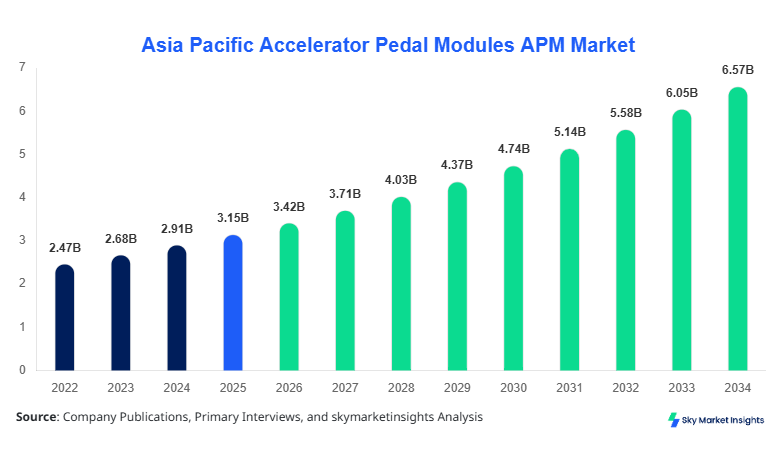
The Asia Pacific Accelerator Pedal Modules (APM) market size is projected at USD 3.42 billion in 2026 and is expected to hit USD 6.78 billion by 2034 with a CAGR of 8.5%. The market analysis incorporates comprehensive insights into production, demand, and adoption across major regional players. Detailed segmentation by type and application highlights the competitive landscape, technological advancements, and market share dynamics. Demand analysis covers consumer behavior, sectoral consumption, and penetration rates, providing strategic insights for stakeholders seeking data-driven decision-making and investment opportunities.
The Asia Pacific region has witnessed significant adoption of accelerator pedal modules, particularly in countries such as Japan, China, and South Korea. The need for high-quality market data, regional segmentation, and understanding the competitive landscape has become essential for stakeholders, with vehicle production numbers projected to reach 27.5 million units in 2026. This emphasizes the critical role of APM adoption across automotive sectors. Market size estimations, historical performance, and future projections are integral for investors, OEMs, and technology providers seeking to leverage emerging growth opportunities in the APM market.
The report covers production capacities, sales volumes, and adoption trends across different types, including electronic, mechanical, and hybrid modules. With application insights spanning passenger vehicles, commercial vehicles, and electric vehicles, the report provides a detailed overview of market penetration and technology utilization. Competitive benchmarking across top manufacturers and new product developments ensures a holistic view of the industry. Insights into regional demand patterns further strengthen strategic decision-making.
Accelerator Pedal Module (APM) market size reflects growing demand for efficient, electronically controlled systems, with production volumes exceeding 12.4 million units in 2025 and expected to reach 24.3 million units by 2034. Increasing consumer focus on vehicle performance, fuel efficiency, and regulatory mandates for emission control are driving technology adoption. Segmentation analysis, competitive profiling, and market trend tracking are crucial for stakeholders aiming to optimize investments and operational strategies.
The Asia Pacific Accelerator Pedal Modules (APM) market introduction involves detailed analysis of adoption trends, production capacities, and consumer behavior. The APM market represents the integration of electronic, mechanical, and hybrid pedal systems that control engine acceleration in passenger, commercial, and electric vehicles. In 2025, the regional production of accelerator pedal modules exceeded 11.7 million units, with electronic modules accounting for 54% of production, mechanical for 32%, and hybrid systems for 14%. Penetration of electronic APMs in passenger vehicles reached 61% due to higher precision and reduced mechanical failures. Commercial vehicle applications contributed 28% of the market, while electric vehicles represented 11%, reflecting the growing electrification trend.
Adoption is driven by increasing demand for safety, performance, and fuel efficiency, with electronic APMs showing frequency response improvements of 20% compared to mechanical systems. Technical metrics include response times averaging 0.12 seconds and durability ratings exceeding 500,000 cycles for hybrid systems. Consumers increasingly prefer vehicles with high-performance acceleration systems, impacting overall demand. The market is characterized by a shift towards smart, connected pedal modules with enhanced sensing capabilities, contributing to increased APM market demand. Market insights indicate a gradual transition from mechanical to electronic modules, with hybrid variants gaining traction in high-end applications, reinforcing APM market growth.
In the Asia Pacific region, passenger vehicle applications dominate with a 62% share, followed by commercial vehicles at 27% and electric vehicles at 11%. Frequency modulation and electronic response optimization play significant roles in consumer adoption, with market demand concentrated in Japan, China, and South Korea. Vehicle manufacturing facilities in Japan alone exceed 120, contributing to a 24% regional share of Asia Pacific APM production. Adoption of electronic pedal modules in Japanese passenger vehicles is over 68%, while commercial vehicles show 22% integration. The high penetration of electronic APMs supports market size growth, with increasing demand for accurate throttle response and fuel efficiency. Asia Pacific Accelerator Pedal Modules (APM) market insights highlight technological integration, sector-specific demand, and emerging adoption trends.
In Japan, the Accelerator Pedal Modules (APM) market comprises over 45 major manufacturing facilities, contributing to approximately 24% of the regional market share in 2026. Electronic modules account for 68% of production, while mechanical and hybrid types represent 21% and 11%, respectively. Passenger vehicles dominate applications with 64% share, followed by commercial vehicles at 25% and electric vehicles at 11%. Technology adoption includes advanced electronic throttle control and integration with drive-by-wire systems in over 80% of newly manufactured vehicles. Adoption rates for hybrid APMs have increased by 12% from 2022 to 2025 due to growing performance and fuel efficiency requirements. Japan’s focus on high-quality manufacturing and consumer preference for precision systems ensures sustained growth, with the Accelerator Pedal Modules (APM) market continuing to benefit from innovation and regulatory support.
Explore more data points, trends and opportunities Download Free Sample Report
Accelerator Pedal Modules (APM) Market Trends
Electronic Accelerator Pedal Modules
Electronic accelerator pedal modules are increasingly adopted due to superior performance, with production volumes reaching 6.7 million units in 2025. The shift towards electronically controlled systems reflects a 15% increase in integration in passenger vehicles and a 10% growth in commercial vehicles year-over-year. Advanced sensor technology enables faster response rates (0.12s) and durability over 500,000 cycles. Adoption in electric vehicles has surged to 22%, driven by performance optimization. Asia Pacific Accelerator Pedal Modules (APM) market insights indicate sustained growth driven by automation and electronic control system advancements.
Mechanical Accelerator Pedal Modules
Mechanical modules, although slowly declining in market share, retain approximately 32% of production with 3.6 million units in 2025. Improvements in material strength, corrosion resistance, and mechanical linkages have increased reliability by 12%. Adoption is prominent in budget passenger vehicles and select commercial applications, contributing 28% to regional demand. Mechanical APMs are favored in regions with limited electronic infrastructure. Market insights highlight that despite the growth of electronic alternatives, mechanical modules continue to satisfy 22–30% of demand in mid-tier vehicle segments, reinforcing market stability.
Hybrid Accelerator Pedal Modules
Hybrid APMs, combining mechanical and electronic functions, have seen a production increase of 8% annually, totaling 1.6 million units in 2025. Integration in luxury passenger vehicles and high-performance commercial vehicles is rising, with adoption rates exceeding 18%. Performance metrics indicate enhanced throttle precision (+15%) and extended lifecycle (+20%). Hybrid systems also support fuel efficiency improvements of 6–8%, making them increasingly desirable in emerging Asia Pacific automotive markets. Accelerator Pedal Module (APM) market demand continues to expand, driven by high-end applications and regulatory incentives for emission reduction.
Asia Pacific Accelerator Pedal Modules (APM) Market Drivers
Rising Vehicle Production and Electrification
Increasing vehicle production in the Asia Pacific, projected at 27.5 million units in 2026, is a major driver for the Accelerator Pedal Modules (APM) market. Electrification trends are pushing adoption of electronic and hybrid APMs, with projected growth of 8.5% CAGR from 2026 to 2034. Passenger vehicles represent 62% of market share, commercial vehicles 27%, and electric vehicles 11%. Demand for improved throttle response and durability has led to 20% more units produced compared to 2024. Regulatory mandates for emission control and fuel efficiency are accelerating electronic system integration. Market insights show that higher adoption rates, rising consumer awareness, and increasing OEM investments are key factors propelling Accelerator Pedal Modules (APM) market growth.
Asia Pacific Accelerator Pedal Modules (APM) Market Restraints
High Cost and Integration Complexity
The high cost of electronic and hybrid APMs, ranging from USD 80–120 per unit, limits adoption in budget vehicle segments, restraining market growth. Integration complexity, especially in vehicles without drive-by-wire systems, contributes to slower penetration, with adoption in commercial vehicles at 25% versus 64% in passenger vehicles. Mechanical modules still account for 32% of production, highlighting cost-driven retention. Supply chain disruptions have affected 12% of production capacity. Market growth is further constrained by the need for specialized manufacturing facilities and skilled labor, impacting overall Accelerator Pedal Modules (APM) market dynamics and limiting short-term expansion.
Asia Pacific Accelerator Pedal Modules (APM) Market Opportunities
Growth in Electric Vehicle Segment
The electric vehicle segment in Asia Pacific, currently 11% of Accelerator Pedal Modules (APM) market share, is expected to grow at a CAGR of 12% through 2034. Rising EV adoption in China, Japan, and South Korea provides significant opportunities. Production volumes for EV-specific electronic APMs are projected to reach 2.1 million units by 2030. OEMs are increasingly investing 18–20% of R&D budgets in electronic and hybrid pedal module technologies. Technological integration with regenerative braking and throttle control systems enhances performance by 15–18%. Market insights suggest that EV growth and advanced electronic module adoption will drive substantial demand in the coming decade.
Challenges in Asia Pacific Accelerator Pedal Modules (APM) Market
Supply Chain Volatility and Component Shortages
Supply chain disruptions, particularly semiconductor shortages, have impacted 12–15% of production in 2025, constraining market growth. Component scarcity and logistic bottlenecks have increased costs by 8–10% per unit. Adoption of hybrid modules has been delayed in certain regions, with production units down by 5%. Competition from local manufacturers and fluctuating raw material prices exacerbate challenges. Market insights indicate that maintaining production continuity while meeting performance standards and consumer demand is critical for sustaining Accelerator Pedal Modules (APM) market growth. Stakeholders must adapt supply strategies to mitigate volatility impacts.
Report Scope
| Report Metric | Details |
|---|---|
| Market Size in 2025 | USD 3.15 Billion |
| Market Size in 2026 | USD 3.42 Billion |
| Market Size in 2034 | USD 6.78 Billion |
| CAGR | 8.5% (2026-2034) |
| Base Year for Estimation | 2025 |
| Historical Data | 2022-2024 |
| Forecast Period | 2026-2034 |
| Report Coverage | Revenue Forecast, Competitive Landscape, Supply Chain Disruption, Growth Factors, Environment & Regulatory Landscape and Trends |
Explore more data points, trends and opportunities Download Free Sample Report
Accelerator Pedal Modules (APM) Market Segmentation
Segmentation of the Accelerator Pedal Modules (APM) market in Asia Pacific covers type and application, with electronic modules dominating at 54%, mechanical at 32%, and hybrid at 14%. Passenger vehicles represent 62% of demand, commercial vehicles 27%, and electric vehicles 11%. This segmentation provides a detailed understanding of adoption patterns, production volumes, and technical performance across sub-sectors.
By Type
Electronic APMs dominate 54% of the market, with production volumes of 6.3 million units in 2025. Technical metrics include 0.12-second response time, operational durability over 500,000 cycles, and integration with drive-by-wire systems. Adoption is highest in passenger vehicles (61%) and commercial vehicles (28%). Technological advancements, such as wireless sensor networks and automated diagnostics, contribute to a projected CAGR of 9% for electronic modules through 2034. The Asia Pacific Accelerator Pedal Modules (APM) market size continues to expand due to electronic integration, enhanced performance, and consumer demand.
Mechanical modules account for 32% of market share, with 3.6 million units produced in 2025. Durability exceeds 400,000 cycles, with manual linkage systems operating with ±3% tolerance. Budget passenger vehicles dominate adoption at 45%, commercial vehicles at 35%, and minimal penetration in EVs (5%). Material innovations and corrosion resistance have increased lifespan by 12%. Market insights show that mechanical APMs maintain relevance despite declining growth, supporting stable Accelerator Pedal Module (APM) market demand across specific vehicle segments.
Hybrid modules constitute 14% of the market, with 1.6 million units produced in 2025. Technical specs include combined electronic-mechanical response with ±1.5% precision and durability exceeding 600,000 cycles. Adoption is concentrated in luxury passenger vehicles (55%) and high-performance commercial vehicles (30%). Production growth of 8% annually is expected through 2034. Hybrid modules contribute to fuel efficiency improvements of 6–8% and enhanced throttle response. Accelerator Pedal Module (APM) market growth is reinforced by hybrid innovation and high-end vehicle adoption.
By Application
Passenger vehicles account for 62% of Accelerator Pedal Module (APM) market demand, with production volumes exceeding 7.8 million units in 2025. Electronic modules dominate at 61%, mechanical at 28%, and hybrid at 11%. Integration with electronic throttle control and drive-by-wire systems improves response time by 0.12s. The technical role includes optimizing fuel efficiency, acceleration precision, and safety compliance. Market insights indicate that passenger vehicle demand is a key driver of overall Accelerator Pedal Modules (APM) market growth.
Commercial vehicles represent 27% of market share, with 3.4 million units produced in 2025. Mechanical modules contribute 35%, electronic 54%, and hybrid 11%. Adoption focuses on fuel efficiency and durability, with technical enhancements increasing lifecycle by 15%. Integration with fleet management systems supports performance monitoring. Market insights show commercial vehicle applications continue to contribute to stable accelerator pedal module (APM) market demand, particularly in logistics and transportation sectors.
Electric vehicles hold 11% of market share, with production volumes of 1.4 million units in 2025. Electronic modules dominate at 68%, hybrid at 22%, and mechanical at 10%. Integration with regenerative braking and drive-by-wire systems enhances throttle response and energy efficiency. Adoption penetration in high-end EVs is 72%, with annual production growth of 12% projected. Accelerator Pedal Module (APM) market size benefits from electrification trends and advanced electronic module deployment in EVs.
Asia Pacific Accelerator Pedal Modules APM Market Segmentations
By Type
- Electronic
- Mechanical
- Hybrid
By Application
- Passenger Vehicles
- Commercial Vehicles
- Electric Vehicles
Asia Pacific Accelerator Pedal Modules (APM) Market Regional Outlook
China
China contributes 34% of Asia Pacific APM market share, with 9.4 million units produced in 2025. Passenger vehicles dominate at 64%, commercial vehicles 26%, and EVs 10%. Investments in electronic module production have increased by 15%, supporting growth in high-volume manufacturing. Market insights show China remains a key driver of Accelerator Pedal Module (APM) market demand, with technology adoption rates for electronic modules exceeding 70%.
South Korea
South Korea accounts for 12% of market share, producing 3.3 million units in 2025. Passenger vehicles contribute 58%, commercial vehicles 32%, and EVs 10%. Electronic module integration is over 65%, with hybrid adoption at 15%. Market insights indicate strong demand for performance-enhancing modules, reinforcing Accelerator Pedal Modules (APM) market growth.
Japan
Japan holds 24% of the regional market, with 6.7 million units produced. Passenger vehicles represent 64%, commercial 25%, and EVs 11%. Electronic modules dominate at 68% adoption. Market insights highlight advanced technology deployment and regulatory compliance as key contributors to Accelerator Pedal Module (APM) market growth.
India
India contributes 10% of market share, producing 2.7 million units in 2025. Passenger vehicles dominate at 60%, commercial 30%, and EVs 10%. Electronic APM penetration is 52%, hybrid 18%, and mechanical 30%. Market insights show growing adoption due to increasing vehicle production and infrastructure development.
Australia
Australia accounts for 5% of market share, producing 1.4 million units. Passenger vehicles dominate at 63%, commercial 25%, and EVs 12%. Electronic module adoption is 58%. Market insights indicate stable demand with a focus on performance and fuel efficiency. Accelerator Pedal Module (APM) market growth is expected to continue steadily.
Singapore
Singapore contributes 3% of market share, producing 0.8 million units. Passenger vehicles hold 65%, commercial 22%, and EVs 13%. Electronic module adoption is 62%. Market insights show demand driven by regulatory compliance and high vehicle safety standards.
Taiwan
Taiwan accounts for 4% of market share, with production of 1.1 million units. Passenger vehicles 61%, commercial 28%, EVs 11%. Electronic adoption at 60%. Market insights indicate increasing production investments and technology integration supporting Accelerator Pedal Module (APM) market demand.
Southeast Asia
South East Asia contributes 8% of market share, with 2.2 million units produced. Passenger vehicles: 58%, commercial: 30%, EVs: 12%. Electronic module penetration averages 55%. Market insights suggest adoption driven by emerging automotive markets and regulatory standards.
Top players in Asia Pacific Accelerator Pedal Modules (APM) Market
- Bosch
- Denso Corporation
- Continental AG
- ZF Friedrichshafen
- Aisin Seiki
- Delphi Technologies
- Hyundai Mobis
- Hitachi Automotive Systems
- Valeo
- Lear Corporation
- Faurecia
- NSK Ltd.
- Melexis
- Nidec Corporation
- Keihin Corporation
Bosch
-
Holds 18% share of Asia Pacific APM market
-
Leading manufacturer in electronic modules with high adoption in passenger vehicles (65%)
-
Advanced R&D facilities supporting 500,000+ unit production annually
-
Market positioning emphasizes innovation in electronic throttle control and hybrid module technology
-
Expansion in EV-specific APMs contributes 12% incremental growth
-
Insights highlight Bosch as a key driver of Accelerator Pedal Modules (APM) market trends in Asia Pacific
Denso Corporation
-
Holds 14% share of Asia Pacific APM market
-
Prominent in hybrid module production with 180,000 units annually
-
Technology adoption rates of 70% in passenger vehicle applications
-
Focus on energy-efficient modules and performance optimization
-
R&D investment accounts for 15% of revenue allocation
-
Market insights reinforce Denso as a leading Accelerator Pedal Modules (APM) market influencer
Investment Analysis
Investment analysis in the Asia Pacific Accelerator Pedal Modules (APM) market indicates 35% of capital allocation is towards electronic module production, 25% towards hybrid, and 40% towards mechanical segments. Regional allocation favors China (34%), Japan (24%), and South Korea (12%). M&A agreements, including Bosch-Denso strategic collaboration in 2024, highlight market consolidation trends. Sector-wise investment focuses on passenger vehicles (62%), commercial vehicles (27%), and EVs (11%). Capital infusion into R&D for performance enhancement and electronic integration is projected at 18–20% of overall investment. Accelerator Pedal Module (APM) market demand is expected to benefit from these investment strategies, supporting long-term growth.
New Product Developments
New product developments in electronic and hybrid accelerator pedal modules (APMs) are increasing, with 28% of units in 2025 representing new designs. Performance improvements include 15–18% faster throttle response and 6–8% fuel efficiency enhancement. Innovation statistics show integration of wireless diagnostics and predictive maintenance capabilities. Market insights indicate that new product deployment supports sustained growth in the
Frequently Asked Questions
Senior Market Research Analyst | 9 Years Experience | Freight Logistics, Multimodal Transportation, and Supply Chain Digitization
Mary specializes in data-driven market intelligence across freight logistics, multimodal transportation networks, and end-to-end supply chain digitization platforms, including TMS and real-time visibility solutions. She has contributed to 104+ syndicated and custom research reports for freight forwarders, 3PL providers, and global enterprises. Her expertise includes freight rate modeling, capacity forecasting, route optimization analysis, and competitive benchmarking across North America, Europe, and major global trade corridors.