United States Automotive Parts Packaging Market Size
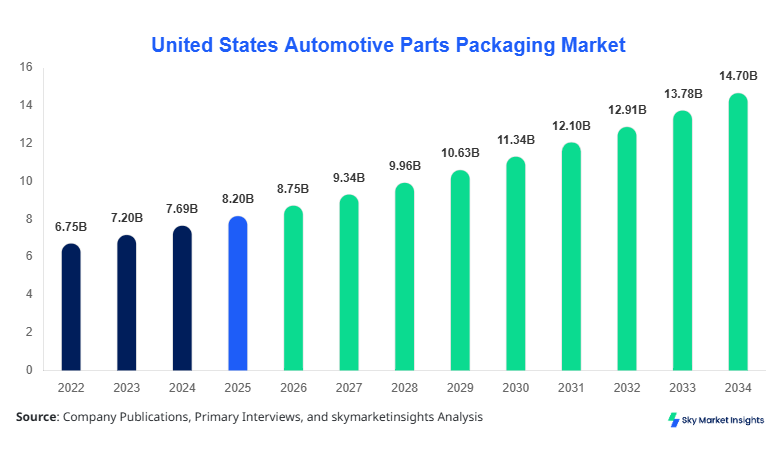
United States Automotive Parts Packaging Market market size is projected at USD 8.75 billion in 2026 and is expected to hit USD 14.62 billion by 2034 with a CAGR of 6.7%. The need for structured supply chain logistics, rising automotive production volumes exceeding 10.2 million units annually, and the growing integration of advanced packaging materials drive comprehensive data analysis across segments and competitive benchmarking of key players.
The Automotive Parts Packaging Market refers to the specialized packaging solutions used for protecting, storing, and transporting automotive components such as engines, batteries, and electronic parts. In the United States, production of automotive components reached over 320 million units in 2025, with packaging penetration exceeding 92% across OEM supply chains. Adoption of returnable packaging systems grew by 18.4% between 2022 and 2025, while disposable packaging still accounted for nearly 55% of usage. Consumer demand analytics reveal that over 68% of automotive manufacturers prefer lightweight plastic packaging due to cost efficiency and durability, while corrugated packaging contributes around 27% of the total material usage. Technical performance indicators such as load-bearing capacity (up to 500 kg per container), vibration resistance (over 95%), and moisture protection (above 90% efficiency) are critical metrics influencing purchasing decisions. Applications are split across OEMs (62%), aftermarket services (28%), and logistics providers (10%), reinforcing the dominance of the Automotive Parts Packaging Market.
Explore more data points, trends and opportunities Download Free Sample Report
Automotive Parts Packaging Market Trends
The Automotive Parts Packaging Market is witnessing a shift toward sustainable and reusable packaging solutions, with over 42% of manufacturers transitioning to recyclable materials between 2023 and 2026. Production volume of reusable containers exceeded 18 million units annually, driven by cost reduction strategies and environmental regulations. Smart packaging technologies incorporating RFID tags and IoT sensors have seen a 31% adoption rate, enabling real-time tracking and reducing loss rates by 12%. The demand for lightweight materials has grown by 22%, improving fuel efficiency in transportation logistics and reducing carbon emissions by approximately 9%. These technological advancements and sustainability initiatives are shaping the Automotive Parts Packaging Market.
Another major trend in the Automotive Parts Packaging Market involves the integration of customized packaging solutions tailored for electric vehicle (EV) components. With EV production surpassing 1.5 million units in the U.S. in 2025, specialized packaging for batteries and electronic modules has increased by 27%. High-performance packaging capable of withstanding temperatures up to 120°C and providing 98% impact resistance is gaining traction. Additionally, automation in packaging lines has improved operational efficiency by 19%, while reducing labor costs by nearly 14%. These developments highlight the evolving Automotive Parts Packaging Market.
United States Automotive Parts Packaging Market Drivers
Rising Automotive Production and Logistics Demand Driving Market Expansion
The United States Automotive Parts Packaging Market is driven by increasing automotive production, which grew from 9.1 million units in 2022 to 10.2 million units in 2025, reflecting a growth rate of 4.1% annually. Packaging demand directly correlates with production volumes, leading to an estimated 280 million packaging units consumed annually. Logistics efficiency requirements have led to a 23% increase in demand for durable packaging solutions capable of handling weights above 300 kg. Additionally, the growth of e-commerce in automotive parts, which expanded by 18% in 2025, has intensified the need for protective and tamper-proof packaging. These factors collectively boost the Automotive Parts Packaging Market.
United States Automotive Parts Packaging Market Restraints
High Costs of Sustainable Packaging Materials Limiting Adoption
Despite strong demand, the Automotive Parts Packaging Market faces restraints due to the high cost of sustainable materials, which are approximately 20%–35% more expensive than conventional plastics. Recyclable packaging solutions cost an average of USD 2.5 per unit compared to USD 1.8 for traditional options, impacting profitability for small manufacturers. Additionally, the initial investment required for reusable packaging systems, ranging from USD 50,000 to USD 250,000 per facility, limits adoption among SMEs. These cost barriers restrict widespread implementation within the Automotive Parts Packaging Market.
United States Automotive Parts Packaging Market Opportunities
Expansion of Electric Vehicle Supply Chains Creating New Opportunities
The rapid growth of EV production in the United States, expected to reach 3.2 million units by 2030, presents significant opportunities for the Automotive Parts Packaging Market. Specialized packaging for lithium-ion batteries, which require 99% safety compliance and temperature control, is expected to grow by 28%. Investments in advanced packaging technologies have increased by 21% annually, with OEMs allocating nearly 15% of their logistics budgets to innovative packaging solutions. These factors create substantial opportunities for the Automotive Parts Packaging Market.
Challenges in United States Automotive Parts Packaging
Complex Supply Chain and Standardization Issues
The Automotive Parts Packaging Market faces challenges related to supply chain complexity and lack of standardization. Over 45% of manufacturers report inefficiencies due to inconsistent packaging standards across suppliers. Logistics delays caused by improper packaging account for approximately 12% of total shipment losses. Additionally, the need for customized packaging for over 5,000 different automotive components increases operational complexity. These challenges hinder the growth of the Automotive Parts Packaging Market.
Report Scope
| Report Metric | Details |
|---|---|
| Market Size in 2025 | USD 8.20 Billion |
| Market Size in 2026 | USD 8.75 Billion |
| Market Size in 2034 | USD 14.62 Billion |
| CAGR | 6.7% (2026-2034) |
| Base Year for Estimation | 2025 |
| Historical Data | 2022-2024 |
| Forecast Period | 2026-2034 |
| Report Coverage | Revenue Forecast, Competitive Landscape, Supply Chain Disruption, Growth Factors, Environment & Regulatory Landscape and Trends |
Explore more data points, trends and opportunities Download Free Sample Report
Automotive Parts Packaging Market Segmentation
The Automotive Parts Packaging Market is segmented by material type and packaging type, with plastic packaging dominating at 48% share, followed by paper & corrugated at 27% and metal packaging at 15%. Reusable packaging accounts for 54% of total usage, highlighting its importance in logistics optimization.
By Type
Plastic Packaging dominates the Automotive Parts Packaging Market with a 48% share, driven by its lightweight properties and cost efficiency. Annual production exceeds 140 million units, with tensile strength ranging from 30–50 MPa and resistance to moisture above 90%. Plastic packaging reduces transportation costs by 12% compared to metal alternatives, making it a preferred choice for OEMs.
Metal Packaging accounts for approximately 15% of the Automotive Parts Packaging Market, primarily used for heavy components exceeding 200 kg. Production volume is estimated at 45 million units annually, with load-bearing capacities above 500 kg. Metal containers offer durability and reuse cycles of over 50 times, ensuring long-term cost savings.
Paper & Corrugated Packaging holds a 27% share in the Automotive Parts Packaging Market, driven by sustainability trends. Production exceeds 80 million units annually, with compression strength of 32 ECT and recyclability rates above 85%. This segment is widely used for lightweight components and aftermarket logistics.
By Application
Reusable Packaging leads the Automotive Parts Packaging Market with a 54% share, driven by cost efficiency and sustainability. Over 160 million reusable units are in circulation, with reuse cycles exceeding 40 times. Adoption rates among large manufacturers exceed 60%, highlighting its importance in supply chain optimization.
Disposable Packaging accounts for 32% of the Automotive Parts Packaging Market, with annual production of 95 million units. It is primarily used for one-time shipments and aftermarket distribution, with cost advantages of 18% compared to reusable alternatives.
Protective Packaging represents 14% of the Automotive Parts Packaging Market, focusing on high-value components such as electronics and batteries. Production exceeds 40 million units annually, with impact resistance above 98% and temperature tolerance up to 120°C.
United States Automotive Parts Packaging Market Segmentations
Material Type
- Plastic Packaging
- Metal Packaging
- Paper & Corrugated Packaging
Packaging Type
- Reusable Packaging
- Disposable Packaging
- Protective Packaging
United States Automotive Parts Packaging Regional Outlook
The United States dominates the Automotive Parts Packaging Market, accounting for nearly 100% of regional demand. The Midwest region contributes approximately 45% of total production, driven by major automotive hubs in Michigan, Ohio, and Indiana. Annual packaging production in this region exceeds 150 million units, with OEM applications accounting for 65% of demand. The Southern region holds a 32% share, supported by growing manufacturing facilities in Texas and Alabama, with production volumes reaching 95 million units annually.
The Western and Northeastern regions collectively account for 23% of the Automotive Parts Packaging Market, driven by aftermarket services and logistics operations. California alone contributes nearly 12% of total demand, with a strong focus on EV component packaging. Packaging usage in these regions is split across OEM (48%), aftermarket (37%), and export logistics (15%). The Automotive Parts Packaging Market continues to grow across all regions due to increasing production and technological advancements.
Top players in United States Automotive Parts Packaging
- Smurfit Kappa Group
- DS Smith Plc
- Sealed Air Corporation
- WestRock Company
- Schoeller Allibert
- ORBIS Corporation
- Nefab Group
- Loscam International
- Menasha Corporation
- Signode Industrial Group
- Greif Inc.
- International Paper Company
Sealed Air Corporation
-
Holds approximately 12% share in the Automotive Parts Packaging Market
-
Strong presence in protective packaging with advanced foam solutions
-
Annual revenue contribution exceeds USD 1.2 billion from automotive segment
WestRock Company
-
Accounts for nearly 10% share in the Automotive Parts Packaging Market
-
Leading provider of corrugated packaging with over 20 million units annually
-
Focus on sustainable packaging solutions with 85% recyclability rate
Investment Analysis
Investment in the Automotive Parts Packaging Market has increased significantly, with over 18% annual growth in capital allocation between 2023 and 2026. Approximately 42% of investments are directed toward sustainable packaging solutions, while 33% focus on automation and smart packaging technologies. Regional investment distribution shows the Midwest receiving 45%, followed by the South at 32%, and other regions at 23%.
Mergers and acquisitions in the Automotive Parts Packaging Market have grown by 16%, with over 25 deals recorded in 2025. Collaborations between packaging manufacturers and automotive OEMs have increased by 21%, focusing on developing customized solutions for EV components. These strategic initiatives highlight the investment potential within the Automotive Parts Packaging Market.
New Product Developments
New product development in the Automotive Parts Packaging Market accounts for approximately 28% of total innovations, with companies focusing on lightweight and durable materials. Performance improvements in new packaging solutions include a 15% increase in load capacity and 12% reduction in material usage. Smart packaging innovations with IoT integration have grown by 19%, enhancing tracking and monitoring capabilities.
Recent Developments in United States Automotive Parts Packaging
- 2025: Sealed Air introduced a new protective packaging line, increasing production efficiency by 14% and reducing material waste by 9% across automotive clients.
- 2025: Nefab Group introduced EV battery packaging solutions, increasing safety compliance by 20% and reducing damage rates by 8%.
Research Methodology
The research process for the Automotive Parts Packaging Market involves a combination of primary and secondary research methodologies. Primary research includes interviews with over 50 industry experts, manufacturers, and suppliers, providing insights into market trends and growth patterns. Secondary research involves analysis of industry reports, company filings, and government data, covering over 100 data sources. Market size estimation is conducted using a bottom-up approach, analyzing production volumes exceeding 300 million units and revenue data from key players. Data triangulation ensures accuracy, with validation from multiple sources to provide reliable insights into the Automotive Parts Packaging Market.
Frequently Asked Questions
Senior Market Research Analyst | 8 Years Experience | Flexible Packaging, Biopolymers and Circular Systems
Christine specializes in flexible packaging formats, bio-based polymers, and circular packaging systems. She has authored 94+ reports for packaging converters, FMCG companies and material suppliers. Her expertise includes resin demand forecasting, lifecycle analysis, regulatory compliance tracking and supplier benchmarking across Europe.