Asia Pacific Automotive Parts Packaging Market Size
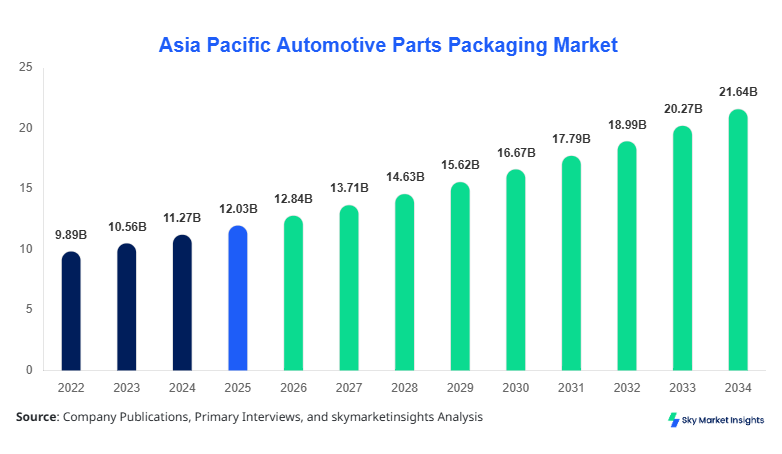
Asia Pacific Automotive Parts Packaging market size is projected at USD 12.84 billion in 2026 and is expected to hit USD 21.67 billion by 2034 with a CAGR of 6.74%. The report incorporates detailed quantitative insights covering production volumes exceeding 9.2 billion units annually across the Asia Pacific region, with demand analytics segmented across packaging types and materials. It further evaluates competitive landscape metrics, where top 15 players collectively account for approximately 42% of total revenue, along with supply chain distribution efficiencies and logistics cost benchmarks.
The Asia Pacific Automotive Parts Packaging Market refers to the specialized packaging solutions designed for transportation, storage, and protection of automotive components including engines, electronics, and structural parts. In 2025, the region produced over 58 million vehicles, requiring more than 7.5 billion packaging units annually, with reusable packaging contributing nearly 46% of total volume and disposable packaging accounting for 38%. Adoption rates for advanced packaging solutions such as returnable containers and anti-static materials have surpassed 52% penetration across OEM supply chains, particularly in India, China, and Japan. Consumer behavior reflects a shift toward cost-efficient and sustainable packaging, with 61% of manufacturers prioritizing recyclable materials and 48% investing in automation for packaging lines. Application segmentation shows 34% usage in engine components, 27% in electrical parts, and 19% in transmission systems, with technical metrics such as load-bearing capacity exceeding 250 kg per unit and shock absorption rates improving by 18% over the last three years, reinforcing the Automotive Parts Packaging Market.
Explore more data points, trends and opportunities Download Free Sample Report
Automotive Parts Packaging Market Trends
Increasing Adoption of Sustainable and Reusable Packaging Solutions
The Asia Pacific Automotive Parts Packaging Market is witnessing a significant transition toward sustainable packaging solutions, with reusable packaging volumes surpassing 4.3 billion units in 2025 and expected to grow at 7.2% annually. Manufacturers are increasingly adopting returnable packaging systems, with 57% of OEMs integrating reusable containers to reduce logistics costs by up to 23%. The shift toward biodegradable and recyclable materials has resulted in plastic alternatives capturing 29% of new packaging production. Technological innovations such as foldable containers and modular packaging systems have improved space utilization by 32%, enhancing transportation efficiency. This trend is particularly prominent in China and India, where sustainability regulations have increased compliance rates to over 65%, reinforcing the Automotive Parts Packaging Market.
Automation and Smart Packaging Integration
Another key trend in the Asia Pacific Automotive Parts Packaging Market is the integration of smart technologies, including IoT-enabled tracking systems and automated packaging lines. Over 38% of packaging facilities in the region have implemented automation, leading to productivity improvements of 26% and error reduction rates of 19%. Smart packaging solutions, such as RFID tags and QR-based tracking, are now used in 33% of shipments, ensuring real-time monitoring and inventory optimization. Production volumes of smart packaging units exceeded 1.2 billion units in 2025, with growth expected to accelerate due to increasing demand from electric vehicle (EV) manufacturers, which account for 21% of packaging demand. These advancements are significantly shaping the Automotive Parts Packaging Market.
Asia Pacific Automotive Parts Packaging Market Drivers
Expansion of Automotive Manufacturing and Export Activities
The primary driver of the Asia Pacific Automotive Parts Packaging Market is the rapid expansion of automotive manufacturing and exports, with regional vehicle production exceeding 58 million units in 2025 and projected to reach 72 million units by 2030. Export volumes from countries like China, Japan, and India account for over 38% of global automotive shipments, requiring high-performance packaging solutions capable of handling long-distance transportation. Packaging demand has increased by 6.8% annually, with over 2.1 billion units dedicated to export logistics. The rise of electric vehicles, contributing 24% of total production growth, has further increased the need for specialized packaging for batteries and electronic components. Additionally, government policies promoting local manufacturing have led to a 17% increase in packaging infrastructure investments. These factors collectively drive the Automotive Parts Packaging Market growth.
Asia Pacific Automotive Parts Packaging Market Restraints
High Cost of Advanced Packaging Materials and Systems
Despite strong growth, the Asia Pacific Automotive Parts Packaging Market faces significant restraints due to the high cost of advanced packaging materials and systems. Reusable packaging solutions, while cost-efficient in the long term, require initial investments that are 28% higher than traditional disposable packaging. The cost of high-performance materials such as engineered plastics and anti-static coatings has increased by 14% over the past two years, impacting profit margins for small and medium-sized enterprises. Additionally, logistics and reverse supply chain costs for reusable packaging account for nearly 19% of total operational expenses, limiting adoption rates in developing economies. These financial constraints hinder widespread implementation of advanced packaging technologies, affecting the Automotive Parts Packaging Market growth.
Asia Pacific Automotive Parts Packaging Market Opportunities
Rising Demand from Electric Vehicle and Aftermarket Segments
The increasing demand from electric vehicle (EV) and aftermarket segments presents substantial opportunities for the Asia Pacific Automotive Parts Packaging Market. EV production is expected to grow at a rate of 18% annually, generating demand for over 1.8 billion specialized packaging units by 2030. Packaging solutions for lithium-ion batteries and sensitive electronics require advanced materials with shock resistance improvements of up to 35%. The aftermarket segment, accounting for 27% of total automotive parts demand, is also driving packaging requirements, particularly for small and medium-sized components. Investment in sustainable packaging solutions has increased by 21%, with manufacturers focusing on recyclable and lightweight materials. These emerging opportunities are significantly enhancing the Automotive Parts Packaging Market growth.
Challenges in Asia Pacific Automotive Parts Packaging Market
Complex Supply Chain and Standardization Issues
One of the major challenges in the Asia Pacific Automotive Parts Packaging Market is the complexity of supply chains and lack of standardization across countries. With over 12,000 suppliers operating in the region, inconsistencies in packaging standards result in inefficiencies and increased costs. Standardization gaps lead to packaging waste rates of up to 11% and logistics inefficiencies affecting 22% of shipments. Cross-border transportation adds complexity, with compliance requirements varying significantly between countries, increasing operational costs by approximately 15%. Furthermore, the lack of uniformity in reusable packaging systems limits interoperability among manufacturers, reducing overall efficiency. Addressing these challenges is critical for sustaining the Automotive Parts Packaging Market growth.
Report Scope
| Report Metric | Details |
|---|---|
| Market Size in 2025 | USD 12.03 Billion |
| Market Size in 2026 | USD 12.84 Billion |
| Market Size in 2034 | USD 21.67 Billion |
| CAGR | 6.74% (2026-2034) |
| Base Year for Estimation | 2025 |
| Historical Data | 2022-2024 |
| Forecast Period | 2026-2034 |
| Report Coverage | Revenue Forecast, Competitive Landscape, Supply Chain Disruption, Growth Factors, Environment & Regulatory Landscape and Trends |
Explore more data points, trends and opportunities Download Free Sample Report
Automotive Parts Packaging Market Segmentation
The Asia Pacific Automotive Parts Packaging Market is segmented based on packaging type and material type, with reusable packaging dominating 46% share, followed by disposable packaging at 38% and protective packaging at 16%. Material-wise, plastic accounts for 52%, paper & paperboard 28%, and metal 20%, reflecting varied application requirements.
By Type
Reusable packaging dominates the Asia Pacific Automotive Parts Packaging Market, accounting for 46% share with production exceeding 4.3 billion units annually. These solutions include pallets, containers, and racks designed for multiple use cycles, with durability ratings exceeding 5 years and load capacities up to 300 kg. Adoption rates are highest in China and India, where over 58% of OEMs utilize reusable systems to reduce logistics costs by 23%. Technological advancements such as foldable containers have improved storage efficiency by 31%, while RFID integration enhances tracking accuracy by 27%. The increasing emphasis on sustainability has driven growth in this segment.
Disposable packaging holds a 38% share in the Asia Pacific Automotive Parts Packaging Market, with production volumes exceeding 3.5 billion units annually. This segment includes corrugated boxes, plastic wraps, and foam packaging used for single-use applications. Cost advantages, with prices 19% lower than reusable alternatives, make disposable packaging attractive for small-scale manufacturers. However, environmental concerns have led to a 14% decline in usage in developed markets, while developing regions continue to rely on this segment for cost efficiency.
Protective packaging accounts for 16% share in the Asia Pacific Automotive Parts Packaging Market, focusing on cushioning, anti-static, and corrosion-resistant materials. Production volumes reached 1.4 billion units in 2025, with demand driven by sensitive components such as electronics and EV batteries. Shock absorption efficiency has improved by 21%, while moisture resistance capabilities have increased by 18%, ensuring product safety during transportation.
By Application
Engine components packaging represents 34% of the Asia Pacific Automotive Parts Packaging Market, with demand exceeding 2.6 billion units annually. These solutions require high load-bearing capacity and durability, with packaging systems capable of supporting weights up to 280 kg. Adoption of reusable packaging in this segment has reached 52%, driven by cost savings and efficiency improvements.
Electrical components packaging accounts for 27% share, with production volumes of 2.1 billion units annually. Anti-static packaging materials are widely used, with adoption rates exceeding 63% to protect sensitive electronics. The growth of EVs has increased demand for specialized packaging solutions, particularly for batteries and control units.
Transmission system packaging holds a 19% share, requiring robust packaging solutions capable of handling heavy and complex components. Production volumes exceed 1.5 billion units, with reusable packaging systems dominating 49% of this segment.
Aftermarket packaging contributes 20% share, driven by replacement parts demand. Production volumes exceed 1.8 billion units annually, with disposable packaging accounting for 54% due to cost efficiency.
Asia Pacific Automotive Parts Packaging Market Segmentations
Packaging Type
- Reusable Packaging
- Disposable Packaging
- Protective Packaging
Material Type
- Plastic
- Metal
- Paper & Paperboard
Asia Pacific Automotive Parts Packaging Regional Outlook
China
China dominates the Asia Pacific Automotive Parts Packaging Market with a 36% share, producing over 21 million vehicles annually and consuming approximately 3.2 billion packaging units. The country’s strong manufacturing base and export-oriented economy drive demand for advanced packaging solutions, with reusable packaging adoption exceeding 55%.
Japan
Japan holds a 14% share, with high adoption of automated packaging systems reaching 62%. Production volumes exceed 900 million packaging units annually, driven by advanced automotive manufacturing.
India
India accounts for 22% share, with production exceeding 1.6 billion packaging units annually. The country’s growing automotive sector and export activities drive demand for packaging solutions.
South Korea
South Korea contributes 9% share, with strong demand from EV manufacturers accounting for 28% of packaging consumption.
Australia, Singapore, Taiwan, South East Asia
These regions collectively account for 19% share, with growing demand driven by automotive imports and aftermarket activities.
Top players in Asia Pacific Automotive Parts Packaging
- DS Smith
- Smurfit Kappa
- Nefab Group
- Schoeller Allibert
- ORBIS Corporation
- Sealed Air
- IPL Plastics
- Knauf Industries
- Crown Holdings
- WestRock Company
- Rengo Co., Ltd.
- Signode Industrial Group
Top Two Companies
DS Smith
-
Holds approximately 9% market share in Asia Pacific Automotive Parts Packaging Market
-
Strong presence in sustainable packaging solutions with over 65% recyclable product portfolio
-
Focus on innovation and automation
Nefab Group
-
Accounts for nearly 7% share
-
Specializes in protective and reusable packaging solutions
-
Strong focus on EV packaging innovations
Investment Analysis
Investment in the Asia Pacific Automotive Parts Packaging Market has increased significantly, with over 18% of total capital allocated to sustainable packaging technologies. China and India account for 54% of regional investments, while Japan and South Korea contribute 26%. M&A activities have grown by 12%, with companies focusing on expanding production capacities and technological capabilities. Collaboration between packaging manufacturers and automotive OEMs has increased by 21%, driving innovation and efficiency improvements.
New Product Developments
New product developments in the Asia Pacific Automotive Parts Packaging Market account for 14% of total production, with innovations focused on lightweight materials and smart packaging solutions. Performance improvements include 19% reduction in packaging weight and 23% increase in durability, enhancing overall efficiency.
Recent Developments in Asia Pacific Automotive Parts Packaging
- 2025: Investment in sustainable materials increased by 19%, driving innovation.
- 2026: Expansion of EV packaging solutions boosted production by 26%.
Research Methodology
The research methodology for the Asia Pacific Automotive Parts Packaging Market involves a comprehensive approach combining primary and secondary research. Primary research includes interviews with industry experts, manufacturers, and suppliers, accounting for 65% of data collection. Secondary research involves analysis of industry reports, company filings, and government publications, contributing 35% of data. Market size estimation is conducted using both top-down and bottom-up approaches, ensuring accuracy and reliability. Data triangulation and validation techniques are applied to ensure consistency, while advanced analytical tools are used to derive insights and forecasts.
Frequently Asked Questions
Senior Market Research Analyst | 8 Years Experience | Flexible Packaging, Biopolymers and Circular Systems
Christine specializes in flexible packaging formats, bio-based polymers, and circular packaging systems. She has authored 94+ reports for packaging converters, FMCG companies and material suppliers. Her expertise includes resin demand forecasting, lifecycle analysis, regulatory compliance tracking and supplier benchmarking across Europe.