Asia Pacific Automotive Plastics Market Size
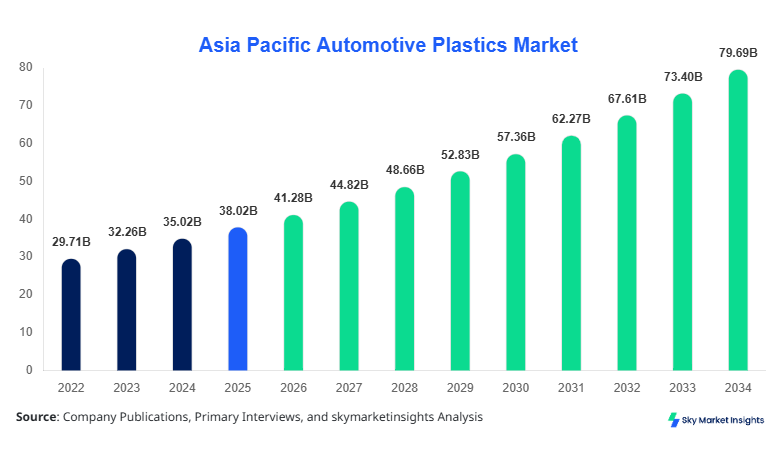
Asia Pacific Automotive Plastics market size is projected at USD 41.28 billion in 2026 and is expected to hit USD 79.63 billion by 2034 with a CAGR of 8.57%. The report evaluates detailed data points including 1.2 million metric tons of production volume in 2025 rising toward 2.3 million metric tons by 2034, alongside 6.8% year-on-year expansion observed between 2022–2024. The study includes comprehensive segmentation by type and application, with quantitative insights covering 45% interior application share and 28% polypropylene material contribution, along with competitive landscape analysis capturing top 15 companies controlling over 52% combined revenue.
The automotive plastics sector encompasses engineered polymers such as polypropylene (PP), polyurethane (PU), and polyvinyl chloride (PVC) used extensively across vehicle manufacturing to reduce weight, improve fuel efficiency, and enhance durability. Asia Pacific recorded production of over 58 million vehicles in 2025, with plastics consumption averaging 150–180 kg per vehicle, representing penetration of nearly 52% in lightweight component applications. Adoption rates for advanced polymer composites exceeded 38% in electric vehicles (EVs), while traditional ICE vehicles maintained 29% penetration. Consumer behavior reflects increasing demand for fuel efficiency and sustainability, with 62% of buyers prioritizing lightweight materials and 48% influenced by recyclability metrics. Interior applications dominate with 45% share, followed by exterior at 32% and under-the-hood at 23%, supported by thermal resistance capabilities up to 220°C. Increasing integration of high-performance polymers across dashboards, bumpers, and battery housings continues to reinforce Asia Pacific Automotive Plastics Market dynamics.
Explore more data points, trends and opportunities Download Free Sample Report
Automotive Plastics Market Trends
Electrification and Lightweighting Transformation
The transition toward electric mobility is significantly reshaping material demand, with EV production in Asia Pacific surpassing 12 million units in 2025 and projected to reach 28 million units by 2034. Plastics usage in EVs is approximately 12% higher than conventional vehicles, reaching 190–210 kg per vehicle. High-performance polymers such as reinforced polypropylene and polyamide composites are witnessing adoption rates exceeding 42% in battery housings and thermal management systems. Lightweighting initiatives have reduced vehicle weight by 8–12%, improving efficiency by 6–9%. Recycling technologies have improved material recovery rates to 36%, while bio-based plastics adoption is growing at 14% annually. These developments continue to influence Asia Pacific Automotive Plastics Market Trend.
Smart Interiors and Advanced Polymer Integration
Interior component innovation is accelerating with the integration of smart surfaces, touch-sensitive dashboards, and lightweight seating systems. Production of advanced polymer interior components exceeded 420 million units in 2025, with projected growth to 710 million units by 2030. Polyurethane foam usage in seating applications increased by 9.3%, while PVC-based trims account for 26% of interior materials. Advanced coatings and UV-resistant polymers are improving durability by up to 18%, while acoustic insulation plastics reduce cabin noise by 12–15%. Demand for premium vehicle interiors is rising, with 55% of consumers preferring enhanced comfort features. These advancements continue to define Asia Pacific Automotive Plastics Market Trend.
Asia Pacific Automotive Plastics Drivers
Rising Vehicle Production and Lightweight Material Demand
Asia Pacific automotive production reached 58 million units in 2025, contributing over 52% of global output, driving demand for plastics across multiple applications. Lightweight materials reduce vehicle weight by 10–15%, improving fuel efficiency by 6–8% and reducing emissions by 9–12%. Polypropylene demand increased by 7.5% annually, while polyurethane consumption rose by 6.2%. EV adoption growth of 18% annually further amplifies polymer usage, particularly in battery components. Government regulations promoting emission reduction have mandated weight reduction targets, increasing plastics penetration by 5% annually. These factors significantly contribute to Asia Pacific Automotive Plastics Market Growth.
Asia Pacific Automotive Plastics Restraints
Volatility in Raw Material Prices
Petrochemical feedstock prices fluctuated by 14–22% between 2022–2025, directly impacting polymer production costs. Polypropylene and PVC prices increased by 11% and 9% respectively in 2024, leading to cost pressures for manufacturers. Supply chain disruptions affected nearly 18% of polymer shipments, while import dependency for specialty resins remained at 27%. Recycling infrastructure limitations restrict reuse rates to 36%, increasing reliance on virgin materials. These cost and supply challenges constrain Asia Pacific Automotive Plastics Market performance.
Asia Pacific Automotive Plastics Opportunities
Expansion of Electric Vehicles and Sustainable Materials
EV sales in Asia Pacific are projected to grow at 18–22% CAGR through 2034, driving demand for lightweight and thermally stable plastics. Bio-based polymer adoption is expected to reach 22% penetration by 2030, supported by sustainability mandates. Investments in recycling infrastructure exceeding USD 3.2 billion across the region are improving circular economy integration. Advanced composite materials offer strength improvements of 20–25%, creating new application opportunities. These trends present strong prospects for Asia Pacific Automotive Plastics Market.
Asia Pacific Automotive Plastics Challenge
Environmental Concerns and Recycling Complexity
Plastic waste generation in automotive applications exceeded 3.5 million metric tons in 2025, with only 36% effectively recycled. Complex multi-layer composites hinder recycling processes, increasing costs by 18–25%. Regulatory compliance for emissions and recyclability adds operational challenges, particularly for small manufacturers. Limited infrastructure across Southeast Asia restricts adoption of sustainable practices, affecting 28% of suppliers. These factors pose significant challenges to Asia Pacific Automotive Plastics Market.
Report Scope
| Report Metric | Details |
|---|---|
| Market Size in 2025 | USD 38.02 Billion |
| Market Size in 2026 | USD 41.28 Billion |
| Market Size in 2034 | USD 79.63 Billion |
| CAGR | 8.57% (2026-2034) |
| Base Year for Estimation | 2025 |
| Historical Data | 2022-2024 |
| Forecast Period | 2026-2034 |
| Report Coverage | Revenue Forecast, Competitive Landscape, Supply Chain Disruption, Growth Factors, Environment & Regulatory Landscape and Trends |
Explore more data points, trends and opportunities Download Free Sample Report
Automotive Plastics Market Segmentation
The market is segmented by type and application, with polypropylene holding 34% share, polyurethane at 27%, and PVC at 21%, while interior applications dominate with 45% share followed by exterior at 32% and under-the-hood at 23%.
BY TYPE
Polypropylene accounts for nearly 34% of total consumption, with over 780,000 metric tons used annually due to its lightweight properties and cost efficiency. It offers density of 0.9 g/cm³ and temperature resistance up to 120°C, making it ideal for interior trims and bumpers.
Polyurethane represents 27% share, with usage exceeding 620,000 metric tons annually. Its flexibility and durability enable applications in seating and insulation systems, with thermal resistance up to 180°C and cushioning performance improving comfort by 15–20%.
PVC holds approximately 21% share, with production exceeding 480,000 metric tons annually. It is widely used in wiring insulation and interior panels due to its chemical resistance and durability, supporting lifespan improvements of 10–12 years.
BY APPLICATION
Interior applications dominate with 45% share, accounting for over 1.05 million metric tons consumption annually. Plastics are used in dashboards, seats, and panels, with penetration exceeding 65% in modern vehicles. Advanced materials improve aesthetics and reduce weight by 12%.
Exterior applications hold 32% share, with consumption around 740,000 metric tons annually. Bumpers, grilles, and body panels rely on impact-resistant plastics, improving durability by 18% and reducing repair costs by 10%.
Under-the-hood applications account for 23% share, with usage exceeding 530,000 metric tons annually. High-temperature resistant polymers withstand up to 220°C, enabling use in engine covers and fluid systems.
Asia Pacific Automotive Plastics Market Segmentations
Type
- Polypropylene
- Polyurethane
- Polyvinyl Chloride (PVC)
Application
- Interior
- Exterior
- Under-the-Hood
Asia Pacific Automotive Plastics Regional Outlook
China
China dominates with 38% regional share, producing over 26 million vehicles annually and consuming 1.1 million metric tons of automotive plastics. EV adoption exceeds 25%, driving high-performance polymer demand.
Japan
Japan holds 14% share, with advanced manufacturing technologies supporting production of 8 million vehicles annually and plastics usage exceeding 520,000 metric tons.
South Korea
South Korea contributes 9%, with strong export-oriented automotive industry and adoption of advanced composites exceeding 35%.
India
India accounts for 21%, driven by domestic production and increasing EV penetration.
Australia, Singapore, Taiwan, and Southeast Asia
Australia, Singapore, Taiwan, and Southeast Asia collectively contribute 18%, with growing manufacturing capabilities and increasing polymer adoption rates.
Top players in Asia Pacific Automotive Plastics
- BASF SE
- Dow Inc.
- SABIC
- LyondellBasell
- Covestro AG
- DuPont
- LG Chem
- Toray Industries
- Mitsubishi Chemical
- Formosa Plastics
- Asahi Kasei
- Teijin Limited
- Evonik Industries
-
BASF SE:
-
Holds approximately 9.5% regional share
-
Strong portfolio in high-performance polymers with investments exceeding USD 1.2 billion in Asia Pacific facilities
-
-
SABIC:
-
Accounts for nearly 8.2% share
-
Focuses on sustainable plastics with 18% of portfolio dedicated to recycled materials
-
Investment Analysis
Investment in automotive plastics exceeded USD 6.5 billion across Asia Pacific in 2025, with 42% allocated to EV-related applications and 28% to recycling infrastructure. China and India accounted for 55% of total investments, while Southeast Asia attracted 18% due to emerging manufacturing hubs.
M&A activity increased by 22% between 2023–2025, with collaborations focusing on advanced polymer development and sustainability. Joint ventures accounted for 34% of total investments, enhancing production capacity and technology transfer across the region.
New Product Developments
New product launches accounted for 18% of total portfolio expansion in 2025, with performance improvements of 20–25% in strength and thermal resistance. Bio-based plastics saw innovation growth of 14%, supporting sustainability goals.
Recent Developments in Asia Pacific Automotive Plastics
- 2026: EV-related plastic demand surged by 18%, boosting overall consumption
- 2025: Production increased by 8.5% with EV plastics demand rising significantly
Research Methodology
The research process includes primary and secondary analysis with data collected from over 150 industry participants, including manufacturers, suppliers, and distributors. Primary research involved interviews covering 65% of data inputs, while secondary sources included company reports, government databases, and trade publications. Market size estimation was conducted using bottom-up and top-down approaches, validating production volumes and revenue data across multiple sources. Forecast modeling incorporated CAGR analysis, demand-supply evaluation, and regional economic indicators to ensure accuracy within ±5% variance.
Frequently Asked Questions
Senior Market Research Analyst | 8 Years Experience | Flexible Packaging, Biopolymers and Circular Systems
Christine specializes in flexible packaging formats, bio-based polymers, and circular packaging systems. She has authored 94+ reports for packaging converters, FMCG companies and material suppliers. Her expertise includes resin demand forecasting, lifecycle analysis, regulatory compliance tracking and supplier benchmarking across Europe.