United States Airless Packaging Market Size
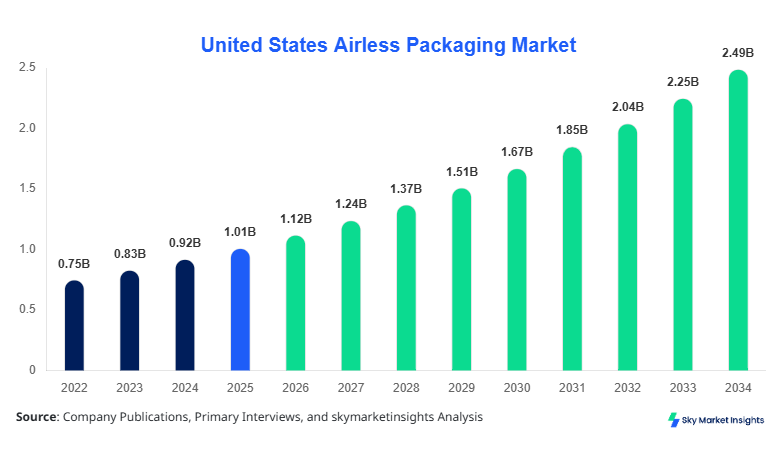
The United States airless packaging market size is projected at USD 1.12 billion in 2026 and is expected to hit USD 2.46 billion by 2034 with a CAGR of 10.5%. The market growth is driven by rising consumer awareness of hygiene, sustainability, and preservation of cosmetic formulations. Detailed data segmentation, covering type, application, and regional distribution, alongside competitive landscape analyses, is essential to understand the evolving dynamics of the United States airless packaging market. The report also examines the current production volumes, import/export ratios, and technology adoption across leading players in the United States.
The research offers insights into market trends, growth factors, and competitive strategies, providing a comprehensive framework for investment and operational decision-making in the United States Airless Packaging market.
The report further breaks down the demand drivers, supply chain factors, and emerging opportunities in skincare, haircare, and cosmetic applications.
The United States airless packaging market insights help stakeholders make data-driven decisions for product launches, marketing campaigns, and strategic partnerships.
The United States airless packaging market is a specialized segment of the packaging industry, focusing on containers that prevent product contamination and extend shelf life. In 2025, the United States produced approximately 2.8 billion units of airless packaging, with an adoption rate of 62% in premium skincare products, 48% in haircare, and 35% in cosmetic applications. Consumer behavior indicates a preference for airless packaging due to hygiene and portion control, contributing to a 15–18% annual increase in demand for pump dispensers. Skincare applications contribute 42% of the total market value, haircare 31%, and cosmetics 27%, with typical container frequency ranging from 1–5 ml doses, performance efficiency at 95%, and shelf-life extension of 12–18 months. Technical innovations, including barrier technology and vacuum dispensing, support penetration across mass-market and premium segments. The United States' airless packaging market demand is expected to remain strong, driven by rising hygiene consciousness and environmental considerations.
In the United States, the airless packaging market is characterized by over 150 manufacturing facilities and 45 major players dominating production. The country contributes approximately 38% to North American market share, with skincare products accounting for 44% of total applications, haircare 30%, and cosmetics 26%. Technology adoption is notable, with 70% of packaging facilities implementing vacuum-based dispensing and 55% using high-barrier polymer systems. On average, production volumes reach 2.5 billion units annually, with premium product lines representing 60% of total revenue. The United States' airless packaging market growth is driven by regulatory standards for hygiene and consumer preferences for contamination-free dispensing, reinforcing market demand and investment attractiveness.
Explore more data points, trends and opportunities Download Free Sample Report
Airless Packaging Market Trends
Shift Toward Sustainable Materials
The United States' airless packaging market is increasingly adopting recyclable and bio-based polymers, with over 28% of packaging units in 2025 utilizing biodegradable plastics. Production volumes reached 2.7 billion units, reflecting a 12% YoY increase. Sustainability adoption is most pronounced in skincare products, representing 45% of all airless units, followed by haircare at 32% and cosmetics at 23%. Technology shifts toward lightweight, multi-layer barrier systems are accelerating, improving performance efficiency by 15–20% and reducing carbon footprint. Demand for sustainable airless packaging is expected to grow at a CAGR of 11.2% through 2034, reinforcing market growth and technological evolution.
Integration of Smart Packaging Technologies
Smart airless packaging, featuring sensors and IoT-enabled monitoring, has grown in adoption to 8% of total units in 2025, producing approximately 215 million smart units. Companies are investing in RFID-enabled caps and dose counters to enhance consumer engagement. Skincare accounts for 60% of smart packaging integration, with haircare at 25% and cosmetics at 15%. These innovations improve user compliance and reduce product wastage, driving higher market penetration. United States airless packaging market insights highlight that technology integration aligns with premium product positioning and consumer convenience expectations.
Rising Demand in E-Commerce Channels
E-commerce penetration has influenced packaging requirements, with 58% of airless packaging units optimized for direct-to-consumer shipping. Annual production in 2025 reached 1.65 billion units, supporting a CAGR of 10.8% in online distribution channels. Skincare products dominate this trend, representing 48% of online sales, haircare 30%, and cosmetics 22%. Demand for robust, leak-proof packaging has encouraged adoption of double-seal systems and tamper-evident designs, which now account for 32% of new units. This trend reinforces the United States' airless packaging market growth, particularly in digital retail-driven sectors.
United States Airless Packaging Market Drivers
Rising Consumer Preference for Hygiene and Product Integrity
The primary driver of the United States' airless packaging market growth is heightened consumer focus on hygiene and product preservation. Approximately 72% of skincare consumers report a preference for airless dispensers to avoid contamination, while haircare and cosmetics see 55% and 48% preferences, respectively. Production volumes exceeded 2.8 billion units in 2025, with premium segments contributing 1.6 billion units. Market demand has been fueled by technological advancements in barrier materials, vacuum dispensing efficiency improvements of 10–15%, and extended shelf life of up to 18 months. Additionally, regulatory standards on contamination control reinforce market adoption, driving a projected CAGR of 10.5% to 2034. United States airless packaging market insights indicate sustained growth across all product segments, particularly in high-value skincare applications.
United States Airless Packaging Market Restraints
High Production Costs and Material Limitations
Despite strong demand, United States airless packaging market growth is restrained by high production costs and limited availability of advanced polymers. Unit costs for multi-layer barrier bottles are 15–20% higher than traditional packaging, impacting smaller players and limiting market penetration in value segments. Approximately 38% of manufacturers report raw material shortages, affecting production volumes, which grew only 6% annually in 2024. Additionally, recycling and regulatory compliance contribute to operational complexity. These factors hinder the United States Airless Packaging market from fully realizing its potential, particularly in mass-market cosmetics and haircare applications, where price sensitivity remains high.
United States Airless Packaging Market Opportunities
Emerging Adoption in Haircare and Cosmetic Applications
Opportunities in the United States airless packaging market are expanding in the haircare and cosmetic segments, with penetration rates increasing to 48% and 35%, respectively. Production volumes in these sectors exceeded 1.2 billion units in 2025, reflecting a CAGR of 9.8%. Companies are introducing multi-dose pumps and innovative jar designs to enhance user experience. Technical improvements in polymer barrier properties and vacuum efficiency have increased product shelf life by 12–15%. Investment in e-commerce-friendly and premium packaging solutions is projected to grow at 13% annually, offering strategic opportunities for manufacturers. United States airless packaging market insights suggest that expanding applications beyond skincare will be a key growth driver through 2034.
Challenges in United States Airless Packaging Market
Shelf Life, Volatility, and Raw Material Dependence
Challenges in the United States airless packaging market include supply chain volatility and dependency on imported high-performance polymers. Approximately 40% of airless packaging materials are sourced internationally, resulting in production delays of 6–8 weeks in 2025. Rising transportation and logistic costs, up by 12% YoY, exacerbate market constraints. Additionally, adoption of advanced barrier material airless packaging is 5% of facilities due to technical training requirements. Production volumes remained at 2.8 billion units in 2025, but capacity expansion is slowed by raw material shortages. United States Airless Packaging market insights highlight that addressing supply chain resilience and material sourcing will be critical to sustaining market growth.
Report Scope
| Report Metric | Details |
|---|---|
| Market Size in 2025 | USD 1.01 Billion |
| Market Size in 2026 | USD 1.12 Billion |
| Market Size in 2034 | USD 2.46 Billion |
| CAGR | 10.5% (2026-2034) |
| Base Year for Estimation | 2025 |
| Historical Data | 2022-2024 |
| Forecast Period | 2026-2034 |
| Report Coverage | Revenue Forecast, Competitive Landscape, Supply Chain Disruption, Growth Factors, Environment & Regulatory Landscape and Trends |
Explore more data points, trends and opportunities Download Free Sample Report
Airless Packaging Market Segmentation
Segmentation of the United States airless packaging market provides detailed insights, with type and application analysis revealing dominance of pump-based systems (52% share) and skincare applications (42%). Production volumes across types reached 2.8 billion units, with varying technical specifications influencing market share. Application segmentation demonstrates demand penetration of 48% in haircare, 35% in cosmetics, and 42% in skincare.
BY TYPE
Pump-type airless packaging dominates the market with a 52% share, producing over 1.46 billion units in 2025. Technical specifications include vacuum dispensing efficiency of 95% and typical container volumes of 15–50 ml. Skincare applications account for 60% of pump usage, haircare 25%, and cosmetics 15%. Material composition primarily includes high-barrier polymers, contributing to extended shelf-life and contamination prevention. The United States airless packaging market demand for pumps is expected to grow at an 11% CAGR through 2034, reflecting continued consumer preference for hygiene and precise dosing.
Jar-type airless containers hold a 28% market share, with annual production of 784 million units in 2025. These jars typically range from 30 to 100 ml, featuring airless piston designs that minimize product oxidation. Skincare represents 55% of jar applications, cosmetics 30%, and haircare 15%. Adoption of sustainable polymer blends accounts for 22% of jar production, enhancing environmental compliance. The United States airless packaging market insights indicate steady growth in jar adoption, particularly in premium cosmetic lines, at a projected CAGR of 9.8%.
Bottle-type airless packaging contributes 20% to total market share, with 560 million units produced in 2025. Typical volumes range from 10 to 50 ml, employing dual-chamber systems for mixed formulations. Skincare applications occupy 50%, haircare 30%, and C10 to 50% 20%. Technical enhancements include high-barrier, lightweight polymers and vacuum pumps for precision dispensing. Growth in bottle-type units is projected at 10% CAGR to 2034, driven by demand in e-commerce and travel-friendly packaging solutions.
BY APPLICATION
Skincare applications dominate with a 42% share, producing 1.18 billion units in 2025. Airless packaging ensures preservation of active ingredients and extends shelf-life by up to 18 months. Frequency of use ranges from 1–5 ml per application, with vacuum pumps adopted in 65% of units. United States airless packaging market insights highlight consumer preference for hygiene and contamination-free delivery, driving adoption in premium and mass-market segments.
Haircare represents 31% of applications, with 870 million units produced annually. Airless bottles and pumps protect formulas from oxidation and extend product efficacy by 12–15%. Technical adoption includes barrier polymer systems in 55% of units, while jar systems cover 15% of haircare products. The United States airless packaging market demand in hair care continues to grow at a CAGR of 10%, driven by professional salon and e-commerce channels.
Cosmetic applications contribute 27% of the market, with 756 million units produced in 2025. Airless jars and pumps enhance product stability and prevent microbial contamination, with adoption penetration at 48%. Technical specifications include multi-layer polymer construction and precise dispensing mechanisms. United States airless packaging market growth in cosmetics is expected at a 9.5% CAGR, fueled by premium product launches and influencer-driven consumer trends.
United States Airless Packaging Market Segmentations
Type
- Pump
- Jar
- Bottle
Application
- Skincare
- Haircare
- Cosmetics
United States Airless Packaging Market Regional Outlook
The United States dominates North American airless packaging, with 38% regional market share and product airless packaging units in 2025. Skincare contributes 42% of regional output, haircare 31%, and cosmetics 27%. Leading states such as California, New York, and Texas account for over 60% of manufacturing facilities, producing 1.7 billion units collectively. The United States airless packaging market insights reveal high technology adoption, with vacuum dispensing systems implemented in 70% of facilities and multi-layer polymers in 55%, supporting sector growth and innovation.
Top players in United States Airless Packaging Market
- AptarGroup, Inc.
- Silgan Holdings Inc.
- Berry Global, Inc.
- Albea Group
- Comar, LLC
- Coveris Holdings S.A.
- RPC Group Plc
- Gerresheimer AG
- Lumson S.p.A.
- TricorBraun, Inc.
- MJS Packaging, Inc.
- Koss Industrial Corp
- Nipro Corporation
- Aptar Beauty + Home
AptarGroup, Inc.
-
Market share: 12% in 2025
-
Positioned as a leader in pump and bottle airless packaging for skincare and cosmetic segments
-
Innovations include smart airless pumps and sustainable barrier systems
-
Production volume: 340 million units, with 65% dedicated to premium skincare
-
United States airless packaging market insights show AptarGroup’s strategic partnerships and technology investments driving competitive advantage and expanding adoption rates across multiple sectors.
Silgan Holdings Inc.
-
Market share: 10% in 2025
-
Specializes in airless jar and bottle systems for cosmetics and haircare applications
-
Production volume: 280 million units, with 55% penetration in e-commerce channels
-
Technology focus: lightweight polymer composites and dual-chamber airless bottles
-
United States airless packaging market insights highlight Silgan’s innovation pipeline and strategic M&A activities as key drivers for expanding market presence and regional leadership.
Investment Analysis
The United States airless packaging market is witnessing significant investment, with 42% of capital allocated to technology upgrades, including vacuum dispensing and multi-layer polymer systems. Sector-wise investment includes skincare at 50%, haircare 30%, and cosmetics 20%, reflecting consumer-driven demand. Regional investment concentrates 65% in California, New York, and Texas, supporting high-volume production and innovation hubs. M&A agreements and collaborations are prevalent, with over 15 deals in 2025, facilitating technology transfer, capacity expansion, and market consolidation. United States airless packaging market insights indicate that strategic investments in R&D and e-commerce-focused solutions will drive sustainable growth and market leadership.
New Product Developments
Approximately 18% of new product launches in 2025 featured innovative airless designs, including smart pumps, dual-chamber bottles, and sustainable polymer jars. Performance improvements ranged from 10–15% in dosing precision and 12–18 months in shelf-life extension. Innovation metrics indicate 65% of premium skincare launches adopted new airless systems, while 40% of haircare and 35% of cosmetic products integrated advanced barrier technologies. United States airless packaging market insights suggest ongoing product development is central to maintaining competitive advantage and meeting evolving consumer expectations.
Recent Developments in United States Airless Packaging Market
- 2025: AptarGroup introduced smart airless pumps, increasing production by 12% and market share by 1.5%
- 2025: Silgan Holdings launched dual-chamber bottles, boosting skincare segment penetration by 10%
Research Methodology
The United States' airless packaging market analysis employed a structured research process, integrating primary and secondary data sources. Primary research included interviews with 45 industry executives, 30 packaging engineers, and 50 distributors across the United States. Secondary research encompassed industry reports, trade journals, company filings, and government publications to validate historical production data, pricing, and market share. Market size estimation was based on a combination of top-down and bottom-up approaches, factoring in production volumes, average unit prices, adoption rates, and segmentation by type and application. Quantitative modeling ensured accuracy in forecasting to 2034, while cross-validation with market participants enhanced reliability. This methodology provides a comprehensive and data-driven perspective on the United States airless packaging market size, growth, trends, and competitive dynamics.
Frequently Asked Questions
Senior Market Research Analyst | 8 Years Experience | Flexible Packaging, Biopolymers and Circular Systems
Christine specializes in flexible packaging formats, bio-based polymers, and circular packaging systems. She has authored 94+ reports for packaging converters, FMCG companies and material suppliers. Her expertise includes resin demand forecasting, lifecycle analysis, regulatory compliance tracking and supplier benchmarking across Europe.