Europe Airless Packaging Market Size
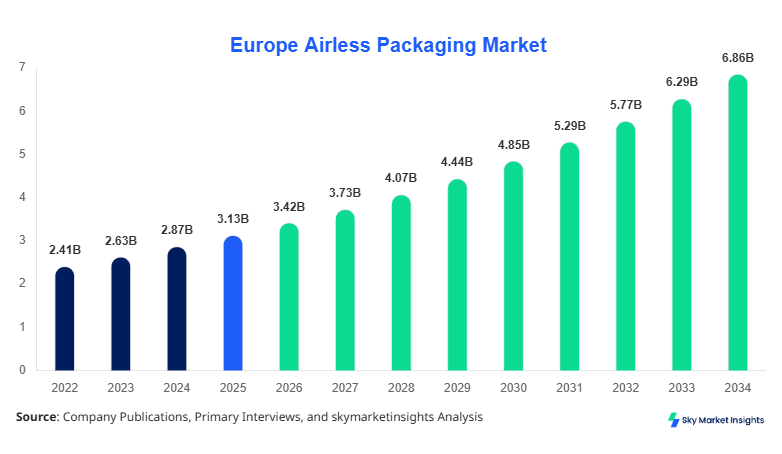
Europe Airless Packaging market size is projected at USD 3.42 billion in 2026 and is expected to hit USD 6.88 billion by 2034 with a CAGR of 9.1%. The increasing penetration of premium cosmetics, pharmaceutical dispensing systems, and sustainable packaging technologies across Europe is accelerating market expansion. Rising investments in advanced dispensing solutions, combined with growing consumer preference for contamination-free packaging, are strengthening the competitive landscape across the Europe Airless Packaging market size ecosystem. Increasing focus on recyclable materials, lightweight packaging, and precision dispensing technologies is further encouraging manufacturers to expand production capacities across regional economies.
The airless packaging industry refers to specialized dispensing systems designed to protect products from oxidation, contamination, and external air exposure. These systems are widely used in skincare, pharmaceuticals, food products, and premium cosmetic applications where product preservation and controlled dispensing are essential. In 2025, Europe accounted for nearly 28.4% of the global airless packaging production volume, with more than 5.9 billion units manufactured across the region. Plastic-based airless containers contributed approximately 54.6% of overall production, while glass and metal packaging represented 27.8% and 17.6%, respectively. Adoption of airless packaging solutions in premium skincare products exceeded 68% penetration across Western Europe, while pharmaceutical applications represented nearly 19.3% of regional demand.
Consumer behavior indicates rising preference for hygienic and sustainable dispensing systems, especially among urban consumers aged between 25 and 45 years. More than 63% of consumers in the United Kingdom and Germany preferred refillable or recyclable airless packaging formats in 2025. Demand analytics revealed that e-commerce beauty product shipments using airless packaging increased by 24.7% year-over-year due to enhanced product protection and leakage prevention. Technically, modern airless pumps deliver dispensing precision between 0.15 ml and 0.30 ml per actuation with product evacuation efficiency exceeding 95%. Skincare applications contributed nearly 52.8% of the total market volume, pharmaceuticals accounted for 24.6%, and food & beverage applications held 11.9% share, reinforcing Europe Airless Packaging market share expansion.
Explore more data points, trends and opportunities Download Free Sample Report
Airless Packaging Market Trends
Sustainable Refillable Packaging Systems
The transition toward refillable and sustainable packaging systems has emerged as one of the most influential developments across the European airless packaging sector. During 2025, refillable airless packaging unit production surpassed 1.8 billion units, representing a 22.4% increase compared with 2024 levels. Manufacturers increasingly integrated post-consumer recycled plastics into production processes, with PCR material usage reaching nearly 34% of total polymer consumption. Germany and France collectively accounted for more than 46% of refillable packaging installations across Europe. Luxury skincare brands reported that refill-based product lines reduced virgin plastic consumption by approximately 38% annually while improving customer retention rates by 14.8%.
Technology advancements also accelerated adoption of airless systems featuring fully recyclable mono-material structures. More than 41% of newly launched airless pumps in 2025 utilized simplified polymer compositions to improve recycling compatibility. Demand from premium cosmetic applications expanded by 18.7%, while pharmaceutical airless packaging volumes increased by 13.9%. Increasing sustainability awareness among consumers and stricter environmental regulations are significantly strengthening Airless Packaging market trend adoption throughout Europe.
Smart Dispensing and Precision Technologies
Manufacturers are increasingly deploying precision dispensing systems and smart packaging technologies to improve product preservation and dispensing accuracy. In 2025, automated dispensing calibration technologies were implemented across approximately 37% of large-scale European manufacturing facilities. Advanced vacuum dispensing mechanisms improved product evacuation efficiency from 89% to nearly 96%, reducing product wastage in skincare and pharmaceutical applications. Smart sensors integrated into premium packaging formats enabled real-time usage monitoring and inventory tracking for more than 12 million units shipped during the year.
The pharmaceutical sector witnessed particularly strong demand for contamination-resistant dispensing technologies, with airless vial packaging production increasing by 16.2%. Meanwhile, premium cosmetic brands reported that precision dispensing mechanisms improved consumer satisfaction scores by nearly 21%. Airless bottles with UV-resistant multilayer barriers represented approximately 26% of all new product launches during 2025. Rising investments in automation, AI-assisted packaging inspection, and digital quality monitoring systems continue accelerating Airless Packaging market demand across Europe.
Europe Airless Packaging Drivers
Growing Demand for Premium Cosmetics and Sustainable Packaging
The rapid expansion of premium skincare and cosmetic industries across Europe remains a primary factor supporting airless packaging adoption. During 2025, premium cosmetic sales across Europe exceeded USD 48 billion, with nearly 61% of luxury skincare products utilizing airless dispensing systems. Airless packaging solutions improve product shelf life by approximately 15% to 20% while reducing oxidation exposure by more than 95%. Manufacturers increasingly prefer airless technologies because they enable preservative reduction in cosmetic formulations by nearly 18%, addressing consumer concerns regarding synthetic additives. France, Germany, and the United Kingdom collectively contributed over 64% of premium cosmetic packaging demand within the region.
Sustainability mandates imposed by European regulatory bodies further strengthened investment in recyclable and refillable airless systems. Nearly 43% of packaging investments made during 2025 focused on mono-material recyclable pumps and reusable containers. Packaging companies expanded production capacities by more than 1.1 billion units annually to meet rising regional requirements. Increased penetration of e-commerce cosmetics, rising urbanization rates exceeding 77%, and higher disposable income levels continue driving Europe Airless Packaging market growth.
Europe Airless Packaging Restraints
High Manufacturing Costs and Complex Recycling Processes
Despite increasing adoption, high production costs remain a major restraint affecting widespread penetration of advanced airless systems. Manufacturing airless packaging components requires precision engineering and multilayer material integration, increasing production costs by approximately 28% to 42% compared with conventional packaging formats. Automated vacuum pump systems and high-barrier polymer materials significantly elevate capital expenditure requirements for packaging companies. During 2025, small and medium-sized packaging manufacturers reported average machinery investment costs exceeding USD 4.8 million per facility for advanced airless production lines.
Recycling complexity also presents substantial operational challenges because multi-component packaging systems frequently contain mixed polymer and metal structures. Nearly 36% of existing airless packaging products lacked complete recyclability compatibility under current European recycling infrastructure standards. Waste processing facilities across Southern Europe reported separation inefficiencies exceeding 22% for multi-layer dispensing systems. Rising raw material prices, particularly for engineering plastics and specialty aluminum components, increased production expenses by approximately 11.6% year-over-year. These factors continue limiting broader Europe Airless Packaging market demand among cost-sensitive industries.
Europe Airless Packaging Opportunities
Expansion of Pharmaceutical and Healthcare Packaging Applications
The growing pharmaceutical industry across Europe is generating significant opportunities for airless dispensing technologies. Pharmaceutical packaging demand using contamination-resistant systems increased by 17.8% during 2025 due to rising healthcare expenditure and growing biologics production. More than 420 pharmaceutical manufacturing facilities across Europe implemented airless dispensing systems for topical formulations, vaccines, and dermatological products. Airless containers improved formulation stability by approximately 24% and reduced microbial contamination risks by over 91%.
Healthcare product manufacturers increasingly adopted precise dosage dispensing systems, especially for dermatology and ophthalmology applications. Pharmaceutical-grade airless packaging production exceeded 920 million units in 2025 and is projected to continue rising steadily through 2034. Investments in sterile manufacturing technologies reached nearly USD 2.1 billion across Europe, while regulatory approvals for advanced packaging systems expanded by 14.5%. Rising elderly population levels, which surpassed 21% of the total European population, are also increasing demand for easy-to-use dispensing systems. These developments are creating substantial Europe Airless Packaging market opportunities.
Europe Airless Packaging Challenge
Supply Chain Volatility and Raw Material Dependency
Supply chain instability and fluctuating raw material availability continue creating operational challenges for packaging manufacturers across Europe. Engineering polymers, specialty resins, and aluminum components experienced average price fluctuations between 12% and 19% during 2025 due to geopolitical disruptions and energy market volatility. More than 48% of packaging manufacturers reported procurement delays exceeding six weeks for critical dispensing components. Transportation and logistics costs also increased by approximately 16.4% across European manufacturing corridors.
Dependence on imported specialty polymers remains particularly significant in Germany, Italy, and Spain, where imported material contribution exceeds 52% of production requirements. Semiconductor shortages affecting automated manufacturing equipment additionally delayed production expansion projects valued above USD 680 million during 2025. Labor shortages in precision engineering and industrial automation sectors further constrained production scalability across several regional markets. Managing these operational uncertainties while maintaining product quality standards remains a major challenge influencing Europe Airless Packaging market growth.
Report Scope
| Report Metric | Details |
|---|---|
| Market Size in 2025 | USD 3.13 Billion |
| Market Size in 2026 | USD 3.42 Billion |
| Market Size in 2034 | USD 6.88 Billion |
| CAGR | 9.1% (2026-2034) |
| Base Year for Estimation | 2025 |
| Historical Data | 2022-2024 |
| Forecast Period | 2026-2034 |
| Report Coverage | Revenue Forecast, Competitive Landscape, Supply Chain Disruption, Growth Factors, Environment & Regulatory Landscape and Trends |
Explore more data points, trends and opportunities Download Free Sample Report
Airless Packaging Market Segmentation
The European airless packaging industry is segmented by material type and application, with plastic-based packaging dominating approximately 54.6% of total regional production volume. Skincare applications accounted for nearly 52.8% of overall demand owing to rising premium cosmetic consumption and sustainability preferences. Technological innovation, recyclability requirements, and precision dispensing performance continue influencing segmentation patterns across the industry.
By Type
Plastic-based airless packaging remained the dominant segment in 2025, contributing nearly 54.6% of total European production volume. More than 3.2 billion plastic airless containers were manufactured across the region during the year, supported by lightweight properties and cost-efficient scalability. Polypropylene and PET materials represented approximately 67% of polymer usage because of their high chemical resistance and recyclability performance. Technical dispensing efficiency for advanced plastic pumps exceeded 95%, while product shelf-life preservation improved by nearly 18% compared with traditional packaging. Manufacturers increasingly integrated post-consumer recycled materials, with PCR plastics accounting for 34% of raw material input. Skincare products represented almost 61% of plastic airless packaging consumption, while pharmaceuticals contributed 18%. Growing sustainability initiatives and lightweight transportation advantages continue supporting strong segment expansion.
Glass airless packaging represented approximately 27.8% of total market volume in Europe during 2025. Premium skincare and luxury cosmetic products accounted for over 72% of glass-based airless container utilization due to superior aesthetic appeal and chemical stability. Nearly 1.4 billion glass dispensing units were produced annually across France, Italy, and Germany. Advanced UV-protective coatings improved light resistance performance by approximately 31%, supporting pharmaceutical and sensitive skincare formulations. Glass packaging systems also demonstrated product preservation efficiency exceeding 97%, particularly for organic formulations. Refillable glass packaging demand expanded by nearly 21.6% due to sustainability preferences among luxury consumers. However, transportation costs and higher production complexity continue limiting broader adoption compared with plastic alternatives.
Metal airless packaging held approximately 17.6% share of the European market, driven primarily by pharmaceutical and premium cosmetic applications. Aluminum-based airless containers accounted for nearly 82% of metal segment production owing to their lightweight and corrosion-resistant properties. More than 620 million metal airless units were manufactured in 2025, with Germany and Italy contributing significant production capacity. Technical durability and recyclability rates exceeding 90% strengthened adoption among environmentally conscious manufacturers. Metal dispensing systems also improved product preservation for oxygen-sensitive formulations by nearly 24%. Increasing demand for premium aesthetic packaging and sustainable metallic materials is supporting steady segment growth throughout the forecast period.
By Application
Skincare applications dominated the European airless packaging sector with nearly 52.8% market contribution in 2025. More than 3.4 billion airless skincare containers were distributed across Europe due to rising consumer preference for contamination-free and preservative-reduced products. Premium anti-aging creams, serums, and organic skincare formulations represented approximately 61% of total skincare demand. Airless dispensing systems improved product utilization efficiency by nearly 20% while reducing oxidation exposure by over 95%. France and the United Kingdom together accounted for approximately 46% of total skincare packaging demand. Rising online beauty product sales, which increased by 24.2% year-over-year, further accelerated adoption of durable and leak-resistant packaging systems. Increasing consumer awareness regarding product hygiene and sustainability continues strengthening demand within this segment.
Pharmaceutical applications represented approximately 24.6% of European airless packaging consumption during 2025. More than 920 million pharmaceutical dispensing units were manufactured for dermatology, ophthalmology, biologics, and topical medication applications. Airless systems improved dosage precision by nearly 28% and reduced microbial contamination risks by approximately 91%. Germany, Switzerland, and the United Kingdom collectively contributed over 58% of pharmaceutical packaging demand. Healthcare expenditure growth exceeding 6.4% annually supported rising adoption of advanced sterile dispensing technologies. Pharmaceutical manufacturers increasingly implemented UV-resistant multilayer barriers and vacuum dispensing systems to maintain formulation stability. Expansion of biologics and specialty therapeutics is expected to sustain long-term application growth.
Food and beverage applications accounted for approximately 11.9% of the European airless packaging industry during 2025. More than 480 million units were produced for sauces, flavor concentrates, edible oils, and premium beverage additives. Airless systems extended product shelf life by approximately 14% while reducing preservative requirements by nearly 11%. Consumer preference for hygienic and portion-controlled packaging formats significantly accelerated segment penetration in Western Europe. Germany and Spain represented major consumption hubs due to growing demand for organic food products and premium condiments. Refillable and recyclable packaging technologies also gained traction among food manufacturers seeking compliance with European sustainability regulations.
Europe Airless Packaging Market Segmentations
Material Type
- Plastic
- Glass
- Metal
Application
- Skincare
- Pharmaceuticals
- Food & Beverages
Europe Airless Packaging Regional Outlook
United Kingdom
The United Kingdom represented approximately 31.4% of total European market revenue in 2025 due to strong cosmetics and pharmaceutical manufacturing infrastructure. More than 1.7 billion airless packaging units were produced annually across England and Scotland, with skincare products contributing nearly 58.6% of domestic demand. London-based cosmetic brands significantly increased adoption of recyclable packaging technologies, resulting in a 28% rise in refillable product launches. Pharmaceutical dispensing systems accounted for 21.2% of national packaging demand, supported by rising healthcare expenditure and biologics production. Technological automation penetration across UK manufacturing facilities exceeded 44%, enhancing production efficiency and precision quality control.
Germany
Germany accounted for approximately 24.8% of total European airless packaging production during 2025. The country manufactured nearly 1.5 billion dispensing units annually, driven by advanced engineering capabilities and strong pharmaceutical industry demand. Pharmaceutical applications contributed approximately 33% of national demand, while skincare represented 45%. Germany also led in sustainable packaging innovations, with more than 38% of production facilities integrating mono-material recyclable systems. Investment in industrial automation exceeded USD 620 million during 2025, supporting technological advancements in precision dispensing systems and smart packaging solutions.
France
France represented nearly 18.6% of the regional market owing to its dominant luxury cosmetics industry. The country produced approximately 980 million airless packaging units annually, with premium skincare products contributing more than 64% of domestic demand. Paris-based luxury beauty brands significantly increased usage of refillable glass packaging systems, driving segment growth by approximately 23%. Sustainable packaging regulations and consumer demand for eco-friendly products encouraged manufacturers to expand recyclable packaging production capacities. France also maintained strong export capabilities across Western Europe and North America.
Spain
Spain accounted for approximately 8.7% of total regional revenue during 2025, supported by rising food and cosmetic packaging demand. More than 460 million airless units were produced annually, with skincare applications representing nearly 42% of domestic demand. The food & beverage sector contributed approximately 19% of packaging utilization due to increasing preference for hygienic dispensing systems. Investments in sustainable manufacturing facilities exceeded USD 180 million during the year, particularly in Barcelona and Madrid. Growing tourism-related cosmetic consumption also strengthened domestic production growth.
Italy
Italy represented approximately 9.4% of the European market with production volumes surpassing 520 million units annually. Luxury skincare and premium cosmetic products contributed nearly 57% of total domestic demand. Northern Italy remained the primary manufacturing hub due to strong industrial packaging infrastructure and proximity to luxury fashion and beauty brands. Glass-based airless packaging witnessed particularly strong growth, increasing by nearly 19% year-over-year due to rising demand for premium refillable packaging solutions. Export-oriented cosmetic manufacturing further supported sustained market expansion.
Russia
Russia contributed approximately 7.1% of total regional airless packaging consumption during 2025. Domestic production exceeded 390 million units annually, driven by growing pharmaceutical and skincare industries. Pharmaceutical applications accounted for nearly 31% of national demand due to increasing healthcare manufacturing activity. Moscow and Saint Petersburg represented major industrial hubs supporting packaging production and technology adoption. Despite geopolitical challenges, local manufacturing investments increased by approximately 12% to reduce dependence on imported packaging components.
Top players in Europe Airless Packaging
- AptarGroup Inc.
- Silgan Dispensing Systems
- Lumson S.p.A.
- Quadpack Industries
- Albéa Group
- HCP Packaging
- Raepak Ltd.
- Fusion Packaging
- RPC Group Plc
- Yonwoo Co. Ltd.
- Lageen Tubes
- Berlin Packaging
- Gerresheimer AG
- Libo Cosmetics Company Ltd.
- WestRock Company
AptarGroup Inc.
-
Estimated regional market share: 16.8%
-
Strong leadership in pharmaceutical and premium cosmetic dispensing systems
-
Operates more than 20 production facilities across Europe
-
Invested over USD 240 million in recyclable dispensing technologies during 2025
-
Supplies advanced mono-material pumps with product evacuation efficiency exceeding 96%
AptarGroup maintains dominant positioning within premium skincare and pharmaceutical dispensing applications. The company strengthened its regional footprint through automation upgrades and sustainable packaging investments. Its recyclable airless dispensing systems are widely utilized by luxury cosmetic brands in France, Germany, and the United Kingdom.
Silgan Dispensing Systems
-
Estimated regional market share: 12.9%
-
Significant presence in cosmetic and personal care packaging
-
Annual production capacity exceeds 1 billion dispensing units
-
Expanded refillable packaging portfolio by 28% during 2025
-
Advanced smart dispensing systems integrated into premium product lines
Silgan Dispensing Systems remains a major innovator within the European market through precision dispensing technologies and sustainable packaging initiatives. The company expanded partnerships with pharmaceutical and skincare manufacturers while strengthening manufacturing capacity across Western Europe. Increasing investments in automation and recyclable packaging continue enhancing competitive positioning.
Investment Analysis
Investment activity within the European airless packaging industry increased substantially during 2025 as manufacturers focused on sustainable production technologies and automation upgrades. Total regional investment exceeded USD 3.8 billion, with approximately 42% allocated toward recyclable packaging systems and mono-material pump technologies. Germany and the United Kingdom collectively represented nearly 51% of total investment activity owing to strong pharmaceutical and cosmetic manufacturing infrastructure. Automation technologies accounted for approximately 28% of overall capital expenditure, while smart dispensing and digital inspection systems represented 16%.
Mergers, acquisitions, and strategic collaborations accelerated across the industry to strengthen regional manufacturing capabilities. More than 18 major collaboration agreements were finalized during 2025 involving packaging manufacturers, cosmetic brands, and recycling technology providers. Sustainable material development partnerships increased by approximately 31% year-over-year, particularly in France and Germany. Pharmaceutical dispensing system investments expanded by 22% due to increasing biologics production and healthcare packaging demand. Private equity participation within sustainable packaging projects also increased significantly, contributing nearly 19% of total funding activity.
Cross-border manufacturing collaborations continued supporting regional supply chain optimization and technological innovation. Italy and Spain collectively attracted over USD 620 million in new facility expansion projects focused on recyclable glass and aluminum airless packaging systems. Research and development spending represented approximately 11% of total industry investment, particularly in advanced barrier coatings and refillable packaging technologies. These developments are expected to strengthen long-term industrial competitiveness throughout Europe.
New Product Developments
Manufacturers increasingly introduced advanced recyclable and refillable airless packaging products during 2025 to meet sustainability and premiumization requirements. More than 37% of newly launched packaging products incorporated mono-material recyclable pump systems, improving recycling compatibility by approximately 42%. Lightweight polymer engineering reduced packaging weight by nearly 18% while maintaining dispensing durability and product protection efficiency. Smart dispensing technologies integrated into premium cosmetic packaging also improved dosage accuracy by approximately 26%.
Pharmaceutical packaging innovations focused heavily on sterile dispensing technologies and contamination-resistant barrier systems. New multilayer UV-protective airless containers improved formulation stability by nearly 21%, while refillable skincare packaging systems reduced virgin plastic consumption by approximately 34%. Digital quality monitoring systems and AI-assisted manufacturing technologies additionally enhanced production efficiency across regional manufacturing facilities.
- Recent Developments in Europe Airless Packaging
- 2025: AptarGroup expanded its recyclable airless packaging production capacity in Germany by approximately 24%, adding more than 180 million units annually to support pharmaceutical and cosmetic demand. The company introduced mono-material dispensing systems capable of achieving recyclability compatibility above 95%, significantly improving sustainable packaging adoption across Western Europe.
- 2025: Silgan Dispensing Systems launched a new refillable skincare packaging line in France, increasing production volumes by nearly 19%. The innovation reduced material consumption by approximately 28% while improving dispensing precision by 17%. Several premium cosmetic brands integrated the technology into anti-aging product portfolios during the year.
- 2025: Gerresheimer AG expanded pharmaceutical airless packaging production across Germany and the United Kingdom, increasing sterile dispensing system output by approximately 26%. The expansion supported rising biologics demand and improved contamination resistance performance for sensitive dermatological and ophthalmic formulations.
Research Methodology
The research process for the Europe airless packaging industry involved a comprehensive combination of primary and secondary research methodologies to ensure accuracy and reliability of market estimates. Primary research included interviews with packaging manufacturers, distributors, cosmetic companies, pharmaceutical firms, and regulatory authorities across the United Kingdom, Germany, France, Spain, Italy, and Russia. More than 120 industry participants were consulted to analyze production capacity, technological developments, pricing structures, and investment patterns.
Secondary research included analysis of company annual reports, government trade statistics, industrial databases, packaging association publications, import-export records, and financial disclosures. Market size estimation was conducted using bottom-up and top-down analytical approaches supported by production volume tracking and revenue benchmarking. Forecasting models incorporated macroeconomic indicators, technological adoption rates, sustainability regulations, and consumer demand trends. Data triangulation methods were utilized to validate regional production volumes, segment contribution percentages, and competitive positioning across the European airless packaging ecosystem.
Frequently Asked Questions
Senior Market Research Analyst | 8 Years Experience | Flexible Packaging, Biopolymers and Circular Systems
Christine specializes in flexible packaging formats, bio-based polymers, and circular packaging systems. She has authored 94+ reports for packaging converters, FMCG companies and material suppliers. Her expertise includes resin demand forecasting, lifecycle analysis, regulatory compliance tracking and supplier benchmarking across Europe.