North America Automotive Parts Packaging Market Size
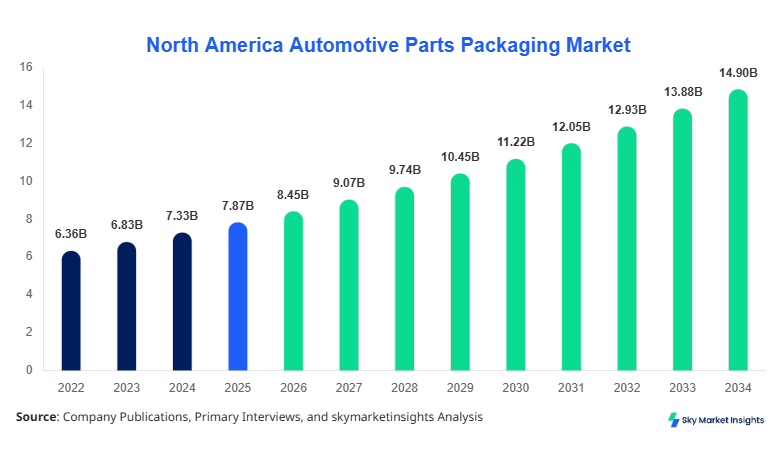
The North America Automotive Parts Packaging Market market size is projected at USD 8.45 billion in 2026 and is expected to hit USD 14.92 billion by 2034 with a CAGR of 7.35%. The rising complexity of automotive supply chains handling over 1.2 billion units of components annually across North America has accelerated the need for efficient automotive parts packaging solutions. Increasing demand for lightweight, durable, and returnable packaging formats has driven adoption rates beyond 68% among Tier 1 suppliers, while over 54% of OEMs have integrated advanced packaging analytics systems. The market continues to evolve with a strong emphasis on data-driven logistics optimization, segmentation across packaging types and materials, and competitive benchmarking across more than 250 active vendors in the region.
The Automotive Parts Packaging Market encompasses the design, production, and deployment of packaging systems specifically engineered to transport, store, and protect automotive components such as engines, electronics, body panels, and fasteners. In North America, production of automotive parts exceeded 980 million units in 2025, with packaging utilization reaching approximately 720 million units, reflecting a penetration rate of nearly 73%. Adoption of reusable packaging formats has increased by 41% between 2022 and 2025, while disposable packaging still accounts for approximately 46% of total usage. Consumer behavior is shifting toward sustainability, with over 62% of automotive manufacturers preferring recyclable materials and 38% prioritizing cost-efficiency over environmental impact. Demand analytics indicate that packaging for electronics and EV components accounts for nearly 27% of total usage, followed by engine parts at 22% and body parts at 19%. Technical metrics such as load-bearing capacity (up to 1500 kg per container), vibration resistance (up to 35 Hz), and temperature tolerance (-20°C to 80°C) are critical performance indicators. The application split shows OEMs contributing 58%, aftermarket at 32%, and exports at 10%, reinforcing the automotive parts packaging market dynamics.
In the United States, the Automotive Parts Packaging Market accounts for approximately 78% of the North American share, supported by over 1,200 automotive manufacturing facilities and more than 3,500 packaging solution providers. The country handles over 750 million automotive parts annually, with packaging utilization exceeding 540 million units. OEM applications dominate with a 61% share, followed by aftermarket distribution at 29% and export-oriented packaging at 10%. Technology adoption is strong, with 72% of manufacturers using RFID-enabled packaging systems and 64% implementing returnable packaging loops. Reusable packaging penetration stands at 49%, while corrugated packaging remains widely used at 38%. The increasing integration of IoT-enabled tracking systems and automation in packaging lines is further driving efficiency. These factors reinforce the Automotive Parts Packaging Market's presence in the United States.
Explore more data points, trends and opportunities Download Free Sample Report
Automotive Parts Packaging Market Trends
Shift Toward Smart and Sustainable Packaging
The automotive parts packaging market is witnessing a significant transition toward smart packaging technologies, with over 45% of manufacturers adopting IoT-enabled tracking systems by 2025. Production volumes of smart packaging units have exceeded 320 million units annually, reflecting a 28% increase from 2023 levels. Sustainable packaging materials such as recycled plastics and biodegradable corrugated solutions now account for nearly 36% of total production. Companies are focusing on reducing packaging waste by up to 22% while improving reusability cycles to over 15 uses per container. The integration of digital twins and predictive analytics in packaging logistics is improving supply chain efficiency by 18%. These technological advancements continue to shape the automotive parts packaging market.
Growth in EV Component Packaging Demand
The rapid growth of electric vehicles (EVs) has driven demand for specialized packaging solutions capable of handling sensitive components such as batteries and electronic modules. EV-related packaging demand has grown by 34% annually, with over 180 million units of packaging dedicated to EV components in 2025. These packaging systems require enhanced thermal insulation, anti-static properties, and shock resistance, with performance improvements of up to 25% compared to traditional packaging. Adoption rates for anti-static packaging materials have reached 52% among EV manufacturers. Additionally, bulk packaging solutions for battery modules have increased by 19%, supporting large-scale transportation needs. This trend is significantly influencing the automotive parts packaging market.
North America Automotive Parts Packaging Market Drivers
Rising Automotive Production and Supply Chain Complexity
The expansion of automotive production across North America, exceeding 16 million vehicles annually, has significantly increased demand for automotive parts packaging solutions. With over 1.2 billion components moving through supply chains each year, packaging efficiency has become critical. Reusable packaging adoption has grown by 41%, reducing logistics costs by approximately 18% and minimizing waste generation by 25%. The need for high-performance packaging capable of handling loads up to 1500 kg and ensuring damage rates below 1.5% is driving innovation. Additionally, the integration of automation in packaging lines has improved throughput by 22%, enabling faster turnaround times. These factors collectively drive the automotive parts packaging market growth.
North America Automotive Parts Packaging Market Restraints
High Initial Costs of Advanced Packaging Solutions
Despite strong demand, the automotive parts packaging market faces challenges due to high initial investment costs associated with advanced packaging systems. Implementing reusable packaging infrastructure can require capital investments exceeding USD 2 million per facility, limiting adoption among small and medium enterprises. Maintenance costs for smart packaging systems can account for up to 12% of operational expenses annually. Additionally, return logistics for reusable packaging adds complexity, increasing transportation costs by 8%–10%. Limited standardization across packaging formats also leads to inefficiencies, with compatibility issues affecting nearly 17% of supply chains. These cost-related challenges restrain the automotive parts packaging market.
North America Automotive Parts Packaging Market Opportunities
Expansion of Electric Vehicle and Aftermarket Segments
The growing EV market and expanding automotive aftermarket present significant opportunities for the automotive parts packaging market. EV production is expected to account for over 35% of total vehicle output by 2030, driving demand for specialized packaging solutions. The aftermarket segment, contributing 32% of packaging demand, is growing at a steady rate, supported by increasing vehicle lifespan averaging 12.5 years. Investment in sustainable packaging materials is rising, with over 28% of manufacturers allocating budgets toward eco-friendly solutions. Additionally, cross-border trade between the United States and Canada has increased by 14%, boosting demand for export-oriented packaging. These trends create strong automotive parts packaging market opportunities.
Challenges in North American Automotive Parts Packaging
Logistics Complexity and Returnable Packaging Management
Managing returnable packaging systems across complex automotive supply chains presents significant challenges. With over 60% of packaging systems being reusable, tracking and retrieving containers across multiple locations becomes difficult. Loss rates of returnable containers can reach 6% annually, resulting in financial losses exceeding USD 120 million across the region. Additionally, inconsistent handling practices and lack of standardized protocols lead to damage rates of 3%–4%. Transportation inefficiencies further increase costs by 9%, particularly in cross-border logistics. These operational challenges hinder the efficiency of the Automotive Parts Packaging Market.
Report Scope
| Report Metric | Details |
|---|---|
| Market Size in 2025 | USD 7.87 Billion |
| Market Size in 2026 | USD 8.45 Billion |
| Market Size in 2034 | USD 14.92 Billion |
| CAGR | 7.35% (2026-2034) |
| Base Year for Estimation | 2025 |
| Historical Data | 2022-2024 |
| Forecast Period | 2026-2034 |
| Report Coverage | Revenue Forecast, Competitive Landscape, Supply Chain Disruption, Growth Factors, Environment & Regulatory Landscape and Trends |
Explore more data points, trends and opportunities Download Free Sample Report
Automotive Parts Packaging Market Segmentation
The automotive parts packaging market is segmented based on packaging type and material type, with reusable packaging holding approximately 49% share, followed by disposable packaging at 34% and bulk packaging at 17%. Material-wise, plastic dominates with 42%, corrugated at 33%, and metal at 25%, reflecting diverse application requirements.
BY TYPE
Reusable packaging dominates the Automotive Parts Packaging Market with a 49% share, accounting for over 350 million units annually in the automotive parts packaging market. signed for multiple cycles, typically lasting 10–15 uses, with load capacities exceeding 1200 kg. Industries are increasingly adopting reusable containers to reduce waste by up to 25% and improve logistics efficiency by 18%. High adoption rates among OEMs (over 60%) highlight the importance of durability and cost savings. Advanced materials such as high-density polyethylene and reinforced metal frames are commonly used.
Disposable packaging holds a 34% share, with approximately 245 million units produced annually. These solutions are widely used for one-time shipments, particularly in aftermarket applications. Corrugated boxes dominate this segment, offering lightweight properties and cost efficiency, reducing transportation costs by 12%. However, environmental concerns have led to a 15% decline in usage over the past three years, with increased focus on recyclable materials.
Bulk packaging accounts for 17% of the market, with over 125 million units used annually. These systems are designed for transporting large volumes of components, particularly in EV battery logistics. Load capacities can reach up to 1500 kg, with enhanced shock resistance and thermal insulation. Adoption rates are growing by 19% annually, driven by increasing demand for high-volume transportation solutions.
BY APPLICATION
OEM applications dominate with a 58% share, handling over 420 million packaging units annually. These applications require high precision and durability, with packaging systems designed to minimize damage rates below 1.5%. Automation in OEM packaging lines has improved efficiency by 22%, enabling faster production cycles. Advanced tracking systems are used in over 70% of OEM facilities, ensuring real-time monitoring of packaging assets.
Aftermarket applications account for 32% share, with approximately 230 million units used annually. This segment focuses on cost-effective and flexible packaging solutions, with corrugated packaging dominating at 54%. Increasing vehicle lifespan has driven demand for spare parts packaging, growing by 14% annually. Packaging systems in this segment prioritize ease of handling and storage efficiency.
Export applications represent 10% share, with around 70 million units annually. These packaging systems must comply with international standards, including ISPM-15 regulations. Durable materials such as metal and reinforced plastic are widely used, ensuring protection during long-distance transportation. Export packaging demand has increased by 12%, driven by cross-border trade.
North America Automotive Parts Packaging Market Segmentations
Packaging Type
- Reusable Packaging
- Disposable Packaging
- Bulk Packaging
Material Type
- Plastic
- Metal
- Corrugated
North America Automotive Parts Packaging Market Regional Outlook
The United States leads the Automotive Parts Packaging Market with a 78% regional share, supported by extensive automotive manufacturing infrastructure. The country produces over 750 million automotive parts annually, requiring more than 540 million packaging units. OEM applications dominate with 61%, followed by aftermarket at 29%. Technology adoption rates exceed 70%, with widespread use of RFID and IoT-enabled packaging systems.
Canada accounts for 22% of the regional market, with over 230 million automotive parts produced annually. Packaging utilization exceeds 160 million units, with reusable packaging adoption at 44%. OEM applications contribute 55%, while aftermarket accounts for 35%. The country is witnessing increased investment in sustainable packaging solutions, with over 30% of manufacturers adopting eco-friendly materials.
Top players in North American automotive parts Packaging Market
- DS Smith
- Smurfit Kappa
- ORBIS Corporation
- Schoeller Allibert
- Nefab Group
- Sealed Air Corporation
- Menasha Corporation
- Returnable Packaging Resources
- Tri-Wall Limited
- Amatech Inc.
- Myers Industries
- Greif Inc.
- Sonoco Products Company
-
ORBIS Corporation
-
Holds approximately 14% market share with strong presence in reusable packaging solutions
-
Focuses on sustainable and returnable packaging systems, reducing waste by 25% and improving logistics efficiency by 18%
-
-
Nefab Group
-
Accounts for around 11% market share with expertise in engineered packaging solutions
-
Specializes in EV component packaging, achieving performance improvements of 20% and reducing damage rates below 1%
-
Investment Analysis
Investment in the automotive parts packaging market is increasing, with over 32% of total investments directed toward sustainable packaging solutions. Approximately 28% of funding is allocated to smart packaging technologies, including RFID and IoT integration. Regional investment distribution shows the United States accounting for 76%, while Canada contributes 24%. M&A activities have increased by 18%, with companies focusing on expanding capabilities in reusable packaging and automation technologies.
Collaborations between packaging providers and automotive manufacturers are growing, with over 45 partnerships formed in the past three years. These agreements aim to enhance supply chain efficiency, reduce costs by up to 20%, and improve sustainability metrics. Investments in research and development account for 12% of total budgets, focusing on material innovation and performance optimization.
New Product Developments
New product development in the automotive parts packaging market has accelerated, with over 22% of companies introducing innovative packaging solutions annually. Performance improvements include 18% higher load capacity, 15% better shock resistance, and 20% enhanced durability. Adoption of biodegradable materials has increased by 27%, reflecting growing sustainability trends.
Advanced packaging designs incorporating modular systems and collapsible containers are gaining traction, reducing storage space by 30% and transportation costs by 12%. These innovations are driving efficiency and sustainability in the market.
Recent Developments in the North American Automotive Parts Packaging Market
- 2025: ORBIS launched a new reusable container system, increasing load capacity by 20% and reducing logistics costs by 15% across 50 facilities.
- 2025: Sealed Air implemented smart packaging systems, improving tracking efficiency by 30% and reducing losses by 12% across supply chains
Research Methodology
The research methodology for the automotive parts packaging market involves a combination of primary and secondary research processes. Primary research includes interviews with over 120 industry experts, including OEMs, packaging manufacturers, and logistics providers, ensuring accurate data collection. Secondary research involves analysis of company reports, industry publications, and government databases, covering over 300 data points. Market size estimation is conducted using a bottom-up approach, analyzing production volumes exceeding 1.2 billion units and revenue contributions across segments. Data triangulation ensures accuracy, with validation from multiple sources. The methodology also incorporates trend analysis, competitive benchmarking, and forecasting models to provide comprehensive insights into market dynamics and future growth potential.
Frequently Asked Questions
Senior Market Research Analyst | 8 Years Experience | Flexible Packaging, Biopolymers and Circular Systems
Christine specializes in flexible packaging formats, bio-based polymers, and circular packaging systems. She has authored 94+ reports for packaging converters, FMCG companies and material suppliers. Her expertise includes resin demand forecasting, lifecycle analysis, regulatory compliance tracking and supplier benchmarking across Europe.