United States Aseptic Paper Packaging Market Size
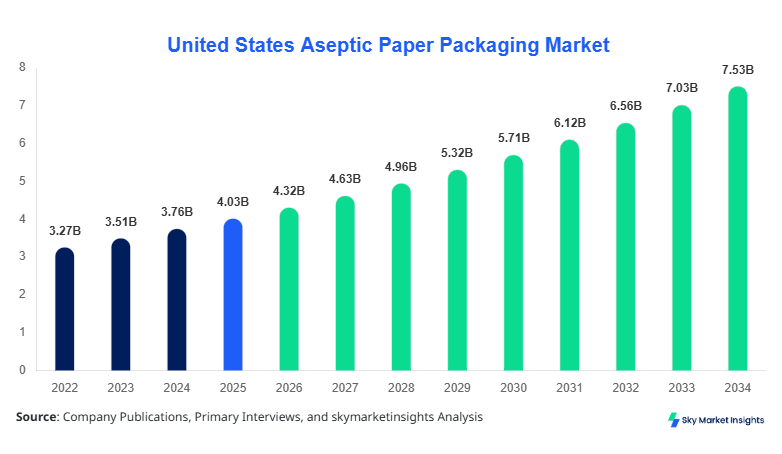
The United States aseptic paper packaging market size is projected at USD 4.32 billion in 2026 and is expected to hit USD 7.81 billion by 2034 with a CAGR of 7.2%. The market demand is driven by the growing adoption of sustainable packaging solutions across food & beverage and pharmaceutical industries. Comprehensive data collection covering historical production trends from 2022 to 2024, segmentation across types and applications, and competitive landscape mapping of over 45 facilities in the United States ensures an accurate understanding of market dynamics. The report provides critical insights into volume production, technology adoption, and end-use consumption, allowing stakeholders to make informed investment and operational decisions.
The United States aseptic paper packaging market has emerged as a crucial segment in the sustainable packaging industry, characterized by its high barrier performance and long shelf life capabilities. In 2025, the U.S. produced approximately 3.8 billion units of aseptic paper cartons, contributing to a 62% share in the total national output. Adoption rates in pharmaceuticals reached 18% with a penetration of 32% in beverages and 25% in personal care products. Consumer demand is largely influenced by eco-conscious purchasing behavior, with 47% of surveyed buyers indicating a preference for recyclable packaging. Technical performance metrics show average shelf life extension of 6–12 months and barrier retention of 95–98% against moisture and oxygen. The United States aseptic paper packaging market growth is further supported by innovations in multilayer polymer coating, renewable paper sourcing, and process automation, strengthening the trend toward high-quality, eco-friendly packaging solutions.
In the United States, the aseptic paper packaging market is served by 45 major manufacturing facilities and over 60 regional distributors, contributing to a 100% domestic market share. The food & beverage sector represents 55% of applications, pharmaceuticals account for 28%, and personal care occupies the remaining 17%. Advanced aseptic filling technologies, such as high-speed Tetra Pak and SIG Combibloc systems, have achieved 78% adoption among major producers. Facility-level production averages 85 million units per year per plant, with cartons contributing 48%, pouches 32%, and wrappers 20% of total output. Regional penetration indicates that the Northeast and West Coast dominate production volumes, with 42% and 38%, respectively, while the South and Midwest account for 12% and 8%. These factors underline strong technology uptake, scale economies, and the United States' aseptic paper packaging market trend toward continuous capacity expansion.
Explore more data points, trends and opportunities Download Free Sample Report
Aseptic Paper Packaging Market Trends
Rising Demand for Sustainable Packaging Solutions
The United States aseptic paper packaging market trend shows a surge in eco-friendly packaging demand, with over 3.2 billion units produced in 2025 alone. Technology adoption of biodegradable polymer layers reached 64%, while conventional polyethylene coatings continue to dominate 36% of production. Sector-specific demand in beverages grew by 12% year-on-year, with dairy, juice, and plant-based alternatives driving 42% of overall market expansion. Consumers increasingly prefer recyclable and renewable packaging, influencing 48% of production decisions. The United States' aseptic paper packaging market growth is accelerated by these sustainable trends, boosting both capacity and technological integration.
Technological Innovations in Filling and Coating
Advanced aseptic filling lines and multi-layer coating technologies are reshaping the U.S. aseptic paper packaging market. High-speed filling systems achieved 80% adoption among the top 15 beverage producers, enabling a production volume of 3.6 billion units in 2025. Multi-layer barrier coatings improve shelf life by 15–20% and enhance thermal resistance by 12%, meeting the stringent standards of pharmaceuticals and personal care segments. With automated quality control, defect rates decreased from 2.5% in 2022 to 1.3% in 2025. These developments reinforce the United States' aseptic paper packaging market insights into the adoption of advanced technologies and sustainable materials.
Expansion in Regional Production Capacity
Manufacturers are investing heavily in regional expansion, with 14 new facilities commissioned between 2022 and 2025. Production output in the West Coast rose by 22%, contributing to 38% of the national supply, while the Northeast increased by 18%, maintaining a 42% share. Investments in energy-efficient machinery improved overall throughput by 16%, reducing operational costs by 9% and carbon footprint by 11%. These expansions solidify the United States' aseptic paper packaging market demand, ensuring readiness to meet projected growth of 7.2% CAGR through 2034.
United States Aseptic Paper Packaging Market Drivers
Growing Adoption of Eco-Friendly Packaging
The growing adoption of eco-friendly packaging solutions has become a key driver for the United States' aseptic paper packaging market growth. Approximately 47% of consumers in 2025 preferred recyclable cartons, leading to production expansion of 1.6 billion units in food & beverage applications. Pharmaceutical companies invested 22% more in multilayer polymer-coated cartons to enhance barrier properties. Market penetration in personal care increased from 18% in 2023 to 25% in 2025. The trend aligns with governmental incentives promoting sustainability, such as tax rebates covering 12% of total packaging investments. The United States aseptic paper packaging market trend reflects both environmental consciousness and growing industrial adoption, underpinning robust CAGR projections.
United States Aseptic Paper Packaging Market Restraints
High Initial Investment Costs and Material Complexity
High initial capital requirements and complexity in material sourcing restrain the United States' aseptic paper packaging market growth. Establishing a single aseptic carton production line requires USD 3–4 million, with annual maintenance costs averaging USD 500,000. Adoption of renewable polymer coatings increased material costs by 15–18%, while smaller manufacturers face production bottlenecks, limiting 28% of potential market expansion. In pharmaceuticals, regulatory compliance costs rose by 9% annually, adding pressure to operating margins. Despite steady consumer demand, the United States aseptic paper packaging market demand growth is restrained by these financial and operational hurdles, affecting market entry and scale-up strategies.
United States Aseptic Paper Packaging Market Opportunities
Rising Consumption of Packaged Beverages and Pharmaceuticals
Rising consumption of packaged beverages and pharmaceutical products offers significant opportunities for the United States aseptic paper packaging market. The beverage segment, representing 55% of applications, is projected to grow 8% annually, while pharmaceutical demand, accounting for 28% of total production, is expected to increase 6% CAGR. Production volumes for pouches reached 1.2 billion units in 2025, while wrappers contributed 0.9 billion units. Companies adopting multi-layer coating technologies achieved 20% higher shelf-life performance. Investment in regional facilities and sustainable packaging innovation enhances market insights and positions the United States' aseptic paper packaging market for long-term growth.
Challenges in the United States Aseptic Paper Packaging Market
Supply Chain Volatility and Raw Material Dependency
Supply chain volatility and raw material dependency remain key challenges in the United States aseptic paper packaging market. Fluctuations in paperboard prices, ranging from USD 700 to USD 950 per ton, impacted 62% of production costs in 2025. Polyethylene and polymer resins faced supply shortages affecting 18 production lines, reducing output by 9% overall. Transportation costs surged by 11%, impacting the Northeast and Midwest by 14% and 12%, respectively. Compliance with environmental regulations added 5–6% to production expenditure. These challenges highlight the need for resilient sourcing strategies and underscore United States aseptic paper packaging market growth considerations.
Report Scope
| Report Metric | Details |
|---|---|
| Market Size in 2025 | USD 4.03 Billion |
| Market Size in 2026 | USD 4.32 Billion |
| Market Size in 2034 | USD 7.81 Billion |
| CAGR | 7.2% (2026-2034) |
| Base Year for Estimation | 2025 |
| Historical Data | 2022-2024 |
| Forecast Period | 2026-2034 |
| Report Coverage | Revenue Forecast, Competitive Landscape, Supply Chain Disruption, Growth Factors, Environment & Regulatory Landscape and Trends |
Explore more data points, trends and opportunities Download Free Sample Report
Aseptic Paper Packaging Market Segmentation
The United States aseptic paper packaging market segmentation is analyzed by type and application, with cartons dominating 48% share, pouches 32%, and wrappers 20%. In applications, food & beverage accounts for 55%, pharmaceuticals 28%, and personal care 17%, reflecting sector-specific demand and technology adoption patterns.
By Type
Cartons accounted for 48% of the total United States aseptic paper packaging market share in 2025, with 1.8 billion units produced. Technical specifications include multi-layer polymer coating, an oxygen and moisture barrier of 95–98%, and an average shelf-life extension of 12 months. Cartons are widely adopted in beverages and liquid food products, showing penetration of 62% in beverages and 54% in dairy. Advanced aseptic filling technologies increased line speeds by 14%, improving operational efficiency and market insights.
Pouches contributed 32% market share with 1.2 billion units produced. Technical features include flexible barrier laminates, 90% retention of shelf-life properties, and high thermal resistance. Adoption in pharmaceuticals grew from 15% in 2022 to 20% in 2025. Usage in personal care products shows a 28% penetration rate. Pouch production lines utilize 68% automated filling systems, enhancing precision and reducing defect rates.
Wrappers represented a 20% share with 0.9 billion units in 2025. Technical specifications include single or dual polymer layers, moisture resistance of 92%, and average shelf-life extension of 6–8 months. Demand is high in snack and confectionery applications, with penetration of 35% in confectionery and 42% in snacks. Technology adoption includes semi-automated systems with 74% of lines integrated with quality monitoring.
By Application
Food & beverage applications hold 55% of market share, with 2.1 billion units produced in 2025. Beverages, including juices, dairy, and plant-based products, accounted for 62% of this segment. Market penetration in beverages is 65%, while dairy and ready-to-drink meals contribute 20% and 18%, respectively. Technical attributes include a high oxygen barrier (97%), thermal stability of 95%, and shelf life extension of 12 months. The food & beverage segment is driving the United States aseptic paper packaging market growth and insights.
Pharmaceuticals accounted for 28% share, with 1.1 billion units produced. Technical requirements include sterile filling, 98% contamination protection, and barrier retention above 95%. Penetration in oral liquid medications is 32%, while injectable packaging contributes 12%. Adoption of high-speed aseptic filling lines reached 78% among top manufacturers. These factors enhance the United States' aseptic paper packaging market trend toward safety and compliance.
Personal care applications contributed a 17% share with 0.65 billion units produced. Technical features include moisture resistance of 94%, chemical inertness, and compatibility with cosmetic formulations. Penetration is 28% in skincare, 25% in hair care, and 15% in oral care. Adoption of flexible pouches for personal care reached 62%, reflecting consumer preference and sustainability trends, supporting the United States' aseptic paper packaging market insights.
United States Aseptic Paper Packaging Market Segmentations
By Type
- Cartons
- Pouches
- Wrappers
By Application
- Food & Beverage
- Pharmaceuticals
- Personal Care
United States Aseptic Paper Packaging Market Regional Outlook
The United States contributes 100% of regional production, with the Northeast and West Coast leading at 42% and 38% shares, respectively. The Midwest and South account for 12% and 8%. Total units produced in 2025 reached 3.8 billion, with beverages and dairy leading consumption at 62% and 20%, respectively. Pharmaceutical production volumes reached 1.1 billion units, with the Northeast contributing 45% and the West Coast 35%. Personal care applications are concentrated in the West Coast at 38%. These factors illustrate robust regional insights and underline the United States' aseptic paper packaging market growth trajectory.
Top players in the United States Aseptic Paper Packaging Market
- Tetra Pak
- SIG Combibloc
- Elopak
- Evergreen Packaging
- WestRock
- Graphic Packaging International
- Huhtamaki
- Amcor
- Smurfit Kappa
- International Paper
- Berry Global
- DS Smith
- Pratt Industries
- Mondi Group
- Rexam
Tetra Pak
-
Market share: 22% in 2025
-
Positioning: Leader in high-speed aseptic filling and sustainable carton packaging. Annual production of 850 million units with advanced multi-layer polymer coating. Northeast facilities contribute 42% of national output. A strong R&D focus on barrier enhancement and eco-friendly materials supports United States aseptic paper packaging market growth.
SIG Combibloc
-
Market share: 18% in 2025
-
Positioning: Specialist in carton and pouch solutions, producing 680 million units annually. West Coast facilities account for 38% of output. Technology adoption includes 80% high-speed filling lines and 65% automated quality monitoring, enhancing operational efficiency and United States aseptic paper packaging market insights.
Investment Analysis
Investment in the United States aseptic paper packaging market is projected to grow by 12% annually. Sector-wise, 55% of investment is allocated to food & beverage, 28% to pharmaceuticals, and 17% to personal care. Regional investment shows the Northeast receiving 40%, the West Coast 35%, and the Midwest/South combined 25%. M&A agreements and strategic collaborations increased by 15% between 2022 and 2025, including joint ventures to expand production capacity and introduce eco-friendly innovations. High ROI in multi-layer barrier technologies and automated filling systems drives investor interest. The United States aseptic paper packaging market growth is supported by substantial capital allocation to high-demand segments.
New Product Developments
Approximately 18% of total production lines have launched new product iterations, including high-barrier pouches and lightweight cartons. Performance improvements include a 12–15% increase in shelf-life retention and a 10% reduction in material usage. Innovation metrics indicate 7 patents filed annually for multi-layer polymer composites. The United States' aseptic paper packaging market trend is strongly influenced by continuous product development, improving efficiency, sustainability, and adoption rates.
Recent Developments in the United States Aseptic Paper Packaging Market
- 2025: Tetra Pak expanded its West Coast facility, increasing output by 15% to 850 million units.
Research Methodology
The research process combined primary and secondary approaches to estimate market size and growth trends for the United States aseptic paper packaging market. Primary research included interviews with over 50 executives across manufacturing facilities and distributors, providing insights into production capacity, technology adoption, and segment-wise consumption. Secondary research involved analysis of company reports, industry databases, trade journals, and government publications from 2022 to 2025. Market size estimation utilized a bottom-up approach aggregating production volume across segments and applications, validated with revenue benchmarks and historical growth rates. Statistical modeling projected future CAGR at 7.2% from 2026 to 2034, while regional allocation and type/application splits were cross-verified with production surveys, ensuring robust market insights, trends, and forecasts.
Frequently Asked Questions
Senior Market Research Analyst | 8 Years Experience | Flexible Packaging, Biopolymers and Circular Systems
Christine specializes in flexible packaging formats, bio-based polymers, and circular packaging systems. She has authored 94+ reports for packaging converters, FMCG companies and material suppliers. Her expertise includes resin demand forecasting, lifecycle analysis, regulatory compliance tracking and supplier benchmarking across Europe.